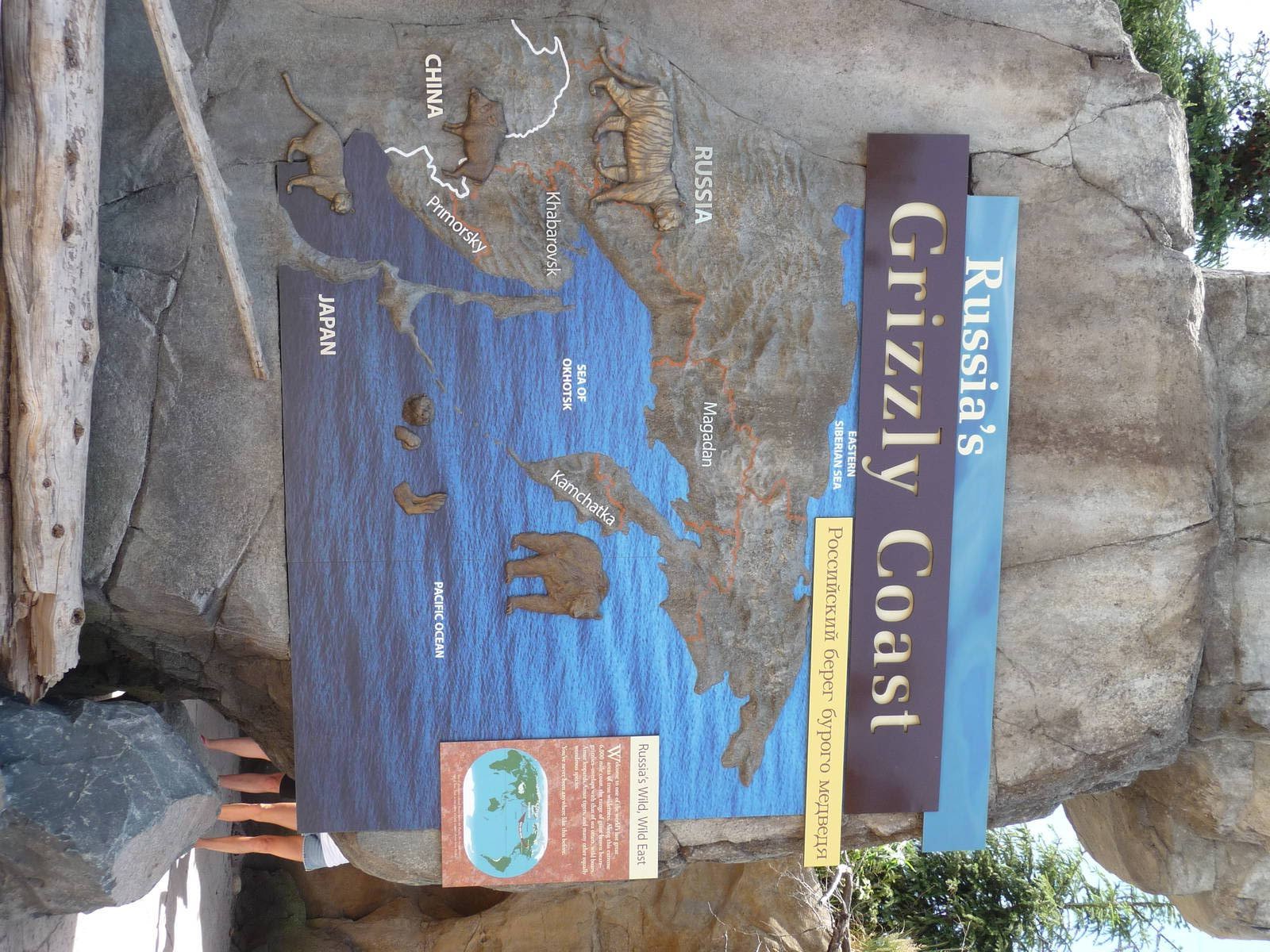
So, at least in America, the term “Russian Grizzly Bear” seems perfectly natural. I can’t find the references but I seem to recall seeing a genetic study somewhere that showed a large amount of similarity between bears on either side of the Bering Strait.
It seems it might be only in America that the habit of refering to Browns as Grizzlies is common. The three links you provided above all have US or Canadian origins. So at least, as Baldur said, the sign above is not the result of some marketing exec with misinformation but an accepted term in the States.
The general consensus (that I'm aware of) has always been that a Grizzly is specifically Ursus arctos horribilis, and that U.a. beringianus has been refered to as the Kamchatka Brown Bear.
As for genetics, the Kamchatka ssp is beleived to have given rise to the Kodiak (U.a.middendorfi), and the grizzly is linked to the Ussuri Brown Bear (U.a.lasiotus).
Interestingly, the Brown bears found on Admiralty, Baranhof and Chichagof Islands in Alaska (U.a.sitkensis) gave rise to Polar Bears, as the brown bears on those islands are more closely related to polars than they are to any other brown bears.
Source: Handbook of the Mammals of the World: Carnivores, Lynx Edicions.
A number of zoos and aquariums will have graphics like this (using the lion as an example)
What/Who am I? - African Lion
Where do I live? - African Savanna
What do I eat? - Antelope, zebra, wildebeest, buffalo
What do I like to do? -Sleep
A number of zoos and aquariums will have graphics like this (using the lion as an example)
What/Who am I? - African Lion
Where do I live? - African Savanna
What do I eat? - Antelope, zebra, wildebeest, buffalo
What do I like to do? -Sleep
Zoos should follow some kind of general rule. Signs and labels should not be too scientific (only a portion of visitors have scientific education; and those that do know where to get the information they need in any case) but not too simple either. Even if the majority of visitors are children, they are almost always accompanied by adults that can explain to them. Nice graphics is also important, but zoos should also consider that most of their visitors can read.
A number of zoos and aquariums will have graphics like this (using the lion as an example)
What/Who am I? - African Lion
Where do I live? - African Savanna
What do I eat? - Antelope, zebra, wildebeest, buffalo
What do I like to do? -Sleep
Zoos should follow some kind of general rule. Signs and labels should not be too scientific (only a portion of visitors have scientific education; and those that do know where to get the information they need in any case) but not too simple either. Even if the majority of visitors are children, they are almost always accompanied by adults that can explain to them. Nice graphics is also important, but zoos should also consider that most of their visitors can read.
I like the design of this Russia's Grizzly Coast graphic in the way that the rockwork is carried through into the sign, but all it does is show the geography of the region. I do assume however that there is a lot of other signage around the exhibit area.
Quite right.
This is simply a sign at the exhibit entry to show visitors where Kamchatka and the Russian Far East are. Other signs explain the animals, geology, human history and conservation issues pertinent to the Russian Far East