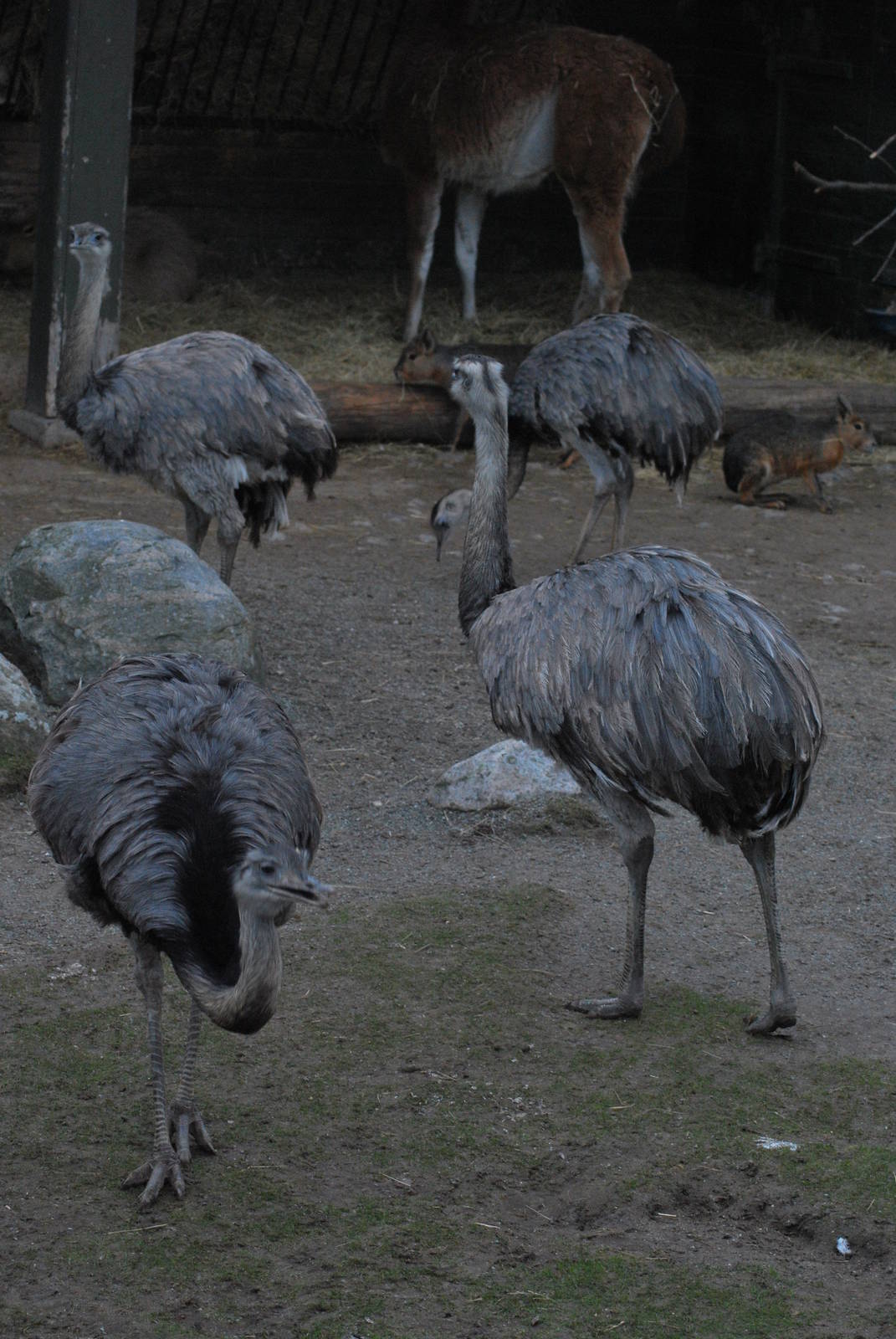
Some varient of 'Nandu/Nandou' is used as the standard name for these birds in almost all European languages in which I've come across the word. English with its more usual 'rhea' is very much the odd-man-out!
@Maguari: very intriguing, and it reminds me of the confusion between "moose" and "elk", which are of course completely different species. Nandu sounds more like emu, and thus somehow seems more appropriate.
This is one of my pet subjects - the campaign against the word 'elk'.
If you're European, Moose and Elk are the same species.
If you're North American, Moose and Elk are different species.
Either way, Wapiti or Red Deer refers to one 'Elk' species and Moose refers to the other.
Therefore, I advocate avoiding 'elk' at all costs. Cervus elaphus is either Wapiti or Red Deer (depending on subspecies) and Alces alces is Moose. Then there's no confusion!
There are several animals that have better-sounding or more interesting names in other languages; one that springs to mind is the Cotton-topped Tamarin, which is German in known as Lisztaffe or 'Liszt Monkey' for it's resemblance to the composer's hairstyle!
And for being a fun-sounding word, I rather like the Dutch for White-cheeked Gibbon, which is Witwang-Gibbon.
It might be aggravating for you to see all of the "elk" labels in North American zoos. I sometimes come across "wapiti" on my travels, but everything is either "elk" or "moose" in the majority of zoos on this side of the Atlantic.
Oh... damn you Englishmen (and your many descendants all over the world) for the richness of your language!
How are we poor savages supposed to keep up with you?
---
But actually, when I check it up right now, it seems that "nandu" is indeed the Danish name for this species and that "rhea" is the English word. That is , when I check out the webpage. I always thought that the signs by the enclosure says that "nandu" is the English word.
Could be mistaken and I probably am. Will check it at my next visit...
You may not be mistaken - translated common names on signs are often not quite right - particularly in cases like this where most languages are consistent then there's one oddity.
It might be aggravating for you to see all of the "elk" labels in North American zoos. I sometimes come across "wapiti" on my travels, but everything is either "elk" or "moose" in the majority of zoos on this side of the Atlantic.