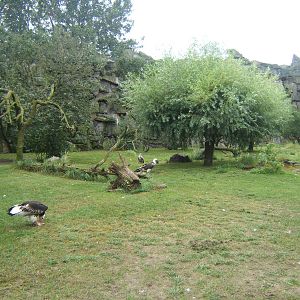
Hence the reason I really want to go... Not sure I'd be keen on the Alfred Brehm Haus and not a fan on their (alleged) breeding records but God are these two collections mouth-watering!
@DavidBrown: "I have only photos to go on, but I am seeing zoo exhibits that would be considered adequate at best if they were in the US, if not completely outdated and embarrassing".
Your statement echoes my sentiments completely from a few years ago. There was a time when I critiqued the pair of legendary Berlin zoos with such remarks, and I was roundly chastised by many European zoogoers. Since then it has been at least a couple of years, the Berlin animal collection is as remarkable as ever, and while the establishments have steadily improved there are a number of enclosures that judging from photos seem merely adequate if not completely outdated.
I have met many ZooChatters online over the past few years and there are a number of Europeans that track every species that they've ever seen in a zoo, love taxonomic arrangements in wildlife facilities and think nothing of spending an afternoon perusing a Monkey House or Cat House that might be historically vital yet the living quarters for its inhabitants are dodgy at best. Those folks LOVE the Berlin zoos, and of course Berlin and San Diego (with perhaps Singapore now challenging) are considered by many the meccas of the zoological world.
There are then folks such as myself, who are well and truly "exhibit people". I roll my eyes when I see the wood and wire farmyard-style menageries that dot the British landscape, or when I encounter brutally harsh mountains of mock-rock at Milwaukee County Zoo, or even the Fred Flintstone quarries of San Antonio Zoo. I've made it well known that I'd rather see primates on lush islands than swinging on tires inside of a functional, practical metal cage, and for the most part there is an interesting difference in zoo fans on each side of the Atlantic. Over time I've realized that such images work both ways, as some Europeans scorn the cascading waterfalls from the heavens, the over-abundance of mock-rock instead of natural substrate and the endless themed ruins that are found in many American zoos. I would truly enjoy visiting many German zoos, but in the case of the Berlin parks my gut feeling is that I would be blown away by the animal collection but would find that a good many American zoos surpass it in exhibitry excellence. I perfectly understand how the Berlin establishments are regarded as amongst the best zoos on the planet, but I find it equally intriguing that adequate enclosures are accepted without hesitation by hardcore zoo fans. Why not strive for greatness?
Finances comes into play as well as the zoos with little money often have to make do with basic accommodation for their well-kept animals, while the major American zoos can easily spend $40 million in the blink of an eye. Just in the last few years the National Zoo, Bronx Zoo, Zoo Miami, Louisville Zoo, Memphis Zoo, Oklahoma City Zoo, Dallas Zoo, Houston Zoo, San Antonio Zoo, Brookfield Zoo, Cleveland Zoo, Columbus Zoo, Minnesota Zoo, Denver Zoo, San Diego Zoo and Los Angeles Zoo (amongst others) spent over $25 million and sometimes up to $50 million on one or two exhibit complexes. At least 7 of those zoos that I just named included a vast new elephant habitat in their mega-projects but the amount of money being paid for zoo exhibits is staggering. Some of the better zoos in Europe have begun to also spend vast sums on improvements in recent years, and that is part of the reason places such as Rotterdam, Arnhem, Leipzig and Vienna are ranked as the best of their kind.
I have met many ZooChatters online over the past few years and there are a number of Europeans that track every species that they've ever seen in a zoo, love taxonomic arrangements in wildlife facilities and think nothing of spending an afternoon perusing a Monkey House or Cat House that might be historically vital yet the living quarters for its inhabitants are dodgy at best. Those folks LOVE the Berlin zoos, and of course Berlin and San Diego (with perhaps Singapore now challenging) are considered by many the meccas of the zoological world.
I would really like to know if the Berlin zoos are considered world-class by other zoo management professionals who run and design zoos? Maintaining a world-class collection was once the prime directive of the zoo world, but at least in the US this has shifted to a conservation-oriented mission. Many zoos opt not to display even popular species if they realize that they cannot properly house and care for them with available resources. Even the Bronx Zoo has announced they are phasing out their elephant program.
The Berlin strategy (i.e., maximize collection) seems very retrograde.
San Diego and Bronx seem like they are the comparisons that everyone makes to Berlin as world-class zoos. These zoos have long shifted to a conservation and naturalistic habitat perspective. As you pointed out many European zoos are also.
"Collection size rules" is a primary metric for measuring zoo quality by some zoo fans, but I wonder if this view is also held by the majority of zoo management professionals in the world, or perhaps more relevant to this discussion, in Europe?
Long ago, as a child I remember reading a definition of conservation as being " the good management of scarce resources". It still works pretty well, and arguably in the financially challenged days of the early 21st century it works better than ever.
If a zoo can provide cheap, basic accommodation for its animals where they feel secure, breed well, and long and happy lives, why spend millions of dollars, pounds or euros that you don't have? Sometimes it's better to be "wood and wire farmyard-style menageries" - especially when the one thing that zoo lovers know all too well is that ideas change fast.
Most of Howletts' enclosures could be demolished in days. How long would it take to bring down JungleWorld in the Bronx? One day, it too will be seen as outdated....
Most of Howletts' enclosures could be demolished in days. How long would it take to bring down JungleWorld in the Bronx? One day, it too will be seen as outdated....
JungleWorld shows people who have never been to a tropical rainforest (and most likely will never be able to visit one) that rain forests are cool and important ecosystems full of cool and important organisms. It exists to make rain forests a meaningful ecosystem to people and demonstrate why they are important and should be conserved.
Howlett's shows people that if you are rich you can keep gorillas, tigers, and elephants as pets and oh boy, isn't it fun to go in and play with them. Until they kill your employees. Oops.
The Bronx Zoo has a meaningful role to play in the 21st century. Hopefully Howletts does too, but they aren't going to do it by showing people animals in wire frame boxes.
I would respectfully point out that I didn't attempt any defence of any JAF animal management protocols, so I don't really see why that had to be brought into the thread.
The point I sought to make is this - the party may be coming to an end. Zoos in the Western world depend on the health of their national economies. I have had several mails this summer imploring me to write to New York City Council so that the WCS funding won't be cut.
It's not for a Brit to pontificate about the rights and wrongs of how the US spends its money, but I would suggest that certain immensely expensive exhibits couldn't be built
without funding from either government or wealthy donors. Given that both in North America and Europe these taps are being turned off with a vengeance I would suggest that wise zoo directors will be looking to cut their caps according to their cloth.
I would respectfully point out that I didn't attempt any defence of any JAF animal management protocols, so I don't really see why that had to be brought into the thread.
You are right Ian, and I don't mean to mock what are obviously tragedies however you look at them (i.e., keeper deaths). I have never been to Howlett's zoos, but Aspinall's antics never looked good from here. His animal management and his exhibits both seemed shoddy.
I don't understand what seems to be deep hostility towards immersion exhibits or a wildlife conservation emphasis by zoo exhibits. You very rightly point out that the majority (perhaps a very large majority) of zoos can never build immersion exhibits on the scale of Bronx or San Diego. The ethos of building naturalistic exhibits nonetheless is firmly in place in the US, and when North American zoogoers are told that is not a good direction for the development of zoos we find that puzzling.
There is not much data brought into these arguments, and maybe that is where the resolution to some of these arguments are. Has anybody ever done a study on the physical and mental health of gorillas, chimps, elephants, etc. in different types of exhibits? It would be fascinating to do a cross-zoo study of gorillas in different types of exhibits that are and see if there are any measurable indicators of exhibit features correlating with better animal health. I'm sure those studies are out there in some form. Beyond that we are all just shooting endless opinions at each other, which is not necessarily bad. We just need to keep in mind that we all love zoos and animals and probably we would all enjoy visiting zoos together, even if we wouldn't all agree on what the best exhibits are!
I don't understand what seems to be deep hostility towards immersion exhibits or a wildlife conservation emphasis by zoo exhibits. You very rightly point out that the majority (perhaps a very large majority) of zoos can never build immersion exhibits on the scale of Bronx or San Diego. The ethos of building naturalistic exhibits nonetheless is firmly in place in the US, and when North American zoogoers are told that is not a good direction for the development of zoos we find that puzzling.
I personally have no issue with immersion exhibits at all - but I do find it a bit frustrating that they are seen as the only 'correct' way to build exhibits in many quarters. The ethos of building immersion exhibits is fine, but I'm troubled that there is an ethos of building nothing but immersion exhibits. Plenty of times on here I've seen a new exhibit criticised for 'not being immersive' when it was clearly never intended to be. Many seem to assume that all new exhibits are trying to be fully immersive, which is not the case.
And a zoo not being immersive doesn't mean it doesn't have a wildlife conservation emphasis (Howletts would in fact be a prime example) - it often just means it goes about it differently, that's all.
I`ve visited Howletts serveral times and I have no doubts that their gorillas are among the happiest and healthiest in the whole (zoo) world.
Re Berlin - neither park makes any effort to create immersion exhibits, which is fine with me. What is NOT fine (and that point is lacking in this discussion) is that almost all enclosures in the Tierpark are very barren and many lack even basic enrichment. Howletts is 100x better then the Tierpark. The hoofstock paddocks and the monkey cages are spacious, but that`s it - they`re barren and boring due to a total lack of ropes, trees, logs, shrubs, shade structures ect. The keepers are not allowed to give enrichment. The big cat cages in the Alfred Brehm house are much too small, too, like the indoor accommodation for elephants in the big Pachyderm house. The house itself is gigantic, but almost all of the space is just for the visitors, not the animals. It`s really awful. The Berlin Zoo is actually a lot better in that regard.
Re Jungle World: it is already outdated. The tapir and jaguar "enclosures" are among the very worst i`ve ever seen, and the enclosures for langurs are average at best, given that there are no outdoor areas. Looks nice for the eyes of the visitors, but I was shocked to see the conditions under which the animals have to live. I have to say that the jaguar cages and tapir enclosures in the Berlin Zoos are a MUCH, much better then "Jungle World".
I personally have no issue with immersion exhibits at all - but I do find it a bit frustrating that they are seen as the only 'correct' way to build exhibits in many quarters. The ethos of building immersion exhibits is fine, but I'm troubled that there is an ethos of building nothing but immersion exhibits. Plenty of times on here I've seen a new exhibit criticised for 'not being immersive' when it was clearly never intended to be. Many seem to assume that all new exhibits are trying to be fully immersive, which is not the case.
And a zoo not being immersive doesn't mean it doesn't have a wildlife conservation emphasis (Howletts would in fact be a prime example) - it often just means it goes about it differently, that's all.