Review of Great Bear Wilderness
Great Bear Wilderness is the newest themed exhibit complex, opened in May 2010, and is a North American journey from Yellowstone to the Yukon. It is located at the terminus of the West Mall, in the location of the historic Ibex Mountain exhibit that was demolished. It begins with a large yard for bison, the symbol of the zoo and zoological society. Their exhibit terminates the entire width of the West Mall and is first viewed from across a low rock-lined moat and rustic split-wood railing that does not obstruct the view. The grassy field rises away from here and is punctuated with several dirt wallows, and backed by a series of simulated rock outcrops which partially contain the back of their enclosure.
Bison Exhibit, viewing area from end of the West Mall:
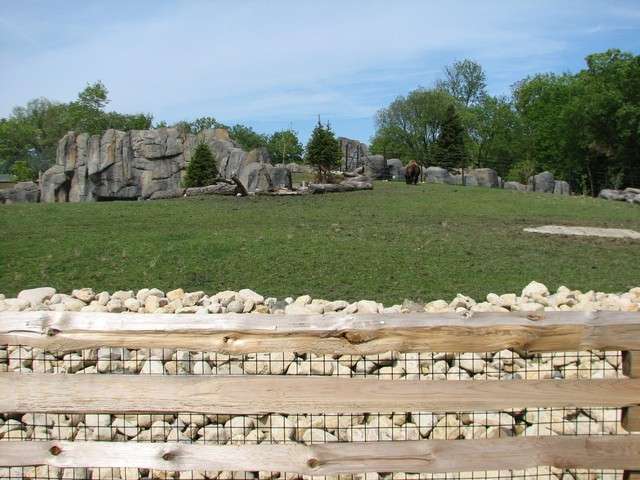
Paths for visitors branch off from this front view and loop around the large habitat, most of which is contained by green steel pole-and-cable fencing; the paths are not adjacent to the fence, but visitors can step off them into informal mulch areas to approach it. The right path goes past their holding area and low building, which is a poor location for such a practical facility near a major walkway; young plantings in front of it hold the promise of concealment in the future. This path also passes a new timber-and-stone restroom building which fits the theme well, but also has a view of the back of the bear exhibits building with its practical and unadorned two-story architecture. Again, the landscape here will eventually hide this ugly feature. The plantings of the complex are very good but it is not yet apparent. Care was taken to preserve some existing deciduous native trees, while a large variety of conifers are designed to create a more authentic experience of the theme. However, the paved paths are generally open to the mulch planting areas adjacent, enabling visitors to enter them and take shortcuts or play; this will be detrimental to the young plants and could create a rather barren landscape. The absence of temporary stake-and-rope barriers along the paths leads me to believe that this loose definition of acceptable walking areas may be purposeful, to eventually appear undesigned, but if so it will be messy. Both side paths around the bison exhibit meet near the back of the habitat; the reason that the ground plane rises in the exhibit is so that it can narrow and cross over a visitor tunnel where the paths meet, and then widen again as it gently drops to a smaller pasture that ends with the woodsy façade of an education building. The simulated rockwork that contains the bison over the tunnel is interrupted over the tunnel entrances, where the cable fencing is used again; if visitors time it right, they may be able to view a bison staring down at them! One tunnel entrance is topped with a sign over its archway announcing the exhibit complex; the other is topped by a short nature quote by Thoreau spelled in large raised letters, a common feature throughout the complex and its excellent consistent graphics. The tunnel itself is not surfaced with the simulated rockwork that frames its entrances; instead, it has stucco walls covered with an airbrush-painted series of stylized bison, as well as two openings in the wall for viewing part of the exhibit. There is also a very large floor-to-ceiling graphic on one wall; each of the species in the complex has one, with full-size paintings and range graphics and other information in a consistent style. Each large graphic is announced not by the scientific or common name of the species, but by a native tribal name, in this case Tatanka, the Lakota word for bull buffalo. Set in the ceiling of the tunnel are a series of speakers that play a recording of a bison stampede! How many hoofstock exhibits are designed with these unique features and attention to detail? It is a successful exhibit and a scenic start to the complex. The path on the left side of the bison exhibit leads to a small plaza surrounded by three buildings for visitor services. One is a shop called Bear Crossing and a medium-sized education room next to it; their building is a rustic timber peaked-roof one with open beam ceilings inside. The shop is woodsy and stocked with appropriate merchandise, while the education room features a viewing window on each side, one for the bison exhibit and one for a polar bear exhibit described later. There is also another small timber-and-stone restroom building, and a counter-service restaurant called Bison Prairie Grill. It is poorly designed; a basic CMU construction with a bit of wood slapped on the front and a low flat roof with all the utilities visible on top. Its dining area is all outside in a large expanse of mulch filled with traditional picnic benches around an existing chaotic play structure area that seems like extreme value engineering. This is not the fantastic National Park lodge-themed restaurant with an expansive view overlooking the prairie that it should be. At least it serves buffalo burgers! The plaza leads to the one-way loop exhibit path called Great Bear Wilderness Trail that composes the rest of the complex, entered beneath an attractive stone-and-timber archway with a map graphic and topped with a Pacific Northwest native depiction of a bear. The first exhibit seen here is a steel pole-and-netted medium aviary for bald eagle (the largest graphic announces it as Beshknew, the Potawatomi word for the species), viewed from one side. It is dominated by a simulated branched tree trunk rising from a grassy patch and is too small for much flight. If the inhabitant is an injured bird that will not be returned to the wild (as is the case with many similar exhibits for this species) then it is larger than many I have seen; if not it is a poor design. Eventually it will be shielded with vegetation on all sides except the viewing side.
Bald Eagle Exhibit:

Next is the best exhibit in the complex; ironically it is a slightly older one that has been incorporated along the trail, called Wolf Woods. It is a massive fenced yard for Mexican gray wolf, filled with grassy slopes and trees and a few rocky perches, and its backside melts into the surrounding forest. It is viewed from several small spots on two sides, as well as an indoor shelter with a curved glass window area. Also within this small building is an exhibit alcove, a rocky den with windows for kids to crawl in, and a video monitor to see remote views of the exhibit via controllable cameras. A door also leads into a 10x10 foot room in darkness for a 2-minute audio show called Call of the Wolves, which is rather spooky! Back outside, a mulch-surfaced open area is the Kill Site, with metal lifesize silhouettes of four wolves attacking a deer as well as interpretive graphics about the subject and a simulated deer skeleton. Next to this is a mulch area contained with a circle of logs that form the Naturalist Outpost, for very small education presentations. The other existing zoo feature that has been incorporated into this new complex is Salt Creek Wilderness; it is a beautiful 20-minute loop trail through the native woods around Indian Lake and to Dragonfly Marsh. There are no captive animal exhibits along its course (except a back view of several of the exhibits in Habitat Africa – The Forest) but native sightings are common and there are plenty of interpretive graphics along the way. The entry to it is now a branch off the Great Bear Wilderness Trail; a former entry from the older hoofstock yards at the North of the zoo is now barricaded. The rest of the new complex is a series of three medium similarly-sized bear exhibits contained within high rocky walls and connected to a massive building for both viewing and holding. The first exhibit seen is currently for grizzly bear; the map at the beginning of the trail identifies it as for polar bear, but the graphics at the exhibit itself are correct. I understand that the bear exhibits are designed for either species according to the needs of the collection, especially since the zoo has a good polar bear breeding record. The first view of the grizzly bear exhibit is through a tall window imbedded in the rockwork; etched onto its upper surface is another nature quote. Next to the window is a door that can be opened, with wire behind it, for training demonstrations. The habitat itself has several alcoves between the rocks, natural substrate, grass, fallen logs, an attractive rocky swimming pool, and some brave young trees; a nearby wide viewing area sees it from across a deep moat whose steep sloping face is too stark.
Grizzly Bear Exhibit:
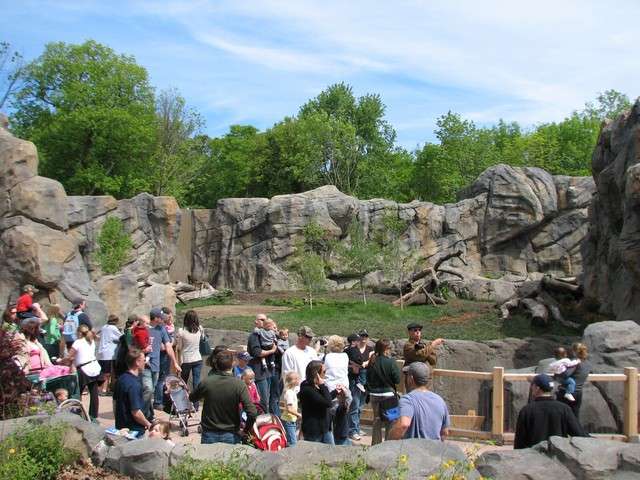
Nearby is a similar viewing area for the first polar bear exhibit, of similar size and quality. A large graphic here announces the species as Pisugtooq, the Inuit word for great wanderer.
First Polar Bear Exhibit:
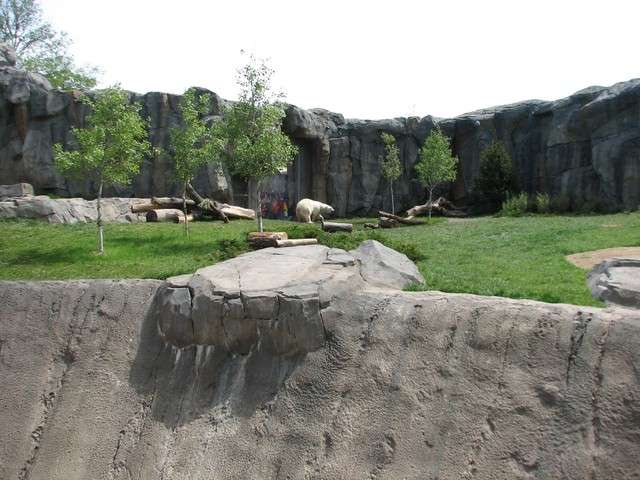
Between these two viewing areas is the entry to the building, which is a flat woodsy façade with another Pacific Northwest native depiction of a bear over its doorway. Unfortunately, this and several other places where the building is exposed are rather clumsy transitions between architecture and simulated rockwork; the architecture should have been more detailed or the rockwork should have been allowed to entirely cover the building. Once inside, the large two-story volume is a plain modern interior, dominated on each side by large windows with above-and-underwater views for the grizzly bear pool on one side and the polar bear pool on the other, which features a sunken viewing area for added capacity. It is a successful space with plenty of room for crowds to watch any play in the two attractive pools; the only decorations are several large framed photos of the species, a large wall display about the region represented, and another about ways that people can help the species.
Indoor viewing area of first Polar Bear Exhibit:

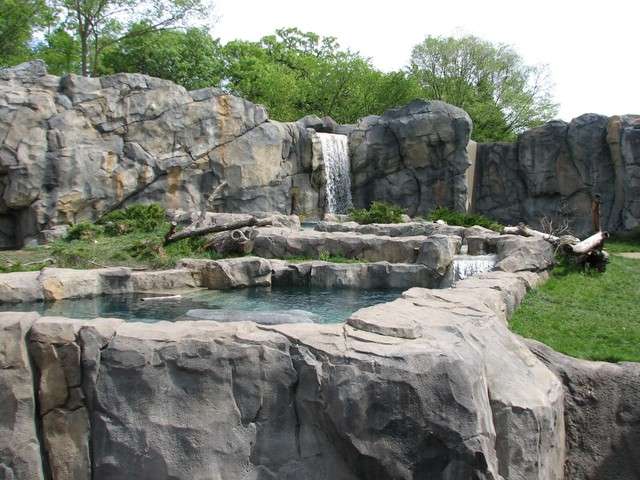
A tall but narrower hallway leads from here with a breaking iceflow graphic on the floor into a rocky-walled alcove that has a viewing window into a small rocky den of the third exhibit, which is currently for polar bear. I assume that this will be used for a mother and cubs display in the future, if the occasion happens. Exiting the building, another large graphic is imbedded in the rockwork walls that surround this outdoor passage, this time for Nitakyaio, the Blackfeet word for grizzly bear. Currently there are no grizzly bears exhibited near the graphic, which supports the fact that the exhibits can be used for either species. A nearby viewing window imbedded in the rock and framed with massive timbers looks into the first polar bear exhibit, from the opposite side as first seen, making this the exhibit with the greatest viewing opportunities of the three. Next is a small window into the second polar bear exhibit (the one with the rocky den), followed by a longer open viewing area across a moat. This exhibit is similar to the other two, although it has a waterfall (one of those out-of-nowhere illogical ones) and its swimming pool is in the center of the space with no underwater viewing.
Second Polar Bear Exhibit:
The path ends here, at the plaza where it started; currently, a wood railing funnels visitors into the Bear Crossing gift shop to exit out its front side, but in the future when crowds become less common this could be removed to allow free flow (it helps to have enforced one-way traffic while the complex is new). Although the bear exhibits are glorified grottos, they are much more open feeling than old grottos; however it is disappointing that they are not the impressive best-of-their-kind habitats that they could have been. Despite this, the complex is a great addition to the zoo and a good replacement for the now-empty former exhibits for these species!


