A couple of new (to me at least) thylacine photos.

Paddle certainly proposed the idea that the curved tail was a sign of confidence. As I've said before though, I'm wary of his conclusions. That said it may well be right.

The photo of the 'Burrell Thylacine' after it had been thrown a chicken, also shows the curved tail posture (perhaps indicating 'possession' in that particular case), so I tend to agree with his thinking- in that instance at least.
 
This is the other better-known photo of the Washington Thylacines- thought to be probably the two surviving cubs when they were grown up. There is another one that shows a single younger animal too.

Thanks, I'm not really familiar with thylacine in US collection.
 
The photo of the 'Burrell Thylacine' after it had been thrown a chicken, also shows the curved tail posture (perhaps indicating 'possession' in that particular case), so I tend to agree with his thinking- in that instance at least.

I think that's probably right.

Another thing that occurred to me the other day is that, like so many things, there's next to nothing ever said about sexual competition/conflict among males.
 
I think that's probably right.

Another thing that occurred to me the other day is that, like so many things, there's next to nothing ever said about sexual competition/conflict among males.

There are just two references to this in Paddle's book(that I know of). Page 46, where Robinson describes a group of Thylacines with 'elevated tails' which he thinks was a mother & cubs, but Paddle attributes to sexual competition between males. And on Pages 53/54 there is a description by Wilson of males(?) fighting over a female.

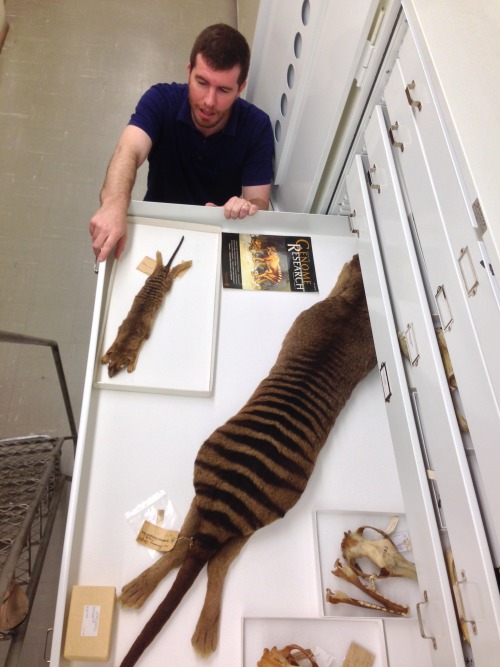
Incidentally I typed in 'Washington Thylacine Images' and one of the photos with the baby skin and adult on the tray appeared not very far down.
 
Incidentally I typed in 'Washington Thylacine Images' and one of the photos with the baby skin and adult on the tray appeared not very far down.

Found it this time:

tumblr_n5rw3bcyzV1r4wpt9o3_500.jpg
 
I thought I'd issue another challenge for TLD to come up with it.
:)
Funny little critter, ain't it? :) Just like a tiny replica of the adult. Sad that it didn't make it though, it was at the Zoo for just nine days. The other one must be one of its grown-up siblings, the male as in the other photo I think..

The way they prepare the skins, they always look like they have got fat bottoms.
 
There is another one without a person in the shot, where the baby and adult are both facing the same way.

The adult skin looks absolutely pristine regarding its state of preservation. Imagine seeing one like that alive.
 
Last edited:
Back
Top