American Herping: A Guide to Reptiles and Amphibians in US Zoos

Miscellaneous Frogs
Part 1: Tiny Frogs


It’s Miscellaneous Week! Time to clean up the last of the frogs with a bunch of randos that didn’t warrant a full post and didn’t neatly fit with the previous groups. There are 11 families left to cover overall, which will be done over the course of the week. Today will be three families of tiny frogs.

Family Centrolenidae – Glass Frogs
Status in US Zoos: Rare

These 1-3 inch Neotropical frogs are named for having transparent or translucent skin, allowing one to see their internal organs. A photo below demonstrates this, though I’ve put it in a spoiler so the squeamish can move along unperturbed.

Species:
Granular Glass Frog (Cochranella granulosa)
Atrato Glass Frog (Hyalinobatrachium aureoguttatum)
La Palma Glass Frog (Hyalinobatrachium valerioi)


full

Granular Glass Frog (C. granulosa)
Taken at Smithsonian National Zoo by @fkalltheway

full
Inside view of La Palma Glass Frog (H. valerioi)
Taken at Electric City Aquarium & Reptile Den (Scranton, PA) by @TinoPup

Family Eleutherodactylidae – Coquis (or Rain Frogs)
Status in US Zoos: Rare

Small Neotropical frogs, many of which are found on Caribbean islands. The most well-known species is the Common Coqui of Puerto Rico, named for its obnoxiously loud call (CO-KEE). The survey only found 2 species with one holding each. This is in contrast to European captive collections – particularly in Germany – which hold a few species in several collections.

Common Coqui (Eleutherodactylus coqui) – possibly gone. This is a 2018 listing from Oklahoma City Zoo; by my visit in 2021 they were no longer on display (the building they’d been in closed and its footprint is within a construction area). A zoo in Florida held them earlier in the 2010’s.

Mona Coqui (Eleutherodactylus monensis) – at Zoo Miami

full

Mona Coqui (E. monensis) taken at Zoo Miami by @red river hog


Family Hyperoliidae – Sedge Frogs or Bush Frogs
Status in US Zoos: Uncommon

A group of small, brightly colored frogs from sub-Saharan Africa and Madagascar. Four species were found in the survey, held by five zoos – all of which are (coincidentally) in the western half of the country.

Species:
Riggenbach’s Reed Frog (Hyperolius riggenbachi)
Starry Night Reed Frog (Heterixalus alboguttatus)
Powder Blue Reed Frog (Heterixalus madagascariensis)
Red-legged Running Frog (Phlyctimantis (
or Hylambates) maculatus)

A fifth species - Mitchell’s Reed Frog (Hyperolius mitchelli) - was held at the Boise Zoo earlier in the 2010’s, and in 2019 was still held in Canada at the Vancouver Aquarium.

full

Riggenbach's Reed Frog (H. riggenbachi)
Taken at California Academy of Sciences by @Northwest_FIsh_Keeping
 
I'm surprised this species is "rare" in zoos. Isn't it fairly easy to find in the private trade?

Seems to be, yes. That's true of many herps though; broadly speaking, most species are as prevalent or more so in the private trade than in zoos - with a few exceptions like venomous snakes, some endangered species, etc.

I can't say why reed frogs like H. alboguttatus specifically aren't more popular. They're colorful, widely available, and fit perfectly with other Malagasy herp collections - all great attributes. That being said, it's also true that tiny frogs are uncommon in US collections generally. Reed frogs are also fairly rare in most European zoos, the exception being alboguttatus in the UK and Czech Republic (and even then they still aren't that common) - so there may be factors at play I'm not aware of.

One possibility is that the frogs can be difficult to see, given that they are tiny and liable to hide themselves from view. I know visibility can be an issue for some other small frogs.
 
most species are as prevalent or more so in the private trade than in zoos - with a few exceptions like venomous snakes
On the contrary; quite a lot of venomous snake species are considerably more common in the private trade than in zoos - especially in Europe.

One possibility is that the frogs can be difficult to see, given that they are tiny and liable to hide themselves from view. I know visibility can be an issue for some other small frogs.
I just witnessed that myself while visiting Zoo Salzburg today; couldn't find their Hyperolius marmoratus specimens.
 
Last edited by a moderator:
I just witnessed that myself while visiting Zoo Salzburg today; couldn't find their Hyperolius marmoratus specimens.

Took us two or three attempts to spot the species a few weeks ago, and even then it was just a head poking out from the depths of some vegetation at the back of the exhibit!
 
On the contrary; quite a lot of venomous snake species are considerably more common in the private trade than in zoos - especially in Europe.

That's a fair point. I should have specified that by "private trade" I was referring more specifically to the pet trade - i.e. species that can be easily acquired by members of the general public - and not necessarily to all herpkeeping outside public zoos. Very few reptiles or amphibians in public zoos are absent from various private collections, including venomous snakes. I can't speak to overall abundance in private hands, only whether an animal is common and easy to acquire from pet stores and dealers (since that information only requires a simple Internet search).

I know very little about the legality or prevalence of keeping venomous snakes in Europe. I know that in the US it varies by state; a handful of states have few or no restrictions, but most prohibit private ownership without a permit (with the feasibility of acquiring a permit also varying by state, from fairly easy to nearly impossible)... not that this stops some people from keeping them anyway!
 
I know very little about the legality or prevalence of keeping venomous snakes in Europe.
It pretty much depends on the national legislation of each European state. In some countries, it's completely illegal to keep venomous snakes as a private person. In others, it's allowed within the realm of certain nationally defined guidelines (certified expertise, proof of adequate insurance coverage, CRB check, access to antivenom etc). In some countries, it varies within the country from federal state to federal state and even within townships. While you can't keep venomous snakes legally (and yes, there are plenty of black sheep here as well) in, say, Berlin or Vienna, you have little to no legal rules and thus problems to do so in rural Brandenburg or Czechia, especially if you live in the "right" community. Some people actually move to such "complaisant" places on purpose to be able to keep venomous snakes, crocodiles, scorpions etc.
 
The miscellaneous frogs continue...

Family Leptodactylidae

Mountain Chicken (Leptodactylus fallax) – Rare

While a European breeding program for this large and critically endangered Caribbean frog exists, there are few specimens here in the US.

full

Taken at Chester Zoo (UK) by @Fallax

Smoky Jungle Frog (Leptodactylus pentadactylus) – Common

Conversely, this common mainland South American relative is almost absent from Europe while being fairly common in zoos here. These are large frogs at 7 inches long.

full

Taken at Tulsa Zoo by @Coelacanth18

Family Microhylidae – Narrow-mouthed Frogs

Tomato Frogs (Dyscophus antongilii and Dyscophus guineti)
Status in US Zoos: Common

These pudgy red frogs are a common highlight in Madagascar-themed exhibits, and are also prevalent in the pet trade. D. guineti – the Sambava Tomato Frog and slightly less common species – is often signed as False Tomato Frog, which isn’t a very good name considering they are closely related… in fact, there is evidence they may not even be different species!

full

Sambava Tomato Frog (D. guineti)
Taken at Bioparc Valencia (Spain) by @MagpieGoose

Other Microhylidae Species (both Rare):

Banded Bullfrog (Kaloula pulchra)
This is a species popular in the pet trade and on social media right now, frequently referred to as the “chubby frog”. They don’t seem to have caught on in zoos.

Madagascar Rain Frog (Scaphiophryne madagascariensis)
 
Family Hynobiidae – Asiatic salamanders
Status in US Zoos: Rare

A basal group of salamanders related to the giants, many of these species are from Japan (where they are commonly found in captivity). The only species that came up in the survey was Shangcheng Stout Salamander (Pachyhynobius shangchengensis), native to the Chinese highlands and only seen at the Detroit Zoo. An educational video posted on the zoo website also revealed their breeding of another species, Tokyo Salamander (Hynobius tokyoensis) though I have not seen that reported as being on exhibit.
If you need this stout salamander's picture I can upload today's night, this species might be the only two species can be seen in it's exhibition(mixed with Anderson's crocodile newt and emperor newt, which I did not find)
 
If you need this stout salamander's picture I can upload today's night, this species might be the only two species can be seen in it's exhibition(mixed with Anderson's crocodile newt and emperor newt, which I did not find)

If you want to upload it that would be great :) I don't think the species is currently represented in the gallery at all.
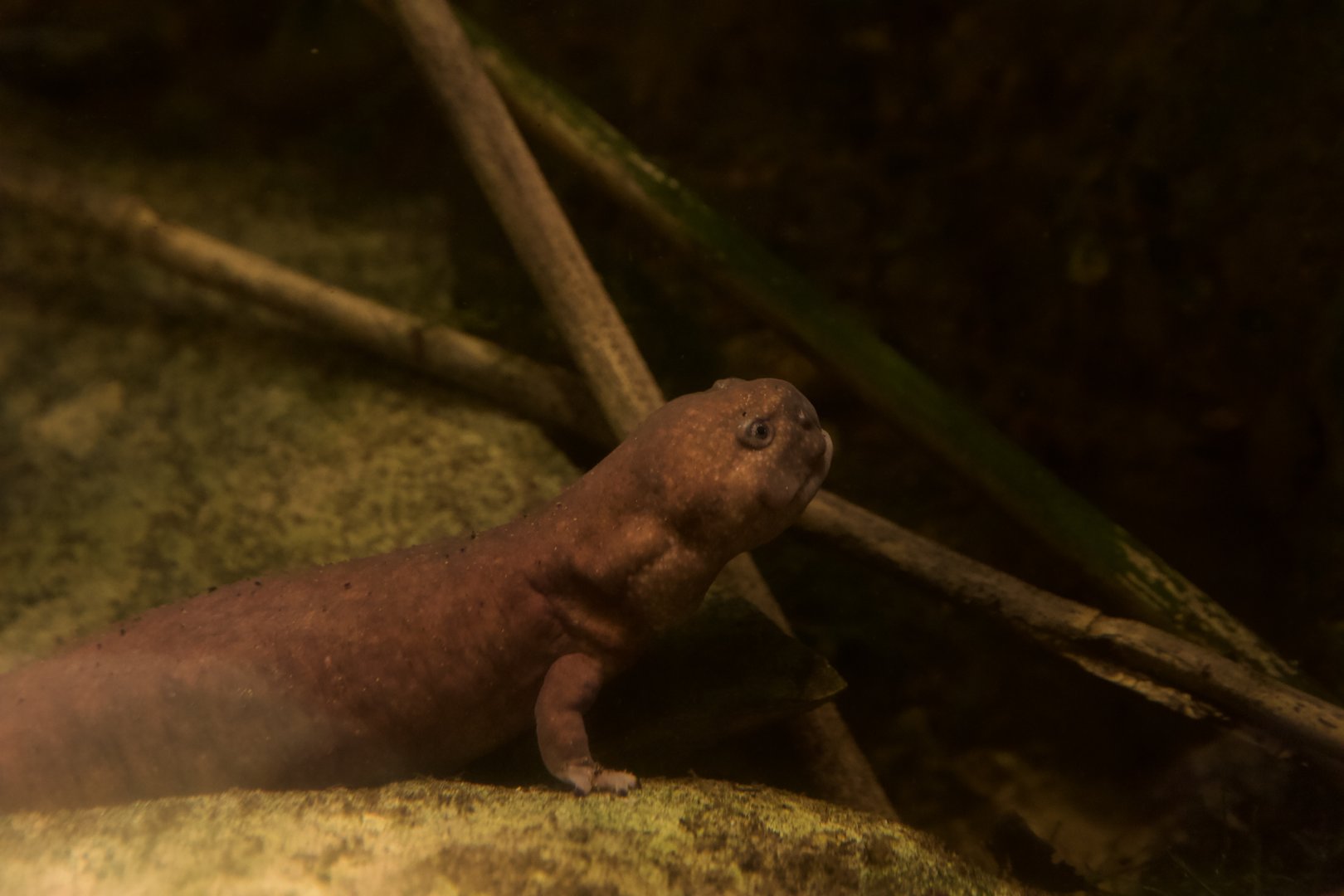
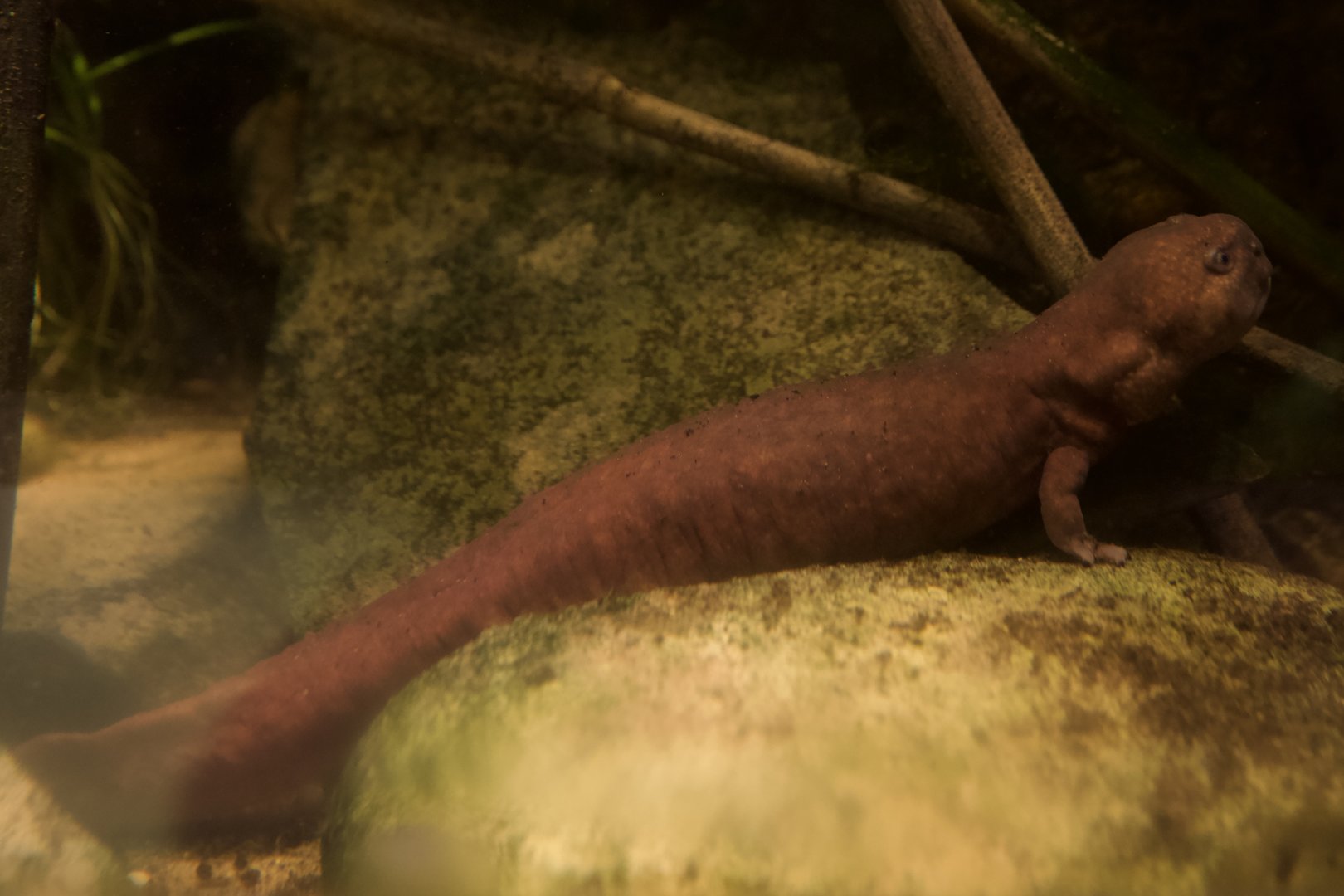
 
That thing is creepy as heck.
Not really; it's just a cute chubby newt :p

I think it looks like the salamander equivalent of a Billiken... which I guess puts me more in the "creepy" camp. Maybe there's a reason more zoos haven't gotten into that one :p

Anyway... back to miscellaneous frogs! We're finishing up the last ones that appeared in the survey today: four families with a single species each. Tomorrow will be about frogs that didn't appear in the survey.

Family Ceratobatrachidae

Solomon Island Leaf Frog (Cornufer guentheri) – Prevalent

This Southeast Asian and Pacific frog family is represented by one species from the Solomon Islands, known for its distinctive large eye crests and camouflaged appearance. This frog is much more common in the States (17+ holders) than in western Europe (4 holders); however, this difference might be explained by the presence of a very similar frog on that continent which is possibly absent here - more on that tomorrow!

full

Taken at Cape May County Zoo (NJ) by @red river hog

Family Conrauidae

Togo Slippery Frog (Conraua derooi) – Rare

From the same genus as the Goliath Frog (the world’s largest frog), this obscure West African species is critically endangered with only a few populations in Togo and Ghana. The Brookfield Zoo has been keeping and breeding the species behind the scenes for years; in 2021 they sent some of their frogs to Omaha, which put them on display. As of the last few months they are also now on display at the Sedgwick County Zoo in Kansas.

The only photos in the gallery are from a nocturnal exhibit and so the visual is not very clear; it's an interesting frog though, so feel free to search engine "togo slippery frog" and take a look for yourself!

Family Hemiphractidae

Andean Marsupial Tree Frog (Gastrotheca riobambae) – Rare

The name stems from females carrying their eggs in a dorsal pouch. An endangered species from the mountains of Ecuador, the Saint Louis Zoo has held this species for several years. Apparently I've uploaded the only American photo of this species - yay me - but the Toronto Zoo in Canada has them as well... so I threw the Canadians a bone and decided to go with the photo below, which is better quality than mine.

full

Taken at Toronto Zoo by @StellarChaser

Family Telmatobiidae

Lake Titicaca Water Frog (Telmatobius culeus) – Prevalent

A wrinkly blob of a frog, this peculiar and endangered amphibian hails from South America’s largest lake high in the Andes. In the wild it mostly resides on the lake floor; Jacques Cousteau filmed them at depths of 400 ft (120 m), the deepest underwater of any amphibian. Due to a number of threats including overhunting, pollution, and introduced trout, the frogs have undergone a startling population decline in the past 30 years.

This is a fairly new species to the zoo scene, and it’s spread like wildfire. The Denver Zoo originally imported a breeding group from Peru in 2015; within 2 or 3 years it dispersed its successful colony to a number of zoos throughout the States, and in 2019 exported a large number of frogs to Europe. Less than 8 years after the original Denver import, they can now be found in over 30 zoos across the planet. Long live the lake blobs!

full

Taken at Zoo Knoxville (TN) by @Coelacanth18
 
This is a fairly new species to the zoo scene, and it’s spread like wildfire.

Thoroughly assisted by the fact it seems to breed like the clappers in captivity - I believe Prague has increased their own breeding population by a factor of ten, for instance.
 
Lost Frogs

We’ve now concluded the frogs and toads found by the survey – so today we’ll switch focus a bit and cover two frog families that seem to have been lost from US zoo collections at some point.

There are two species in particular I’d like to highlight; if anyone reading this has information about American zoos keeping these frogs in the past or currently, it would be greatly appreciated!

Family Megophryidae

Long-nosed Horned Frog (Pelobatrachus nasutus) – Gone?

Also called the Malayan Horned Frog or Malayan Leaf Frog, this distinctive species is similar to the Solomon Island leaf frog in its camouflage strategy. Unlike that species, however, I was not able to find evidence of this being kept in US collections currently. The most recent references to one on display was at Butterfly Wonderland (Arizona) in 2016, which seems to be absent now. It was also held at the California Academy of Sciences in 2011 and the Bronx Zoo in 2010, but is now absent from both. Over a dozen European zoos hold the species, as do the Singapore Zoo and a few places in Japan. Below is the only American photo I could find of the species.

full

Taken at Bronx Zoo by @fkalltheway

Family Arthrolepidae

Big-eyed Tree Frog (Leptopelis vermiculatus) – Gone?

Also called Peacock Tree Frog, Amani Forest Treefrog, or Vermiculated Tree Frog, this tree frog is native to the jungles of Tanzania. This is a species I recorded actually, in 2015 at the Miller Park Zoo in Illinois. Having been new to the forum and not knowing much about what was held at the time, it’s rather fortunate that I was intrigued by them: I recorded the Latin name on the signage and took a photo (admittedly a low-quality one, taken by a flip phone – for the teens in the crowd, Google it and yes they were still fairly common 8 years ago) which I then uploaded to the gallery. It does appear to be the species in question, far as I can tell. I have not heard any further references to them from Miller Park visits since, so I believe they have now been gone a while (though it's possible I'm wrong!)

L. vermiculatus
is apparently still held in a couple of British collections, and a few other photos of the species are in the gallery. Given that this is both an endangered species and an otherwise unrepresented family, I’d be very curious to know if this species is still around in the States somewhere.

full

Taken at the Miller Park Zoo (IL) by @Coelacanth18
 
Lost Frogs

We’ve now concluded the frogs and toads found by the survey – so today we’ll switch focus a bit and cover two frog families that seem to have been lost from US zoo collections at some point.

There are two species in particular I’d like to highlight; if anyone reading this has information about American zoos keeping these frogs in the past or currently, it would be greatly appreciated!

Family Megophryidae

Long-nosed Horned Frog (Pelobatrachus nasutus) – Gone?

Also called the Malayan Horned Frog or Malayan Leaf Frog, this distinctive species is similar to the Solomon Island leaf frog in its camouflage strategy. Unlike that species, however, I was not able to find evidence of this being kept in US collections currently. The most recent references to one on display was at Butterfly Wonderland (Arizona) in 2016, which seems to be absent now. It was also held at the California Academy of Sciences in 2011 and the Bronx Zoo in 2010, but is now absent from both. Over a dozen European zoos hold the species, as do the Singapore Zoo and a few places in Japan. Below is the only American photo I could find of the species.

full

Taken at Bronx Zoo by @fkalltheway

Family Arthrolepidae

Big-eyed Tree Frog (Leptopelis vermiculatus) – Gone?

Also called Peacock Tree Frog, Amani Forest Treefrog, or Vermiculated Tree Frog, this tree frog is native to the jungles of Tanzania. This is a species I recorded actually, in 2015 at the Miller Park Zoo in Illinois. Having been new to the forum and not knowing much about what was held at the time, it’s rather fortunate that I was intrigued by them: I recorded the Latin name on the signage and took a photo (admittedly a low-quality one, taken by a flip phone – for the teens in the crowd, Google it and yes they were still fairly common 8 years ago) which I then uploaded to the gallery. It does appear to be the species in question, far as I can tell. I have not heard any further references to them from Miller Park visits since, so I believe they have now been gone a while (though it's possible I'm wrong!)

L. vermiculatus
is apparently still held in a couple of British collections, and a few other photos of the species are in the gallery. Given that this is both an endangered species and an otherwise unrepresented family, I’d be very curious to know if this species is still around in the States somewhere.

full

Taken at the Miller Park Zoo (IL) by @Coelacanth18

In 2019, I saw about a dozen Malayan Horned Frogs at a reptile expo in White Plains, NY. Never encountered them in a zoo or at an expo before or since, however.

~Thylo
 
I think you'd have to mention Ecnomiohyla rabborum here--the last known specimen worldwide, wild or captive, died at the Atlanta Botanical Garden in 2016.

Of course very notable, however rabborum was a treefrog (Hylidae), a family still heavily represented in US zoos. @Coelacanth18's is highlighted frog families that were still fairly recently in US zoos but now appear to be absent.

~Thylo
 
Back
Top