Do you happen to remember what zoos in North America have mountain chickens?Mountain Chicken (Leptodactylus fallax) – Rare
While a European breeding program for this large and critically endangered Caribbean frog exists, there are few specimens here in the US.
You are using an out of date browser. It may not display this or other websites correctly.
You should upgrade or use an alternative browser.
You should upgrade or use an alternative browser.
American Herping: A Guide to Reptiles and Amphibians in US Zoos
- Thread starter Coelacanth18
- Start date

cloudedleopard611
Well-Known Member
Saint Louis Zoo has themDo you happen to remember what zoos in North America have mountain chickens?


Saint Louis and Detroit.Do you happen to remember what zoos in North America have mountain chickens?

In 2019, I saw about a dozen Malayan Horned Frogs at a reptile expo in White Plains, NY. Never encountered them in a zoo or at an expo before or since, however.
Interesting. Did you find out at the time whether they were wild-caught or captive-bred?
Do you happen to remember what zoos in North America have mountain chickens?
Saint Louis Zoo has them
Saint Louis and Detroit.
Saint Louis may now be the only US holder, actually. Detroit and Akron both had them within the survey timeframe, but it was reported last October that Detroit had replaced them with the related Smoky Jungle Frog, while Akron's last individual just died - coincidentally, a mere two days before my post about the species!
One of the oldest mountain chicken frogs passes away | Akron Zoo
I feel like this nails my original point on the head, about how information on specific holders can become outdated very quickly. If I had made that post just a few days earlier and @wild boar had asked me then, I would have noted Akron as a holder - only for it to be untrue days later.
I think you'd have to mention Ecnomiohyla rabborum here--the last known specimen worldwide, wild or captive, died at the Atlanta Botanical Garden in 2016.
Of course very notable, however rabborum was a treefrog (Hylidae), a family still heavily represented in US zoos. @Coelacanth18's is highlighted frog families that were still fairly recently in US zoos but now appear to be absent.
My post was actually aimed more at finding out more information about those two particular species, in case they are still around and I just missed them somehow. E. rabborum is one that unfortunately we know is definitely lost, so it didn't occur to me to mention it... but I'm actually glad you did @Antimony96, because now that you've reminded me I definitely think it's worth mentioning.
Rabbs' Fringe-limbed Treefrog (Ecnomiohyla rabborum) - Gone & Extinct
A large Panamanian tree frog, and one that was capable of gliding. The males cared for the young, and this species was unique in that the tadpoles fed on dead skin cells from the father. Like the Panamanian Golden Frog and many other species from that ecosystem, this species was a victim of chytrid fungus; after only being discovered in 2005, it was believed to be extinct in the wild only a couple years later. A breeding pair lived at the Atlanta Botanical Gardens for a few years, producing tadpoles that unfortunately never survived to adulthood. The female died in 2009, followed by a male at the nearby Atlanta Zoo in 2012. Toughie - the last of his kind - died at the Botanical Garden in 2016.
There appear to be no photos of this species in the gallery; to my knowledge the frogs at the botanical garden were kept in a biosecure room and were not on public display. Not sure what the situation was for the frog at the zoo. The Wikipedia article for them has a good photo of Toughie: Ecnomiohyla rabborum - Wikipedia
I know the individual at Atlanta was on exhibit for a period of time.My post was actually aimed more at finding out more information about those two particular species, in case they are still around and I just missed them somehow. E. rabborum is one that unfortunately we know is definitely lost, so it didn't occur to me to mention it... but I'm actually glad you did @Antimony96, because now that you've reminded me I definitely think it's worth mentioning.
Rabbs' Fringe-limbed Treefrog (Ecnomiohyla rabborum) - Gone & Extinct
A large Panamanian tree frog, and one that was capable of gliding. The males cared for the young, and this species was unique in that the tadpoles fed on dead skin cells from the father. Like the Panamanian Golden Frog and many other species from that ecosystem, this species was a victim of chytrid fungus; after only being discovered in 2005, it was believed to be extinct in the wild only a couple years later. A breeding pair lived at the Atlanta Botanical Gardens for a few years, producing tadpoles that unfortunately never survived to adulthood. The female died in 2009, followed by a male at the nearby Atlanta Zoo in 2012. Toughie - the last of his kind - died at the Botanical Garden in 2016.
There appear to be no photos of this species in the gallery; to my knowledge the frogs at the botanical garden were kept in a biosecure room and were not on public display. Not sure what the situation was for the frog at the zoo. The Wikipedia article for them has a good photo of Toughie: Ecnomiohyla rabborum - Wikipedia

Interesting. Did you find out at the time whether they were wild-caught or captive-bred?
I don't know unfortunately. I would assume wild caught, though.
~Thylo

This is indeed the case.Saint Louis may now be the only US holder, actually.
I'd be wary of the ID of those Leptopelis, too- a lot of the wild caught stock identified in the private trade as L. vermiculatus are other species within the genus.

In 2019, I saw about a dozen Malayan Horned Frogs at a reptile expo in White Plains, NY. Never encountered them in a zoo or at an expo before or since, however.
~Thylo
I don't know unfortunately. I would assume wild caught, though.
~Thylo
Josh's Frogs apparently has them available captive bred from time to time - I recall seeing the species offered on other sites as well. Maybe just a low interest species compared to other similar species such as Solomon Islands Leaf Frog? They're supposedly difficult to breed and need to be kept cool as well as being a relatively large frog - might be enough to make them less popular.
Malaysian Horned Frog - Pelobatrachus nasuta (Captive Bred)

I don't know the current situation but it was only relatively recently that the species was bred for the first time. The first problem (so I had read in the past) was that only males tended to be in the trade because they were collected by following the calls. The second was that they have very specific spawning requirements and they are just difficult to breed in general.Also called the Malayan Horned Frog or Malayan Leaf Frog, this distinctive species is similar to the Solomon Island leaf frog in its camouflage strategy. Unlike that species, however, I was not able to find evidence of this being kept in US collections currently. The most recent references to one on display was at Butterfly Wonderland (Arizona) in 2016, which seems to be absent now. It was also held at the California Academy of Sciences in 2011 and the Bronx Zoo in 2010, but is now absent from both. Over a dozen European zoos hold the species, as do the Singapore Zoo and a few places in Japan. Below is the only American photo I could find of the species.

Long-nosed Horned Frog (Pelobatrachus nasutus)
The North Carolina Zoo held this species previously; I last saw them (and even got photos) during an October 2017 visit. They were exhibited in the Cypress Swamp exhibit as part of a now-gone display called "Amphibian Alert". Sometime in 2018, that display was replaced with a new Sandhills exhibit, and the Horned Frogs haven't been seen since.
Interesting, thanks for all the information everyone. It sounds like maybe the few Malayan Horned Frog individuals that were in US zoos in the past were wild-caught, then. I wonder if the prevalence of the Solomon Islands Leaf Frog also stifles interest for a similar species that is much harder to obtain... though I'm not sure why that wouldn't also be the case in Europe, where the megophryid species are notably more common than the Solomon Islands frog. Maybe it's just coincidental.
Another species present thats not mentioned is Mexican Brown Tree Frog (Smilisca baudini). Held in Jacksonville as of a couple months ago.
Do you know if this different than the Masked Tree Frog that @Astrotom3000 saw and photographed from Jacksonville a year prior? That was the only Smilisca I had originally, but now that I'm looking at it I think you both reported them from the same tank - so either the zoo switched species (or signage), or my ID for S. phaeota was incorrect and should have been baudini.
For reference: Amphibian Conservation Center - Masked Tree Frog - ZooChat

SusScrofa
Well-Known Member
Here is the signage at Jacksonville from my visit.Do you know if this different than the Masked Tree Frog that @Astrotom3000 saw and photographed from Jacksonville a year prior? That was the only Smilisca I had originally, but now that I'm looking at it I think you both reported them from the same tank - so either the zoo switched species (or signage), or my ID for S. phaeota was incorrect and should have been baudini.
For reference: Amphibian Conservation Center - Masked Tree Frog - ZooChat
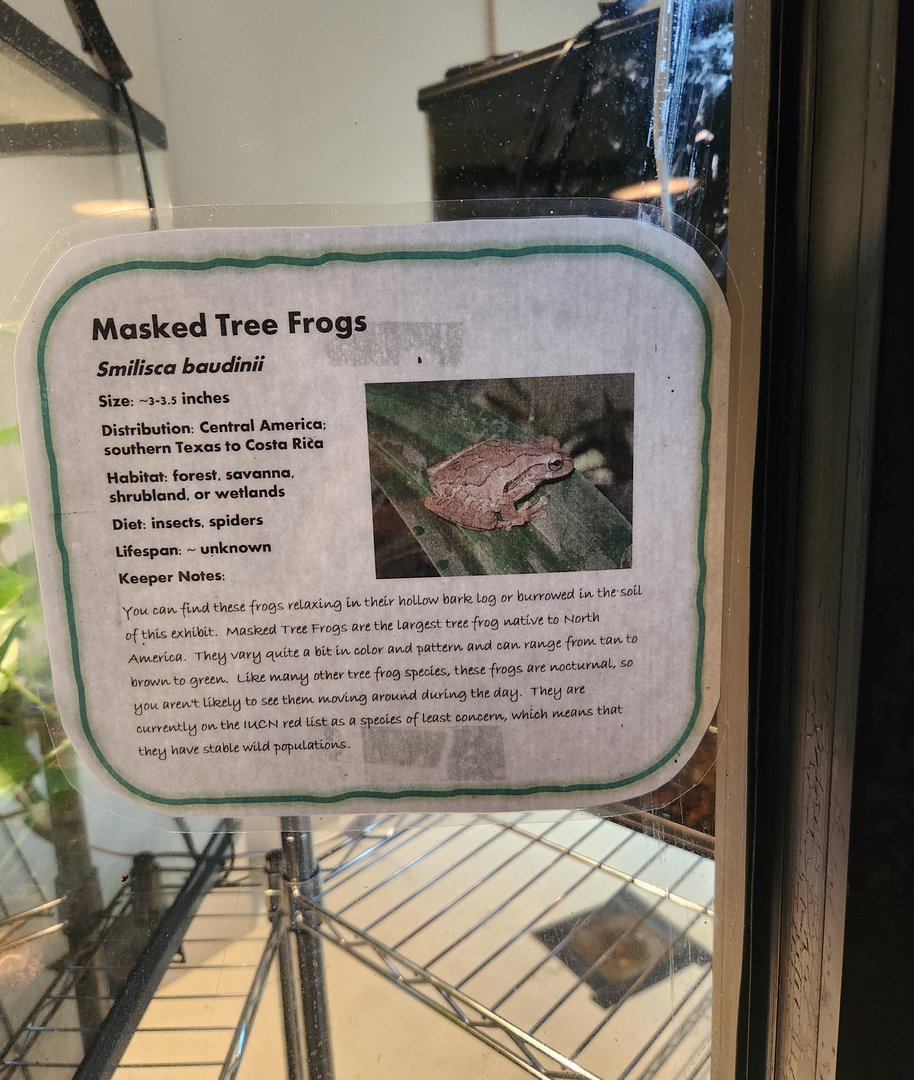
Hey @Coelacanth18, the Masked Tree Frog I saw and photographed at Jacksonville Zoo in January 2022 was indeed signed as Smilisca baudini (I took a picture of the signage as well, but didn't upload it as I intended it for just personal reference). From @SusScrofa 's picture, it looks like they just updated the signage to something more proper (the signage present during my visit looked like temporary/placeholder signage).
Something I did notice, and probably where the confusion is coming from, is that "Masked Tree Frog" isn't really used for S. baudini. In fact, both Wikipedia and iNatuarlist use "Masked Tree Frog" to refer to S. phaeota as the Masked Tree Frog, rather than S. baudini, which is usually referred to as the Mexican Tree Frog or Mexican Smilisca. Jacksonville appears to be the only party referring to S. baudini as the Masked Tree Frog.
None of the facilities I visited have S. phaeota to my knowledge.
Something I did notice, and probably where the confusion is coming from, is that "Masked Tree Frog" isn't really used for S. baudini. In fact, both Wikipedia and iNatuarlist use "Masked Tree Frog" to refer to S. phaeota as the Masked Tree Frog, rather than S. baudini, which is usually referred to as the Mexican Tree Frog or Mexican Smilisca. Jacksonville appears to be the only party referring to S. baudini as the Masked Tree Frog.
None of the facilities I visited have S. phaeota to my knowledge.
Something I did notice, and probably where the confusion is coming from, is that "Masked Tree Frog" isn't really used for S. baudini. In fact, both Wikipedia and iNatuarlist use "Masked Tree Frog" to refer to S. phaeota as the Masked Tree Frog, rather than S. baudini, which is usually referred to as the Mexican Tree Frog or Mexican Smilisca.
Yeah that was where the confusion came from; I assigned a Latin name at the time because I didn't have one, but the common name they use is typically not applied to that species. Jacksonville is the only holder of Smilisca I found, so interesting either way! I just wanted to straighten out my statistics and that one was a question mark.
------------------
Today's post will be a short one. Tomorrow I have something different planned, which will hopefully be interesting and put a lot of what we've covered so far in perspective... then Thursday we'll move on to reptiles
Order Gymnophiona – Caecilians
Family Typhlonectidae – Aquatic Caecilians
The oft-forgotten third order of amphibians, these limbless creatures are mostly found below the ground where they feed on earthworms. Fossorial animals don’t really lend themselves well to public display, so unsurprisingly the only two caecilians I found in captive collections here are both aquatic species from tropical South America.
Typhlonectes natans – Prevalent
Called by various common names – Rio Cauca caecilian, aquatic caecilian, rubber eel – this is the primary captive caecilian. In addition to being in several zoos, it is also kept by some as an aquarium pet. Frankly I think it looks like a foot-long gray worm. One was found outside Miami in 2019, so it’s been added to the ever-growing list of “animals that shouldn’t be in Florida but are anyway.”
Taken at Zoo Antwerpen (Belgium) by @KevinB

Close up of head; taken at Smithsonian National Zoo by @Andrew_NZP
Kaup’s Caecilian (Potamotyphlus kaupii) – Rare
A rarer aquatic caecilian that looks similar to T. natans.
Just looked into that population in Florida, and wow! I had no idea they were established there. They haven't for sure been recorded breeding but that are strongly suspected of doing so given their sheer numbers.Yeah that was where the confusion came from; I assigned a Latin name at the time because I didn't have one, but the common name they use is typically not applied to that species. Jacksonville is the only holder of Smilisca I found, so interesting either way! I just wanted to straighten out my statistics and that one was a question mark.
------------------
Today's post will be a short one. Tomorrow I have something different planned, which will hopefully be interesting and put a lot of what we've covered so far in perspective... then Thursday we'll move on to reptiles
Order Gymnophiona – Caecilians
Family Typhlonectidae – Aquatic Caecilians
The oft-forgotten third order of amphibians, these limbless creatures are mostly found below the ground where they feed on earthworms. Fossorial animals don’t really lend themselves well to public display, so unsurprisingly the only two caecilians I found in captive collections here are both aquatic species from tropical South America.
Typhlonectes natans – Prevalent
Called by various common names – Rio Cauca caecilian, aquatic caecilian, rubber eel – this is the primary captive caecilian. In addition to being in several zoos, it is also kept by some as an aquarium pet. Frankly I think it looks like a foot-long gray worm. One was found outside Miami in 2019, so it’s been added to the ever-growing list of “animals that shouldn’t be in Florida but are anyway.”

Taken at Zoo Antwerpen (Belgium) by @KevinB
Close up of head; taken at Smithsonian National Zoo by @Andrew_NZP
Kaup’s Caecilian (Potamotyphlus kaupii) – Rare
A rarer aquatic caecilian that looks similar to T. natans.
Amphibian Recap
So I know that originally I said I was going to do a bonus content post before we moved onto reptiles. I still plan on doing a few of those, but the one I was working on got scrapped on account of being too much work for data that was not interesting enough. Instead I’ve decided to end each major group with a recap.
Real quick before we dive in, though – a bit of good news that I missed. Back in January the Atlanta Zoo added an exhibit for Mona Coquis to their reptile house, making that now 2 zoos that hold this species. Given that the most recent reference to this species at the other holder – Zoo Miami – was just last year in 2022, it’s possible we might be seeing the start of a more substantial coqui population in US zoos… but only time will tell!
Zoo Atlanta News 2023 [Zoo Atlanta]
AMPHIBIANS: THE NUMBERS
226 species from 31 families
7 species were added from contributions to this thread
Family with Most Species: Bufonidae (toads) – 37 spp
Family with Most Holdings: Dendrobatidae (poison dart frogs) – 339 survey holdings
Species abundance breakdown:
- 5 Abundant (40+ holders)
- 6 Very Common (30-39 holders)
- 11 Common (20-29 holders)
- 27 Prevalent (10-19 holders)
- 29 Uncommon (5-9 holders)
- 148 Rare (1-4 holders) (~65%)
Of the 148 rare species, 81 (~55%) were only found in 1 surveyed facility – though keep in mind that some of these may not be truly unique holdings, especially for native species.
The most common species overall is the Green-and-black Poison Dart Frog (Dendrobates auratus), followed closely behind (within the margin of error, really) by the Dyeing Poison Dart Frog (Dendrobates tinctorius) which includes Blue Poison Dart Frogs. The most common native species (after accounting for missing data) are Hellbenders, American Bullfrogs, and Eastern Tiger Salamanders.
GOLD MEDALIST
This section will feature a US collection that stood out from the rest for this category. Today’s gold medalist is…
Detroit Zoo
Okay, not the most climactic pick I recorded a total of 44+ amphibian species displayed at Detroit over the past 5 years, well above any other surveyed facility. Its dominance is thanks to its National Amphibian Conservation Center, the largest dedicated amphibian exhibit in the country with ~40 exhibits. An overview and some photos of the exhibit are covered in @pachyderm pro’s post in America’s 100 Must-see Exhibits thread, linked below. The zoo also breeds several species, including 5 that are part of reintroduction programs.
America's 100 Must See Exhibits
Possibly the second largest amphibian collection on display is at the Smithsonian National Zoo – which keeps 30-35 amphibian species across two different buildings, and has breeding labs for salamanders and tropical frogs. Several other major zoos and aquaria were roughly in the 20-25 species range, possibly a bit higher. Meanwhile most mid-sized and smaller facilities had more like 10 or 15 – though many had few or none.
RISING STARS
This section highlights species that are rapidly becoming more common on the scene.
Lake Titicaca Water Frog (Telmatobius culeus) – the most obvious one; new to the scene at Denver Zoo in 2015, has spread to several zoos since 2021. Breeding well, popular. These blobs may soon be a common sight in major and mid-sized US collections across the country.

Photo taken at Denver Zoo by @Ituri
COELY’S HIGHLIGHT SPECIES
With every major group I will highlight one or two personal favorites of mine. Since this recap involves both salamanders and frogs, I’ll choose a representative from both:
Salamanders: Asian Giant Salamanders (Andrias)
The largest amphibians on Earth; still awe-inspiring when I see them, especially on the rare occasion of activity. Reminiscent of the long-extinct crocodile sized amphibians of past eras, and a reminder of the diversity still hanging on by a thread today. These are uncommon in American zoos but a special treat to see.

Chinese Giant Salamander (A. davidianus)
Taken at ZSL London Zoo by @amur leopard
Frogs: Waxy Monkey Leaf Frogs (Phyllomedusa)
Lots of frogs look weird or goofy, but this is straight up a Star Wars alien. What does it want with us? What is it waiting so patiently for? What's going on behind those big bug eyes? We may never know, but I for one think this eerily primate-like amphibian makes for an engaging tropical American display.

Photo taken at Serpentario Machaqway (Argentina) by @devilfish
With that, I’ll kick off reptiles on Thursday. Until then, this would be a perfect opportunity to say anything about the amphibian portion of the guide. Comments or additions to my recap? Any surprises so far? Species that you’d like to see highlighted more in US zoos? Plug away till Thursday! (Or later - I won’t stifle good a frog discussion if it happens to come up)

Colorado River Toad (Incilius alvarius) watching the end credits of this chapter
Taken at Sedgwick County Zoo by @Ituri
So I know that originally I said I was going to do a bonus content post before we moved onto reptiles. I still plan on doing a few of those, but the one I was working on got scrapped on account of being too much work for data that was not interesting enough. Instead I’ve decided to end each major group with a recap.
Real quick before we dive in, though – a bit of good news that I missed. Back in January the Atlanta Zoo added an exhibit for Mona Coquis to their reptile house, making that now 2 zoos that hold this species. Given that the most recent reference to this species at the other holder – Zoo Miami – was just last year in 2022, it’s possible we might be seeing the start of a more substantial coqui population in US zoos… but only time will tell!
Zoo Atlanta News 2023 [Zoo Atlanta]
AMPHIBIANS: THE NUMBERS
226 species from 31 families
7 species were added from contributions to this thread
Family with Most Species: Bufonidae (toads) – 37 spp
Family with Most Holdings: Dendrobatidae (poison dart frogs) – 339 survey holdings
Species abundance breakdown:
- 5 Abundant (40+ holders)
- 6 Very Common (30-39 holders)
- 11 Common (20-29 holders)
- 27 Prevalent (10-19 holders)
- 29 Uncommon (5-9 holders)
- 148 Rare (1-4 holders) (~65%)
Of the 148 rare species, 81 (~55%) were only found in 1 surveyed facility – though keep in mind that some of these may not be truly unique holdings, especially for native species.
The most common species overall is the Green-and-black Poison Dart Frog (Dendrobates auratus), followed closely behind (within the margin of error, really) by the Dyeing Poison Dart Frog (Dendrobates tinctorius) which includes Blue Poison Dart Frogs. The most common native species (after accounting for missing data) are Hellbenders, American Bullfrogs, and Eastern Tiger Salamanders.
American Toad (Anaxyrus americanus)
Barred Tiger Salamander (Ambystoma maculatum)
Colorado River Toad (Incilius alvarius)
Green and Gray Tree Frogs (Dryophytes spp.)
Barred Tiger Salamander (Ambystoma maculatum)
Colorado River Toad (Incilius alvarius)
Green and Gray Tree Frogs (Dryophytes spp.)
Abundant
Amazon Milk Frog (Trachycephalus resinifictrix)
Panamanian Golden Frogs (Atelopus zeteki/varius)
Yellow-banded Poison Dart Frog (Dendrobates leucomelas)
Very Common
Axolotl (Ambystoma mexicanum)
Cane Toad (Rhinella marina)
Golden Poison Dart Frog (Phyllobates terribilis)
Common
African Bullfrog (Pyxis adspersus)
Anthony’s/Phantasmal Poison Dart Frog (Epipedobates anthonyi)
Red-eyed Tree Frog (Agalychnis callidryas)
Smoky Jungle Frog (Leptodactylus pentadactylus)
Vietnamese Mossy Frog (Theloderma corticale)
White’s Tree Frog (Ranoidea caerulea)
Amazon Milk Frog (Trachycephalus resinifictrix)
Panamanian Golden Frogs (Atelopus zeteki/varius)
Yellow-banded Poison Dart Frog (Dendrobates leucomelas)
Very Common
Axolotl (Ambystoma mexicanum)
Cane Toad (Rhinella marina)
Golden Poison Dart Frog (Phyllobates terribilis)
Common
African Bullfrog (Pyxis adspersus)
Anthony’s/Phantasmal Poison Dart Frog (Epipedobates anthonyi)
Red-eyed Tree Frog (Agalychnis callidryas)
Smoky Jungle Frog (Leptodactylus pentadactylus)
Vietnamese Mossy Frog (Theloderma corticale)
White’s Tree Frog (Ranoidea caerulea)
GOLD MEDALIST
This section will feature a US collection that stood out from the rest for this category. Today’s gold medalist is…
Detroit Zoo
Okay, not the most climactic pick
I recorded a total of 44+ amphibian species displayed at Detroit over the past 5 years, well above any other surveyed facility. Its dominance is thanks to its National Amphibian Conservation Center, the largest dedicated amphibian exhibit in the country with ~40 exhibits. An overview and some photos of the exhibit are covered in @pachyderm pro’s post in America’s 100 Must-see Exhibits thread, linked below. The zoo also breeds several species, including 5 that are part of reintroduction programs.America's 100 Must See Exhibits
Possibly the second largest amphibian collection on display is at the Smithsonian National Zoo – which keeps 30-35 amphibian species across two different buildings, and has breeding labs for salamanders and tropical frogs. Several other major zoos and aquaria were roughly in the 20-25 species range, possibly a bit higher. Meanwhile most mid-sized and smaller facilities had more like 10 or 15 – though many had few or none.
RISING STARS
This section highlights species that are rapidly becoming more common on the scene.
Lake Titicaca Water Frog (Telmatobius culeus) – the most obvious one; new to the scene at Denver Zoo in 2015, has spread to several zoos since 2021. Breeding well, popular. These blobs may soon be a common sight in major and mid-sized US collections across the country.
Photo taken at Denver Zoo by @Ituri
COELY’S HIGHLIGHT SPECIES
With every major group I will highlight one or two personal favorites of mine. Since this recap involves both salamanders and frogs, I’ll choose a representative from both:
Salamanders: Asian Giant Salamanders (Andrias)
The largest amphibians on Earth; still awe-inspiring when I see them, especially on the rare occasion of activity. Reminiscent of the long-extinct crocodile sized amphibians of past eras, and a reminder of the diversity still hanging on by a thread today. These are uncommon in American zoos but a special treat to see.
Chinese Giant Salamander (A. davidianus)
Taken at ZSL London Zoo by @amur leopard
Frogs: Waxy Monkey Leaf Frogs (Phyllomedusa)
Lots of frogs look weird or goofy, but this is straight up a Star Wars alien. What does it want with us? What is it waiting so patiently for? What's going on behind those big bug eyes? We may never know, but I for one think this eerily primate-like amphibian makes for an engaging tropical American display.
Photo taken at Serpentario Machaqway (Argentina) by @devilfish
With that, I’ll kick off reptiles on Thursday. Until then, this would be a perfect opportunity to say anything about the amphibian portion of the guide. Comments or additions to my recap? Any surprises so far? Species that you’d like to see highlighted more in US zoos? Plug away till Thursday! (Or later - I won’t stifle good a frog discussion if it happens to come up
)Colorado River Toad (Incilius alvarius) watching the end credits of this chapter
Taken at Sedgwick County Zoo by @Ituri
Last edited:
Besides the aforementioned stout salamanders and giant salamanders, are there any other notable rarities in the Detroit Zoo amphibian collection? Given the size of the collection I'm assuming it's a safe bet there's at least a few other not commonly kept species.Detroit Zoo
Okay, not the most climactic pick
I am still shocked there were no Hymenochirus in the survey. It's one of the most common frogs in the private trade and I've kept them myself in the past. Most very common pet store species seem to be abundant in zoos, so what about Hymenochirus is keeping them from that status?
I do remember that Shedd kept them years ago but I think that was before your timeframe.
I do remember that Shedd kept them years ago but I think that was before your timeframe.
Last edited: