I'm back with a redo with corrected information with a new format.
To review, here are the scales that I'm using.
Abundance Scale:
Abundant: 51+
Extremely Common: 36-50
Common: 21-35
Uncommon: 11-20
Rare: 6-10
Extremely Rare: 1-5
Feasibility Scale:
Extremely Plausible: 5
Plausible: 4
Somewhat Plausible: 3
Barely Plausible: 2
Implausible: 1
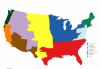
Regions of Zoos:

These regions aren't completely accurate but they will be used in enclosure recommendations.
Platypus Ornithorhynchus anatinus
@WhistlingKite24
- Extremely Rare in AZA
- Not Present in Non-Accredited
- Extremely Rare as a Whole
This species is monotypic, only found in San Diego Zoo Safari Park (in the USA). Breeding has been non-existent (in the US) and worldwide, it's rare and often unsuccessful. They tend to level for 15-20 years in captivity. Group sizes wise, they are mostly solitary but for breeding purposes,
1.1 can work with separated enclosures except during breeding season which is during late July through early November.
@WhistlingKite24
They typically have indoor enclosures but due to habitat and climate similarities, facilities in the Pacific Northwest (look at map above) could have outdoor enclosures though they are easily stressed. To maximize viewing, reversed lighting is best and is
commonly used.
For solitary platypus, an enclosure with 20+ sq. m total space including a 10+ sq. m pool works and for a pair, 40+ sq. m total space with a 15 sq. pool works (separated burrows would be needed).
My recommended enclosure requirements are:
- Underwater viewing
- In the pool, aquatic plants, leaf litter, and submerged logs
- Simulated burrows and nesting chambers surrounded by vegetation
Overall, they are
Barely Plausible (suggested by
@Aardwolf ) as they aren’t implausible but only major zoos with strong partnerships with Australian zoos would work. Their diet is also extremely expensive as yabbies are banned? Like
@WhistlingKite24 mentioned, demand is too high and it’s unlikely that there will be enough platypus to replace future deceased ones. In my opinion, it’s
Not Recommended as they aren’t that sustainable.
Short-beaked Echidna Tachyglossus aculeatus
@WhistlingKite24
- Rare in AZA
- Extremely Rare in Non-Accredited
- Uncommon as a Whole
The Short-beaked Echidna has many subspecies but the specific subspecific information in zoos is not certain (the Zootierlieste probably isn't accurate). Breeding has been historically unsuccessful but it's been increasingly successful recently. They tend to level for 30+ years in captivity (though long-beaked echidnas live longer in captivity). Group sizes wise, they are also mostly solitary but for breeding purposes,
1.1 can work.
Some possible challenges of them in captivity is their hard/expensive (ish) diets, challenging/complicated reproduction habits, and stress levels.
@Zoofan15
Indoor and outdoor enclosures are varied with outdoor housing year-round being possible for the Southeast (deep), Californian Mediterranean, and the Southwestern Deserts (mostly year-round). To maximize viewing, reversed lighting is best and is
commonly used if indoor enclosures are present.
For solitary echidna, an enclosure that's 10+ sq. m large works and for a pair, an enclosure with 40+ sq. m large size and multiple burrows works.
They work in many mixed species enclosures but in
my opinion, nocturnal animals should be housed with them to minimize stress so the following species are my recommended compatible animals:
- Bare-nosed Wombat Vombatus ursinus
- Huon Tree Kangaroo Dendrolagus matschiei
- Koala Phascolarctos cinereus
- Parma Wallaby Notamacropus parma
- Southern Hairy-nosed Wombat Lasiorhinus latifrons
- Sugar Glider Petaurus breviceps
- Tammar Wallaby Notamacropus eugenii
- Tawny Frogmouth Podargus strigoides
- Woylie Bettongia penicillata
- Yellow-footed Rock Wallaby Petrogale xanthopus
My recommended enclosure requirements are:
- Underground barriers to prevent escapes (0.5 m deep is good) and fully enclosed to prevent pests
- The substrate should be deep and burrowable. Artificial Burrows and tunnels would be interesting
- Hollow logs, plants, rock crevices, and nesting boxes with a shallow water feature
Overall, they are
Plausible as the captive population has increased and are found in almost a dozen facilities. In my opinion, they are
Recommended for the same reasons.
Example Enclosure:
the Las Vegas Zoological Park: the Land Down Under
Inhabitants: Breeding Pair of
1.1 Short-beaked Echidna Tachyglossus aculeatus (
1.1 ambassadors behind the scenes) and a Breeding Pair of
1.1 Tawny Frogmouth Podargus strigoides (
0.1 ambassador behind the scenes, used for
Flight Show)
There are two enclosures, one outdoors and the other indoors. The outdoor area is 90 sq. m large and 6 m tall with 1.5 m deep underground fencing. Vegetation includes various trees, shrubs, and grasses. There are rocky outcrops, logs, branches, and a shallow pool. The indoor enclosure is lit by red LED lights and is 30 sq. m large and 4 m tall. There is underground viewing for artificial burrows and tunnels. There is a dead tree, rocky outcrops, hollow logs, branches, and nesting boxes. Connecting these enclosures is a ground tunnel and a 3 m tall elevated tunnel.
Species of Interest:
- Western Long-beaked Echidna Zaglossus bruijnii - An EEP was recently established which hoped to use confiscated individuals from Indonesia (illegal pet trade). If this happens, in the not so near future, they might be imported (though I doubt there will be high demand).
Recommended Species Document:
Untitled document
What do you think so far? Please identify any mistakes, errors, feedback, etc.