An overview of Brazilian zoos and their specialities

Yes , I agree, I find it very sad and frustrating too.

I think there is definitely a thing with some institutions being possesive of their "star species" (for reasons of status) because of not wanting to share the limelight in breeding success or a sort of "We've got this species and you havent , nah-nah NAH na naaaah-nah" childish mentality thing.

These are all very silly behaviours in my opinion and maybe ok and understandable in a 10 year old child collecting pokemon cards, but totally unacceptable in grown adults working on something as important as ex-situ conservation. But some organizational cultures seem to promote and attract people who have this kind of deficit of emotional matury.

So there can be a lot of thinking in very narrow, myopic and narcissistic terms of rivalry rather than seeing or recognizing the bigger picture of the necessity for cooperation and collaboration between institutions to achieve the common goal of ex-situ conservation.

Often it can be down to current or historic interpersonal issues in communications between directors or zoo staff. This seems to particularly be the case / dynamic with some of the bigger more famous zoos in the region in their dealings with some of the smaller zoos where there can be an attitude of arrogance and "superiority" (I won't give any names though , haha). However, I've also seen this kind of rivalry occur between the bigger zoos and it can get pretty toxic.

Yes, I have read a few times (and heard by some professionals) about this enfuring selfish behavior... This really puts me down, because we already know that the purpose of the zoos nowadays is extremely important, and it looks like those people (who manage and/or are part of the zoo's staff) simply ignore the objectives of modern zoos, and keep the ancient thoughts...

I was actually scared about some facts that were presented in this speech that I previously mentioned from biologist Igor; like the fact that only 7% of the brazilian zoos keep real and effective conservation programmes, and only 7 institutions in the entire country let their animals walk on the exhibit at night instead of arresting them on the handling area. For one side, I got very proud of Belo Horizonte zoo, for being included in both aspects and being so well positioned in the conservation issues, (thanks to it's director, mr. Humberto E. S. Mello, with whom I had the pleasure to talk a few times, and all the other people in the staff that are extremely and equaly important) but for another side, I got really sad that we have such an incredibly high percentage of zoos that don't effectivate the real purpose they are supposed to follow, and many of these institutions are in this situation because of selfish and late-thought managers. That shows us that, besides we might have already achieved many improvements in our national zoos, there's still a long way to go...
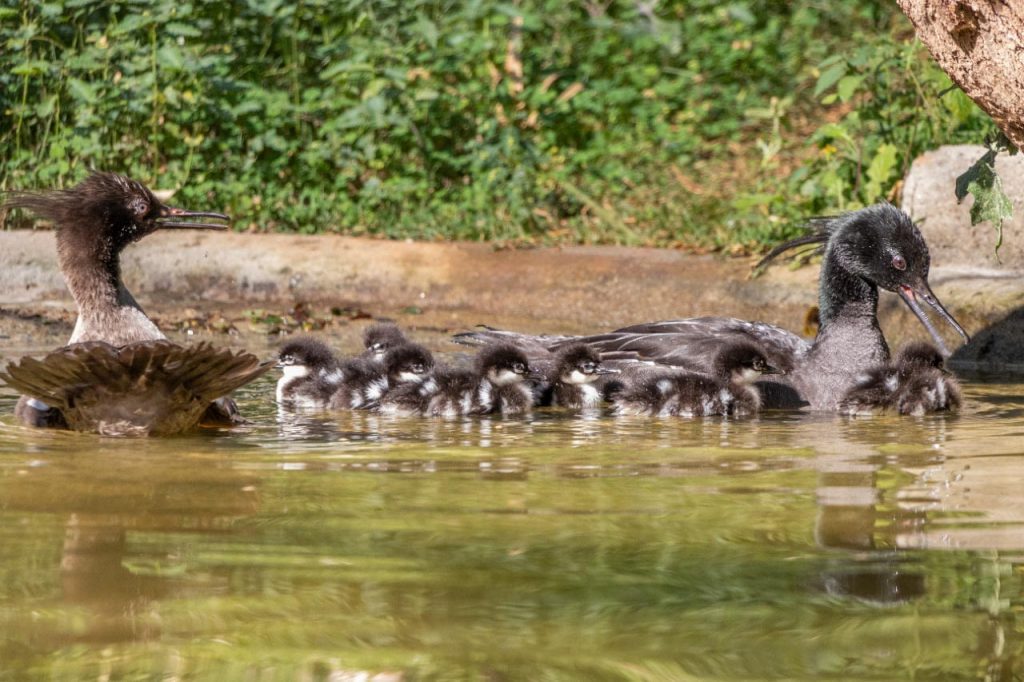
 
Zooparque Itatiba - Brazilian merganser (Mergus octosetaceus)

Due to its habit of diving to eat small fishes like lambaris and plecos from the 5th day of life, even the slightest disturbance and pollution of rivers narrows today's range of the brazilian merganser to the Serra da Canastra region mostly, where probably most of the less than 250 ducks in the wild reside.

All the captive individuals are held in Zooparque Itatiba as part of the brazilian merganser PAN, started by IBAMA in 2006, propelled in 2012 after CMIBio's creation and of which the second cicle has begun in 2019.
(National Action Plan / Brazilian Institute of Environment and Renewable Natural Resources / Chico Mendes Institute for Biodiversity Conservation)

The first birth of 4 birds of the species under human care took place in August 2017 via artificial incubation. In July 2018, from 7 eggs, 4 new mergansers were hatched and raised by their own parents.
Zooparque currently holds 29 adults and 14 ducklings, as of the births earlier this month: 7 captivity recordists, 5 from a first-timer couple and 2 from eggs collected in Serra da Canastra. According to biologist Camila Piovani, that's the second generation of ducklings born from the ex situ program. Zooparque still expects a higher sum by the end of this month, since the reproductive period of their merganser population is still ongoing.

Each enclosure contains a 100 sqm for each monogamous pair, running water artificial pond, vegetation, nest in a wooden trunk, natural cavities and cameras. They are fed living young fishes and live with as little human contact as possible.

Besides the ex situ breeding, as of 2015, another important part of the action plan are the in natura egg collection expeditions, led by PAN consultant and vet Alexandre Resende, which contributes to the genetic variability of the captive population. The eggs are incubated by adoptive mothers.

Report about one of the egg collections:

Zooparque-Itatiba-1024x682.jpg

Great update! I never had the chance to really read a detailed text like yours about zooparque Itatiba's merganser's programmes before. I really hope it keeps going as well as it already is, and in the future, make those incredible birds swim around in big populations around our waters again.
 
Yes, I have read a few times (and heard by some professionals) about this enfuring selfish behavior... This really puts me down, because we already know that the purpose of the zoos nowadays is extremely important, and it looks like those people (who manage and/or are part of the zoo's staff) simply ignore the objectives of modern zoos, and keep the ancient thoughts...

I was actually scared about some facts that were presented in this speech that I previously mentioned from biologist Igor; like the fact that only 7% of the brazilian zoos keep real and effective conservation programmes, and only 7 institutions in the entire country let their animals walk on the exhibit at night instead of arresting them on the handling area. For one side, I got very proud of Belo Horizonte zoo, for being included in both aspects and being so well positioned in the conservation issues, (thanks to it's director, mr. Humberto E. S. Mello, with whom I had the pleasure to talk a few times, and all the other people in the staff that are extremely and equaly important) but for another side, I got really sad that we have such an incredibly high percentage of zoos that don't effectivate the real purpose they are supposed to follow, and many of these institutions are in this situation because of selfish and late-thought managers. That shows us that, besides we might have already achieved many improvements in our national zoos, there's still a long way to go...


Yes, it is incredibly depressing that this kind of behaviour continues, I agree. Particularly because as you have said the two main objectives / purposes of zoos in the 21st century should be ex-situ conservation and environmental education of the general public.

I think that the statistic of 7 % that you mention is correct because I think that a great many zoos still consider themselves first and foremost as centres of recreation and don't prioritize highly enough the conservation programs of native species or any meaningful environmental education (which ultimately is a form of conservation).

One consequence of the unwillingness to change and stultifying attitudes stuck in the past of many zoo directors and staff does is give fuel and the impression of legitimacy to the "animal rights" activists ridiculous and simplistic anti-zoo arguments. This is very dangerous and ultimately just causes way more problems than we need not to mention a decrease in the public support that we need to actually conduct conservation work.

A lot of zoos throughout Latin America (including some of the best ones) unfortunately still continue to shut animals in their outside enclosures during the day so that they can be seen by the public and only allow them inside their indoor quarters at night (to be fair though in some cases this is due to fears and concerns of rarer animals being stolen by traffickers). This really is harmful and counterproductive and does have to change. I hope it will become a thing of the past at some point because again this only serves to undermine the credibility of institutions.

Maybe what is needed (and I guess this will happen gradually and naturally anyway) is that as older directors and staff retire younger generations will take up their positions. I think that perhaps as a result of this generational / demographic shift they will bring new ideas and a greater ethical integrity to zoos of the region that are in greater alignment with the 21st century concept of the zoo and the conservation / societal role it should perform.
 
Last edited:
Zooparque Itatiba - Brazilian merganser (Mergus octosetaceus)

Due to its habit of diving to eat small fishes like lambaris and plecos from the 5th day of life, even the slightest disturbance and pollution of rivers narrows today's range of the brazilian merganser to the Serra da Canastra region mostly, where probably most of the less than 250 ducks in the wild reside.

All the captive individuals are held in Zooparque Itatiba as part of the brazilian merganser PAN, started by IBAMA in 2006, propelled in 2012 after CMIBio's creation and of which the second cicle has begun in 2019.
(National Action Plan / Brazilian Institute of Environment and Renewable Natural Resources / Chico Mendes Institute for Biodiversity Conservation)

The first birth of 4 birds of the species under human care took place in August 2017 via artificial incubation. In July 2018, from 7 eggs, 4 new mergansers were hatched and raised by their own parents.
Zooparque currently holds 29 adults and 14 ducklings, as of the births earlier this month: 7 captivity recordists, 5 from a first-timer couple and 2 from eggs collected in Serra da Canastra. According to biologist Camila Piovani, that's the second generation of ducklings born from the ex situ program. Zooparque still expects a higher sum by the end of this month, since the reproductive period of their merganser population is still ongoing.

Each enclosure contains a 100 sqm for each monogamous pair, running water artificial pond, vegetation, nest in a wooden trunk, natural cavities and cameras. They are fed living young fishes and live with as little human contact as possible.

Besides the ex situ breeding, as of 2015, another important part of the action plan are the in natura egg collection expeditions, led by PAN consultant and vet Alexandre Resende, which contributes to the genetic variability of the captive population. The eggs are incubated by adoptive mothers.

Report about one of the egg collections:

Zooparque-Itatiba-1024x682.jpg

Excellent post Felipe and thank you for your amazing contributing to the thread !

Have really enjoyed reading about this conservation programe (which I'll admit I only knew the basics about) and it's successes.

I really hope that this zoo can make a difference in conserving the merganser at this critical time and by the sounds of it they already are making a lot of progress to building up an insurance population and learning valuable lessons about the captive husbandry of the species.
 
This is interesting news and very encouraging. However, so far I don't think (I may be wrong on this matter though) that there are many available females in Brazilian zoos for this kind of exchange between zoos for captive breeding purposes.

Very hard to breed this species in a lot of facilities here too , breeding success unfortunately seems to be mostly a sporadic event in many zoos.

To add to this the matter is complicated further by some issues of lack of cooperation / collaboration between zoos which leads to communication breakdowns, delays and an unwillingness for dialogue that become institutional "cold wars" (very common / endemic problem from what I've observed in zoos in Latin America in general).


Could be interesting to have a read of this , is this publication available to read online ?
If you have access to Wiley publishers, probably yes. If not, it is behind a paywall.
(Damn, do I detest being confronted with paywalls and non open access journals. It is stifling exchange of scientific papers, thought and knowledge. To be aware that my taxes for years went to a.o. educational facilities and educating millions and being shut out one self from this .... It positively makes me frown!).

@DavidMatos, do you know what the current situation is in Brasil with numbers of giant otters in its zoos?

More generally, does not the SZB hold clout in cooperative breeding programs? What is the Brasilian zoo association's affiliation like with ALPZA?
 
If you have access to Wiley publishers, probably yes. If not, it is behind a paywall.
(Damn, do I detest being confronted with paywalls and non open access journals. It is stifling exchange of scientific papers, thought and knowledge. To be aware that my taxes for years went to a.o. educational facilities and educating millions and being shut out one self from this .... It positively makes me frown!).

@DavidMatos, do you know what the current situation is in Brasil with numbers of giant otters in its zoos?

More generally, does not the SZB hold clout in cooperative breeding programs? What is the Brasilian zoo association's affiliation like with ALPZA?

My access to Wiley and most other journals / publishers has now ended so cannot access these unfortunately. I hate the damn paywalls and non access journals too ! :mad:
 
Last edited:
If you have access to Wiley publishers, probably yes. If not, it is behind a paywall.
(Damn, do I detest being confronted with paywalls and non open access journals. It is stifling exchange of scientific papers, thought and knowledge. To be aware that my taxes for years went to a.o. educational facilities and educating millions and being shut out one self from this .... It positively makes me frown!).

@DavidMatos, do you know what the current situation is in Brasil with numbers of giant otters in its zoos?

More generally, does not the SZB hold clout in cooperative breeding programs? What is the Brasilian zoo association's affiliation like with ALPZA?

Well, unfortunately, I do not have acces to this site...

In Brazil, there are eleven giant river otters in zoos (two males and nine females) but one female is already too old to reproduce, so we gotta consider 10 animals to help the reproduction program.

SZB (nowadays is called AZAB (associação dos zoológicos e aquários do Brasil) might have some afiliations with ALPZA, but at least considering social media, ALPZA doesn't mention brazilian zoos a lot, but I unfortunately don't know a lot about ALPZA's afiliations in Brazil... I know that zoo Belo Horizonte is afiliated to EAZA because of the gorilla program and the elephant management, but besides that, I don't think many brazilian zoos are afiliated to other associations. Onychorhynchus coronatus , please, correct me if I'm wrong.
 
Yes, it is incredibly depressing that this kind of behaviour continues, I agree. Particularly because as you have said the two main objectives / purposes of zoos in the 21st century should be ex-situ conservation and environmental education of the general public.

I think that the statistic of 7 % that you mention is correct because I think that a great many zoos still consider themselves first and foremost as centres of recreation and don't prioritize highly enough the conservation programs of native species or any meaningful environmental education (which ultimately is a form of conservation).

One consequence of the unwillingness to change and stultifying attitudes stuck in the past of many zoo directors and staff does is give fuel and the impression of legitimacy to the "animal rights" activists ridiculous and simplistic anti-zoo arguments. This is very dangerous and ultimately just causes way more problems than we need not to mention a decrease in the public support that we need to actually conduct conservation work.

A lot of zoos throughout Latin America (including some of the best ones) unfortunately still continue to shut animals in their outside enclosures during the day so that they can be seen by the public and only allow them inside their indoor quarters at night (to be fair though in some cases this is due to fears and concerns of rarer animals being stolen by traffickers). This really is harmful and counterproductive and does have to change. I hope it will become a thing of the past at some point because again this only serves to undermine the credibility of institutions.

Maybe what is needed (and I guess this will happen gradually and naturally anyway) is that as older directors and staff retire younger generations will take up their positions. I think that perhaps as a result of this generational / demographic shift they will bring new ideas and a greater ethical integrity to zoos of the region that are in greater alignment with the 21st century concept of the zoo and the conservation / societal role it should perform.

Oh, yes, and I get very happy when I realize this is probably gonna happen naturaly. Let's hope the new generations are not smashed by the old thoughts and structures that already exist in our institutions...
 
Well, unfortunately, I do not have acces to this site...

In Brazil, there are eleven giant river otters in zoos (two males and nine females) but one female is already too old to reproduce, so we gotta consider 10 animals to help the reproduction program. Onychorhynchus coronatus , please, correct me if I'm wrong.

SZB (nowadays is called AZAB (associação dos zoológicos e aquários do Brasil) might have some afiliations with ALPZA, but at least considering social media, ALPZA doesn't mention brazilian zoos a lot, but I unfortunately don't know a lot about ALPZA's afiliations in Brazil... I know that zoo Belo Horizonte is afiliated to EAZA because of the gorilla program and the elephant management, but besides that, I don't think many brazilian zoos are afiliated to other associations.

Yes, I believe that this is correct David.

I honestly don't know the specifics of the Brazilian zoo association or their affiliations though and it is a bit of a kafkaesque nightmate to figure all of this out because as you've said there is a lot of them that have no affiliations.
 
Oh, yes, and I get very happy when I realize this is probably gonna happen naturaly. Let's hope the new generations are not smashed by the old thoughts and structures that already exist in our institutions...

It will be a difficult one... I think this will depend largely on the organizational culture of each institution and of course there will be some that are far less resistant to change than others for a variety of reasons.

But overall I am hopeful and I can definitely see this already occurring in a lot of zoos here and elsewhere in Latin America so things are ultimately moving in the right direction.
 
It will be a difficult one... I think this will depend largely on the organizational culture of each institution and of course there will be some that are far less resistant to change than others for a variety of reasons.

But overall I am hopeful and I can definitely see this already occurring in a lot of zoos here and elsewhere in Latin America so things are ultimately moving in the right direction.
@DAVID, how is Brasilia Zoo's alignment with AZAB and ..., (speculating) would it not be an option to look to European zoos for excess males to make up the numbers and make it an across ocean's program for the lobo de rio? I remember that not too long ago an European zoo sent a giant otter to another zoo in northern South America.
 
@DAVID, how is Brasilia Zoo's alignment with AZAB and ..., (speculating) would it not be an option to look to European zoos for excess males to make up the numbers and make it an across ocean's program for the lobo de rio? I remember that not too long ago an European zoo sent a giant otter to another zoo in northern South America.

Yes, definitely, this is such a good strategy... this situation happened last year with the Brasilia zoo, actually, and a giant otter came from Dortmund zoo, in Germany. The issue is that the female they already had, and was supposed to make a couple with the one from Dortmund, died a few months after his arrival; so now he's alone... But yeah, I definitely think exchanging animals with europe would be a very good strategy for both sides (in brazilian zoos we have a good reproduction of anteaters, tapirs, capuchin monkeys, caimans and many others, that could be sent to conservation programmes in european zoos).
This is already a reality for some zoos around here; as I said, in Belo Horizonte, two european gorillas were brought and started a great family with another european gorilla they already kept here. I bet more relations with european institutions would surely be very interesting.
 
Yes, definitely, this is such a good strategy... this situation happened last year with the Brasilia zoo, actually, and a giant otter came from Dortmund zoo, in Germany. The issue is that the female they already had, and was supposed to make a couple with the one from Dortmund, died a few months after his arrival; so now he's alone... But yeah, I definitely think exchanging animals with europe would be a very good strategy for both sides (in brazilian zoos we have a good reproduction of anteaters, tapirs, capuchin monkeys, caimans and many others, that could be sent to conservation programmes in european zoos).
This is already a reality for some zoos around here; as I said, in Belo Horizonte, two european gorillas were brought and started a great family with another european gorilla they already kept here. I bet more relations with european institutions would surely be very interesting.

Perhaps relations with other Latin American zoos in Colombia (I'm thinking Cali in particular), Argentina, Peru and Ecuador would also be a good idea.

I feel that in Brazil in most cases these inter-Latin American relations are often sorely neglected and I'm sure that they could also be a good source for animal exchanges.
 
Last edited:
Perhaps relations with other Latin American zoos in Colombia (I'm thinking Cali in particular), Argentina, Peru and Ecuador would also be a good idea.

I feel that in Brazil in most cases these inter-Latin American relations are often sorely neglected and I'm sure that they could also be a good source for animal exchanges.
To add to this: there is a rewildling program in Sendero del Ibera, Corrientes Province in Argentina. The EAZA/EEP is supporting it and European zoos have provided mate(s) for this program to get started. This program has a Facebook page and is actively connecting with the sister Lobo de Rio program of ALPZA.

Source: Security Check Required


A quick scan of news from the last few months already revealed 5 different zoos in the program having offspring born. This underlines that with a structured conservation breeding program much more is possible!

I also do think that the EEP would be sort of "jealous" with 2.11 individual Lobo de Rio in Brasil! I suggest your friend the zoo curator should be invited over to ALPZA and EAZA. I am sure it would work wonders. Maybe local workshop for the species in Brasil and invite the local Brasilian zoos with giant otter to it?

The first international workshop was in Cali Zoo in Colombia in May 2017.
 
To add to this: there is a rewildling program in Sendero del Ibera, Corrientes Province in Argentina. The EAZA/EEP is supporting it and European zoos have provided mate(s) for this program to get started. This program has a Facebook page and is actively connecting with the sister Lobo de Rio program of ALPZA.

Source: Security Check Required


A quick scan of news from the last few months already revealed 5 different zoos in the program having offspring born. This underlines that with a structured conservation breeding program much more is possible!

I also do think that the EEP would be sort of "jealous" with 2.11 individual Lobo de Rio in Brasil! I suggest your friend the zoo curator should be invited over to ALPZA and EAZA. I am sure it would work wonders. Maybe local workshop for the species in Brasil and invite the local Brasilian zoos with giant otter to it?

The first international workshop was in Cali Zoo in Colombia in May 2017.

I've heard of what is going on with the rewilding programe in Ibera in Argentina, it is all very impressive and inspiring (I would love to see similar programs / initiatives done here in Brazil).

I agree that a more structured conservation breeding program would be more than ideal here in Brazil but unfortunately I just think it would be hard to achieve (or at least would have to be put on the backburner for a while) given the current crisis and current administration.

I think you might be confusing my comment with David's as he has contact with the person who is in charge of the Giant otter studbook in Brazil but I do know zoo curators and in the future when the opportunity presents itself I could have a word with them about this.

Honestly I do think there are a lot of obstacles to doing this at the moment that could crop up though. Having just finished a workshop I am very aware that logistically they do take a lot of time to set up, economically there are costs too and not to mention getting everyone on the same page etc.

But , yes, its a good idea and fingers crossed it will happen in the future, if I can help in any small way to contribute in making something like this happen I will.
 
Last edited:
Bauru zoo : The speciality of this small but lovely zoo in Sao Paulo state is centred primarily on two native mammal species: the maned wolf (the logo / emblem of the zoo) and the giant anteater.

Both of these species occur in neighbouring cerrado habitat and are heavily endangered due to widescale habitat destruction (for soy, cattle ranching, pine, eucalyptus and citrus fruit plantations etc), wild fires and most notably being killed on roads while crossing. Bauru zoo both breeds these animals in captivity and has conducted several long-term studies to ascertain the impact on the populations of these species within the area and the incidence of roadkill.

Another important feature of their work with these species is taking on injured or orphaned animals (road collision victims are extremely common locally) for veterinary care / treatment and either eventual rehabilitation back into the wild or providing a home for those that cannot be released.

In addition to this the zoo is also heavily involved with campaigns of environmental education with local communities to raise awareness of the conservation of these animals and the anthropogenic impacts which threaten them. These programs are an ongoing feature of the zoos outreach work and are really very impressive in their educational scope.

It is also worth mentioning that the zoo does not just keep native species and a number of exotics can be seen here too (Andean bears, cassowary, Bactrian camel, llamas, Humboldt penguin, African lion, hippo, giraffe, meerkats, fallow deer, ostrich, emu , crowned crane, kangaroo, Siberian tiger, mandrill, sacred baboons, patas monkey to name but a few).


Last edited:
Back
Top