Animal Stereotypes That You Hate

Of course, there’s referring clownfish and tangs (and sometimes reef fish in general) as Nemo and Dory. But the really bad part that somehow hasn’t been talked about yet is the fact that both films appear to be anti-captivity, and the second one in particular involves the “rescue” of some marine life from an aquarium, which in real life would probably be a pretty good, conservation-minded aquarium. So ironically, it would be somewhat hypocritical to refer to the films’ characters in the context of aquaria.
Yet Disney World actually have their Finding Nemo ride in an aquarium. :confused:
 
Also, the aquarium in the second movie was directly based on several reputable real-world aquariums, including the Monterey Bay Aquarium and the Vancouver Aquarium; at least people weren’t discouraged from going to aquariums after seeing the escape of marine animals from a fictional one. Also, the movies increased the popularity of anemonefish and tangs for private aquariums. That may have gone too far, though, as most people who bought (and still buy) these fish due to the movies were (and are) non-ichthyologically-minded children who can’t tell the difference between a tang and a triggerfish.
 
Last edited:
One that drives me crazy is the misconceptions about white tigers. There are so many lies about them that nobody really knows that they are color variant and not a separate species.

1. White tigers are Siberian/live in the snow
2. White tigers are a separate species
3. The white tiger "species" was killed off in the wild,
4. White tigers are albino
 
One that drives me crazy is the misconceptions about white tigers. There are so many lies about them that nobody really knows that they are color variant and not a separate species.

1. White tigers are Siberian/live in the snow
2. White tigers are a separate species
3. The white tiger "species" was killed off in the wild,
4. White tigers are albino
With the first one, I can see why people would make that mistake, "Ah well it has white fur so it must be like a polar bear or Arctic wolf", obviously it's wrong but I can see the logic behind it. I didn't realise the mistaken idea that white tigers were a seperate species that were killed off in the wild was such a prominent one.
 
One that drives me crazy is the misconceptions about white tigers. There are so many lies about them that nobody really knows that they are color variant and not a separate species.

1. White tigers are Siberian/live in the snow
2. White tigers are a separate species
3. The white tiger "species" was killed off in the wild,
4. White tigers are albino

With the first one, I can see why people would make that mistake, "Ah well it has white fur so it must be like a polar bear or Arctic wolf", obviously it's wrong but I can see the logic behind it. I didn't realise the mistaken idea that white tigers were a seperate species that were killed off in the wild was such a prominent one.

The misconception that annoys me most is the belief the general public has that white tigers are a rare and endangered species. Shows like the Lion Man have done little to help the cause by promoting them as a species that needs saving.

As a child, I thought white tigers were spellbinding creatures; but as an adult I’m more interested in seeing purebred subspecies - seeing Siberian and Malayan was a highlight given Australasia focuses on Sumatran tigers.

Dreamworld in Australia has an association with them going back to the 90’s and they draw huge crowds. The zoo is apparently one of the biggest contributors to wild tiger conservation programmes, so arguably the role of their white tigers as ambassadors is justified in this instance - a rare example against many that aren’t.
 
The misconception that annoys me most is the belief the general public has that white tigers are a rare and endangered species. Shows like the Lion Man have done little to help the cause by promoting them as a species that needs saving.

As a child, I thought white tigers were spellbinding creatures; but as an adult I’m more interested in seeing purebred subspecies - seeing Siberian and Malayan was a highlight given Australasia focuses on Sumatran tigers.

Dreamworld in Australia has an association with them going back to the 90’s and they draw huge crowds. The zoo is apparently one of the biggest contributors to wild tiger conservation programmes, so arguably the role of their white tigers as ambassadors is justified in this instance - a rare example against many that aren’t.
I will admit, I have always wanted to see a real white tiger, they were a favourote of mine as a kid, and I've never seen one before. Sumatrans are a focus here in the UK too, Bengals, white or otherwise, aren't as prominent. Despite knowing all of the health problems that white tigers can have as a result of inbreeding, I still want to see one some day.
 
Insofar as much as there haven't been *any* Bengals in the UK (or indeed Europe) since the last one died in 1984 :p
I could've swore I saw Bengals mentioned on the West Midland Safari Park's website recently as I was looking into the place, but I looked again and it just says "tigers".
 
Hyenas have an unwarranted reputation as lowly, cowardly scavengers (to be contrasted with the noble hunting lions) cultivated by a combination of The Lion King and nature documentaries. In fact, lions steal kills from hyenas as least as often as hyenas steal from lions (though both will bully cheetahs).
 
I could've swore I saw Bengals mentioned on the West Midland Safari Park's website recently as I was looking into the place, but I looked again and it just says "tigers".

It's quite possible you did see that - a large number of places tend to use "Bengal" as a more glamorous name for their generic zoomix animals.
 
Hyenas have an unwarranted reputation as lowly, cowardly scavengers (to be contrasted with the noble hunting lions) cultivated by a combination of The Lion King and nature documentaries. In fact, lions steal kills from hyenas as least as often as hyenas steal from lions (though both will bully cheetahs).


This video makes the point that hyenas have been casted in a negative light for centuries before The Lion King, and that peoples’ dislike of hyenas ultimately stems from the various actual traits of the animals that humans find ugly or off-putting. Though all of this is quite true, I have a sneaking suspicion that that this video may be trying to exculpate the Walt Disney Company. While The Lion King was not entirely responsible for giving hyenas a bad name, it was the first time these animals prominently appeared in Western popular culture, and did no favors for their image. This negative portrayal of hyenas became the shape of things to come. While it is true that they do have some features that most people would find repulsive or foreign, The Lion King probably did play an outsized role in how Americans in particular and Westerners in general view these animals today (for example, exaggerating the “scavenging” nature of the Spotted Hyena). Besides, the video itself says that people don’t necessarily hate other animals with “inhuman” features.
In any case, I wholeheartedly agree that hyenas are underrated and that people should like them as much as the Lion, Tiger, or Cheetah.
 
Last edited:
I’ve got two, both for Australian wildlife:
  1. Koalas (and Giant Pandas to a lesser extent) are “useless” because some copypasta on Reddit said so. I’ll admit that I used to believe this, too, but now it comes off as bad taste in a post-bushfire world.
  2. Cassowaries are “the world’s most dangerous bird”. Technically true, but that number is astronomically low compared to cattle, for example. I thought we learned our lesson about labeling animals as killers with sharks, but ok.
 
Cassowaries are “the world’s most dangerous bird”. Technically true, but that number is astronomically low compared to cattle, for example. I thought we learned our lesson about labeling animals as killers with sharks, but ok.
You said it. There have only been two recorded human fatalities caused by cassowary attacks: one involved a 16-year old who was attacking a cassowary (not to mention, he was with a dog), and the other involved a private Florida owner. A 1999 study (cited in a likely deleted 2007 Tetzoo article which was republished as a 2016 Scientific American article) that examined 221 recorded Southern Cassowary attacks in Australia found that the majority of them involve food. Indeed, cassowaries are naturally very wary of humans; interactions generally come in the form of food-related situations, pet encounters, and cassowaries getting run over by cars. Long story short, there’s really no reason to put them on any shortlist of deadliest animals; while they are the deadliest bird in the world, that “astronomically low” number of fatalities does says more about how harmless birds are in general. There are dozens upon dozens of animals more dangerous than cassowaries. It’s a different story for dogs, though; cassowaries are notorious cynophobes and are quite willing to kick back at any dog that gets too close. Of course, close to the only predators of cassowaries are dingos and stray or feral dogs, so I don’t blame them; they have good reason to dislike canines.

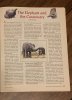
This doesn’t really have anything to do with cassowary attacks on humans, but this page from the February 1997 issue of Highlights may be relevant to the topic of cassowary stereotypes.
517F3620-2DF9-45C9-AC0A-00F9FB53AFB1.jpeg
Well, this is right about one thing; it’s usually not advisable to keep Casuarius casuarius in mixed-species enclosures, and definitely not with a juvenile Elephas maximus! But don’t blame the cassowary; blame that grandpa who decided to put these animals together in a veranda.
Also, note that the elephant calf was probably not in a very good situation in the first place; hopefully he went to a good zoo. And, the Southern Cassowary is not native to Singapore.
In addition, it seems kind of unfair that the elephant is referred to as “he” but the cassowary is “it”.
Lastly, I’m sure many people would disagree with the comment about the cassowary not being a beautiful bird. Myself included, and also the two gentlemen here:
 

Attachments

  • 517F3620-2DF9-45C9-AC0A-00F9FB53AFB1.jpeg
    517F3620-2DF9-45C9-AC0A-00F9FB53AFB1.jpeg
    96 KB · Views: 69
As for the Koala, though;
While they definitely aren’t the hopeless evolutionary dead-ends that Tierzoo might call them, it would be inaccurate to call the species “endangered”, or worse, “functionally extinct” due to the bushfires. Koalas are currently classed as Vulnerable under the IUCN. The Koala population, while threatened, is not so small or inbred that it’s already entered an extinction vortex. While some populations are endangered or even extinct, the species as a whole is not quite in such a bad situation as some other species are. That said, they could use some conservation help, but the “functionally extinct” platitude has got to go extinct itself.
 
Cassowaries are “the world’s most dangerous bird”. Technically true, but that number is astronomically low compared to cattle, for example. I thought we learned our lesson about labeling animals as killers with sharks, but ok.

Re. Southern cassowary:

I have no problem with people highlighting the dangers of coming in close contact with this bird.

Though fatalities have been low, many serious injuries (some life threatening) have been sustained by people who didn’t apply commonsense and provoked the bird.

It’s not uncommon to see tourists interacting with them in a way that identifies them as tourists; because every Australian knows not to approach them (especially when it’s a male with chicks).

While there’s no need to portray them as vicious killers or any sort of dramatisation, education of tourists on their behaviour etc. has surely prevented countless injuries.
 
I agree. Non-fatal attacks can be quite serious, and also quite preventable. If people just avoid approaching them, stop feeding the cassowaries, and leave their dogs at home, more than a few attacks could be avoided.3E0B07B2-8C55-469A-91D5-61082EDD7232.jpeg6A33335B-B102-4AAD-924D-132925B20DE4.jpeg
Images courtesy of the Wet Tropics Management Authority.
 

Attachments

  • 3E0B07B2-8C55-469A-91D5-61082EDD7232.jpeg
    3E0B07B2-8C55-469A-91D5-61082EDD7232.jpeg
    90.7 KB · Views: 73
  • 6A33335B-B102-4AAD-924D-132925B20DE4.jpeg
    6A33335B-B102-4AAD-924D-132925B20DE4.jpeg
    82.8 KB · Views: 65
Last edited:
I agree. Non-fatal attacks can be quite serious, and also quite preventable. If people just avoid approaching them, stop feeding the cassowaries, and leave their dogs at home, more than a few attacks could be avoided.View attachment 547864View attachment 547865
Images courtesy of the Wet Tropics Management Authority.

I’ve seen Southern cassowary in the wild and am always careful to give them space. While I’ve never encountered aggression from a wild cassowary (only curiosity), a male I saw in a zoo once kicked the fence in response to people standing in close proximity to his exhibit. It’s not hard to imagine the result had the barrier not been in place.

In 1952, a man scaled the walls of the Southern cassowary exhibit at Taronga Zoo in an attempt to steal their eggs. He was attacked by the birds and collapsed some distance from the zoo, suffering 30 puncture wounds to the stomach. He survived, but first responders believed he’d been the victim of a vicious stabbing.
 
Re. Southern cassowary:

I have no problem with people highlighting the dangers of coming in close contact with this bird.

Though fatalities have been low, many serious injuries (some life threatening) have been sustained by people who didn’t apply commonsense and provoked the bird.

It’s not uncommon to see tourists interacting with them in a way that identifies them as tourists; because every Australian knows not to approach them (especially when it’s a male with chicks).

While there’s no need to portray them as vicious killers or any sort of dramatisation, education of tourists on their behaviour etc. has surely prevented countless injuries.
Oh, I have no problem with people highlighting the danger cassowaries present. My problem is that whenever cassowaries come up in online conversations, the dangerous stuff is all that's ever mentioned.
I guess that's a consequence of certain animals getting popular online. People hear one fact (that may or may not be true) about an animal, and that fact becomes the only thing that animal is known for. Just look at all the memes about capybaras being chill, or Honey Badger Don't Care, or the name "Floppa" showing up whenever there's a Caracal involved. Animals aren't just one thing, and I wish more people understood that.
 
Lastly, I’m sure many people would disagree with the comment about the cassowary not being a beautiful bird.
I absolutely agree. Cassowaries are gorgeous birds, just not one you want to get too close to!

Plus, they're an extremely important keystone species - they're one of the most effective seed dispersers in their habitat, as they wander large distances and their size allows them to disperse seeds much larger than any other animals in their habitat can.
 
Back
Top