You are using an out of date browser. It may not display this or other websites correctly.
You should upgrade or use an alternative browser.
You should upgrade or use an alternative browser.
ZSL London Zoo Animals kept at london zoo in the past
- Thread starter Cat-Man
- Start date

Bib Fortuna
Well-Known Member
@Tim May
According to a Cape Mountain zebra foal at Regent’s park. Today I’ve got a postcard, showing the cape mountain zebra mare”Jenny” with a foal, just a couple of days old !
The card is unused, so I can’t date it-publisher is W &K London, the card has a Number-No.1.
So there are now several options.Edwards Book"London Zoo from old photographs" shows two pictures of jenny, high pregnant,in probably 1910.There are leafs on the trees, so I guess, the picture was made in late Winter 1910 or early spring 1910.
Because Jenny gave birth to the hybrid foal, father was the Somali wild ass, in may 1911, and mountain zebras have a gastation period of 12 months,I guess, she gave birth to a mountain zebra shortly after the picture was made.The stallion died on July 20 by injuries inflicted by Jenny, but it seems, he has mated her before his death-so she already had to be pregnant, when she killed him-not unusally for equids.
She gave birth to the foal in spring 1910, but for reasons unknown, it died, maybe in early 1911,and was given to the Museum of natural History. For my point of view, this is the most probably scenario.
Other option is, the zoo got a new stallion, and the last option, the father was a Hartman mountain zebra, but I don’t know, if the zoo has them at this time in the collection.
I think, I have to contact the zoo and or the museum, to get more details, but we already have now the evidence of a (half) cape mountain zebra was born at London Zoo !
According to a Cape Mountain zebra foal at Regent’s park. Today I’ve got a postcard, showing the cape mountain zebra mare”Jenny” with a foal, just a couple of days old !
The card is unused, so I can’t date it-publisher is W &K London, the card has a Number-No.1.
So there are now several options.Edwards Book"London Zoo from old photographs" shows two pictures of jenny, high pregnant,in probably 1910.There are leafs on the trees, so I guess, the picture was made in late Winter 1910 or early spring 1910.
Because Jenny gave birth to the hybrid foal, father was the Somali wild ass, in may 1911, and mountain zebras have a gastation period of 12 months,I guess, she gave birth to a mountain zebra shortly after the picture was made.The stallion died on July 20 by injuries inflicted by Jenny, but it seems, he has mated her before his death-so she already had to be pregnant, when she killed him-not unusally for equids.
She gave birth to the foal in spring 1910, but for reasons unknown, it died, maybe in early 1911,and was given to the Museum of natural History. For my point of view, this is the most probably scenario.
Other option is, the zoo got a new stallion, and the last option, the father was a Hartman mountain zebra, but I don’t know, if the zoo has them at this time in the collection.
I think, I have to contact the zoo and or the museum, to get more details, but we already have now the evidence of a (half) cape mountain zebra was born at London Zoo !

@Tim May
According to a Cape Mountain zebra foal at Regent’s park. Today I’ve got a postcard, showing the cape mountain zebra mare”Jenny” with a foal, just a couple of days old !
The card is unused, so I can’t date it-publisher is W &K London, the card has a Number-No.1.
So there are now several options.Edwards Book"London Zoo from old photographs" shows two pictures of jenny, high pregnant,in probably 1910.There are leafs on the trees, so I guess, the picture was made in late Winter 1910 or early spring 1910.
Because Jenny gave birth to the hybrid foal, father was the Somali wild ass, in may 1911, and mountain zebras have a gastation period of 12 months,I guess, she gave birth to a mountain zebra shortly after the picture was made.The stallion died on July 20 by injuries inflicted by Jenny, but it seems, he has mated her before his death-so she already had to be pregnant, when she killed him-not unusally for equids.
She gave birth to the foal in spring 1910, but for reasons unknown, it died, maybe in early 1911,and was given to the Museum of natural History. For my point of view, this is the most probably scenario.
Other option is, the zoo got a new stallion, and the last option, the father was a Hartman mountain zebra, but I don’t know, if the zoo has them at this time in the collection.
I think, I have to contact the zoo and or the museum, to get more details, but we already have now the evidence of a (half) cape mountain zebra was born at London Zoo !
The Cape mountain zebra “Jenny” gave birth to two hybrids at the zoo:-
• Somali wild ass x Cape mountain zebra born 21st June 1911
• Chapman’s zebra x Cape mountain zebra born 17th June 1915
Yes, I have a copy of this W & K postcard too.
The zebra mare depicted in the postcard is the mountain zebra mare “Jenny”; however, to the best of my knowledge, the foal in postcard is the hybrid born on 17th June 1915 to a Chapman’s zebra stallion.
(The W & K series is a set of seventy two zoo postcards featuring photographs taken by the zoo’s accountant F. W. Bond.)
Bib Fortuna
Well-Known Member
Question to Indian Rhinos and Black Rhinos at London Zoo:
There were two female Indian Rhinos between 1997 and 1998, imported for Whipsnade.Were they on display, and if yes, I guess, in the Elephant house ?
Was the 1969 born black rhino the first rhino ever to be born at Regents Park ? I guess, so. And was Rosie, born in 1989 the second and last rhino born at the Zoo ?
What happend to the Black Rhinos then ?I think, they are gone since around 2002 ?
There were two female Indian Rhinos between 1997 and 1998, imported for Whipsnade.Were they on display, and if yes, I guess, in the Elephant house ?
Was the 1969 born black rhino the first rhino ever to be born at Regents Park ? I guess, so. And was Rosie, born in 1989 the second and last rhino born at the Zoo ?
What happend to the Black Rhinos then ?I think, they are gone since around 2002 ?
Birds never seem to feature very highly in these lists. In living memory I can think of a few gems. Princess Stephanies Astrapia, Sickle billed BOP, Apostle birds, Laughing Falcon, Red thighed Falconet and Fairy wrens. I think Giant Salamanders deserves a mention.
Of mammals I remember seeing my first Golden cat and Wolverine and first and only Royal antelope. She lived in the Stork and Ostrich house. She was tame but very shy. If the house was empty and I called her name softly she would leave her nest box and lick my fingers while I fed her tiny bits of carrot.
Of mammals I remember seeing my first Golden cat and Wolverine and first and only Royal antelope. She lived in the Stork and Ostrich house. She was tame but very shy. If the house was empty and I called her name softly she would leave her nest box and lick my fingers while I fed her tiny bits of carrot.
There were two female Indian Rhinos between 1997 and 1998, imported for Whipsnade.Were they on display, and if yes, I guess, in the Elephant house ?
Was the 1969 born black rhino the first rhino ever to be born at Regents Park ? I guess, so. And was Rosie, born in 1989 the second and last rhino born at the Zoo ?
What happend to the Black Rhinos then ?I think, they are gone since around 2002 ?
1.The two female Indian rhinos were housed on the Cotton Terraces while at London. In the enclosure now home to Okapi- it then had a watermoat which they used to bathe in.
2.Afaik the 1969 calf was the first bred at London. Other Black rhino calves were born at London in 1972,1975,1978 and 1982. Then finally Rosie, but to a different female- the one formerly at Whipsnade.
3. Rosie's parents were moved from London to Port Lympne. Rosie and her partner 'Jos' failed to breed at London. 'Rosie' later went to Chester and 'Jos' went to Port Lympne(where he died) Rosie was more recently transferred from Chester to Port Lympne, where she still is(afaik).
Bib Fortuna
Well-Known Member
Many Thanks, Pertinax
Interesting, the Indian Rhinos were on Disply in the Cottons and not in the elephant house...so was that before the zoo got okapi ? I thought, London had at this time okapis ?
So do you know when exactly the last black rhino was shipped, 2001 or 2?
Interesting, the Indian Rhinos were on Disply in the Cottons and not in the elephant house...so was that before the zoo got okapi ? I thought, London had at this time okapis ?
So do you know when exactly the last black rhino was shipped, 2001 or 2?
I thought, London had at this time okapis ?
So do you know when exactly the last black rhino was shipped, 2001 or 2?
The Okapi at that time would have been living in a section of the Giraffe House and paddock. This is adjacent to where they are now.
I don't know the exact year/date of the last Black Rhino leaving London- it was either Rosie or Jos. Hopefully someone can answer your query there.
I don't know the exact year/date of the last Black Rhino leaving London- it was either Rosie or Jos. Hopefully someone can answer your query there.
The black rhinoceros 'Rosie' left London Zoo in 1999; 'Jos' left in 2002.

How many species of bird would London Zoo have now? (I don't feel like counting up the list on Zootierliste). I was just reading the 1983 guidebook and it states that they then had about 350 species on display.

Something like 110 taxa I believe.
I remember a very large colony of Pig Tailed macaques - what ever happened to them ?
just going to re print this question ?
How many species of bird would London Zoo have now? (I don't feel like counting up the list on Zootierliste). I was just reading the 1983 guidebook and it states that they then had about 350 species on display.
Something like 110 taxa I believe.
The most recent ZSL Animal Inventory lists 113 bird species at London Zoo as at 1st January 2014; obviously these figures are just over a year out of date.
Incidentally, the ZSL Annual Report for 1983 lists 338 species of birds (excluding domestic) at London Zoo as at 31st December 1983
thanks for that. The guidebook itself is pretty basic but it does have a photo of a single-wattled cassowary and mentions kiwi in the text. And apparently the Snowdon Aviary normally housed 150-200 birds within at that time.The most recent ZSL Animal Inventory lists 113 bird species at London Zoo as at 1st January 2014; obviously these figures are just over a year out of date.
Incidentally, the ZSL Annual Report for 1983 lists 338 species of birds (excluding domestic) at London Zoo as at 31st December 1983
Bib Fortuna
Well-Known Member
I've found this Picture in the guidebook 1935. Does anybody know, if both hippo species were kept sometimes together ? Or could both use the outdoor Paddock only in change ,what I belive, and the pymy hippo and hippo were together only for this Picture ?
Thank you.
Thank you.
Attachments
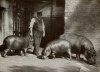
I've found this Picture in the guidebook 1935. Does anybody know, if both hippo species were kept sometimes together ? Or could both use the outdoor Paddock only in change ,what I belive, and the pymy hippo and hippo were together only for this Picture ?
I’ve seen many photographs of both common hippos and pygmy hippos at London Zoo but this photo, from the 1935 guidebook, is the only one I’ve seen depicting both species together.
I very much doubt that the two species of hippos were regularly kept together; if they were then, presumably, pictures like this would be more common. I think that you’re correct and the two were mixed specially for this photograph.
Incidentally, as well as featuring in the 1935 guidebook, this photograph is also reproduced in “A Survey of the Hippopotamus in Captivity in the British Isles” (John Frost; 1996).

A species kept only once at the London Zoo and in no other zoo world-wide is the Lorius tibialis. The London specimen was obtained by William Jamrach on a Calcutta market and discribed as a new species by Sclater in 1871. The London specimen is the only specimen known by science sofar and even where it came from originaly is still not known !
I'll up-load a picture which was published togehter with the original discription in the London Zoo Gallery.
I'll up-load a picture which was published togehter with the original discription in the London Zoo Gallery.
A species kept only once at the London Zoo and in no other zoo world-wide is the Lorius tibialis. The London specimen was obtained by William Jamrach on a Calcutta market and discribed as a new species by Sclater in 1871. The London specimen is the only specimen known by science sofar and even where it came from originaly is still not known !
Checking various editions of the “ZSL List of Vertebrated Animals” this bird was purchased by London Zoo on 4th May 1871.
According to “Parrots of the World” (Forshaw & Cooper;2nd edition,1978) this individual was probably just an aberrant specimen of Lorius domicellus. I don't have a more up to date book on psittacine taxonomy; is that the generally accepted view?
(Incidentally, this lory, whatever species it really was, laid two eggs whilst at London Zoo.)
Yes, the 'species' Lorius tibialis is only known from the single female specimen held at London Zoo. Most authorities believe it to have been a very odd specimen of Purple-naped Lory (Lorius domicellus) which lacked the black crown & purple nape.According to “Parrots of the World” (Forshaw & Cooper; 2nd edition,1978) this individual was probably just an aberrant specimen of Lorius domicellus. I don't have a more up to date book on psittacine taxonomy; is that the generally accepted view?