Animals that Can't be Exhibited in Open Topped Enclosures?

BenFoxster

Well-Known Member
I was wondering if there any particular animals that couldn't be held in an open-topped enclosure? In particular tree arboreal tree climbing animals? For instance, if someone were to make a nocturnal house with animals like bushtailed possoms, oppossums, quolls, numbats, aye-ayes, or binturongs with open topped enclosures (and perhaps have an artificial tree to connect each species to multiple exhibits for overhead climbing) would such be possible? Or would the animals find a way to climb out of their exhibits assuming the fronts of the exhibits included glass viewing with the back, right, and left side of each exhibits having walls, much like San Diego Zoo's Tasmanian Devil and wombat enclosures. Would the animals still be able to climb out, or leap down from the overhead crossings and escape?

Similarly, how does Omaha keep reptiles from escaping their open topped enclosures in the Desert Dome?

Lastly, could rock hyraxes escape from an open topped enclosure? I've never seen an open topped rock hyrax enclosure before. And again, would they be able to escape if it had overhead crossing, like leap down from it and scatter off?
 
Honey Badgers are often considered to be impossible to keep in open-topped exhibits because they are far too resourceful.

Similarly, how does Omaha keep reptiles from escaping their open topped enclosures in the Desert Dome?
All of the open-topped exhibits there have barriers MUCH higher than any of those reptiles could hope to climb. The barriers are all much taller than any person (except on some turtle exhibits, but obviously no climbing concern there.
 
There are exceptions - Exmoor has honey badgers in an open topped enclosure and you also see them for Binturong (Hamerton for example) so ‘impossible’ is probably a bit strong.

‘Appropriate’ is probably a better term and enclosure design needs to take into account the security of the animal, whatever it is.
 
Many butterflies, bats and birds are often kept in free flight enclosures. It is not a good idea to keep great apes, octopuses, venomous snakes and dangerous insects in open-topped enclosures
 
It is not a good idea to keep great apes, octopuses, venomous snakes and dangerous insects in open-topped enclosures
I agree with you with the dangerous insects and octopuses, but I have seen venomous snakes kept in open-topped enclosures in several Australian zoos.
 
I agree with you with the dangerous insects and octopuses, but I have seen venomous snakes kept in open-topped enclosures in several Australian zoos.
I too have seen many open topped enclosures for venomous snakes and the like. Probably a common thing over here in Australia. I've yet to see one for spiders though..
 
It is not a good idea to keep great apes, octopuses, venomous snakes and dangerous insects in open-topped enclosures
I agree in principle, Dassie Rat, but am interested to know whether your main concern is animals escaping, (e.g. octopuses), or the public reaching in, (e.g. venomous insects/ snakes)?

Also, for zoos that do keep apes in open topped enclosures, (e.g.(Monkey World, Dudley Zoo, Welsh Mountain Zoo and Twycross Zoo), using "hot wires or "unclimbable" smooth walls, I would be interested to know the "failure" rate, (i.e. frequency of escape). I know there have been escapes at Burgers' Zoo and Belfast Zoo but these appear to me to have been opportunistic, using unnoticed detached branches as ladders rather than an intrinsic design fault of the enclosure. Obviously escaped apes are potentially extremely dangerous and one escape is one too many, but I am just wondering if this negates the idea of using an open topped enclosure itself, rather than being alert to potential tool use opportunities.
 
Personally I think any open-topped fish tank reachable by visitors or that visitors can possibly let objects fall in (i.e. tanks under bridges) or throw objects in and any "touch tank" with aquatic animals is a bad idea due to the risks of animals being mistreated by visitors, of objects being thrown or falling in and of introduction of dangerous chemicals or pathogens by visitors. Perhaps with supervision and mandatory handwashing and thorough rinsing it can be done more safely, but otherwise I'm really not in favor of such exhibits.

Lastly, could rock hyraxes escape from an open topped enclosure? I've never seen an open topped rock hyrax enclosure before. And again, would they be able to escape if it had overhead crossing, like leap down from it and scatter off?

The only open-topped rock hyrax exhibit I have ever seen is the exhibit in the crocodile greenhouse at the Rotterdam Zoo. This exhibit has a substantial height difference between the exhibit floor and the visitor area, as well as a water feature at the edge of the exhibit on the visitor side. I'm sure there are photos of it in the gallery.
 
I agree in principle, Dassie Rat, but am interested to know whether your main concern is animals escaping, (e.g. octopuses), or the public reaching in, (e.g. venomous insects/ snakes)?
Both. Octopuses and great apes are good at escaping, while it is better for visitors not to try to touch animals that can hurt them. I saw a man put his finger in a squirrel monkey's mouth. I told him not too, although I couldn't have blamed if the monkey if he had bitten the man.
 
I too have seen many open topped enclosures for venomous snakes and the like. Probably a common thing over here in Australia. I've yet to see one for spiders though..
I've also seen open-topped enclosures for native snakes including venomous ones in Southern France (Écomusée de la Gaude).
 
Personally I think any open-topped fish tank reachable by visitors or that visitors can possibly let objects fall in (i.e. tanks under bridges) or throw objects in and any "touch tank" with aquatic animals is a bad idea due to the risks of animals being mistreated by visitors, of objects being thrown or falling in and of introduction of dangerous chemicals or pathogens by visitors. Perhaps with supervision and mandatory handwashing and thorough rinsing it can be done more safely, but otherwise I'm really not in favor of such exhibits.


The only open-topped rock hyrax exhibit I have ever seen is the exhibit in the crocodile greenhouse at the Rotterdam Zoo. This exhibit has a substantial height difference between the exhibit floor and the visitor area, as well as a water feature at the edge of the exhibit on the visitor side. I'm sure there are photos of it in the gallery.
I've seen open-topped tanks for fish in public aquaria, but in most cases the view from above isn't interesting, except for the largest species or special environments as mangrove tanks.
 
There are exceptions - Exmoor has honey badgers in an open topped enclosure and you also see them for Binturong (Hamerton for example) so ‘impossible’ is probably a bit strong.

‘Appropriate’ is probably a better term and enclosure design needs to take into account the security of the animal, whatever it is.
Exmoor’s Honey Badger enclosure had heavy gauge netting over the top the last time I looked
 
Many butterflies, bats and birds are often kept in free flight enclosures. It is not a good idea to keep great apes, octopuses, venomous snakes and dangerous insects in open-topped enclosures
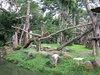
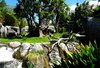
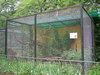
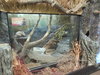
To be fair aren't most great ape enclosures open topped? Like chimps, orangs, and gorillas kept on islands? For example from Zoo Chats gallery, I consider the first three of these to be open-topped (Singapore orangs, San Diego gorillas, and La chimps) but not the latter three (New Zoo Civets, Discovery Zoo Oppossum, and Cincinatti Aye Aye). So I'm wondering if the latter three animals as well as quolls or rock hyraxes could be exhibited in open topped enclosures. I'll add more details in a separate comment in a moment.
 

Attachments

  • Orang Island.JPG
    Orang Island.JPG
    337.6 KB · Views: 14
  • SD Zoo Gorillas.jpg
    SD Zoo Gorillas.jpg
    285.9 KB · Views: 11
  • LA zoo chimps.jpg
    LA zoo chimps.jpg
    221.2 KB · Views: 11
  • Civet New Zoo.JPG
    Civet New Zoo.JPG
    390.8 KB · Views: 12
  • Oppossum exhibit.JPG
    Oppossum exhibit.JPG
    240.8 KB · Views: 12
  • Cincinatti Aye Aye.JPG
    Cincinatti Aye Aye.JPG
    158.2 KB · Views: 14
Hello everyone, I made a mistake in my original post, as I confused Omaha's Desert Dome with Indianapolis Zoo's The Desert Dome (which is what I meant to talk about, sorry). I am curious as to how they prevent herps like lizards from escaping, as mentioned here on Zoo Tours at approximately 2:27.


Not to fall too far into spec/fantasy zoo building, but I was wondering if such enclosures as seen in Indianapolis could work for an indoor nocturnal house exhibit with animals like aye-ayes, African civets, Australian Possums, opossums, quolls, etc, or if the animals would leap out, climb the glass, cilmb the walls, etc. The idea would be to have a nighthouse with open topped exhibits and small waterfalls as well as trees grows up over the glass railings to create a more naturalistic almost indoor rainforest feel rather than being like a stuffy reptile house.
 
There are exceptions - Exmoor has honey badgers in an open topped enclosure and you also see them for Binturong (Hamerton for example) so ‘impossible’ is probably a bit strong.

‘Appropriate’ is probably a better term and enclosure design needs to take into account the security of the animal, whatever it is.

Unfortunatley I can't find any pictures of any of them online. :(
 
Open-topped herp exhibits can be incredibly risky, in areas where corvids or gulls are present. Such birds tend to already be bolder in zoos anyway, and won't be picky between discarded chips and basking snakes.
It wasn't a zoo but a nature museum with a few animal exhibits for native herps. So there wasn't any food supply, nor large flocks of birds.
 
Back
Top