AnimalsRAmazing's Speculative Zoo (Discovery Hills Zoo)

IndianRhino

Well-Known Member
5+ year member
Hey everyone!

As many of you may know, this is my first time ever doing something like this. In fact, I've never actually posted any real content in this subforum nor the old Fantasy Zoo subforum. I just like to pop in every once in a while and read others' threads and give feedback so I'm very excited to make a thread for myself. That being said, I will take all the feedback and help I can get, it will be very much appreciated! Before I get started with everything, I'd like to thank @Great Argus for all his help, he actually reviewed the first few habitats, that I'm about to post, for me and has been very helpful! Not to mention, the thread he created with resources for Speculative Zoo Designing, I'd also like to thank many of you who posted in that thread for all the wonderful resources! Now that that's out of the way, why don't we get started!

Right now I'm thinking I'll post new habitats either weekly or every other week and I'll try my very best to get those updates posted regularly.

So... I'll start with a quick introduction of my zoo:

Introduction: Discovery Hills Zoo is a 110 acre zoo that opened in 1993 and is located in San Marcos, California. The zoo was granted AZA accreditation in 2011 and specializes in keeping and breeding rare mammals but also houses a large variety of birds, reptiles, and other herps. The zoo will be open daily from 10 AM to 5 PM with the exception of a few holidays.

My first few habitats aren't too impressive especially when accounting the number of species that were included but I wanted to start off small so I could get in the hang of things. I'll definitely try to start making more species rich exhibits as we start moving along. Habitat sizes is also another thing I was big skeptical about so if there are any habitats in here that you think would be too small or anything, please let me know! Another quick thing, I tried my best to create unique names for my exhibits but I'm not that creative so they're not that unique lol, sorry about that. I also apologize for the quality of my maps, especially the first one, I think I found a better way to make them so hopefully my next set of maps will look better!

Anyways, without further ado... here's the opening set of habitats. This will be followed by one more sections for now and then, like I said earlier, I'll start posting updates every week or every other week.

- ARA!

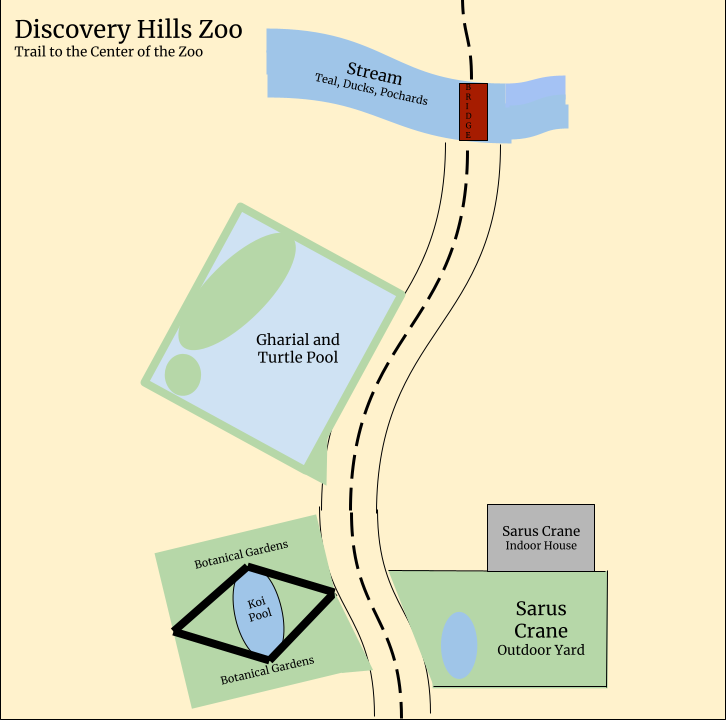
As soon as guests walk into the gates of the zoo, they are guided into a winding path into the heart of the zoo with a few habitats along the way. To the left of the walking path, a grassy 25 sq meter enclosure with a small pond is home to a pair of flight-restricted 1.1 sarus cranes (Grus antigone). On the other side of the path is a small 30 sq meter walk-through botanical garden with a crystal clear pond in the middle with a large group of koi carp (Cyprinus rubrofuscus). Further down the path, on the right side there is a large 40 sq meter enclosure with a large pond home to a group of 2.5 gharials (Gavialis gangeticus), 1.1 Fly river turtles (Carettochelys insculpta), and 1.2 Asian leaf turtles (Cyclemys dentata). Finally as the path comes to an end, a bridge passes over a small stream and brings visitors into the heart of the zoo. A number of ducks and other waterfowl species such as 5.6 marbled teal (Marmaronetta angustirostris), 1.3 baikal teal (Anas formosa), 5.5 laysan duck (Anas laysanensis), 6.3 Baer’s pochard (Aythya baeri), and 1.1 falcated duck (Anas falcata) inhabitat the stream.

As guests enter the heart of the zoo, they are greeted by a large 300 sq meter habitat, surrounded by a moat, inhabited by a breeding pair of 1.1 siamang (Symphalangus syndactylus). The center of the island is filled with trees which allows for natural behaviors such as brachiation but there are none closer to the ends of the habitat to prevent escapes. The roughly 40 sq meter siamang indoor house is behind the island, and off-view. Just to the left of the habitat, a trail surrounded by long stalks of bamboo welcomes guests into the first major renovation and expansion project completed by the zoo in 1999, “Into the Mangroves: Asian Adventure.”

The path leading into this habitat is surrounded by long and tall stalks of bamboo and after a bit of walking, the entrance to the Primate House comes into view. Prior to entering the house, guests get their first glimpse at the first habitat housing a troop of 1.3 Sumatran orangutans (Pongo abelii). The zoo’s troop consists of an adult breeding male, Burung, two adult females (Alicia and her daughter Cinta), and Burung & Cinta’s 4 year old daughter Hadiah. Once inside the house, guests can view one of the day rooms of the indoor orangutan habitat which is roughly 500 sq meters and is divided into two day rooms, various shift rooms, and a quarantine area. If guests continue walking forward they will exit the Primate House and will see a large grassy yard that’s home to a small group of 2.2 Bornean orangutans (Pongo pygmaeus) and 1.1 Lar gibbons (Hylobates lar), who share the indoor housing quarters with the Sumatran orangutans but are kept in separate stalls/rooms. The Bornean orangutan troop is made up of a breeding pair (1.0 Berani and 0.1 Suriya) and their two offspring (10-year old female Sabah, and 2-year old male Rocky). The gibbons are a young pair named Johnny and Suki, they have not produced offspring so far but that is the goal. Both the Sumatran and Bornean orangutan/gibbon yards are 800 sq meters each and have large climbing structures. The outdoor orang habitats are separated from the public by tall glass panels right next to the walking path as well as large empty moats between the habitats and the panels.

Once passing by the orangutan/gibbon indoor viewing area, guests will turn to the right (rather than continuing forward), to view the remaining primates in the building. Guests will walk around in a large circle to view all the habitats in the Primate House, which are all along the edges of the House. All the guest-viewable habitats in the House are indoor habitats with glass barriers, but all the primates have behind-the-scenes outdoor access. The center of the Primate House is filled with signage on the dangers these primates face in the wild such as palm oil plantations, deforestation, poaching, etc and how guests can get involved in helping these animals out.

The first habitat on the right is 30 sq meters and 5 meters tall, and is home to a breeding group of 3.7 Silvered Leaf Monkey (Trachypithecus cristatus). The next habitat immediately to the left of the SL monkeys is a 40 sq meter, 5.5 meter tall room home to 4.10 François' langur (Trachypithecus francoisi) and 1.2 Javan gibbon (Hylobates moloch). The last habitat on the right hand side of the Primate House is home to an elderly pair of 1.1 Lion-tailed macaques (Macaca silenus) named Krish and Leela, this habitat is the exact same size as the SL monkey habitat.

The habitat on the back side of the Primate House is around 300 sq meters and about 7.5 meters tall. It is home to a non-breeding troop of 3.4 Barbary macaques (Macaca mulatta) and an elderly herd of 0.5 Kordofan Aoudad (Ammotragus lervia). The habitat is filled with fake rockwork for the aoudad and lots of artificial climbing structures for the macaques. The aoudad are on phase-out in accordance with the AZA’s decision and the habitat will be renovated for a new species once the girls pass away. This habitat was previously home to a breeding group of markhor and Sulawesi crested macaques but the macaques were phased out and the markhor were moved to another region of the zoo. The barbary macaques and aoudad both have their own bts outdoor yards so that they can get away from the other species when needed.

There are 3 habitats on the left side of the Primate House as well and they are all the exact same sizes as the 3 on the right side. The first habitat as you turn the corner from the macaque/aoudad habitat is home to a large breeding troop of 3.9 Japanese macaques (Macaca fuscata). The middle habitat is home to a family of 2.2 Northern White-cheeked gibbons (Nomascus leucogenys). The gibbon family consists of adult male Gus, adult female Ratu, and their two offspring, 3-year old Kara and newborn Leo. The last habitat closest to the exit is home to a breeding pair of 1.1 pygmy slow loris (Nycticebus pygmaeus), named Mekong and Mei. The glass barrier has reflective window film and the habitat has dim lights to darken it and mimic their nocturnal lifestyles as much as possible.

Guests will have made an entire loop around the primate house at this point and would be back near the exit and the indoor orang viewing area.

Once guests exit the Primate House and walk down the path and pass the Bornean orangutan/gibbon yard, they will be surrounded by the sights and sounds of tigers. On the right side of the path is a 1-acre habitat inhabited by 1.1 Malayan tiger (Panthera tigris jacksoni) while the left side is a 1.5-acre habitat home to a family of 2.4 Amur tigers (Panthera tigris altaica). Both habitats are meshed and are very well planted. The Malayan tiger indoor room is roughly 100 sq meters and is divided into two large rooms and a third small one while the Amur tiger indoor quarters are 115 sq meters and are divided into two large stalls and two small ones that can be combined to make another large stall if needed. The male Malayan tiger is named Roshan and was born at DHZ while the female, named Kasih, arrived at the zoo just a few months ago to breed with Roshan. The Amur tiger family consists of a breeding pair named Nikolai and Altaica and their 6-month old (1.4) cubs named Putin, Georgia, Katie, and Sasha.

Past the tiger habitats, guests are guided into a beautiful 25 meter tall, 230 sq meter walkthrough, two-story aviary called “Forest of the Avians” home to the following bird species:
  • 2.5 Golden-crested Myna (Ampeliceps coronatus)
  • 3.4 Metallic Pigeon (Columba vitiensis)
  • 6.6 Nicobar Pigeon (Caloenas nicobarica)
  • 3.1 Sumba Eclectus Parrot (Eclectus roratus cornelia)
  • 4.6 Bali Myna (Leucopsar rothschildi)
  • 1.1 Pink-necked Green Pigeon (Treron vernans)
  • 1.0 Palm Cockatoo (Probosciger aterrimus)
  • 4.3 White-naped Pheasant-pigeon (Otidiphaps nobilis aruensis)
  • 5.8 Papuan Mountain-pigeon (Gymnophaps albertisii albertisii)
  • 1.2 Pink-headed Fruit-dove (Ptilinopus porphyreus)
  • 2.3 Victoria Crowned-Pigeon (Goura Victoria)
  • 1.1 Eurasian Collared Dove (Streptopelia decaocto)
  • 1.3 Golden Pheasant (Chrysolophus pictus)
  • 0.3 Satyr Tragopan (Tragopan satyra)
  • 0.2 Temminck’s Tragopan (Tragopan temminckii)
  • 2.2 Himalayan Monal (Lophophorus impejanus)
  • 4.3 Wompoo Fruit Dove (Ptilinopus magnificus)
  • 1.2 Great Argus (Argusianus argus)
  • 1.3 Grosbeak starlings (Scissirostrum dubium)
Guests will move up the aviary in a circular pattern around the ends and exit the aviary at the top of the winding hill. Near the exit, they will be greeted by a few smaller meshed aviaries on the left side of the path. The first 6 meter tall, 18 sq meter aviary is home to an elderly pair of 1.1 Rhinoceros hornbill (Buceros rhinoceros) named 1.0 Borneo and 0.1 Indah. The next aviary is about 4.5 meters tall and is about 15 square meters, and its inhabitants are a family of 2.1 Southern Sulawesi Hornbills (Rhabdotorrhinus exarhatus). The family consists of a breeding pair 1.0 Dave and 0.1 Wesi and their 1.0 adolescent chick, Nakal. The third and final aviary is home to a breeding pair of 1.1 Wreathed Hornbill (Rhyticeros undulatus) named Satu and Kirana and their 0.1 chick, Hannah. This aviary is the largest of the 3 and measures 7 meters tall and is 20 sq meters in size.

The other side of the path also has 3 meshed aviaires with a few species of hornbill and other birds. The first habitat on the right is home to a family of 1.3 Great hornbill (Buceros bicornis), an adult male (Mohan), an adult female (Sundara), and their two female chicks (Kasi and Kasthuri). This aviary is about 20 sq meters and 11 meters tall, and is filled with many real trees and vegetation which allows the birds to nest naturally. The next aviary is home to a pair of 1.1 Knobbed hornbill (Rhyticeros cassidix) named Tang and Koko, it is the same size as the Rhinoceros hornbill aviary (6 meters tall, 18 sq meters). The final aviary is about 16 sq meters and 5 meters tall and is home to a large variety of birds including 1.1 Asian Fairy-bluebird (Irena puella), 1.3 Edward’s Pheasant (Lophura edwardsi), 2.2 Green-imperial Pigeon (Ducula aenea), 2.4 Mindanao Bleeding-heart Dove (Gallicolumba crinigera), and 3.2 Chinese Hwamei (Garrulax canorus). The aviary was previously home to a pair of Oriental pied Hornbill (Anthracoceros albirostris) until they passed away and a number of other bird species from “Forest of the Avians” were moved in here to replace them.
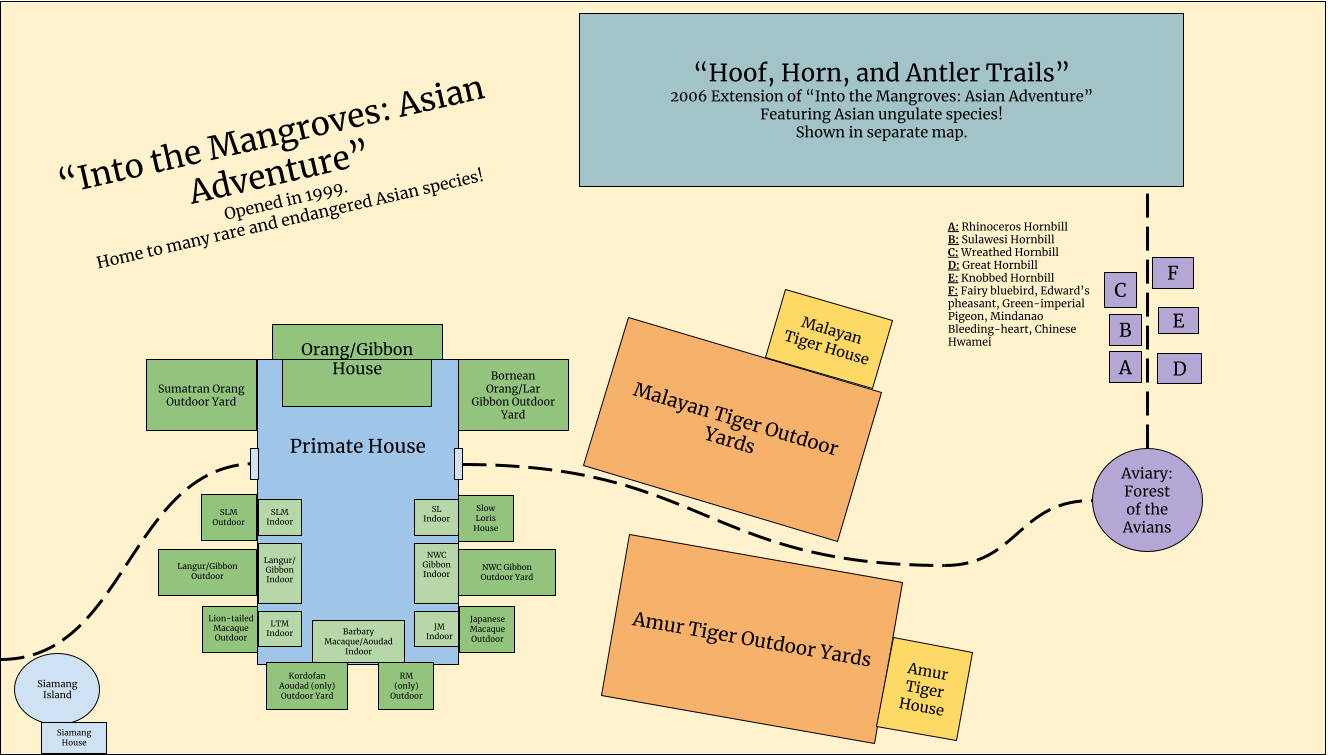

The final row of habitats in this section of the zoo are an extension of “Into the Mangroves: Asian Adventure” that opened in 2006 and the area is referred to as “Hoof, Horn, and Antler Trails”, I'll get this posted in a little bit.
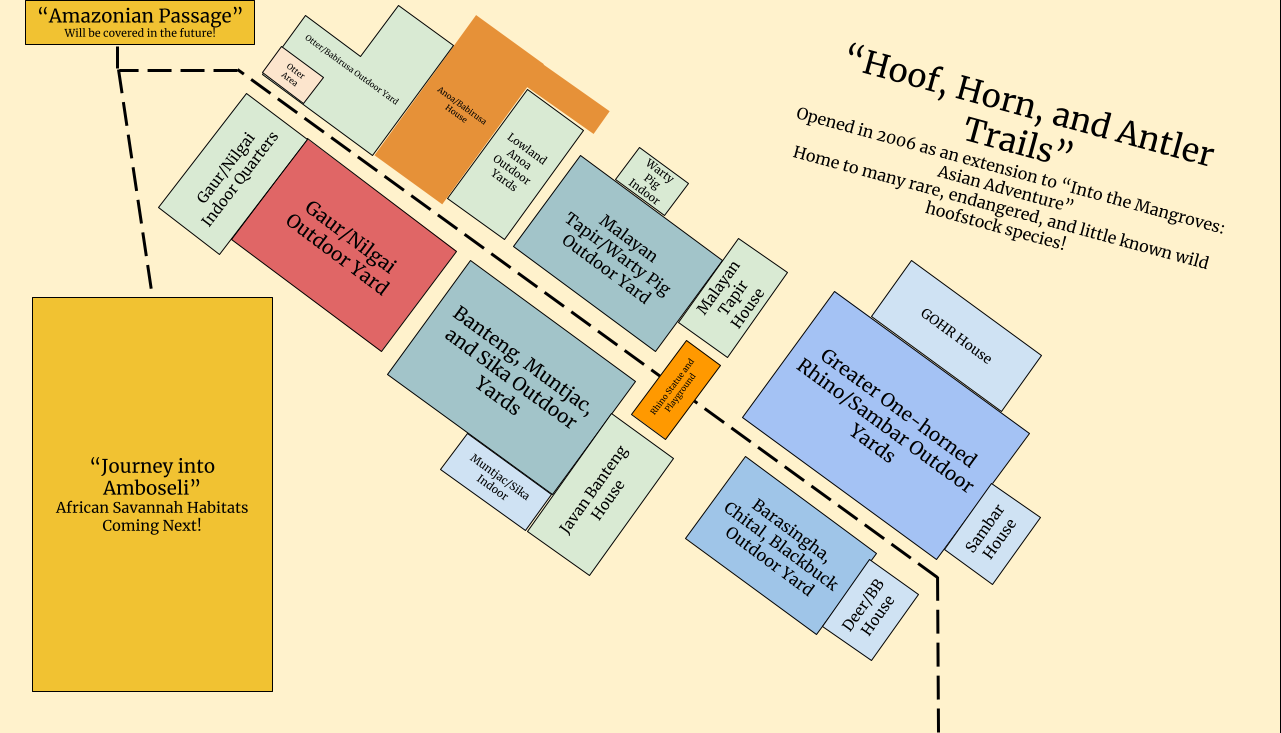
 
"Horn, Hoof, and Antler Trails"

The first paddock on the right of the path is the largest at roughly 1200 square meters and is home to a crash of 2.3 Greater one-horned rhinoceros (Rhinoceros unicornis), and a small herd of 1.4 Indian Sambar (Rusa unicolor). The rhino crash consists of an adult male named Kumar, two related adult cows (Rani and Vidya), Rani’s male calf (Hari), and Vidya’s female calf (Charu). There are several small pools spread throughout the habitat and a slightly larger one for several animals to swim together. The habitat can be split up into 3 separate yards which allows keepers to separate the GOHR crash when needed but the gates between the yards are usually kept open since all the current animals get along well. The GOHR house, which is 300 square meters, is located behind the paddock and there is no indoor viewing area. The deer indoor quarters are located to the right of the outdoor yards and measure about 50 square meters. The first yard on the left side of the path is home to 1.5 Barasingha (Rucervus duvaucelii), 2.9 Chital (Axis axis), and 3.10 Blackbuck (Antilope cervicapra). The outdoor enclosure is roughly 500 square meters and the indoor house shared by all 3 species is 50 square meters and is split up into various stalls.

Past these yards there are 2 large buildings on both sides of the passage, with 3 signs on the wall. The first informs guests about the danger rhinos face in the wild and how the zoo is contributing to conservation. The next sign informs guests about ungulates and what they are, as well as the many different types of ungulates that are from Asia. The last and final sign on each side displays a map of the entire ungulate trails complex. Once guests pass the wall with signage, a large window comes into view where guests can look into the indoor enclosure of whatever animal lives on that side of the path (described in the following paragraphs). In the center of the path, there is a 10-foot long Indian rhinoceros statue that was built in honor of the zoo’s founder who passed away shortly before the opening of the complex. There is also a small children’s playground right by the statue.

Past this section, on the left side of the path is a 350 square meter yard home to a pair of 0.2 Malayan Tapir (Tapirus indicus) and a non-breeding group of 1.3 Visayan Warty-pigs (Sus cebifrons). The warty pigs’ indoor enclosure is located behind the outdoor yard, it is about 35 sq meters and split up into a few different stalls. The pigs also have a small outdoor pen right outside the entrance of their indoor enclosure that is inaccessible to the tapir thanks to a small gate. The tapir house is located to the right of the outdoor yards and one of the rooms is open for public view by the GOHR statue, described in the previous paragraph. The Malayan tapir house is roughly 70 square meters and has 3 separate stalls as well as a larger stall meant for multiple individuals which is the one viewable to the public. The tapirs also have two pools, one 1.5 meter deep one in the outdoor enclosure and a slightly smaller but deeper (1.8 meter) pool in the guest-viewable indoor stall.

Opposite the tapir/pig enclosure, a breeding herd of 2.4 Javan Banteng (Bos javanicus javanicus), a breeding pair of 1.1 Reeve’s Muntjac (Muntiacus reevesi), and a small elderly non-breeding herd of 1.2 Indochinese Sika (Cervus nippon pseudaxis) live in a 900 sq meter paddock. The banteng and muntjac are taken off habitat and separated from the other animals prior to giving birth and calves are introduced to the group at a few months old. The banteng house is about 200 sq meters and is located opposite the tapir house in the pathway, the banteng house also has a wall with signage and a window, identical to the tapir house. The house can be split into 7 different individual stalls, a large family group yard (which is visible to the public) and a smaller bull yard connected to one of the individual stalls. The muntjac and sika indoor quarters are 50 sq meters and are located behind the outdoor yard and are out of public view. There are 3 individual stalls for the muntjac and 6 individual stalls for the sika as well as a small group stall for the sika.

The next habitat just past the banteng/deer/muntjac habitat is the last habitat on the right side of “Horn, Hoof, and Antler Trails” and is 500 sq meters. It is home to a small herd of 0.4 Gaur (Bos gaurus) and a breeding herd of 3.5 Nilgai (Boselaphus tragocamelus) and they both share a 200 sq meter indoor building to the right of the habitat. The gaur are all post-reproductive females and will be phased out upon their death in accordance with the AZA phase-out of the species.

On the other side of the pathway, there are two habitats that are connected by an indoor house. The first paddock is home to a breeding pair of 1.1 Lowland anoa (Bubalus depressicornis), named Bandar and Julie, and is approximately 150 sq meters. The large indoor building has no indoor viewing areas but is 350 sq meters and can be divided into 4 individual stalls for the anoa. The second paddock on the other side of the building is about 400 sq meters and is the last habitat that is on public view in the Asian ungulate complex. This habitat is home to the zoo’s breeding group of 3.8 Northern Sulawesi Babirusa (Babyrousa celebensis), consisting of 1.3 adults and 2.5 juveniles, as well as a non-breeding pair of 1.1 Asian small-clawed otters (Amblonyx cinereus) named Joe and Ganga. The indoor enclosure for the babirusa is split up into 9 individual stalls as well as a larger group stall and takes up roughly 50% of the house. The anoa and babirusa used to be kept together but the anoa began acting aggressively to the babirusa so the two species were separated and the babirusa were introduced to the ASCOs. The otter/babirusa paddock has a very large pool and lots of rocks and logs. The end of the pool is in a small separate pen for the otters but there is a glass barrier underwater that only the much smaller otters can fit under so this allows the otters to get away from the babirusa if and when needed. The anoa enclosure also has a pool but it is not as big as the otter/babirusa one and it is right along the pathway so guests have the opportunity to see the anoa taking a dip.


Once visitors walk past the otter/babirusa habitat, they will exit “Into the Mangroves: Asian Adventure” and if they turn right and walk uphill they will get to explore “Amazonian Passage” but if guests turn left and head downhill they will enter “Journey into Amboseli” which we will be exploring next.
 
"Horn, Hoof, and Antler Trails"

The first paddock on the right of the path is the largest at roughly 1200 square meters and is home to a crash of 2.3 Greater one-horned rhinoceros (Rhinoceros unicornis), and a small herd of 1.4 Indian Sambar (Rusa unicolor). The rhino crash consists of an adult male named Kumar, two related adult cows (Rani and Vidya), Rani’s male calf (Hari), and Vidya’s female calf (Charu). There are several small pools spread throughout the habitat and a slightly larger one for several animals to swim together. The habitat can be split up into 3 separate yards which allows keepers to separate the GOHR crash when needed but the gates between the yards are usually kept open since all the current animals get along well. The GOHR house, which is 300 square meters, is located behind the paddock and there is no indoor viewing area. The deer indoor quarters are located to the right of the outdoor yards and measure about 50 square meters. The first yard on the left side of the path is home to 1.5 Barasingha (Rucervus duvaucelii), 2.9 Chital (Axis axis), and 3.10 Blackbuck (Antilope cervicapra). The outdoor enclosure is roughly 500 square meters and the indoor house shared by all 3 species is 50 square meters and is split up into various stalls.

Past these yards there are 2 large buildings on both sides of the passage, with 3 signs on the wall. The first informs guests about the danger rhinos face in the wild and how the zoo is contributing to conservation. The next sign informs guests about ungulates and what they are, as well as the many different types of ungulates that are from Asia. The last and final sign on each side displays a map of the entire ungulate trails complex. Once guests pass the wall with signage, a large window comes into view where guests can look into the indoor enclosure of whatever animal lives on that side of the path (described in the following paragraphs). In the center of the path, there is a 10-foot long Indian rhinoceros statue that was built in honor of the zoo’s founder who passed away shortly before the opening of the complex. There is also a small children’s playground right by the statue.

Past this section, on the left side of the path is a 350 square meter yard home to a pair of 0.2 Malayan Tapir (Tapirus indicus) and a non-breeding group of 1.3 Visayan Warty-pigs (Sus cebifrons). The warty pigs’ indoor enclosure is located behind the outdoor yard, it is about 35 sq meters and split up into a few different stalls. The pigs also have a small outdoor pen right outside the entrance of their indoor enclosure that is inaccessible to the tapir thanks to a small gate. The tapir house is located to the right of the outdoor yards and one of the rooms is open for public view by the GOHR statue, described in the previous paragraph. The Malayan tapir house is roughly 70 square meters and has 3 separate stalls as well as a larger stall meant for multiple individuals which is the one viewable to the public. The tapirs also have two pools, one 1.5 meter deep one in the outdoor enclosure and a slightly smaller but deeper (1.8 meter) pool in the guest-viewable indoor stall.

Opposite the tapir/pig enclosure, a breeding herd of 2.4 Javan Banteng (Bos javanicus javanicus), a breeding pair of 1.1 Reeve’s Muntjac (Muntiacus reevesi), and a small elderly non-breeding herd of 1.2 Indochinese Sika (Cervus nippon pseudaxis) live in a 900 sq meter paddock. The banteng and muntjac are taken off habitat and separated from the other animals prior to giving birth and calves are introduced to the group at a few months old. The banteng house is about 200 sq meters and is located opposite the tapir house in the pathway, the banteng house also has a wall with signage and a window, identical to the tapir house. The house can be split into 7 different individual stalls, a large family group yard (which is visible to the public) and a smaller bull yard connected to one of the individual stalls. The muntjac and sika indoor quarters are 50 sq meters and are located behind the outdoor yard and are out of public view. There are 3 individual stalls for the muntjac and 6 individual stalls for the sika as well as a small group stall for the sika.

The next habitat just past the banteng/deer/muntjac habitat is the last habitat on the right side of “Horn, Hoof, and Antler Trails” and is 500 sq meters. It is home to a small herd of 0.4 Gaur (Bos gaurus) and a breeding herd of 3.5 Nilgai (Boselaphus tragocamelus) and they both share a 200 sq meter indoor building to the right of the habitat. The gaur are all post-reproductive females and will be phased out upon their death in accordance with the AZA phase-out of the species.

On the other side of the pathway, there are two habitats that are connected by an indoor house. The first paddock is home to a breeding pair of 1.1 Lowland anoa (Bubalus depressicornis), named Bandar and Julie, and is approximately 150 sq meters. The large indoor building has no indoor viewing areas but is 350 sq meters and can be divided into 4 individual stalls for the anoa. The second paddock on the other side of the building is about 400 sq meters and is the last habitat that is on public view in the Asian ungulate complex. This habitat is home to the zoo’s breeding group of 3.8 Northern Sulawesi Babirusa (Babyrousa celebensis), consisting of 1.3 adults and 2.5 juveniles, as well as a non-breeding pair of 1.1 Asian small-clawed otters (Amblonyx cinereus) named Joe and Ganga. The indoor enclosure for the babirusa is split up into 9 individual stalls as well as a larger group stall and takes up roughly 50% of the house. The anoa and babirusa used to be kept together but the anoa began acting aggressively to the babirusa so the two species were separated and the babirusa were introduced to the ASCOs. The otter/babirusa paddock has a very large pool and lots of rocks and logs. The end of the pool is in a small separate pen for the otters but there is a glass barrier underwater that only the much smaller otters can fit under so this allows the otters to get away from the babirusa if and when needed. The anoa enclosure also has a pool but it is not as big as the otter/babirusa one and it is right along the pathway so guests have the opportunity to see the anoa taking a dip.


Once visitors walk past the otter/babirusa habitat, they will exit “Into the Mangroves: Asian Adventure” and if they turn right and walk uphill they will get to explore “Amazonian Passage” but if guests turn left and head downhill they will enter “Journey into Amboseli” which we will be exploring next.
Beautiful Asian exhibits.
But the shape of the enclosures looks too geometrical.
 
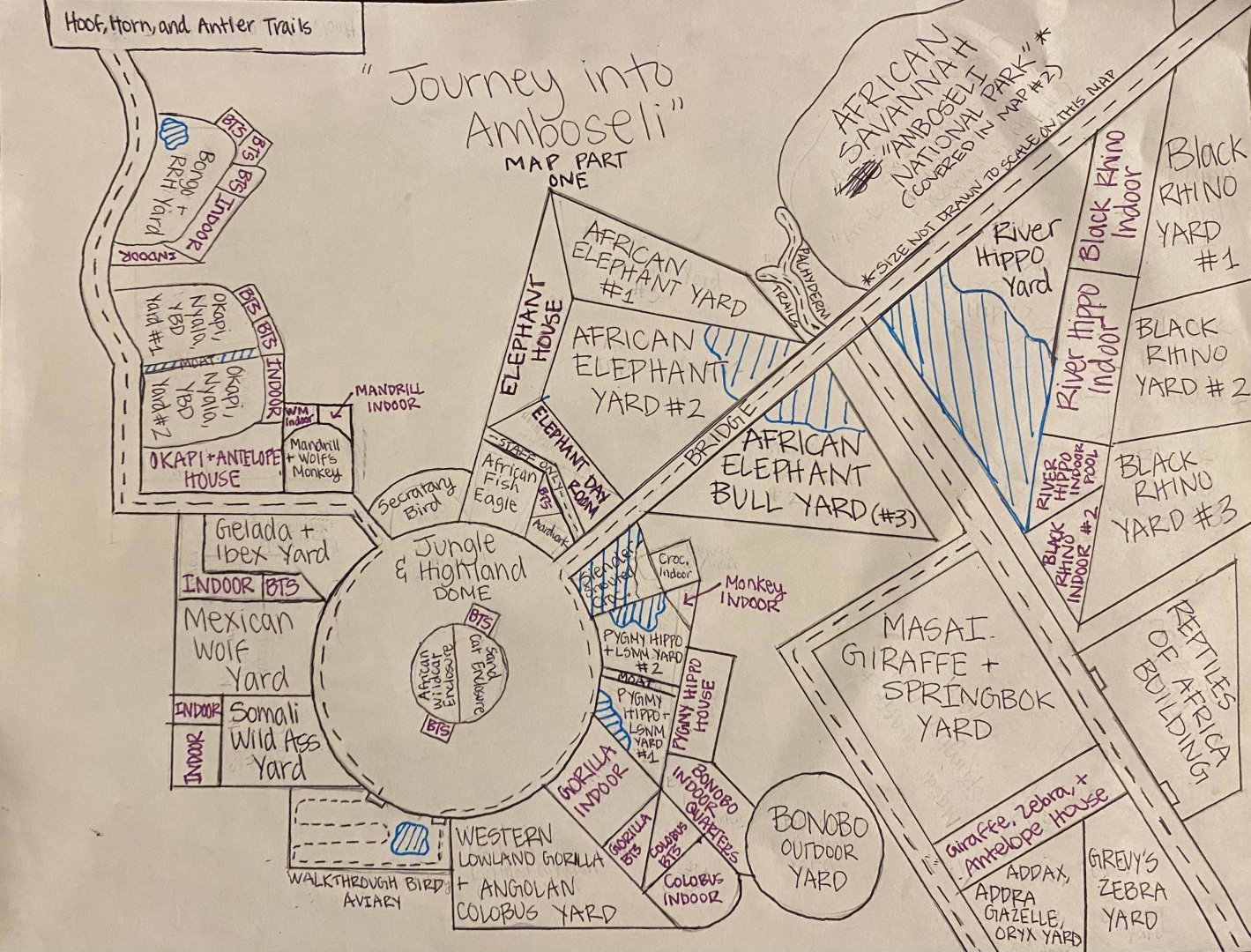
Ok folks! I'm back and I'm very sorry for the long wait... I know I said I would post every week or every other week but I got carried away with other things and have been pretty busy lately. But I'm here now and I'm ready to roll! As promised, I have now completed the first part of "Journey into Amboseli: from Jungles to Savannas" and will be posting that today. Two extensions to the habitat will be posted in the following weeks ("Amboseli National Park: African Savannah" and "Malagasy Expedition").

Before I begin, I just wanted to inform everyone that I've switched from making the maps digitally to making them by hand because it was easier to do and I feel like it looks nicer this way (thanks to @HungarianBison for the inspiration!). I'd like to apologize for the inconsistency and also because the map is not scaled very well, I only realized how not scaled some of the exhibits are after I made it and I'm very sorry about that. I plan on paying closer attention to the scale of the map next time and hopefully it'll be a bit better! This whole project is definitely a learning experience for me so I'll take any advice you guys have, as well! :)

Anyways, without further ado, I'd like to welcome everyone to Part 1 of "Journey into Amboseli: from Jungles to Savannas"!

As guests walk down the hill from “Hoof, Horn, and Antler Trails” they are welcomed into a new habitat by a large sign that reads, “Journey into Amboseli: from Jungles to Savannas”. JiA (I swear I didn’t realize this is exactly what SDZSP’s tram was called until I wrote it out just now :p), is one of the zoo’s larger habitat complexes.
As guests continue walking downhill and past the sign, the first habitat they will encounter will be on the left side of the path and is roughly 75 sq meters. It is home to a pair of 1.1 red river hogs (Potamochoerus porcus) named Vernon and Kipenzi as well as a breeding group of 1.3 Eastern Mountain Bongo (Tragelaphus eurycerus isaaci). The bts yards and indoor area are roughly 100 sq meters and are located behind the habitat, all bongo calves are kept in here for their first few weeks prior to introduction to the rest of the herd and the RRH pair.

The next habitat immediately to the right is home to a small group of 1.2 okapi (Okapia johnstoni), a breeding pair of 1.1 yellow-backed duiker (Cephalophus silvicultor), and a pair of 0.2 Lowland Nyala (Tragelaphus angasii). This habitat is roughly 500 sq meters and is divided into 2 on-view yards separated by a moat and lots of vegetation. There are also a few smaller bts yards and an indoor house, which is mostly used by the okapi, that is roughly 350 sq meters and to the right of the habitat. The okapi family is made up of a breeding pair (1.0 Kijani and 0.1 Tana) and their 1-year old daughter, Cecelia, Kijani lives in one of the two yards while Tana and Cecelia live in the other. The duiker pair are named Hodari and Sukari and have produced numerous offspring and they have been recommended to breed once more. The two female nyalas are half-sisters that are living separately from the breeding herd (that live in another habitat at the zoo) since the herd’s breeding male is their father, so the girls are waiting to be placed at another facility. The duiker and nyala are given access to both yards but are mostly seen in the female yard.

Once passing by these two habitats, guests will take a sharp turn to the left to view the remaining habitats in the complex. They will walk under more signage for "JiA" and continue down the winding path surrounded by lots of foliage and plants. Guests will be able to look into the okapi house through glass windows to the left of this path and right past it is a roughly 75 sq meter habitat, home to a small family of 1.2 Mandrill (Mandrillus sphinx) and a small troop of 2.3 Wolf’s Monkeys (Cercopithecus wolfi). Behind the habitat, there are two 20 sq meter indoor buildings, one for the mandrill and the other for the Wolf’s monkeys. Past this habitat, the path will turn slightly to the right to guide guests into another section of habitats referred to as the “Jungle and Highland Dome”, a 0.5-acre indoor area where guests can get up close to numerous mammal, bird, and reptile species. All habitats in the dome are separated by glass barriers and while the guest viewing area is all indoor, all of the actual animal habitats are outdoor. This creates the illusion of the people being inside an enclosure while the animals roam free, in the great outdoors! However, a few animals have guest-viewable indoor rooms in the dome. There is also large fake rockwork between all the yards to separate the various habitats featured in this section.

Once guests enter the dome, the first habitat to the right is a 350 sq meter habitat with rocky terrain and grassy slopes home to a breeding troop of 4.8 Geladas (Theropithecus gelada) and a bachelor herd of 5.0 Nubian Ibex (Capra nubiana). The indoor area for the gelada and ibex (which is behind the outdoor yard) measures about 250 sq meters and is not viewable to the public. The ibex also have access to a small 90 sq meter (bts) yard to the left of the main habitat which is inaccessible to the gelada. The Nubian Ibex breeding herd is located in another section of the zoo and bachelors are regularly moved from that herd once they age out.

The next habitat guests will see, if they continue moving in a circle, will be directly to the left of the gelada/ibex habitat and is home to a pack of 4.3 Mexican wolves (Canis lupus baileyi) consisting of a dominant breeding pair (Leo and Valentina) and their 3.2 offspring of various ages. The Mexican wolves are exhibited here in place of Ethiopian wolves (Canis simensis), much like SDZ’s “Africa Rocks” Amur leopard habitat. There are multiple signs around the glass viewing areas informing guests about the threats Ethiopian wolves face in the wild and how the zoo is contributing to conservation efforts. Guests are also informed about the zoo’s fantastic breeding program for the Mexican wolf and the differences between Mexican and Ethiopian wolves. This habitat is roughly 500 sq meters and is filled with tall vegetation, trees, and a few rocky slopes. The indoor area for the wolves is also behind the outdoor yard is about 70 sq meters.

The following habitat, to the left of the wolf yard, is home to a breeding herd of 1.5 Somali Wild Ass (Equus africanus somaliensis). The habitat is roughly 300 sq meters and the indoor quarters, located behind the habitat and adjacent to the wolf indoor house, are about 115 sq meters. The habitat is on a rather steep slope and is very sandy, but there are also several trees spread throughout the yard to provide the animals with shade. Once guests walk past this habitat they are greeted by a door with a sign that says, “J&H Aviary” and once entering the aviary, they will walk through a small winding path around the entire 350 sq meter, 20-meter tall building home to the following bird species. Much of the aviary is filled with trees of various sizes and some fake rockwork, but there is also a large pool located near the exit for the inhabiting ducks and waterfowl.
  • 2.3 Superb Starling (Lamprotornis superbus)
  • 0.2 Western Long Tailed Hornbill (Horizocerus albocristatus)
  • 1.3 Hamerkop (Scopus umbretta)
  • 2.4 Great Blue Turaco (Corythaeola cristata)
  • 4.3 Ross’s Turaco (Tauraco rossae)
  • 5.3 Green Woodhoopoe (Phoeniculus purpureus)
  • 1.1 African Grey Parrot (Psittacus erithacus)
  • 0.3 Emerald starling (Lamprotornis iris)
  • 1.4 West African thrush (Turdus pelios)
  • 0.1 White-Headed Lapwing (Vanellus albiceps)
  • 2.1 Blue Naped Mousebird (Urocolius macrourus)
  • 2.2 Bruce's green pigeon (Treron waalia)
  • 1.1 African Olive Pigeon (Columba arquatrix)
  • 0.2 Tambourine Dove (Turtur tympanistria)
  • 0.1 Yellow Necked Francolin (Pternistis leucoscepus)
  • 5.3 African darter (Anhinga rufa)
  • 2.5 Ferruginous Duck (Aythya nyroca)
  • 3.3 White Faced Whistling Duck (Dendrocygna viduata)
  • 1.3 Fulvous whistling-duck (Dendrocygna bicolor)
  • 4.7 White-backed duck (Thalassornis leuconotus)
  • 1.2 Four-banded Sandgrouse (Pterocles quadricinctus)
  • 5.2 African Jacana (Actophilornis africanus)
Once guests exit the aviary, a 550 sq meter habitat comes into view to the right and is home to a small non-breeding, retirement troop of 1.3 Western lowland Gorilla (Gorilla gorilla gorilla) and a breeding troop of 2.5 Angolan Colobus (Colobus angolensis). The habitat is a very grassy yard with several large climbing structures spread throughout it, as well as a large real tree in the center of the habitat. The gorilla house is 115 sq meters and guests can look into the indoor quarters through a window immediately to the right of the outdoor yard. There are also a pair of 50 sq meter bts yards behind the Gorilla House, one for the gorillas and another for the colobus which is inaccessible to the gorilla. The colobus indoor quarters are also right behind the colobus bts yard and are about 80 sq meters and divided into various stalls and a large day room. These yards and buildings are all separated by hydraulic gates and this allows for the keepers to easily mix and separate the two species if and when needed.

The following two yards are separated by a large 1.5-meter moat filled with plants as well as a minimal amount of water to help conceal the moat. The inhabitants of this pair of enclosures are a breeding pair of 1.1 Pygmy hippo (Choeropsis liberiensis) and 5.4 Lesser Spot-nosed Monkey (Cercopithecus petaurista). The first yard is 100 sq meters and home to a 19-year old male hippo named Jomo and a bachelor troop of (3.0) Spot-nosed monkeys named Mike, Jim, and Hasani. The second yard is slightly larger at roughly 125 sq meters and is home to the 5-year old female pygmy hippo (Tombi) and the breeding troop of (1.3 adults + 1.1 offspring) monkeys. Both yards are covered in large trees and vines for the monkeys and each yard has a 10,000-gallon pool for the hippo. The monkey house is behind yard #2 on the left side and it is about 35 sq meters and divided into 10 smaller stalls and two group stalls. The pygmy hippo house is directly behind both yards and can be accessed from both yards, it is about 115 sq meters and divided into various stalls which enables the zoo to accommodate up to 4 adult pygmy hippos at a time.

The final habitat on the path around the dome is about 100 sq meters and is home to a pair of 1.1 West African Slender-snouted Crocodile (Mecistops cataphractus). Most of the enclosure is made up of the 2.5-meter deep pool, and the small remaining portion is densely planted and allows the crocs to stay up on land if and when needed. The entrance to the indoor quarters, which measure 40 sq meters, is also located right behind the land portion of the habitat.

Past this habitat, guests will turn to the right to exit the dome, but a pair of 30 sq meter indoor enclosures await them right in the middle of the dome. The first, opposite to the pygmy hippo/monkey yard is home to a family of 2.2 Sand cat (Felis margarita), a breeding pair (Liam and Johari), and their 1.1 cubs (Ryder and Isabelle). There is also a 10 sq meter bts room which allows keepers to rotate Liam; and Johari and the cubs on habitat. The other enclosure is the exact same size and is home to 1.3 African Wildcat (Felis lybica), a trio of juvenile sisters (Zuri, Kamari, and Tumani), and their father (Simba). Just like the sand cats, the wildcats also have a 10 sq meter bts room off to the side allowing keepers to rotate Simba and the girls.

Before guests exit the dome, another trio of habitats will catch their eye to the left of the exit. If guests had immediately turned left upon entering the dome, they would’ve also been able to see these habitats. The first habitat right past the exit is home to 0.2 aardvarks (Orycteropus afer), the mother and daughter pair live in a 40 sq meter outdoor enclosure with a 30 sq meter indoor enclosure right behind it. The next two habitats are aviaries, the first is roughly 100 sq meters and is home to a family of 1.2 African Fish Eagles (Haliaeetus vocifer), a breeding pair (1.0 Mosi and 0.1 Imani), and their 0.1 chick, Azizi. The final habitat to be featured in the dome, snuggled right between the African Fish Eagle aviary and the entrance to the entire dome, is home to a pair of 1.1 Secretary Birds (Sagittarius serpentarius). The aviary is roughly 75 sq meters, and both the eagle and secretary bird aviaries are about 10 meters high with a few trees and rocks scattered around the enclosures. At this point, guests can either exit through the “entrance” of the dome and go back towards the mandrill habitat or turn around and head back to the actual exit of the dome, located right in between the aardvark and crocodile habitats.

Once guests exit the dome and walk down the path a little, a large 800 sq meter building comes into view on the left-hand side of the path. Guests will be able to look into the building through large windows, this is one of two indoor buildings for the zoo’s herd of 3.7 African elephants (Loxodonta africana). The other building is located right behind this building and measures about 1100 sq meters and is not open to public viewing. Once guests walk past the day room, they will walk onto a bridge that will take them over the zoo’s 4-acre outdoor habitat that is split into 3 different yards, all separated via hydraulic gates. The yard to the right of the bridge is home to the zoo’s bachelor herd consisting of 3 young males, 12-year old Hasani, 12-year old Kito, and 10-year old Tembo. The boys are half-brothers and all 3 were born at the zoo. The yard to the left of the bridge is home to the zoo’s breeding cow group which consists of 29-year old Kimani, her 27-year old half-sister Zalika, Kimani’s two daughters (15-year old Jana and 9-year old Kendi), and Zalika’s 7-year old daughter Kambiri. These two yards are separated by a hydraulic gate that is located right under the bridge, however, the bachelors are rarely if ever mixed with the cows. The zoo’s breeding bull, who sired Jana, Hasani, Kito, Tembo, Kendi, and Kambiri, was named Kyle but unfortunately, he passed away a few years back. The third and final yard is located behind the breeding cow yard and is home to two, geriatric 52-year old cows named Fiona and Norah, who have been at the zoo since opening and do not get along with the breeding cows. This yard is not easily viewable from the bridge and can be viewed from another area, which will be described later on. There is a large, nearly 100,000-gallon pool, located right towards the end of the habitats as the bridge comes to an end. The pool is accessible in the bull yard as well as the breeding cow yard and another large underwater gate keeps the elephants from moving to the habitat on the other side of the bridge.

Once guests walk off the bridge, they have 3 options: they can continue forward, turn left, or turn right. If guests turn to the left they will walk through a short passage called the "Pachyderm Trails" that allows guests to get another glimpse of the elephant yards on the left side of the path (including a much closer view of yard #3, home to Fiona and Norah) as well as some of the African Savanna habitat (which will be covered in the next post in a few weeks) on the right side.

Heading back to the intersection, this time we will move forward instead of turning to the left. The next habitat complex is called “Pachyderm Plaza” and is made up of a large narrow building split up into various sections and outdoor habitats on either side of the building.

Guests will come across a 1100 sq meter habitat with a 50,000 gallon, 3-meter deep pool home to a trio of 1.2 River hippo (Hippopotamus amphibius), on the right-hand side of the path. The zoo is home to a breeding pair named 1.0 Joe and 0.1 Gloria and their 1.5-year old calf 0.1 Zahara, they all live together as a pod. The pool makes up roughly 60% of the outdoor habitat and the remaining 40% is a grassy plain which allows the hippos to graze and rest on land when needed. The indoor quarters are roughly 300 sq meters and can be divided into 3 separate stalls as well as a slightly larger group stall. To the left of the building is the indoor pool which is used to separate Joe from the females if and when needed.

Once guests walk past the river hippo yard and continue walking forward in the path, they will come across another large 250 sq meter building home to the zoo’s breeding pair of 1.1 Eastern Black rhino (Diceros bicornis michaeli), 6-year old male Jasiri, and 3-year old female Fahari. Though guests cannot look into the rhino house, just past it is the 1000 sq meter outdoor area which is split into 2 different yards (1 for Jasiri and the other for Fahari) that are separated via a hydraulic gate. Guests can only view one of the yards from the pathway as the other is behind the first one and there are lots of trees and a shade structure towards the back of the front yard. Once guests walk past the outdoor rhino yards they will exit the first portion of Journey into Amboseli and will arrive at the tram loading station for “Amboseli National Park: African Savannah” which will be featured next.

Going back to the intersection, this time we will turn to the right and guests will get to see the hippo pod in action underwater at the Hippo Underwater Viewing (HUV) area on the left side of the path. Past the HUV, guests will come across a 100 sq meter triangular building home to a pair of 0.2 South-central Black Rhino (Diceros bicornis minor), a 33-year old female named Astra, and her 3-year-old daughter Kibali. Guests can look into the day room through large windows on the side of the building and past the building they can get a small glimpse of the 500 sq meter outdoor yard behind the building. This concludes the small section of habitats referred to as the “Pachyderm Plaza”.

On the right side of this path, guests will get yet another glimpse at the elephant exhibit, this particular location gives guests a much closer look at the bull yard featuring bachelor elephants Hasani, Kito, and Tembo.

Past “Pachy Plaza” and the bull yard there are more habitats on either side of the path. On the left side, there is a 550 sq meter building called the “Reptiles of Africa” building and is home to the following species in a series of well-planted terrariums fitted with pools, logs, and more based on the needs of each individual species. Quite a few of these species are breeding so there are numerous bts nesting and nursery areas.

* including hatchlings and immature juveniles.
  • 1.1 African Rock Python (Python sebae)
  • 1.0 Nile Monitor (Varanus niloticus)
  • 0.1 Black-throated Monitor (Varanus albigularis microstictus)
  • 3.3* Savannah Monitor (Varanus exanthematicus)
  • 1.1 Western Green Mamba (Dendroaspis viridis)
  • 4.5* African Dwarf Crocodile (Osteolaemus tetraspis)
  • 0.1 Mozambique Spitting Cobra (Naja mossambica)
  • 3.0 Madagascar Tree Boa (Sanzinia madagascariensis)
  • 4.2* Pancake Tortoise (Malacochersus tornieri)
  • 1.3 Leopard Tortoise (Stigmochelys pardalis)
  • 2.1 Geometric Tortoise (Psammobates geometricus)
  • 1.0 Gaboon Viper (Bitis gabonica)
  • 1.1 Yellow-throated Day Gecko (Phelsuma flavigularis)
  • 1.4* Cape Cobra (Naja nivea)
  • 2.2 Johnston’s Chameleon (Trioceros johnstoni)
  • 6.1* Meller’s Chameleon (Trioceros melleri)
  • 7.4* Ball Python (Python regius)
On the other side of the path is a 0.5-acre grassy enclosure home to a tower of 2.5 Masai Giraffe (Giraffa camelopardalis tippelskirchi) and a small herd of 4.5 Springbok (Antidorcas marsupialis). The habitat was made to mimic the African savannah with numerous acacia trees spread throughout the habitat, and the habitat is divided up into various slopes which make it easy for the animals to hide from one another as well as the guests. This enclosure used to be home to various other hoofstock species but they were moved over to “Amboseli National Park: African Savannah” when that habitat opened a few years back. Just past the outdoor yard is the narrow, 200 sq meter indoor building that the giraffe and springbok share with a few other species that live in habitats on the other side of the building.

There are two 230 sq meter yards on the other side of the building, and the first one home to a small bachelor herd of 4.0 Grevy’s Zebra (Equus grevyi) comes into view right past the building. The habitat is a sandy slope with a large shade structure towards the side and a few trees spread throughout the enclosure. At the top of the slope, there is a fence that separates the yard from the habitat on the other side which is viewable to the public through another path. When the giraffe/springbok yard first came into view, right past the bull yard, there is a small path that goes off to the right which allows guests to view the giraffe and springbok from all sides of the enclosure since it’s so large and the animals can easily hide. Once guests go completely around the yard, they will once again see the indoor building but on this side of the building, there is a tall glass panel that allows guests to look into the giraffe day room.

Once guests are on the opposite side of the giraffe yard, across the path there is a large 500 sq meter circular yard home to a family of 4.4 Bonobo (Pan paniscus), the yard is filled with trees and vines as well as artificial climbing structures. The 150 sq meter bonobo house is snuggled right in between the previously mentioned colobus indoor quarters and the pygmy hippo house. Back on the other side of the path, just past the giraffe day room, is the aforementioned habitat adjacent to the zebra yard. This habitat is also a sandy slope with a large shade structure and a grass patch and it is home to a small group of arid land antelope. There is a breeding herd of 1.5 Addax (Addax nasomaculatus), a bachelor herd of 3.0 Addra gazelle (Nanger dama ruficollis), and a trio of elderly 0.3 Scimitar-horned Oryx (Oryx dammah). These species share an indoor house with the giraffe, springbok, and zebra. The addax are separated from the group a few weeks prior to giving birth and newborn calves are introduced at a few months of age to minimize aggression and fatalities. Past this yard guests will make a left turn to get another view of the antelope and zebra yards before arriving back at the other side.

This concludes Part One of “Journey into Amboseli: from Jungles to Savannas”, if guests continue walking down this very path they will stumble upon “Malagasy Expedition” which will be covered after “Amboseli National Park: African Savannah”.

Here's my map, and again I apologize it's not to scale and a bit messy, my map-making skills are still a work in progress and I hope my next set of maps will be a bit better than this one!


Hope everyone enjoys and as always, please let me know of anything you think I should change. I'll take all the help and feedback I can get from you guys! :)
 
  • 1.3 Hamerkop (Scopus umbretta)
  • 2.4 Great Blue Turaco (Corythaeola cristata)
  • 4.3 Ross’s Turaco (Tauraco rossae

Hamerkop are typically exhibited as pairs, I think multiples work though. Not a recommended change, just a note.
Mixing turacos is inherently risky, it can be done but it's tricky. They are also frequently picky in tolerating their own kind and thus most turaco exhibits have only one or a pair. Turacos are decidedly aggressive and particular, and are commonly known to thrash and/or kill other turacos. Mixing them can be done successfully, but extreme caution must be observed and continued monitoring.

5.2 African Jacana (Actophilornis africanus)

Another group that tends to beat up its own kind outside of the dominant pair. While your figuring of the ratio is on the right track, it doesn't work well in captive situations.

On the other side of the path is a 0.5-acre grassy enclosure home to a tower of 2.5 Masai Giraffe (Giraffa camelopardalis tippelskirchi) and a small herd of 4.5 Springbok (Antidorcas marsupialis).

Half acre seems too small for this group, might need to be a bit bigger. Also male Springbok do not tolerate each other very well, it's recommended only one male per exhibit.

There is a breeding herd of 1.5 Addax (Addax nasomaculatus), a bachelor herd of 3.0 Addra gazelle (Nanger dama ruficollis), and a trio of elderly 0.3 Scimitar-horned Oryx (Oryx dammah).

Remember Addax and all Oryx are capable of hybridization.

Other than that it sounds pretty good, I'm a little confused about how the hoofstock building works, a bit of straightforward explanation or a diagram might be helpful.
 
Hamerkop are typically exhibited as pairs, I think multiples work though. Not a recommended change, just a note.
Mixing turacos is inherently risky, it can be done but it's tricky. They are also frequently picky in tolerating their own kind and thus most turaco exhibits have only one or a pair. Turacos are decidedly aggressive and particular, and are commonly known to thrash and/or kill other turacos. Mixing them can be done successfully, but extreme caution must be observed and continued monitoring.
Noted, I will switch from 1.3 hamerkop to 2.2 then. Perhaps I will remove the turacos from the walkthrough aviary and put both species in closed off smaller aviaries within the walkthrough.
Another group that tends to beat up its own kind outside of the dominant pair. While your figuring of the ratio is on the right track, it doesn't work well in captive situations.
Ok, thank you. I will switch to 1.1 adults and 1.1 chicks. I looked up their breeding behaviors online and thought it was interesting that females bred with multiple males rather than the other way around but it makes sense that this isn't very practical in a captive setting.
Half acre seems too small for this group, might need to be a bit bigger. Also male Springbok do not tolerate each other very well, it's recommended only one male per exhibit.
Do you think it will work if I increase it to 1 acre? Yes, I did know that most antelope live in single male multiple female herds, so I'm not sure what I was thinking when I wrote this out. Perhaps I meant to specify that the herd is made up of 1.5 adults and 3.0 offspring. Nevertheless, I think that should work for the time being and I will make that change.
Remember Addax and all Oryx are capable of hybridization.
I was not aware of that but I did say the oryx were elderly and hence are likely post-reproductive so I don't think hybridization will be an issue.
Other than that it sounds pretty good, I'm a little confused about how the hoofstock building works, a bit of straightforward explanation or a diagram might be helpful.
I'm assuming you mean the giraffe, springbok, zebra, addax, etc. building and in that case, I apologize for my rather vague explanation of that area.

First of all, I did originally say it would be 200 sq meters but I think it would be best if I increased that size to 350 sq meters. So I was thinking about 50% of the building would be used by the giraffe, this would be the left side of the building. So there is the day room which can be seen by the public from the path opposite the bonobo enclusure and would be roughly 40 sq meters. The remaining 135 sq meters will be divided into various (5-7) individual stalls, 2 birthing stalls, and another slightly smaller day room. I will also specify that the tower is currently made up of 1.3 adults and 1.2 offspring.

The remaining 50% or 175 acres of the building will be used by the springbok, zebra, addax, oryx, and addra gazelle. The zebra part is about 50 sq meters and is also divided up into various individual stalls and a small group stall. The addra gazelle and addax share an indoor area which is roughly 50 sq meters and it is divided up into a 15 sq meter day room shared by both species and of the remaining 35 sq meters, the addax have access to a 20 sq meter area divided into 5-6 individual stalls. The addra gazelle bachelors are given access to a 15 sq meter area divided into 4 separate stalls and a small group stall. Another 45 sq meters are given to the scimitar horned oryx ladies and is divided into multiple medium-sized stalls. The remaining 25 sq meters of the building is for the springbok and is mostly made up of a group stall as well as a few birthing stalls.

I hope that makes sense and it works. Let me know if there's anything that doesn't make sense or should be changed. Once again, thanks so much for all your help with this project, Argus, it's very much appreciated! :)
 
Perhaps I will remove the turacos from the walkthrough aviary and put both species in closed off smaller aviaries within the walkthrough.

Well there's no reason to pull both species from the aviary, but it's safer to only have one species per section. They're fine with other birds, just not other turaco species.

Ok, thank you. I will switch to 1.1 adults and 1.1 chicks. I looked up their breeding behaviors online and thought it was interesting that females bred with multiple males rather than the other way around but it makes sense that this isn't very practical in a captive setting.

Well like I said your logic is correct, but as jacanas are highly territorial it doesn't work to replicate in captivity unfortunately.

Do you think it will work if I increase it to 1 acre? Yes, I did know that most antelope live in single male multiple female herds, so I'm not sure what I was thinking when I wrote this out. Perhaps I meant to specify that the herd is made up of 1.5 adults and 3.0 offspring. Nevertheless, I think that should work for the time being and I will make that change.

It should, yes. That should work with the Springbok, it's recommended males should be pulled at weaning. So if they're younger than that it works.

I was not aware of that but I did say the oryx were elderly and hence are likely post-reproductive so I don't think hybridization will be an issue.

Not too likely, true. Harassment by the male addax might be more problematic.

I'm assuming you mean the giraffe, springbok, zebra, addax, etc. building and in that case, I apologize for my rather vague explanation of that area.

First of all, I did originally say it would be 200 sq meters but I think it would be best if I increased that size to 350 sq meters. So I was thinking about 50% of the building would be used by the giraffe, this would be the left side of the building. So there is the day room which can be seen by the public from the path opposite the bonobo enclusure and would be roughly 40 sq meters. The remaining 135 sq meters will be divided into various (5-7) individual stalls, 2 birthing stalls, and another slightly smaller day room. I will also specify that the tower is currently made up of 1.3 adults and 1.2 offspring.

The remaining 50% or 175 acres of the building will be used by the springbok, zebra, addax, oryx, and addra gazelle. The zebra part is about 50 sq meters and is also divided up into various individual stalls and a small group stall. The addra gazelle and addax share an indoor area which is roughly 50 sq meters and it is divided up into a 15 sq meter day room shared by both species and of the remaining 35 sq meters, the addax have access to a 20 sq meter area divided into 5-6 individual stalls. The addra gazelle bachelors are given access to a 15 sq meter area divided into 4 separate stalls and a small group stall. Another 45 sq meters are given to the scimitar horned oryx ladies and is divided into multiple medium-sized stalls. The remaining 25 sq meters of the building is for the springbok and is mostly made up of a group stall as well as a few birthing stalls.

I hope that makes sense and it works. Let me know if there's anything that doesn't make sense or should be changed. Once again, thanks so much for all your help with this project, Argus, it's very much appreciated! :)

Yes I think this works, thanks for the better explanation. Originally it was hard to tell what the building was supposed to look like.

You're welcome!
 
I'm back! With a new name, lol. I guess this thread should be called, “IndianRhino’s Speculative Zoo” now. Anyways, I know most of you probably thought I had abandoned this thread but I was just very busy these past few months and finally have some time now that it's summer. I’m definitely going to be continuing on with this project but updates may not be posted as regularly as I’d like (will try though!). Today I will be presenting Part Two of "Journey into Amboseli: from Jungles to Savannas" which I had started quite a few months ago but here I am posting it 5 months later! :p

Amboseli National Park - African Savanna

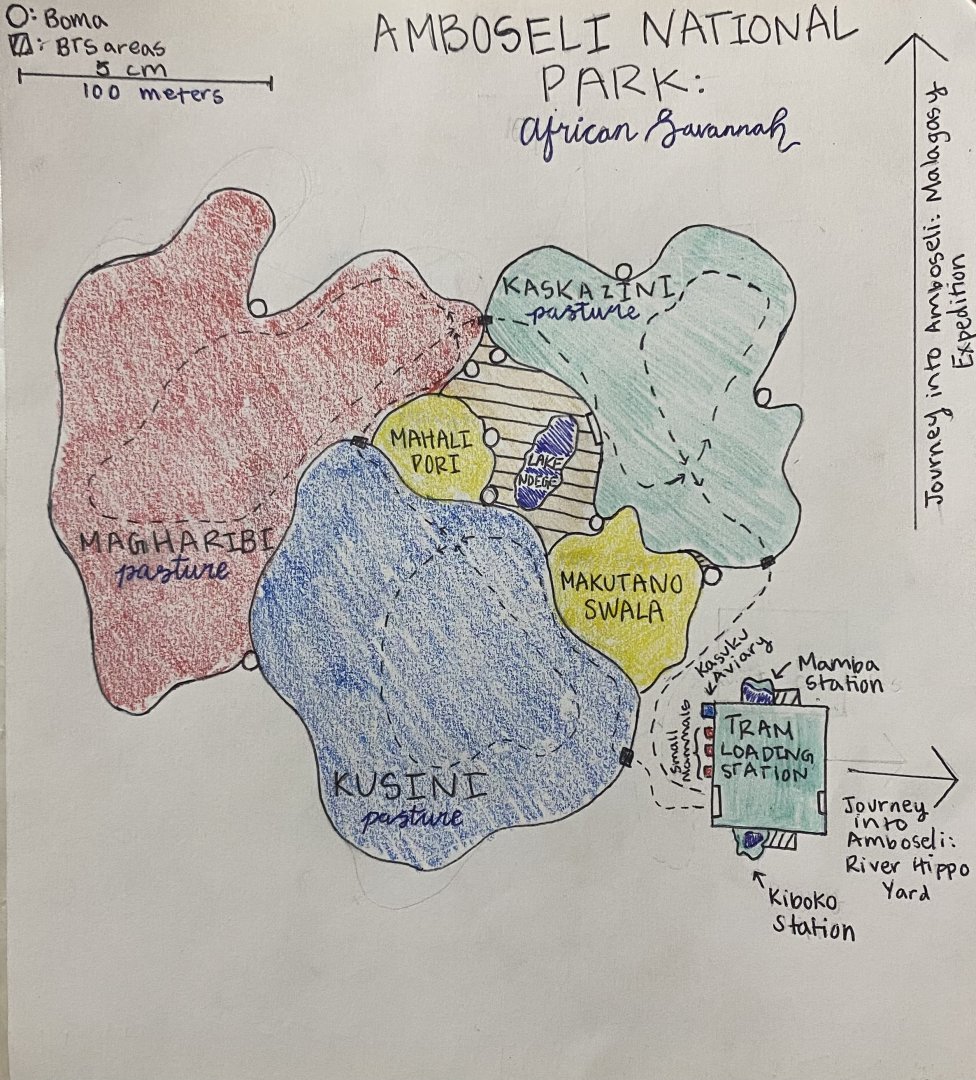
The African Savanna portion of JiA consists of several pastures and habitats that guests are guided through on a tram ride. Guests will enter the tram in the Tram Loading Station (TLS) which is opposite the River Hippo yard. There are numerous habitats and animals guests will encounter during this experience and will begin their journey as soon as they enter the TLS. The TLS is an indoor building that is kept dark with some dim lights. Guests will get to see a few different habitats (through windows) on either side of the building itself as they wait in line. The order of habitats and pastures seen in this portion of JiA is as follows:

- Kiboko Station (left side of TLS)
- Mamba Station (right side of LTS)
- Kasuku Aviary and Small Mammals (front of TLS)
- Kusini (Pasture #1)
- Makutano Swala (Side Habitat #1)
- Mahali Pori (Side Habitat #2)
- Magharibi (Pasture #2)
- Kaskazini (Pasture #3)
- Lake Ndege (Waterfowl)

There are a total of 10 bomas spread throughout the savanna which are used by certain animals for medical assistance, birthing, etc. Each of the bomas is about 10 sq meters and consists of an outdoor portion and a small indoor barn providing shade and a place to hide if needed. The bomas are placed in and around the 3 pastures and 2 side habitats and are primarily used by animals that need to be separated for giving birth.

Now, without further ado, let’s begin our journey!

Kiboko Station
Translating to “Hippo Station,” this habitat is home to a young 1.0 Pygmy Hippo (Choeropsis liberiensis) named Jelani that was born to the zoo’s breeding pair last spring and is now living separately from mom. It originally held an elderly female Pygmy Hippo who died a few years back and then held surplus Nile Crocodile until Jelani moved in. The habitat is on the right of the TLS and can only be seen from inside the building. It is about 90 sq meters and has an 8-foot deep, 10,000-gallon pool. A small group of 1.3 Hartlaub’s Duck (Pteronetta hartlaubii) and a school of Johanni Cichlid (Pseudotropheus johannii) also live with the Pygmy Hippo in this habitat. The Pygmy Hippo also has a BTS indoor area to the right of the outdoor yard that is about 60 sq meters.

Mamba Station
Located on the other side of the building, this habitat is nearly identical to Kiboko Station (100 sq meters with an 8-foot deep, 10,000-gallon pool). Mamba Station translates to “Crocodile” Station and is home to a group of 3.3 Nile Crocodiles (Crocodylus niloticus) which were formerly breeding but the zoo ceased breeding a few years back after a few of the crocodiles died. The remaining 6 crocodiles currently at the zoo are all closely related. The crocs share their habitat with a large school of Red Empress Cichlid (Protomelas taeniolatus). The land portion of the habitat resembles a beach and is very sandy allowing the crocodiles to sunbathe as needed. Mamba Station also has a roughly 50 sq meter BTS indoor yard for the crocodiles to the right of the outdoor yard.

Kasuku Aviary and Small Mammals
The aviary and small mammal habitats are a cluster of small enclosures along the walls of the TLS and can only be seen from inside the TLS while waiting to board the tram. Kasuku translates to “parrot” and thus this aviary holds a family of 2.2 Rosy-faced Lovebirds (Agapornis roseicollis) consisting of a breeding pair and their 1.1 hatchlings. The lovebirds also share their 2-meter tall, 10 sq meter home with a breeding pair of 1.1 Golden-breasted Starling (Lamprotornis regius) that have failed to produce viable chicks thus far.

A trio of 5 sq meter habitats are viewable to the side of the aviary just as the TLS line comes to an end and guests are about to enter the tram. A family group of 2.3 Cape Ground Squirrels (Geosciurus inauris) live in the first enclosure, a sandy habitat with rocks and mounds placed all around. 1.2 adult squirrels were imported from the Rotterdam Zoo a few years ago and the zoo recently bred 1.1 pups. The second habitat is inhabited by a non-breeding pair of 1.1 Bat-eared Fox (Otocyon megalotis) that moved in a few months ago from the Jungle and Highland Dome. This enclosure is also very sandy and dry but also has some burrows and dens for the foxes to hide and rest when they feel like it. The third and final habitat, which is adorned with branches and climbing structures, is home to a young 0.1 Cape Genet (Genetta tigrina) named Asali.

Right past the genet habitat is the exit to the TLS building and guests will enter and get seated in the tram. The tram ride will be roughly 45 minutes long (including a 15 minute break at Lake Ndege) and guests will get to see animals, including tons of antelope and gazelles, from places all over Africa. Once everyone is seated and ready to go, the journey begins as guests are able to take their first glance at the beautiful Kusini pasture.

Kusini
This is the first habitat that the tram goes through and it translates to “South” in Swahili which represents the geographical location of this pasture at the zoo (it does not represent South Africa). This is the second largest pasture in the savanna and is roughly 7 acres. Guests get a glimpse into Makutano Swala (covered below) to the right as they enter the pasture and then the tram makes a loop around the center of the pasture. As the tram exits this pasture, guests get a first look at Mahali Pori (covered below) before entering the second pasture on the tram tour (Magharibi).

The largest bovid at the park, namely the breeding group of 4.12 Cape Buffalo (Syncerus caffer caffer), lives in this enclosure. The herd consists of 1.8 adults and their numerous calves of various ages and genders. A pair of antelope species were also recently added to this pasture and are both expected to breed. There are 1.4 Defassa Waterbuck (Kobus ellipsiprymnus defassa) that were recently transferred over to the zoo from SDZSP to form a second breeding herd in the US. A small breeding herd of 1.3 Sable Antelope (Hippotragus niger) also inhabits this pasture and was moved in from the Kazkazini pasture recently for breeding purposes. This pasture is also home to a small bachelor herd of giraffes which includes a pair of 2.0 Masai Giraffe (Giraffa tippelskirchi) that were born at the zoo and recently transferred into the Kusini pasture from the JtS habitat. There are also 3.0 Reticulated Giraffes (Giraffa reticulata) that were born at the zoo in the Kaskazini habitat and moved into this pasture to join the Masai bachelors and form a bachelor herd. Two pairs of (2.2) East African Grey-crowned Cranes (Balearica regulorum gibbericeps) are the only avian inhabitants of this pasture and are pinioned and non-breeding. The cranes have a few safety areas scattered around the pasture which are only accessible to the cranes. This allows the cranes to escape and remain safe from any aggression they may face from their ungulate neighbors.

Makutano Swala
Unlike the three pastures, the tram will not actually enter this habitat or Mahali Pori but will instead pass by it so guests can take a look into the habitats during multiple sections of the tour. This enclosure is the larger of the two and is about 0.75 acres. Makutano Swala translates to “Antelope Intersection” as this habitat lies right between Kusini and Kazkazini and is home to a trio of antelope species.

A small breeding herd of 1.3 Bontebok (Damaliscus pygargus) lives in this habitat and the zoo has been attempting to breed this species for years without any success. A herd of 2.3 Thomson’s Gazelle (Eudorcas thomsonii) also lives in this enclosure including a pair of castrated males and a trio of young females. The zoo only holds non-breeding and surplus Thommies and has no plans to breed this species as the focus is on Bontebok. Lastly, a breeding herd of 1.4 Lowland Nyala (Tragelaphus angasii) live here as well but are not being bred for the time being due to overrepresentation.

Mahali Pori
Mahali Pori translates to “Wild Place” in Swahili and has held various species over the years. It is the smaller of the two side enclosures and is about 0.5 acres. This enclosure is seen right when the tram leaves Kusini and right as it enters Magharibi.

A breeding herd of 1.6 Southern Gerenuk (Litocranius walleri walleri) was recently introduced to the other inhabitants of this enclosure after being moved from another part of the zoo. The enclosure’s other ungulate inhabitant is a 0.1 Black Duiker (Cephalophus niger) named Subira who lived with her mate, Ralph, until last year when he died. The gerenuk herd moved in shortly after his death and the two species get along pretty well now. Once Subira passes away, Black Duiker will be phased out of the zoo’s collection since the AZA has recommended that this species is phased out.

Two avian species also call this habitat home, namely the Southern Ground Hornbill (Bucorvus leadbeateri) and Blue Crane (Anthropoides paradisaeus). There are a 1.1 pair of both species, however both pairs are non-breeding since all the animals are elderly and post-reproductive. This habitat is also not ideal for either of these species to successfully raise a chick.

Magharibi
This is the largest pasture in the entire Savanna and is roughly 9.5 acres. It translates to “West” as it is the westernmost pasture in the Savanna and is the second pasture that guests will go through during the tram tour. Guests will get another look at Mahali Pori just as they enter the second pasture and then will be taken on a small loop around Magharibi before exiting and moving on to the last pasture.

The stars of this pasture are one of the tallest species in the entire zoo, a breeding herd of 2.9 Reticulated Giraffe (Giraffa reticulata). Unlike a vast majority of other “Reticulated” giraffes in North America, the park’s herd are not generics and instead descend from European imports of pure Reticulated giraffe. Arguably one of the most well-known bird species, a group of 0.6 Common Ostrich (Struthio camelus), also reside in this pasture and get along really well with the giraffe herd, especially the calves. The remaining inhabitants of this pasture are all antelope and are usually found sitting together on the grassy hills or napping under the shade of the trees. Of the four species represented in this enclosure, only two are actively breeding. 3.7 Fringe-eared Oryx (Oryx beisa callotis) live in Magharibi including 1.6 breeding adults and 2.1 calves that were born this spring. A small all-female herd of 0.4 Sable Antelope (Hippotragus niger) is often found near the Oryx herd. The females are all post-reproductive and retired from breeding so they remain in this pasture while the reproductive females and male were moved into Kusini for breeding purposes as the male Sable and male Fringe-eared Oryx did not get along. The other non-breeding species that lives in Magharibi is the herd of 0.9 East African Sitatunga (Tragelaphus spekii spekii), this species is to be phased out from the zoo’s collection so breeding has ceased since the death of the breeding male. These girls are usually found in or around the small pond towards the center of the pasture and are very difficult to spot from the tram due to their elusive nature. The last species living in this pasture is the (1.4) Common Impala (Aepyceros melampus melampus), this herd consists of 1.2 adults and 0.2 calves that were born these past two years. The impala usually sunbathe on the grassy hills making them very easy to spot from the tram ride.

Kaskazini
This is the smallest pasture in the entire Savanna and is about 4.5 acres. It translates to “North” in Swahili and is home to an assortment of hoofstock. Before guests are able to get a good look at the pasture, the tram will stop at a viewing deck for 15 minutes so that guests have the chance to see Lake Ndege (covered below). After the break, guests will be guided through Kaskazini and will see the following wildlife.

The largest antelope species at the zoo resides in Kazkazini and is known as the Patterson’s Eland (Taurotragus oryx pattersonianus), the zoo’s herd is made up of 0.6 adult females and 4.0 calves that were born earlier this year. The breeding male passed away late last year and will be replaced in a few months. One of the smaller but much more rare species to inhabit the pasture is the breeding herd of 1.12 Uganda Kob (Kobus kob thomasi). DHZ imported a small group of Kob around 15 years ago from SDZSP and continues to maintain a large herd. A trio of 1.2 Eastern Mountain Bongo (Tragelaphus eurycerus isaaci) also live in this habitat but are usually hidden under the trees or behind the bushes. They are all non-breeding as the females are both too old for breeding and the male (the son of one of the females) is castrated and thus non-breeding. A small herd of young 0.4 Roan Antelope (Hippotragus equinus) was recently imported from White Oak Conservation Center to replace another hoofstock species that was moved into another section of the zoo. If all goes well, a breeding male will be imported soon and calves will be born next spring.

The tram goes through the majority of this pasture so, despite the elusive nature of some of the inhabitants, guests have a very good chance of seeing all the species in Kaskazini. After exiting the pasture, guests will get one last look at Makutano Swala before the tram stops at the Tram Loading Station.

Lake Ndege
This translates to “Bird Lake” (I know. So creative! :p) and is a 150,000-gallon lake with a small island in the center that is home to a variety of African waterfowl. This lake is located right in the center of Amboseli National Park - African Savanna and is approximately 1.5 meters deep, 38 meters long, and 10 meters wide. The tram will make a stop and allow guests to take 15 minutes to appreciate this beautiful lake and its even more beautiful inhabitants. This stop is made shortly after the tram enters the Kaskazini pasture, guests will be guided through this pasture after the Lake break.

Lake Ndege is home to the following species:
*including hatchlings and/or chicks

- 2.3 Pink-backed Pelican (Pelecanus rufescens)
- 3.4* White-breasted Cormorant (Phalacrocorax lucidus)
- 2.3 Ferruginous Duck (Aythya nyroca)
- 3.3 Marbled Duck (Marmaronetta angustirostris)
- 5.2* Egyptian Goose (Alopochen aegyptiaca)
- 4.5 African Comb Duck (Sarkidiornis melanotos)
- 1.5 Maccoa Duck (Oxyura maccoa)
- 4.2 Great White Pelican (Pelecanus onocrotalus)
- 2.5 Eurasian Wigeon (Mareca penelope)
- 4.2* Blue-billed Teal (Spatula hottentota)
- 1.1 Cape Teal (Anas capensis)
- 0.4 African Black Duck (Anas sparsa)

This concludes Part Two of “Journey into Amboseli: from Jungles to Savannas” and if guests turn left and walk down that path, they will enter the third and final portion of JiA, “Malagasy Expedition” which will be covered next.

Here is my map for "Amboseli National Park - African Savanna". Sorry that it’s a bit messy but I think it’s much better in terms of scale than the last one. Not perfect but getting there, I think :p


As always, I hope you enjoy and if you have any feedback or advice for this portion, don't hesitate to let me know!
 
This is fantastic! I love how you gave some of the exhibits some backstory about previous inhabitants. Keep up the good work!
 
I'm back! With a new name, lol. I guess this thread should be called, “IndianRhino’s Speculative Zoo” now. Anyways, I know most of you probably thought I had abandoned this thread but I was just very busy these past few months and finally have some time now that it's summer. I’m definitely going to be continuing on with this project but updates may not be posted as regularly as I’d like (will try though!). Today I will be presenting Part Two of "Journey into Amboseli: from Jungles to Savannas" which I had started quite a few months ago but here I am posting it 5 months later! :p

Amboseli National Park - African Savanna

The African Savanna portion of JiA consists of several pastures and habitats that guests are guided through on a tram ride. Guests will enter the tram in the Tram Loading Station (TLS) which is opposite the River Hippo yard. There are numerous habitats and animals guests will encounter during this experience and will begin their journey as soon as they enter the TLS. The TLS is an indoor building that is kept dark with some dim lights. Guests will get to see a few different habitats (through windows) on either side of the building itself as they wait in line. The order of habitats and pastures seen in this portion of JiA is as follows:

- Kiboko Station (left side of TLS)
- Mamba Station (right side of LTS)
- Kasuku Aviary and Small Mammals (front of TLS)
- Kusini (Pasture #1)
- Makutano Swala (Side Habitat #1)
- Mahali Pori (Side Habitat #2)
- Magharibi (Pasture #2)
- Kaskazini (Pasture #3)
- Lake Ndege (Waterfowl)

There are a total of 10 bomas spread throughout the savanna which are used by certain animals for medical assistance, birthing, etc. Each of the bomas is about 10 sq meters and consists of an outdoor portion and a small indoor barn providing shade and a place to hide if needed. The bomas are placed in and around the 3 pastures and 2 side habitats and are primarily used by animals that need to be separated for giving birth.

Now, without further ado, let’s begin our journey!

Kiboko Station
Translating to “Hippo Station,” this habitat is home to a young 1.0 Pygmy Hippo (Choeropsis liberiensis) named Jelani that was born to the zoo’s breeding pair last spring and is now living separately from mom. It originally held an elderly female Pygmy Hippo who died a few years back and then held surplus Nile Crocodile until Jelani moved in. The habitat is on the right of the TLS and can only be seen from inside the building. It is about 90 sq meters and has an 8-foot deep, 10,000-gallon pool. A small group of 1.3 Hartlaub’s Duck (Pteronetta hartlaubii) and a school of Johanni Cichlid (Pseudotropheus johannii) also live with the Pygmy Hippo in this habitat. The Pygmy Hippo also has a BTS indoor area to the right of the outdoor yard that is about 60 sq meters.

Mamba Station
Located on the other side of the building, this habitat is nearly identical to Kiboko Station (100 sq meters with an 8-foot deep, 10,000-gallon pool). Mamba Station translates to “Crocodile” Station and is home to a group of 3.3 Nile Crocodiles (Crocodylus niloticus) which were formerly breeding but the zoo ceased breeding a few years back after a few of the crocodiles died. The remaining 6 crocodiles currently at the zoo are all closely related. The crocs share their habitat with a large school of Red Empress Cichlid (Protomelas taeniolatus). The land portion of the habitat resembles a beach and is very sandy allowing the crocodiles to sunbathe as needed. Mamba Station also has a roughly 50 sq meter BTS indoor yard for the crocodiles to the right of the outdoor yard.

Kasuku Aviary and Small Mammals
The aviary and small mammal habitats are a cluster of small enclosures along the walls of the TLS and can only be seen from inside the TLS while waiting to board the tram. Kasuku translates to “parrot” and thus this aviary holds a family of 2.2 Rosy-faced Lovebirds (Agapornis roseicollis) consisting of a breeding pair and their 1.1 hatchlings. The lovebirds also share their 2-meter tall, 10 sq meter home with a breeding pair of 1.1 Golden-breasted Starling (Lamprotornis regius) that have failed to produce viable chicks thus far.

A trio of 5 sq meter habitats are viewable to the side of the aviary just as the TLS line comes to an end and guests are about to enter the tram. A family group of 2.3 Cape Ground Squirrels (Geosciurus inauris) live in the first enclosure, a sandy habitat with rocks and mounds placed all around. 1.2 adult squirrels were imported from the Rotterdam Zoo a few years ago and the zoo recently bred 1.1 pups. The second habitat is inhabited by a non-breeding pair of 1.1 Bat-eared Fox (Otocyon megalotis) that moved in a few months ago from the Jungle and Highland Dome. This enclosure is also very sandy and dry but also has some burrows and dens for the foxes to hide and rest when they feel like it. The third and final habitat, which is adorned with branches and climbing structures, is home to a young 0.1 Cape Genet (Genetta tigrina) named Asali.

Right past the genet habitat is the exit to the TLS building and guests will enter and get seated in the tram. The tram ride will be roughly 45 minutes long (including a 15 minute break at Lake Ndege) and guests will get to see animals, including tons of antelope and gazelles, from places all over Africa. Once everyone is seated and ready to go, the journey begins as guests are able to take their first glance at the beautiful Kusini pasture.

Kusini
This is the first habitat that the tram goes through and it translates to “South” in Swahili which represents the geographical location of this pasture at the zoo (it does not represent South Africa). This is the second largest pasture in the savanna and is roughly 7 acres. Guests get a glimpse into Makutano Swala (covered below) to the right as they enter the pasture and then the tram makes a loop around the center of the pasture. As the tram exits this pasture, guests get a first look at Mahali Pori (covered below) before entering the second pasture on the tram tour (Magharibi).

The largest bovid at the park, namely the breeding group of 4.12 Cape Buffalo (Syncerus caffer caffer), lives in this enclosure. The herd consists of 1.8 adults and their numerous calves of various ages and genders. A pair of antelope species were also recently added to this pasture and are both expected to breed. There are 1.4 Defassa Waterbuck (Kobus ellipsiprymnus defassa) that were recently transferred over to the zoo from SDZSP to form a second breeding herd in the US. A small breeding herd of 1.3 Sable Antelope (Hippotragus niger) also inhabits this pasture and was moved in from the Kazkazini pasture recently for breeding purposes. This pasture is also home to a small bachelor herd of giraffes which includes a pair of 2.0 Masai Giraffe (Giraffa tippelskirchi) that were born at the zoo and recently transferred into the Kusini pasture from the JtS habitat. There are also 3.0 Reticulated Giraffes (Giraffa reticulata) that were born at the zoo in the Kaskazini habitat and moved into this pasture to join the Masai bachelors and form a bachelor herd. Two pairs of (2.2) East African Grey-crowned Cranes (Balearica regulorum gibbericeps) are the only avian inhabitants of this pasture and are pinioned and non-breeding. The cranes have a few safety areas scattered around the pasture which are only accessible to the cranes. This allows the cranes to escape and remain safe from any aggression they may face from their ungulate neighbors.

Makutano Swala
Unlike the three pastures, the tram will not actually enter this habitat or Mahali Pori but will instead pass by it so guests can take a look into the habitats during multiple sections of the tour. This enclosure is the larger of the two and is about 0.75 acres. Makutano Swala translates to “Antelope Intersection” as this habitat lies right between Kusini and Kazkazini and is home to a trio of antelope species.

A small breeding herd of 1.3 Bontebok (Damaliscus pygargus) lives in this habitat and the zoo has been attempting to breed this species for years without any success. A herd of 2.3 Thomson’s Gazelle (Eudorcas thomsonii) also lives in this enclosure including a pair of castrated males and a trio of young females. The zoo only holds non-breeding and surplus Thommies and has no plans to breed this species as the focus is on Bontebok. Lastly, a breeding herd of 1.4 Lowland Nyala (Tragelaphus angasii) live here as well but are not being bred for the time being due to overrepresentation.

Mahali Pori
Mahali Pori translates to “Wild Place” in Swahili and has held various species over the years. It is the smaller of the two side enclosures and is about 0.5 acres. This enclosure is seen right when the tram leaves Kusini and right as it enters Magharibi.

A breeding herd of 1.6 Southern Gerenuk (Litocranius walleri walleri) was recently introduced to the other inhabitants of this enclosure after being moved from another part of the zoo. The enclosure’s other ungulate inhabitant is a 0.1 Black Duiker (Cephalophus niger) named Subira who lived with her mate, Ralph, until last year when he died. The gerenuk herd moved in shortly after his death and the two species get along pretty well now. Once Subira passes away, Black Duiker will be phased out of the zoo’s collection since the AZA has recommended that this species is phased out.

Two avian species also call this habitat home, namely the Southern Ground Hornbill (Bucorvus leadbeateri) and Blue Crane (Anthropoides paradisaeus). There are a 1.1 pair of both species, however both pairs are non-breeding since all the animals are elderly and post-reproductive. This habitat is also not ideal for either of these species to successfully raise a chick.

Magharibi
This is the largest pasture in the entire Savanna and is roughly 9.5 acres. It translates to “West” as it is the westernmost pasture in the Savanna and is the second pasture that guests will go through during the tram tour. Guests will get another look at Mahali Pori just as they enter the second pasture and then will be taken on a small loop around Magharibi before exiting and moving on to the last pasture.

The stars of this pasture are one of the tallest species in the entire zoo, a breeding herd of 2.9 Reticulated Giraffe (Giraffa reticulata). Unlike a vast majority of other “Reticulated” giraffes in North America, the park’s herd are not generics and instead descend from European imports of pure Reticulated giraffe. Arguably one of the most well-known bird species, a group of 0.6 Common Ostrich (Struthio camelus), also reside in this pasture and get along really well with the giraffe herd, especially the calves. The remaining inhabitants of this pasture are all antelope and are usually found sitting together on the grassy hills or napping under the shade of the trees. Of the four species represented in this enclosure, only two are actively breeding. 3.7 Fringe-eared Oryx (Oryx beisa callotis) live in Magharibi including 1.6 breeding adults and 2.1 calves that were born this spring. A small all-female herd of 0.4 Sable Antelope (Hippotragus niger) is often found near the Oryx herd. The females are all post-reproductive and retired from breeding so they remain in this pasture while the reproductive females and male were moved into Kusini for breeding purposes as the male Sable and male Fringe-eared Oryx did not get along. The other non-breeding species that lives in Magharibi is the herd of 0.9 East African Sitatunga (Tragelaphus spekii spekii), this species is to be phased out from the zoo’s collection so breeding has ceased since the death of the breeding male. These girls are usually found in or around the small pond towards the center of the pasture and are very difficult to spot from the tram due to their elusive nature. The last species living in this pasture is the (1.4) Common Impala (Aepyceros melampus melampus), this herd consists of 1.2 adults and 0.2 calves that were born these past two years. The impala usually sunbathe on the grassy hills making them very easy to spot from the tram ride.

Kaskazini
This is the smallest pasture in the entire Savanna and is about 4.5 acres. It translates to “North” in Swahili and is home to an assortment of hoofstock. Before guests are able to get a good look at the pasture, the tram will stop at a viewing deck for 15 minutes so that guests have the chance to see Lake Ndege (covered below). After the break, guests will be guided through Kaskazini and will see the following wildlife.

The largest antelope species at the zoo resides in Kazkazini and is known as the Patterson’s Eland (Taurotragus oryx pattersonianus), the zoo’s herd is made up of 0.6 adult females and 4.0 calves that were born earlier this year. The breeding male passed away late last year and will be replaced in a few months. One of the smaller but much more rare species to inhabit the pasture is the breeding herd of 1.12 Uganda Kob (Kobus kob thomasi). DHZ imported a small group of Kob around 15 years ago from SDZSP and continues to maintain a large herd. A trio of 1.2 Eastern Mountain Bongo (Tragelaphus eurycerus isaaci) also live in this habitat but are usually hidden under the trees or behind the bushes. They are all non-breeding as the females are both too old for breeding and the male (the son of one of the females) is castrated and thus non-breeding. A small herd of young 0.4 Roan Antelope (Hippotragus equinus) was recently imported from White Oak Conservation Center to replace another hoofstock species that was moved into another section of the zoo. If all goes well, a breeding male will be imported soon and calves will be born next spring.

The tram goes through the majority of this pasture so, despite the elusive nature of some of the inhabitants, guests have a very good chance of seeing all the species in Kaskazini. After exiting the pasture, guests will get one last look at Makutano Swala before the tram stops at the Tram Loading Station.

Lake Ndege
This translates to “Bird Lake” (I know. So creative! :p) and is a 150,000-gallon lake with a small island in the center that is home to a variety of African waterfowl. This lake is located right in the center of Amboseli National Park - African Savanna and is approximately 1.5 meters deep, 38 meters long, and 10 meters wide. The tram will make a stop and allow guests to take 15 minutes to appreciate this beautiful lake and its even more beautiful inhabitants. This stop is made shortly after the tram enters the Kaskazini pasture, guests will be guided through this pasture after the Lake break.

Lake Ndege is home to the following species:
*including hatchlings and/or chicks

- 2.3 Pink-backed Pelican (Pelecanus rufescens)
- 3.4* White-breasted Cormorant (Phalacrocorax lucidus)
- 2.3 Ferruginous Duck (Aythya nyroca)
- 3.3 Marbled Duck (Marmaronetta angustirostris)
- 5.2* Egyptian Goose (Alopochen aegyptiaca)
- 4.5 African Comb Duck (Sarkidiornis melanotos)
- 1.5 Maccoa Duck (Oxyura maccoa)
- 4.2 Great White Pelican (Pelecanus onocrotalus)
- 2.5 Eurasian Wigeon (Mareca penelope)
- 4.2* Blue-billed Teal (Spatula hottentota)
- 1.1 Cape Teal (Anas capensis)
- 0.4 African Black Duck (Anas sparsa)

This concludes Part Two of “Journey into Amboseli: from Jungles to Savannas” and if guests turn left and walk down that path, they will enter the third and final portion of JiA, “Malagasy Expedition” which will be covered next.

Here is my map for "Amboseli National Park - African Savanna". Sorry that it’s a bit messy but I think it’s much better in terms of scale than the last one. Not perfect but getting there, I think :p


As always, I hope you enjoy and if you have any feedback or advice for this portion, don't hesitate to let me know!
Egyptian Geese are dangerously aggressive to similarly sized waterfowl.
Pelicans will eat small ducks
 
IndianRhino, I loved reading these (I know I'm late to the party.) This is what I liked on the old fantasy zoo forum. Lately I've been kicking around some ideas but I'm not sure I understand how this forum works these days.
 
I know this was from a year ago, but the effort you put into this zoo design is absolutely insane! The fact that you included animal and exhibit names and everything is just icing on the cake! Not a single tiny bit of this speculation is bad, and this is a zoo that I do really want to visit!
 
Back
Top