Are These in Captivity?

Status
Not open for further replies.
Are there any Rio Acari marmosets (Mico acariensis) In captivity?

Yes, I think perhaps in the Rio Primate centre, I have a colleague who works there so I can check on this.

Sorry to burst your bubble but I don’t think there’s been a fossa in Australia for at least 50 years.

Also @Onychorhynchus coronatus are there any Moustached Tamarins (Saguinus mystax) in captivity. Not endangered but is still a cool overlooked species.

That comes as quite a suprise as I thought they would be kept by zoos in Australia too :eek:

Yes, there are I believe. As @lintworm has mentioned these monkeys are kept by several European zoos and also here within South / Latin America too.

I agree, they are a beautiful species indeed, though personally I do find some of the other Saguinus species of Brazil and Colombia to be far more interesting.
 
Last edited:
Yes, I think perhaps in the Rio Primate centre, I have a colleague who works there so I can check on this.


That comes as quite a suprise as I thought they would be kept by zoos in Australia too :eek:

Yes, there are I believe. As @lintworm has mentioned these monkeys are kept by several European zoos and also here within South / Latin America too.

I agree, they are a beautiful species indeed, though personally I do find some of the other Saguinus species of Brazil and Colombia to be far more interesting.

I'd be interested to see a photo of this species (M. acariensis). A google search shows me a mix of images of what are obviously two completely different species both labeled as this species.

Moustached Tamarins might be kept at a couple US zoos as well, they certainly used to be. I remember Moustached and Weid's Tamarins at Bronx until their Monkey House closed in 2012...

~Thylo
 
I'd be interested to see a photo of this species (M. acariensis). A google search shows me a mix of images of what are obviously two completely different species both labeled as this species.

Moustached Tamarins might be kept at a couple US zoos as well, they certainly used to be. I remember Moustached and Weid's Tamarins at Bronx until their Monkey House closed in 2012...

~Thylo
I think Previously, the Animal Arkive website had some pictures up, until the website was shut down.
 
Recently I learned about a rare type of Melanism in tigers, called black tigers. I wonder, is there actually any black tigers in captivity?
 
Moustached Tamarins might be kept at a couple US zoos as well, they certainly used to be. I remember Moustached and Weid's Tamarins at Bronx until their Monkey House closed in 2012...

~Thylo

I don't get any hits in my USDA files.

Regarding melanistic tigers, Nandankanan Zoo is the only place. One is orange, and one is white. They're the second instance of melanistic tigers being born in captivity. The first was actually at Oklahoma City, but the mother killed the cubs.
 
I don't get any hits in my USDA files.

Regarding melanistic tigers, Nandankanan Zoo is the only place. One is orange, and one is white. They're the second instance of melanistic tigers being born in captivity. The first was actually at Oklahoma City, but the mother killed the cubs.

When was this? Any photos?

~Thylo
 
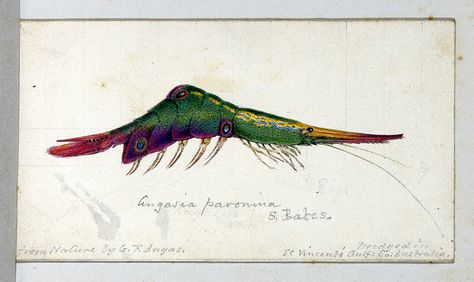
I recently learned about a genus of shrimp called the keyhole shrimp, in a book I read. They popped out at me, as the illustration of one of the species looked really interesting. Are they held in captivity anywhere? I absolutely love shrimp (alive, not fried), so I hope I might see these in captivity someday, or better yet. In the wild. (When I finish school and study to become a zoologist). This google image is similar to the one I saw In my book.
67b2bf7d1005a6b704e29d3a6a2ea764--book-illustrations-port.jpg
 
I recently learned about a genus of shrimp called the keyhole shrimp, in a book I read. They popped out at me, as the illustration of one of the species looked really interesting. Are they held in captivity anywhere? I absolutely love shrimp (alive, not fried), so I hope I might see these in captivity someday, or better yet. In the wild. (When I finish school and study to become a zoologist). This google image is similar to the one I saw In my book.
67b2bf7d1005a6b704e29d3a6a2ea764--book-illustrations-port.jpg
What a cool little critter! It seems feasible to keep in captivity. Once obtained, most shrimp are fairly straightforward to keep (with the exception of the harlequin shrimp, which eats only live starfish). Do you know what the scientific name of the keyhole shrimp is? I'm not getting any results on Zootierliste (only lists the keyhole cichlid and keyhole angelfish). I know the pic has the scientfic name, but I can't read the writing.
 
What a cool little critter! It seems feasible to keep in captivity. Once obtained, most shrimp are fairly straightforward to keep (with the exception of the harlequin shrimp, which eats only live starfish). Do you know what the scientific name of the keyhole shrimp is? I'm not getting any results on Zootierliste (only lists the keyhole cichlid and keyhole angelfish). I know the pic has the scientfic name, but I can't read the writing.
First of all, Zootierliste only does invertebrates, not vertebrates. In the book I read their wasn't any explicit species, just the genera name. On worms they only list one species, Angasia tetrica.
 
Last edited:
What a cool little critter! It seems feasible to keep in captivity. Once obtained, most shrimp are fairly straightforward to keep (with the exception of the harlequin shrimp, which eats only live starfish). Do you know what the scientific name of the keyhole shrimp is? I'm not getting any results on Zootierliste (only lists the keyhole cichlid and keyhole angelfish). I know the pic has the scientfic name, but I can't read the writing.

ZTL does not list invertebrates at all.

~Thylo
 
Do you know what the scientific name of the keyhole shrimp is? I'm not getting any results on Zootierliste (only lists the keyhole cichlid and keyhole angelfish). I know the pic has the scientfic name, but I can't read the writing.
The picture is labelled Angasia pavonina, which is a species now called Tozeuma pavoninum. It is an Australian species.
 
They're the second instance of melanistic tigers being born in captivity. The first was actually at Oklahoma City, but the mother killed the cubs.
When was this? Any photos?
I've heard both 1964 and early 1970s. It could be two different cubs - the 60s one I tend to see described as being blue, while the 70s one was melanistic or pseudomelanistic. It (or both) died very young. The body is preserved somewhere. I've never found a photo :(
This took a little bit to track down - the story is on Wikipedia, Messy Beast, and all the crypto and conspiracy type forums, but never with any reference.

Turns out it comes from Karl Shuker. The article is pretty long so you have to scroll down a long way, but there is a photo of the preserved cub in a jar:
ShukerNature: THE BLACK TIGER – A VERITABLE BÊTE NOIRE OF MYSTERY CATS

Subsequent to the publication of Mystery Cats of the World, I learnt that a partial black tiger had recently been alive, albeit very briefly, in captivity! Within the space of four years during the early 1970s, when Dr Warren D. Thomas was director, Oklahoma City Zoo's pair of tigers produced six litters. All of the cubs in five of these litters were normal, but of the four cubs in litter #3, three possessed varying degrees of abnormal coat colouration. One had normal background colour but darkening on all four limbs, and a second had dark feet (though these gradually lightened until as an adult the tiger was totally normal in colour). The third, however, was dramatically different. Quoting from a letter that I received from Dr Thomas in 1993:

"It had a normal ground color, but considerable darkening over the shoulders, down both front legs, over the pelvis, and encompassing both back legs. The darkening was essentially the same coloring as the stripes. Over the areas of darkening, the stripes were only partly visible."

This was clearly a case of melanism, albeit of an incomplete nature - which makes it all the more tragic that shortly after their birth, three of the four cubs, including this unique black one, were killed by their mother. Fortunately, Dr Thomas preserved the black cub in formalin, and although this has faded its colouration somewhat over the years, photos taken of it not long after its preservation reveal its remarkable appearance.
 
Status
Not open for further replies.
Back
Top