You are using an out of date browser. It may not display this or other websites correctly.
You should upgrade or use an alternative browser.
You should upgrade or use an alternative browser.
Artis Royal Zoo Artis Zoo News 2024
- Thread starter JurassicMax
- Start date
-
- Tags
- artis zoo

JurassicMax
Well-Known Member
During my recent visit to Artis I noticed quite a few changes in both the Reptile, Small Mammal and Forest Houses.
The Grey-handed Night Monkeys (Aotus griseimembra) have been removed from the Forest House / Apenhuis and can now be seen in ther former Cotton-top tamarin (Saguinus oedipus) enclosure in the Small Mammal House / Kleine Zoogdierenhuis. The cotton-top tamarins have been moved to the former binturong enclosure, giving them access to direct sunlight for the first time. This does mean that this species is only visible on the outside of the Small Mammal House. The Pygmy marmosets (Cebuella pygmaea) and Bearded emperor tamarin (Saguinus imperator subgrisescens) have been moved to the Forest House.
The Reptile House / Reptielenhuis has also undergone some changes, I have updated my schematic overviews for the Reptile House.
The most changes have happend in the Small Hall, the "colder" part next to the Forest House, where animals either left the collection of were moved to different terrariums.
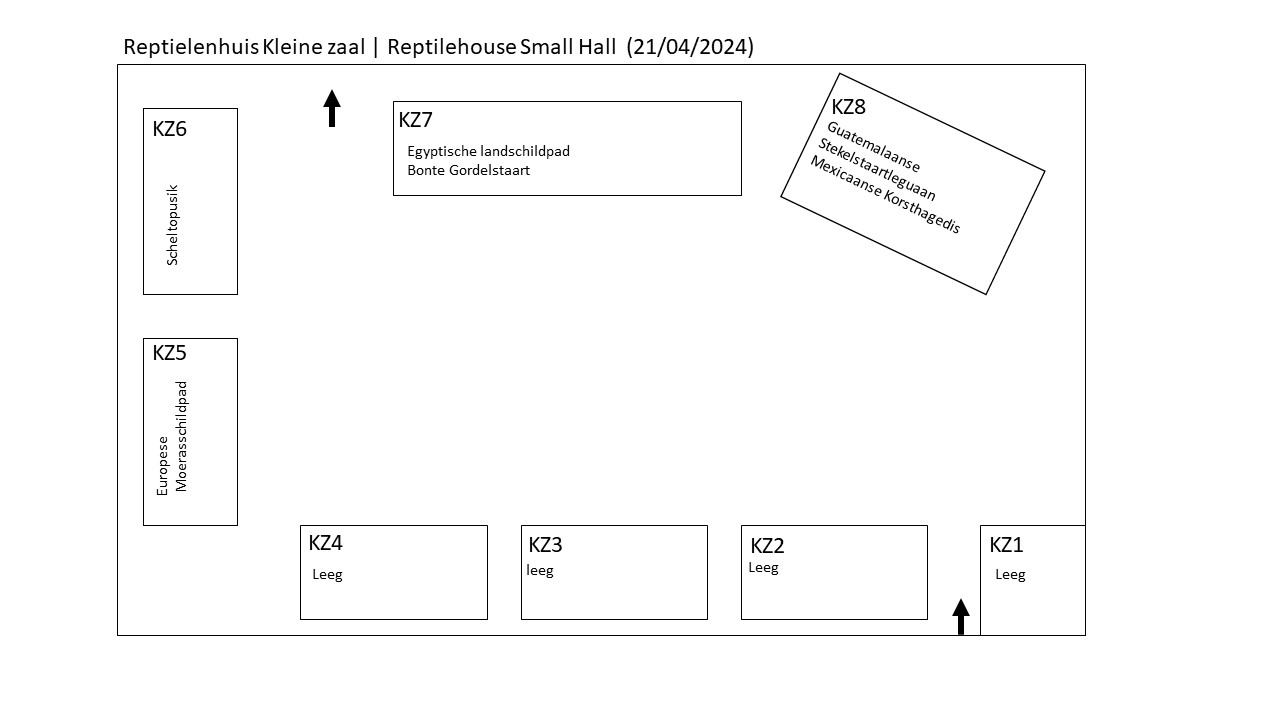
KZ1: Empty
KZ2: Empty (used to house Crocodile lizards (Shinisaurus crocodilurus)).
KZ3: Empty (animals moved to KZ7)
KZ4: Empty (animals moved to KZ6)
KZ5: European pond turtles (Emys orbicularis).
KZ6: European legless lizards (Pseudopus apodus), previously housed San Francisco gartersnakes (Thamnophis sirtalis tetrataenia).
KZ7: Egyptian tortoises (Testudo kleinmanni) and Zoutpansberg girdled lizard (Smaug depressus). Previously housed Algerian orange-tailed skink (Eumeces algeriensis) and Common chuckwallas (Sauromalus ater), they moved to terrariums in the warmer part of the reptile house.
KZ8: Guatemalan spiny-tailed iguana (Ctenosaura palearis) and Rio Fuerte beaded lizards (Heloderma horridum exasperatum).
As you can see, quite a lot of terrariums are sitting empty at the moment.
They have been redecorated so I persume new animals will arrive soon.
The European pond turtles (Emys orbicularis) and European legless lizards (Pseudopus apodus) will also soon leave the reptile house, they will live in the former Asian small clawed otter enclosure in the small mammal house.
The Big Hall, the "warmer" part next to the former lion enclosure, has mostly stayed the same.
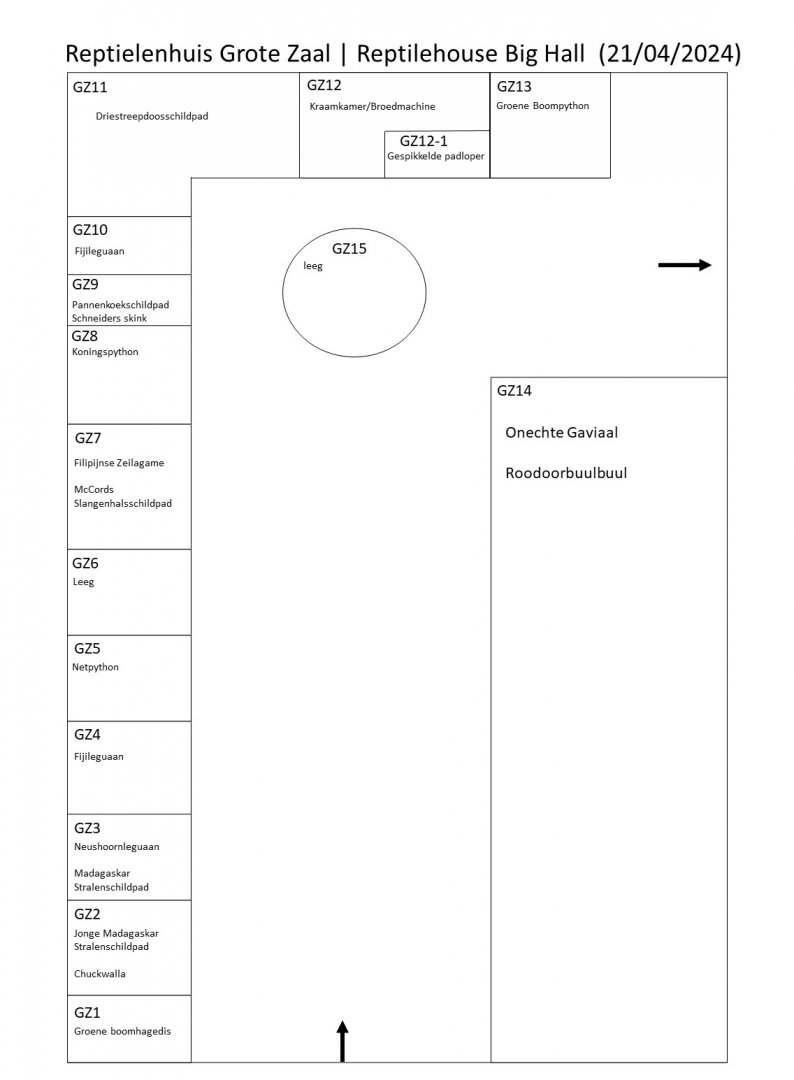
GZ1: Green keel-bellied lizards (Gastropholis prasina).
GZ2: Juvenile Radiated tortoises (Astrochelys radiata) and Common chuckwallas (Sauromalus ater), previously housed Central bearded dragons (Pogona vitticeps).
GZ3: Hispaniolan rhinoceros iguanas (Cyclura cornuta cornuta) and adult Radiated tortoises (Astrochelys radiata).
GZ4: Fiji banded iguanas (Brachylophus fasciatus).
GZ5: Reticulated python (Malayopython reticulatus).
GZ6: Empty, used to house Frill-necked lizards (Chlamydosaurus kingii).
GZ7: Philippine sailfin lizard (Hydrosaurus pustulatus) and McCord's snake-necked turtles (Chelodina mccordi). The McCord's snake-necked turtles swapped enclosures with the Chinese three-striped box turtles (Cuora trifasciata).
GZ8: Royal pythons (Python regius).
GZ9: Pancake tortoises (Malacochersus tornieri) and one Algerian orange-tailed skink (Eumeces algeriensis).
GZ10: Fiji banded iguanas (Brachylophus fasciatus).
GZ11: Chinese three-striped box turtles (Cuora trifasciata). Previously housed McCord's snake-necked turtles (Chelodina mccordi) and one Chinese water dragon (Physignathus cocincinus).
GZ12: Two separate terrariums with Speckled cape tortoises (Chersobius signatus), this used to be the reptile nursery. The speckled cape tortoises used to be kept in the Gorilla house next to the Aldabra giant tortoises (Aldabrachelys gigantea gigantea).
GZ13: Green tree python (Morelia viridis).
GZ14: False gharial (Tomistoma schlegelii) and free flying Red-whiskered bulbuls (Pycnonotus jocosus).
GZ15: Empty, this used to have multiple separate terrariums with juvenile Tokay geckos (Gekko gecko), one Common leopard gecko (Eublepharis macularius) and one Greater Madagascar day gecko (Phelsuma grandis).
Not that much has changed.
GZ1 now houses a new species, a few species have left mainly because the small terrariums in GZ15 have been removed. The reptile nursery has also been replaced for two terrariums for Speckled cape tortoises (Chersobius signatus) which used to be kept in the Gorilla House.
The Grey-handed Night Monkeys (Aotus griseimembra) have been removed from the Forest House / Apenhuis and can now be seen in ther former Cotton-top tamarin (Saguinus oedipus) enclosure in the Small Mammal House / Kleine Zoogdierenhuis. The cotton-top tamarins have been moved to the former binturong enclosure, giving them access to direct sunlight for the first time. This does mean that this species is only visible on the outside of the Small Mammal House. The Pygmy marmosets (Cebuella pygmaea) and Bearded emperor tamarin (Saguinus imperator subgrisescens) have been moved to the Forest House.
The Reptile House / Reptielenhuis has also undergone some changes, I have updated my schematic overviews for the Reptile House.
The most changes have happend in the Small Hall, the "colder" part next to the Forest House, where animals either left the collection of were moved to different terrariums.
Reptielenhuis Kleine Zaal | Reptile House Small Hall (21/04/2024)
Schematic overview of the content of each terrarium in the small hall (April 2024). This is the...
KZ1: Empty
KZ2: Empty (used to house Crocodile lizards (Shinisaurus crocodilurus)).
KZ3: Empty (animals moved to KZ7)
KZ4: Empty (animals moved to KZ6)
KZ5: European pond turtles (Emys orbicularis).
KZ6: European legless lizards (Pseudopus apodus), previously housed San Francisco gartersnakes (Thamnophis sirtalis tetrataenia).
KZ7: Egyptian tortoises (Testudo kleinmanni) and Zoutpansberg girdled lizard (Smaug depressus). Previously housed Algerian orange-tailed skink (Eumeces algeriensis) and Common chuckwallas (Sauromalus ater), they moved to terrariums in the warmer part of the reptile house.
KZ8: Guatemalan spiny-tailed iguana (Ctenosaura palearis) and Rio Fuerte beaded lizards (Heloderma horridum exasperatum).
As you can see, quite a lot of terrariums are sitting empty at the moment.
They have been redecorated so I persume new animals will arrive soon.
The European pond turtles (Emys orbicularis) and European legless lizards (Pseudopus apodus) will also soon leave the reptile house, they will live in the former Asian small clawed otter enclosure in the small mammal house.
The Big Hall, the "warmer" part next to the former lion enclosure, has mostly stayed the same.
Reptielenhuis Grote Zaal | Reptile House Big Hall (21/04/2024)
Schematic overview of the content of each terrarium in the Big Hall (April 2024). This is the...
GZ1: Green keel-bellied lizards (Gastropholis prasina).
GZ2: Juvenile Radiated tortoises (Astrochelys radiata) and Common chuckwallas (Sauromalus ater), previously housed Central bearded dragons (Pogona vitticeps).
GZ3: Hispaniolan rhinoceros iguanas (Cyclura cornuta cornuta) and adult Radiated tortoises (Astrochelys radiata).
GZ4: Fiji banded iguanas (Brachylophus fasciatus).
GZ5: Reticulated python (Malayopython reticulatus).
GZ6: Empty, used to house Frill-necked lizards (Chlamydosaurus kingii).
GZ7: Philippine sailfin lizard (Hydrosaurus pustulatus) and McCord's snake-necked turtles (Chelodina mccordi). The McCord's snake-necked turtles swapped enclosures with the Chinese three-striped box turtles (Cuora trifasciata).
GZ8: Royal pythons (Python regius).
GZ9: Pancake tortoises (Malacochersus tornieri) and one Algerian orange-tailed skink (Eumeces algeriensis).
GZ10: Fiji banded iguanas (Brachylophus fasciatus).
GZ11: Chinese three-striped box turtles (Cuora trifasciata). Previously housed McCord's snake-necked turtles (Chelodina mccordi) and one Chinese water dragon (Physignathus cocincinus).
GZ12: Two separate terrariums with Speckled cape tortoises (Chersobius signatus), this used to be the reptile nursery. The speckled cape tortoises used to be kept in the Gorilla house next to the Aldabra giant tortoises (Aldabrachelys gigantea gigantea).
GZ13: Green tree python (Morelia viridis).
GZ14: False gharial (Tomistoma schlegelii) and free flying Red-whiskered bulbuls (Pycnonotus jocosus).
GZ15: Empty, this used to have multiple separate terrariums with juvenile Tokay geckos (Gekko gecko), one Common leopard gecko (Eublepharis macularius) and one Greater Madagascar day gecko (Phelsuma grandis).
Not that much has changed.
GZ1 now houses a new species, a few species have left mainly because the small terrariums in GZ15 have been removed. The reptile nursery has also been replaced for two terrariums for Speckled cape tortoises (Chersobius signatus) which used to be kept in the Gorilla House.
Last edited:
JurassicMax
Well-Known Member
Last Wednesday I visited Artis again and noticed the following changes:
The White-faced sakis (Pithecia pithecia) have been moved to the Apenhuis / Foresthouse. Their former enclosure is getting redecorated and will house the Goeldi's monkeys (Callimico goeldii) and Southern three-banded armadillo (Tolypeutes matacus).
A new species can be found in the BirdHouse, namely Mindanao bleeding-heart doves (Gallicolumba crinigera). They can be found in the same aviary as the Greater hill mynas (Gracula religiosa intermedia).
Also a new species arrived in the Fazanterie / Pheasantry, namely 2 (a pair?) Blue-crowned laughingthrushes (Pterorhinus courtoisi). They can be found in the former Northern white-faced scops-owl (Ptilopsis leucotis) enclosure, the owls have moved to the bald ibis aviary (where they were also kept in the past).
Recently a young pair of Ocellated turkeys (Meleagris ocellata) arrived to accompany the already present female. They can also be found in the Fazanterie, the resident female was kept in a separate aviary for the time being.
More bird news!
The Hollandse Polder Voliére / Hollandse Polder Aviary also has 2 new species, namely Stock doves (Columba oenas) and Common rock pigeon (Columba livia livia). Both species are quite rare in European zoos, being kept in 14 and 5 zoos respectively (according to ZTL).
According to two signs in the Reptile House, KZ2 and KZ3 (see post above) will be housing
amphibians. Namely, Dyeing dart frogs (Dendrobates tinctorius regina) and Golfodulcean poison dart frogs (Phyllobates vittatus) in one terrarium and the other will house Red-eyed Tree Frogs (Agalychnis callidryas). These species are currently on show in the Stek at the Vlindertuin / Butterfly pavilion. Whether new species will be put on show there, hasn't been announced.
The White-faced sakis (Pithecia pithecia) have been moved to the Apenhuis / Foresthouse. Their former enclosure is getting redecorated and will house the Goeldi's monkeys (Callimico goeldii) and Southern three-banded armadillo (Tolypeutes matacus).
A new species can be found in the BirdHouse, namely Mindanao bleeding-heart doves (Gallicolumba crinigera). They can be found in the same aviary as the Greater hill mynas (Gracula religiosa intermedia).
Also a new species arrived in the Fazanterie / Pheasantry, namely 2 (a pair?) Blue-crowned laughingthrushes (Pterorhinus courtoisi). They can be found in the former Northern white-faced scops-owl (Ptilopsis leucotis) enclosure, the owls have moved to the bald ibis aviary (where they were also kept in the past).
Recently a young pair of Ocellated turkeys (Meleagris ocellata) arrived to accompany the already present female. They can also be found in the Fazanterie, the resident female was kept in a separate aviary for the time being.
More bird news!
The Hollandse Polder Voliére / Hollandse Polder Aviary also has 2 new species, namely Stock doves (Columba oenas) and Common rock pigeon (Columba livia livia). Both species are quite rare in European zoos, being kept in 14 and 5 zoos respectively (according to ZTL).
According to two signs in the Reptile House, KZ2 and KZ3 (see post above) will be housing
amphibians. Namely, Dyeing dart frogs (Dendrobates tinctorius regina) and Golfodulcean poison dart frogs (Phyllobates vittatus) in one terrarium and the other will house Red-eyed Tree Frogs (Agalychnis callidryas). These species are currently on show in the Stek at the Vlindertuin / Butterfly pavilion. Whether new species will be put on show there, hasn't been announced.
JurassicMax
Well-Known Member
Yesterday I received the new Artis member magazine, not much news to share.
However, a new species was announced, namely the Siberian weasel (Mustela sibirica).
As far as I know this species is not on show yet, but will probably be kept in the formerNorthern yellow-throated marten (Martes flavigula aterrima) enclosure. This enclosure has recently been refurbished and now also has a small pond.
I totally forgot to mention that they are now on show in this enclosure! Two males are kept according to a caretaker.

The Kerber terras will be remodeled for a lemur species.
Artis wil halfapen houden in voormalig leeuwenverblijf
Artis wil halfapen houden in voormalig leeuwenverblijf

Artis has temporarily opened the Kerbertterras/the former lion exhibit for visitors.
Uniek: Artis geeft bezoekers toegang tot voormalig leeuwenverblijf
Uniek: Artis geeft bezoekers toegang tot voormalig leeuwenverblijf

Nile Hippo Expert
Well-Known Member
JurassicMax
Well-Known Member
Last week I visited Artis again, not much had changed.
The Goeldi's monkeys (Callimico goeldii) and Southern three-banded armadillo (Tolypeutes matacus) can now be seen in the former white-faced saki enclosure. The former armadillo enclosure will soon house Round-eared elephant shrews (Macroscelides proboscideus).
The Goeldi's monkeys (Callimico goeldii) and Southern three-banded armadillo (Tolypeutes matacus) can now be seen in the former white-faced saki enclosure. The former armadillo enclosure will soon house Round-eared elephant shrews (Macroscelides proboscideus).
I commend you on the list, only you left the S.E Asian fish species in the Sunda gharial exhibit out of the equation / review.During my recent visit to Artis I noticed quite a few changes in both the Reptile, Small Mammal and Forest Houses.
The Grey-handed Night Monkeys (Aotus griseimembra) have been removed from the Forest House / Apenhuis and can now be seen in ther former Cotton-top tamarin (Saguinus oedipus) enclosure in the Small Mammal House / Kleine Zoogdierenhuis. The cotton-top tamarins have been moved to the former binturong enclosure, giving them access to direct sunlight for the first time. This does mean that this species is only visible on the outside of the Small Mammal House. The Pygmy marmosets (Cebuella pygmaea) and Bearded emperor tamarin (Saguinus imperator subgrisescens) have been moved to the Forest House.
The Reptile House / Reptielenhuis has also undergone some changes, I have updated my schematic overviews for the Reptile House.
The most changes have happend in the Small Hall, the "colder" part next to the Forest House, where animals either left the collection of were moved to different terrariums.
Reptielenhuis Kleine Zaal | Reptile House Small Hall (21/04/2024)
Schematic overview of the content of each terrarium in the small hall (April 2024). This is the...
KZ1: Empty
KZ2: Empty (used to house Crocodile lizards (Shinisaurus crocodilurus)).
KZ3: Empty (animals moved to KZ7)
KZ4: Empty (animals moved to KZ6)
KZ5: European pond turtles (Emys orbicularis).
KZ6: European legless lizards (Pseudopus apodus), previously housed San Francisco gartersnakes (Thamnophis sirtalis tetrataenia).
KZ7: Egyptian tortoises (Testudo kleinmanni) and Zoutpansberg girdled lizard (Smaug depressus). Previously housed Algerian orange-tailed skink (Eumeces algeriensis) and Common chuckwallas (Sauromalus ater), they moved to terrariums in the warmer part of the reptile house.
KZ8: Guatemalan spiny-tailed iguana (Ctenosaura palearis) and Rio Fuerte beaded lizards (Heloderma horridum exasperatum).
As you can see, quite a lot of terrariums are sitting empty at the moment.
They have been redecorated so I persume new animals will arrive soon.
The European pond turtles (Emys orbicularis) and European legless lizards (Pseudopus apodus) will also soon leave the reptile house, they will live in the former Asian small clawed otter enclosure in the small mammal house.
The Big Hall, the "warmer" part next to the former lion enclosure, has mostly stayed the same.
Reptielenhuis Grote Zaal | Reptile House Big Hall (21/04/2024)
Schematic overview of the content of each terrarium in the Big Hall (April 2024). This is the...
GZ1: Green keel-bellied lizards (Gastropholis prasina).
GZ2: Juvenile Radiated tortoises (Astrochelys radiata) and Common chuckwallas (Sauromalus ater), previously housed Central bearded dragons (Pogona vitticeps).
GZ3: Hispaniolan rhinoceros iguanas (Cyclura cornuta cornuta) and adult Radiated tortoises (Astrochelys radiata).
GZ4: Fiji banded iguanas (Brachylophus fasciatus).
GZ5: Reticulated python (Malayopython reticulatus).
GZ6: Empty, used to house Frill-necked lizards (Chlamydosaurus kingii).
GZ7: Philippine sailfin lizard (Hydrosaurus pustulatus) and McCord's snake-necked turtles (Chelodina mccordi). The McCord's snake-necked turtles swapped enclosures with the Chinese three-striped box turtles (Cuora trifasciata).
GZ8: Royal pythons (Python regius).
GZ9: Pancake tortoises (Malacochersus tornieri) and one Algerian orange-tailed skink (Eumeces algeriensis).
GZ10: Fiji banded iguanas (Brachylophus fasciatus).
GZ11: Chinese three-striped box turtles (Cuora trifasciata). Previously housed McCord's snake-necked turtles (Chelodina mccordi) and one Chinese water dragon (Physignathus cocincinus).
GZ12: Two separate terrariums with Speckled cape tortoises (Chersobius signatus), this used to be the reptile nursery. The speckled cape tortoises used to be kept in the Gorilla house next to the Aldabra giant tortoises (Aldabrachelys gigantea gigantea).
GZ13: Green tree python (Morelia viridis).
GZ14: False gharial (Tomistoma schlegelii) and free flying Red-whiskered bulbuls (Pycnonotus jocosus).
GZ15: Empty, this used to have multiple separate terrariums with juvenile Tokay geckos (Gekko gecko), one Common leopard gecko (Eublepharis macularius) and one Greater Madagascar day gecko (Phelsuma grandis).
Not that much has changed.
GZ1 now houses a new species, a few species have left mainly because the small terrariums in GZ15 have been removed. The reptile nursery has also been replaced for two terrariums for Speckled cape tortoises (Chersobius signatus) which used to be kept in the Gorilla House.

I commend you on the list, only you left the S.E Asian fish species in the Sunda gharial exhibit out of the equation / review.
There are more than just the Bulbuls?

Artis officially announced the plans for this today. The current red ruffed lemur enclosure will be connected to the Kerbert Terrace via two aerial tunnels. The ruffed lemurs will live together with the ring-tailed lemurs, which can currently be found in the Small Mammal House. The radiated tortoises will also move to this new enclosure. The enclosure in will be inspired by Madagascar's different types of landscapes, from wet tropical forests to arid deserts and mountains.The Kerber terras will be remodeled for a lemur species.
Artis wil halfapen houden in voormalig leeuwenverblijf
Renovation of the Kerbert Terrace and construction of the new enclosure will start this autumn. The terrace will be temporarily accessible to visitors until the start of the renovation. Via a pontoon, visitors walk across the water onto the terrace.
Source: Artis


JurassicMax
Well-Known Member
There are fish, but these aren't signed and are not that easy to spot.There are more than just the Bulbuls?
JurassicMax
Well-Known Member
Out of curiously (not too familiar with the zoo history) when was the last chimpanzee birth at the zoo and what are the dynamics like in the troop?
The last chimpanzee birth was in 2013, group consists of 3.5 individuals. The youngest male (*2013) has made a few attempts to become the new alpha, but thus far without success.
JurassicMax
Well-Known Member
Since last month the Round-eared elephant shrews (Macroscelides proboscideus) have been put on display in the Small Mammal house. Furthermore, the European pond turtles (Emys orbicularis) have moved to the former Otter enclosure.
At the end of June a William's electric blue gecko (Lygodactylus williamsi) hatched.
Last month 2 Lesser kestrels (Falco naumanni) hatched! This could be a zoo first breeding for Artis.
Source:
Instagram of Artis (30/06/2024)
Instagram of Artis (02/08/2024)
At the end of June a William's electric blue gecko (Lygodactylus williamsi) hatched.
Last month 2 Lesser kestrels (Falco naumanni) hatched! This could be a zoo first breeding for Artis.
Source:
Instagram of Artis (30/06/2024)
Instagram of Artis (02/08/2024)

Some notes from the Small Mammal House today:
The garden dormice were very active and it was the first time I ever saw them in Artis. It seems that they are so active because there are young mice at the moment in need of food.
The same case for the Crete spiny mice; multiple young mice and quite active adults.
Scheltopusiks will join the European turtles in the former otter enclosure. Nice species, but a bit odd choice for the Small Mammal House. I had preferred a small mammal, for instance rakali..
Return of a species of aguti or paca (together with the night monkeys) and squirrel (with the mousedeer) would be nice, but I don't know if Artis has any plans in the direction.
The garden dormice were very active and it was the first time I ever saw them in Artis. It seems that they are so active because there are young mice at the moment in need of food.
The same case for the Crete spiny mice; multiple young mice and quite active adults.
Scheltopusiks will join the European turtles in the former otter enclosure. Nice species, but a bit odd choice for the Small Mammal House. I had preferred a small mammal, for instance rakali..
Return of a species of aguti or paca (together with the night monkeys) and squirrel (with the mousedeer) would be nice, but I don't know if Artis has any plans in the direction.
A very premature conclusion, no pregnancies have been confirmed as of yet.As mentioned by @Yassa in the Asian Elephants in Europe thread, the zoo's bull elephant Sibu mated with Sanuk last weekend. It appears as though Artis may have one or even two baby elephants in the Spring of 2026!
Prepare for some major news soon (you will have to wait for the official discourse later in the year ..., it may be some time yet).
Lesser kerstrel hatchings are actually a Netherlands zoo first.Since last month the Round-eared elephant shrews (Macroscelides proboscideus) have been put on display in the Small Mammal house. Furthermore, the European pond turtles (Emys orbicularis) have moved to the former Otter enclosure.
At the end of June a William's electric blue gecko (Lygodactylus williamsi) hatched.
Last month 2 Lesser kestrels (Falco naumanni) hatched! This could be a zoo first breeding for Artis.
Source:
Instagram of Artis (30/06/2024)
Instagram of Artis (02/08/2024)
The garden dormouse have had a very successful breeding season. And yes they are well and truly very active even daytime hours.Some notes from the Small Mammal House today:
The garden dormice were very active and it was the first time I ever saw them in Artis. It seems that they are so active because there are young mice at the moment in need of food.
The same case for the Crete spiny mice; multiple young mice and quite active adults.
Scheltopusiks will join the European turtles in the former otter enclosure. Nice species, but a bit odd choice for the Small Mammal House. I had preferred a small mammal, for instance rakali..
Return of a species of aguti or paca (together with the night monkeys) and squirrel (with the mousedeer) would be nice, but I don't know if Artis has any plans in the direction.
Personally, I found the refurb of the old otter exclosure indoor for European pond turtles and scheltopusiks a direct hit. I am glad that curatorial management is much more progressive and adres to be different.
JurassicMax
Well-Known Member
Sadly a female Reticulated giraffe (Giraffa camelopardalis reticulata) gave birth to a stillborn male today. The young was positioned incorrectly, which increased the risk of it becoming stuck in the mother's pelvis. Therfore caretakers had to step in and support the birth by pulling the front leggs of the young. Luckly the mother is doing well.
Source:
Instagram of Artis (15/08/2024)
Source:
Instagram of Artis (15/08/2024)