Yes, the tortoises need sand and loose soil substrates to dig their nesting holes and lay their eggs.I spoke to one of the managers at the zoo in 1999 he told me that the tortoises had avoided the then concrete pool all the time, I suggested that they replace the water with sand I am not sure if that happened but I do know that years before the San Deigo zoo had some work done in the Giant tortoise exhibit which resulted in some piles of sand being left over in which if was found that the Tortoises were using it not only for being able to be a better mating area but also some eggs being laid in it so luckily a good lesson leant!
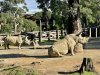
Being star attractions most zoos have exhibited giant tortoises in the traditional fashion of hard standing or concrete floorings. This among other things like not separating males from females explains why most zoos do not manage to breed their tortoises.
In fact, the record is in pretty poor so far ... and private breeders have long surpassed zoos in the breeding stakes for both Aldabran tortoise and the Galapagos giant tortoises. Even in this day and age most zoos seem reluctant to have their pure-bred Galapagos tortoises live with their correct species...!
A further peeve of mine is that zoos are reflectant to test their pure-bred Galapagos tortoises according to the Santa Cruz Charles Darwin Center genetic testing protocols developped by Yale University (Omaha's Henry Doorly Zoo also similarly has the expertise to test the Galapagos internationally).
A flickering and rays of hope exists in that increasingly now zoos with known wild born Galapagos tortoises are storting to have theirs tested using the latest technology and it is high time that internationally exchanges happen across Continents and individual nations and less treat them as the zoo's "items" and not share or exchange in the interest of species conservation (Remember: there are 15 species of Galapagos tortoise with 12 extant, 1 functionally extinct and 2 extinct).



 )
)