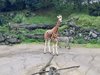
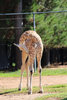
Australasian Giraffe Population

0.1 Kamili at Orana Wildlife Park has given birth to her first calf. Sire would be the late 1.0 Mabuti from Monarto. The male calf had to be handraised following his birth just before Christmas off-site at Rangiora Vet Centre but has now returned to the park. He will be on-display as of tomorrow with the rest of the herd: 登录 Facebook | Facebook

Wow, given the sire of this calf died in October 2021 and gestation for this species is 15 months, he was literally sired at the eleventh hour.

Nice to know Mbuti’s legacy lives on - especially following the death of his first (and only other) calf last month.
 
A few updates already found in their respective news threads:

1.0 calf born to 0.1 Kamili (b. 2018 at Perth Zoo) at Orana Wildlife Park has been named Kevin.

1.0 calf has been born at Taronga Western Plains Zoo on 21st January to 1.0 Mtoto (b. 2017 at Mogo) and 0.1 Zane (b. 2016 at Dubbo). The calf has been named Shomari and this is Zane's second calf. This is Mtoto's fifth calf he has sired since he was transferred from Mogo.
 
1.0 calf at Adelaide Zoo that was born to 0.1 Thula and had to be handraised has been named Matumi after a species of tree. Matumi has also made his public debut at the zoo alongside the other females - reported on social media.
 
I'm curious about something: if and when Australia imports new blood giraffewise, what would be the logical way of phasing out the inbred population in favor of separate Baringo/Masai/Southern giraffe populations?

The logical way would be to start by acquiring bulls. These will be at a greater surplus overseas. These would replace the breeding bulls in herds across Australasia, where we could expect them to remain in place for 10-20 years, siring calves. Then during their 10-20 year tenure, import as many purebred cows as availability/resources allow, while contracepting current cows they no longer want to breed.

That said, I’m of the opinion they’ll persist with a generic population and merely import new generic giraffes to supplement that. It would be my preference to see a purebred population established, but I struggles to see it happening.
 
0.1 Sally at Australia Zoo gave birth to a 0.1 calf on the 21st May. The female has been named Zarraffa and gives a total of eight giraffes at the zoo. There is still a mystery giraffe among them with only seven individuals known - adults 1.0 Forest, 0.1 Rosie, 0.1 Penny and 0.1 Sally and calves 1.0 Jessie, 0.1 PLB and 0.1 Zarraffa.
 
A giraffe named Mzungu...o_O

It’s a Swahili word that means ‘bright’ or ‘fair complexion’ and the calf does indeed appear light coloured. Though giraffes darken as they age, I’ve seen great variation in the region (which is surprising considering how inbred they all are).

I’ve attached a photo of Billy (Auckland Zoo) I took when he was three years old. He’s already considerably darker than the three adult cows. His ancestor (Jan Smuts) at Taronga was noted to be ‘almost black’ when he died in his 25th year.

Mkali (newborn):

upload_2023-10-7_7-14-30.jpeg
Source: Zoo welcomes new giraffe baby, Mkali | Canberra CityNews

Billy (three years):

upload_2023-10-7_7-11-11.jpeg
 

Attachments

  • upload_2023-10-7_7-11-11.jpeg
    upload_2023-10-7_7-11-11.jpeg
    200.9 KB · Views: 60
  • upload_2023-10-7_7-14-30.jpeg
    upload_2023-10-7_7-14-30.jpeg
    122.4 KB · Views: 58
It’s a Swahili word that means ‘bright’ or ‘fair complexion’ and the calf does indeed appear light coloured. Though giraffes darken as they age, I’ve seen great variation in the region (which is surprising considering how inbred they all are).

I’ve attached a photo of Billy (Auckland Zoo) I took when he was three years old. He’s already considerably darker than the three adult cows. His ancestor (Jan Smuts) at Taronga was noted to be ‘almost black’ when he died in his 25th year.

Mkali (newborn):

View attachment 660295
Source: Zoo welcomes new giraffe baby, Mkali | Canberra CityNews

Billy (three years):

View attachment 660294
It more commonly means 'foreigner' though...
 
AND the literal meaning is "to wander around aimlessly". The base word "zungu" meaning to spin around.

Thanks for your insights, they're most insightful :) While I generally support zoo animals being named in keeping with the languages spoken in their native ranges, this goes to show that the task involves having a firm grip on those languages, more than a quick glimpse online might be able to offer.

(Not to say, of course, that this etymology wasn't considered in naming Mzungu, but likewise, that's not to say that it was).
 
AND the literal meaning is "to wander around aimlessly". The base word "zungu" meaning to spin around.

I saw the wander part and thought that was appropriate as giraffes generally explore every inch of their paddock; as opposed to lions, who utilise a fraction of it.

The ‘foreign’ definition is ironic considering there’s no danger of fresh imports anytime soon (even with New Zealand now having the IRA). We’d love some foreign (imported giraffes).
 
Thanks for your insights, they're most insightful :) While I generally support zoo animals being named in keeping with the languages spoken in their native ranges, this goes to show that the task involves having a firm grip on those languages, more than a quick glimpse online might be able to offer.

(Not to say, of course, that this etymology wasn't considered in naming Mzungu, but likewise, that's not to say that it was).

I agree, though I do like it when zoos think outside the box rather than reverting to the overused Swahili or Indonesian names e.g. Zuri, Berani, Melati etc.

One of the strangest in the region is Samaki the chimpanzee (Swahili for fish). His family line produces infants with wrinkled faces; with Shiba’s affinity for termite fishing being my two theories on how he got his name.
 
Back
Top