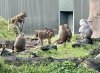
Australasian Hamadryas Baboon Population

How many does this leave Sydney with now?

That’s the million dollar question.

I have the following list, but I’ve contacted Sydney Zoo for an update as when I visited with @steveroberts and @Abbey in November, I only saw one adult male and one adolescent male, suggesting not all of these males remain in the troop. We can also likely remove Kasmut as this appears to be Melbourne’s new female (Kas).

There was also an infant born last year to be added to this.

January 2024 population:

1.0 Babi Imported 2019 (Singapore)
1.0 Nyambi Imported 2019 (Singapore)
1.0 Shezmu Imported 2019 (Singapore)
1.0 Azizi Imported 2019 (Singapore)
1.0 Bennu Imported 2019 (Singapore)
0.1 Izara Imported 2019 (Singapore)
0.1 Aida Imported 2019 (Singapore)
0.1 Anta Imported 2019 (Singapore)
0.1 Kasmut Imported 2019 (Singapore)
0.1 Zuri Imported 2019 (Singapore)
1.0 Apophis Imported 2019 (Singapore)
0.1 Aza (2020)
0.1 Johari (2020)
0.1 Nyota (2020)
1.0 Ramses (2021)
1.0 Seti (2021)
1.0 Deshr (2022)
0.1 Zeinab (2022)
0.1 Eboni (2022)
 
That’s the million dollar question.

I have the following list, but I’ve contacted Sydney Zoo for an update as when I visited with @steveroberts and @Abbey in November, I only saw one adult male and one adolescent male, suggesting not all of these males remain in the troop. We can also likely remove Kasmut as this appears to be Melbourne’s new female (Kas).

There was also an infant born last year to be added to this.

January 2024 population:

1.0 Babi Imported 2019 (Singapore)
1.0 Nyambi Imported 2019 (Singapore)
1.0 Shezmu Imported 2019 (Singapore)
1.0 Azizi Imported 2019 (Singapore)
1.0 Bennu Imported 2019 (Singapore)
0.1 Izara Imported 2019 (Singapore)
0.1 Aida Imported 2019 (Singapore)
0.1 Anta Imported 2019 (Singapore)
0.1 Kasmut Imported 2019 (Singapore)
0.1 Zuri Imported 2019 (Singapore)
1.0 Apophis Imported 2019 (Singapore)
0.1 Aza (2020)
0.1 Johari (2020)
0.1 Nyota (2020)
1.0 Ramses (2021)
1.0 Seti (2021)
1.0 Deshr (2022)
0.1 Zeinab (2022)
0.1 Eboni (2022)
Ok. I will be visiting this Saturday and will try to remember to count (though some may be inside of course).
 
Zambi Wildlife Retreat:

Thank you to @Tigergal for this account of Zambi’s population (1.4 baboons):

We then went onto the Hamadryas Baboons, where they have a troop that contains a male named Fonzie, and four females - Sister’s Pebbles and Kinki, Mum Flash and ‘Aunt’ Keke. The keeper mentioned that Pebbles is two years old, Keke is 23 years old and Fonzie has had a vasectomy. We were able to hand feed the female baboons peanuts, while Fonzie was fed by a volunteer on the other side of the exhibit. It was very cute watching the females, especially Pebbles, fill their cheek pockets up with the peanuts.
 
Auckland Zoo - Birth Announcement

I was excited to learn on my visit to Auckland Zoo yesterday that an infant had been born to Iniko (2020). This is Auckland Zoo’s first Hamadryas baboon birth since 2022.

Iniko turns five years old next month and this is her first infant. I assume the father is Badi, as it appeared Iniko was in his harem. I would estimate the infant was born July 2025.

The infant was unplanned, so unfortunately we have no clearer picture on whether the zoo are still proceeding with the phase out of this species.

I was pleased to see that in addition to the new infant, all nine of the zoo’s adult baboons (plus the juvenile male) were alive and well. The founders have reached impressive ages (20-24 years).

upload_2025-8-10_21-22-42.jpeg

Afar’s harem:

1.0 Afar (2005) Jarmah x Gina
0.1 Kito (2002) Unknown x Greet
0.1 Naeemah (2011) Afar x Kito

Wasaro’s Harem:

0 Wasaro (2005) Jarmah x Gen
0.1 Ayisha (2001) Unknown x Zara

Badi’s harem:

1.0 Badi (2012) Afar x Kito
0.1 Zala (2013) Wasaro x Ayisha
0.1 Mali (2015) Wasaro x Ayisha
0.1 Iniko (2020) Yafeu x Mali
1.0 Jabari (2022) Badi x Mali
0.0.1 Unnamed (2025) Badi x Iniko
 

Attachments

  • upload_2025-8-10_21-22-42.jpeg
    upload_2025-8-10_21-22-42.jpeg
    249.3 KB · Views: 39
Auckland Zoo - Birth Announcement

I was excited to learn on my visit to Auckland Zoo yesterday that an infant had been born to Iniko (2020). This is Auckland Zoo’s first Hamadryas baboon birth since 2022.

Iniko turns five years old next month and this is her first infant. I assume the father is Badi, as it appeared Iniko was in his harem. I would estimate the infant was born July 2025.

The infant was unplanned, so unfortunately we have no clearer picture on whether the zoo are still proceeding with the phase out of this species.

I was pleased to see that in addition to the new infant, all nine of the zoo’s adult baboons (plus the juvenile male) were alive and well. The founders have reached impressive ages (20-24 years).

View attachment 815370

Afar’s harem:

1.0 Afar (2005) Jarmah x Gina
0.1 Kito (2002) Unknown x Greet
0.1 Naeemah (2011) Afar x Kito

Wasaro’s Harem:

0 Wasaro (2005) Jarmah x Gen
0.1 Ayisha (2001) Unknown x Zara

Badi’s harem:

1.0 Badi (2012) Afar x Kito
0.1 Zala (2013) Wasaro x Ayisha
0.1 Mali (2015) Wasaro x Ayisha
0.1 Iniko (2020) Yafeu x Mali
1.0 Jabari (2022) Badi x Mali
0.0.1 Unnamed (2025) Badi x Iniko

This is interesting news - I was unaware Iniko was old enough to breed, but she seems to be coping well with the infant! Hopefully this will mean the zoo will reconsider phasing baboons out and may even consider importing some new blood from overseas.

And thank you @Zoofan15 for the great photo!
 
Last edited:
This is interesting news - I was unaware Iniko was old enough to breed, but she seems to be coping well with the infant! Hopefully this will mean the zoo will reconsider phasing baboons out and may even consider importing some new blood from overseas.

And thank you @Zoofan15 for the great photo!

Iniko was coping very well. Her juvenile brother Jabari is obsssed with the infant (that’s him in the photo above that’s climbed the branches for a better look). The other females were very interested too, but all were respecting Iniko by not touching the infant.

Under natural breeding conditions female Hamadryas baboons baboons often produce their first offspring in their fifth year (Chacma baboons too, though this can be influenced by ranking). However, in contrast to Mali (2020) who had Iniko (2025) at five years and six months of age; Iniko won’t turn five until next month, so is definitely on the younger end of the scale. I don’t know details beyond the infant being unplanned, so perhaps she had only recently been put on contraception; or their hadn’t been visual signs she was cycling (i.e her first maximal swelling hadn’t been observed).

I really hope Auckland Zoo continues with baboons and can eventually import some more females. Melbourne have a decent male/female ratio and have several females that they won’t be breeding with due to their relation to the males; while Sydney Zoo has bred a succession of female infants.

As a side note, Auckland Zoo now has four generations living in their troop, with this infant joining mother Iniko; grandmother Mali; and great-grandparents Wasaro and Ayisha.
 
Iniko was coping very well. Her juvenile brother Jabari is obsssed with the infant (that’s him in the photo above that’s climbed the branches for a better look). The other females were very interested too, but all were respecting Iniko by not touching the infant.

Under natural breeding conditions female Hamadryas baboons baboons often produce their first offspring in their fifth year (Chacma baboons too, though this can be influenced by ranking). However, in contrast to Mali (2020) who had Iniko (2025) at five years and six months of age; Iniko won’t turn five until next month, so is definitely on the younger end of the scale. I don’t know details beyond the infant being unplanned, so perhaps she had only recently been put on contraception; or their hadn’t been visual signs she was cycling (i.e her first maximal swelling hadn’t been observed).

I really hope Auckland Zoo continues with baboons and can eventually import some more females. Melbourne have a decent male/female ratio and have several females that they won’t be breeding with due to their relation to the males; while Sydney Zoo has bred a succession of female infants.

As a side note, Auckland Zoo now has four generations living in their troop, with this infant joining mother Iniko; grandmother Mali; and great-grandparents Wasaro and Ayisha.

Thanks for the update. Jabari has certainly grown and certainly does seem fascinated with the infant! Hopefully when the newcomer is a little older, we'll witness similar play activity between Jabari and the infant, much like Iniko and Jabari used to play, which will certainly draw in large crowds!

I'm glad Iniko seems to be taking well to motherhood, despite her youth. It would make a lot of sense to keep the Hamadryas Baboon exhibit going due to all this activity and popularity. Even before the new infant was born, I've noticed people staying by the exhibit for long periods of time, fascinated by the animals, even when only the adults were visible.
 
Thanks for the update. Jabari has certainly grown and certainly does seem fascinated with the infant! Hopefully when the newcomer is a little older, we'll witness similar play activity between Jabari and the infant, much like Iniko and Jabari used to play, which will certainly draw in large crowds!

I'm glad Iniko seems to be taking well to motherhood, despite her youth. It would make a lot of sense to keep the Hamadryas Baboon exhibit going due to all this activity and popularity. Even before the new infant was born, I've noticed people staying by the exhibit for long periods of time, fascinated by the animals, even when only the adults were visible.

What’s interesting is Auckland Zoo has always followed a format of allowing one female (with the others on contraception) to have two infants back to back:

Ayisha had Yafue (2009) and Sekani (2011)
Kito had Naeemah (2011) and Badi (2012)
Ayisha had Zala (2013) and Mali (2015)
Mali had Iniko (2020) and Jabari (2022)
Iniko has now given birth (2025)

With this in mind, I’ll be interested to see if this pattern follows for a fifth time. Yes, this infant was unplanned; but so was Iniko herself in 2020, who was followed by Jabari within two years.

Overall, Auckland’s troop has a very healthy social structure with minimal conflict. The design of the exhibit (in contrast to Adelaide’s) affords them privacy and is large, naturalistic and open air. Each of the adult males have at least one female in their harem (Badi being a prime aged male has the most) and by the time Jabari approaches maturity in a few years, they’ll likely be an opportunity for him to acquire a female, especially if this infant adds an additional female.
 
What’s interesting is Auckland Zoo has always followed a format of allowing one female (with the others on contraception) to have two infants back to back:

Ayisha had Yafue (2009) and Sekani (2011)
Kito had Naeemah (2011) and Badi (2012)
Ayisha had Zala (2013) and Mali (2015)
Mali had Iniko (2020) and Jabari (2022)
Iniko has now given birth (2025)

With this in mind, I’ll be interested to see if this pattern follows for a fifth time. Yes, this infant was unplanned; but so was Iniko herself in 2020, who was followed by Jabari within two years.

Overall, Auckland’s troop has a very healthy social structure with minimal conflict. The design of the exhibit (in contrast to Adelaide’s) affords them privacy and is large, naturalistic and open air. Each of the adult males have at least one female in their harem (Badi being a prime aged male has the most) and by the time Jabari approaches maturity in a few years, they’ll likely be an opportunity for him to acquire a female, especially if this infant adds an additional female.

It will indeed be interesting to see if Iniko follows the pattern and produces another infant in the next 2-4 years. The birth of the current newcomer, I feel, will delay plans to phase out the baboons, just as Mali's pregnancy with Iniko (plus the pandemic) derailed plans to export the baboons (to Singapore Zoo, if I remember correctly). Hopefully Auckland Zoo will ultimately decide to keep the baboons and even bring in some new members for the troop!
 
It will indeed be interesting to see if Iniko follows the pattern and produces another infant in the next 2-4 years. The birth of the current newcomer, I feel, will delay plans to phase out the baboons, just as Mali's pregnancy with Iniko (plus the pandemic) derailed plans to export the baboons (to Singapore Zoo, if I remember correctly). Hopefully Auckland Zoo will ultimately decide to keep the baboons and even bring in some new members for the troop!

The birth interval can be as short as 14 months, but 18-24 months is more common; so Iniko having another infant in the second half of 2026 or the first half of 2027 are both possibilities if they opt to allow her to breed again.

When the 2.2 founders arrived in 2009, they paired off 1.1 (Wasaro and Ayisha; and Afar and Kito), which was ideal as both males were able to establish a harem. When Yafeu matured, he recruited Zala and Mali into his harem; with Badi then recruiting them when Yafeu passed. Wellington similarly reported how when a harem leader passed, his females divided amongst the other males. We can expect the same to occur when Wasaro and Afar pass; though due to the ages of their females, it may only be Naeemah who is left. At this point in time, I’d expect any available females to be snapped up by Badi; but give Jabari a few years and he’d be a contender.

Yes, you’re correct that Naeemah, Zala and Mali were scheduled to be sent to Singapore pre-Covid. Hopefully this infant will further delay plans to phase them out (if there are still plans to do so).
 
The birth interval can be as short as 14 months, but 18-24 months is more common; so Iniko having another infant in the second half of 2026 or the first half of 2027 are both possibilities if they opt to allow her to breed again.

When the 2.2 founders arrived in 2009, they paired off 1.1 (Wasaro and Ayisha; and Afar and Kito), which was ideal as both males were able to establish a harem. When Yafeu matured, he recruited Zala and Mali into his harem; with Badi then recruiting them when Yafeu passed. Wellington similarly reported how when a harem leader passed, his females divided amongst the other males. We can expect the same to occur when Wasaro and Afar pass; though due to the ages of their females, it may only be Naeemah who is left. At this point in time, I’d expect any available females to be snapped up by Badi; but give Jabari a few years and he’d be a contender.

Yes, you’re correct that Naeemah, Zala and Mali were scheduled to be sent to Singapore pre-Covid. Hopefully this infant will further delay plans to phase them out (if there are still plans to do so).

I too am hoping the baboons will stay, although if they do, new bloodlines will undoubtedly be necessary. As you say, Jabari in a few years will be a contender to build a harem of his own, and should the new infant turn out to be a male, that might add to the need for more females.
 
I too am hoping the baboons will stay, although if they do, new bloodlines will undoubtedly be necessary. As you say, Jabari in a few years will be a contender to build a harem of his own, and should the new infant turn out to be a male, that might add to the need for more females.

I agree. Demographically speaking, if this infant was a female they’d probably be fine for the next few years. Badi would inevitably acquire Naeemah as his fourth female once Afar passes and would probably concede an additional female (i.e. this infant once mature) to Jabari, who is a decade younger than his father.

However, for the sake of genetic diversity, it’d be advisable to bring in some unrelated females. The troop is already quite inbred. They could either import some unrelated females and have the Auckland bred females go on contraception (like Melbourne has recently done); or undertake a swap of either males or females with another zoo. Either way, Auckland have a healthy male/female ratio, so it’d be important to maintain that.
 
I agree. Demographically speaking, if this infant was a female they’d probably be fine for the next few years. Badi would inevitably acquire Naeemah as his fourth female once Afar passes and would probably concede an additional female (i.e. this infant once mature) to Jabari, who is a decade younger than his father.

However, for the sake of genetic diversity, it’d be advisable to bring in some unrelated females. The troop is already quite inbred. They could either import some unrelated females and have the Auckland bred females go on contraception (like Melbourne has recently done); or undertake a swap of either males or females with another zoo. Either way, Auckland have a healthy male/female ratio, so it’d be important to maintain that.

True - Badi could concede the newcomer, if a female, to Jabari, but it would not be ideal for them to breed as the new female would be Jabari's half-niece.

If new females were brought in, didn't you mention that Australia may have some that could be imported?
 
True - Badi could concede the newcomer, if a female, to Jabari, but it would not be ideal for them to breed as the new female would be Jabari's half-niece.

If new females were brought in, didn't you mention that Australia may have some that could be imported?

Yes, Melbourne current have 5.11 Hamadryas baboons of which seven of the females are both reproductive age and related to all the males in the troop. They could spare at least one or two bearing in mind they’d want to retain sufficient females to balance out their males.

0.1 Juju (2015) Jabari x Huddo
0.1 Gana (2017) Unknown x Grace
0.1 Hudson (2018) Unknown x Huddo
0.1 Makali (2019) Unknown x Macey
0.1 Quilton (2020) Unknown x Qetesh
0.1 Muna (2020) Unknown x Macey
0.1 Mei (2021) Unknown x Macey

Macey and Qetesh are Wellington bred and therefore related to Ayisha and Kito; but both pairs of females have since bred with unrelated males to produce the descendants concerned, which would be acceptable.

In addition, Sydney Zoo have produced at least four female infants in recent years and appeared to have a heavily female skewed population on my last visit. They recently sent a surplus female to Melbourne.

The alternative could be a male swap. If a troop such as the Wildlife HQ troop (which has a single ageing male) found themselves without a male, they could acquire a couple from Melbourne or Sydney, which could reduce their male numbers to acceptable levels to undertake a male swap with Auckland in a few years (exchanging Badi and Jabari for 2-3 Australian males).
 
Yes, Melbourne current have 5.11 Hamadryas baboons of which seven of the females are both reproductive age and related to all the males in the troop. They could spare at least one or two bearing in mind they’d want to retain sufficient females to balance out their males.

0.1 Juju (2015) Jabari x Huddo
0.1 Gana (2017) Unknown x Grace
0.1 Hudson (2018) Unknown x Huddo
0.1 Makali (2019) Unknown x Macey
0.1 Quilton (2020) Unknown x Qetesh
0.1 Muna (2020) Unknown x Macey
0.1 Mei (2021) Unknown x Macey

Macey and Qetesh are Wellington bred and therefore related to Ayisha and Kito; but both pairs of females have since bred with unrelated males to produce the descendants concerned, which would be acceptable.

In addition, Sydney Zoo have produced at least four female infants in recent years and appeared to have a heavily female skewed population on my last visit. They recently sent a surplus female to Melbourne.

The alternative could be a male swap. If a troop such as the Wildlife HQ troop (which has a single ageing male) found themselves without a male, they could acquire a couple from Melbourne or Sydney, which could reduce their male numbers to acceptable levels to undertake a male swap with Auckland in a few years (exchanging Badi and Jabari for 2-3 Australian males).

That sounds about right and would be ideal for Auckland to do - perhaps importing one or two of the Melbourne females (perhaps from among the younger ones).

A male swap could also work well - Badi and Jabari or Jabari and the new one when old enough if that infant turns out to be male.
 
Update - Auckland Zoo Hamadryas Baboon Infant

While speaking with a primate keeper today outside the orangutan habitat, besides talking to her about the topic of orangutans I was also able to learn a little more about the new baboon infant born to first-time mother Iniko. The keeper was able to confirm that the new arrival is a male, and may possibly be named Raffi, although this name hasn't received an official sanction yet.

1.0 Unnamed, possibly Raffi, Badi x Iniko
 
Update - Auckland Zoo Hamadryas Baboon Infant

While speaking with a primate keeper today outside the orangutan habitat, besides talking to her about the topic of orangutans I was also able to learn a little more about the new baboon infant born to first-time mother Iniko. The keeper was able to confirm that the new arrival is a male, and may possibly be named Raffi, although this name hasn't received an official sanction yet.

1.0 Unnamed, possibly Raffi, Badi x Iniko

It’s glad to hear the infant has survived thus far. The troop appeared respectful of Iniko and the infant on my visit; even Jabari, who was very curious having never seen an infant seen an infant before. I had assumed Badi was the sire based on the fact Iniko appeared to be in his harem, but it’s good to have that confirmed.

If you get chance to ask a primate keeper, I’d be fascinated to know what the zoo’s current stance is on phasing this species out.

If they’re to continue with this species, than I assume they’d hold back on importing more females all the time they have a new infant in the troop and the troop is stable; but the passing of elderly harem leaders Afar and Wasaro will likely tie in with Jabari seeking to establish his own harem. This would be an excellent time to bring in a couple more females.
 
It’s glad to hear the infant has survived thus far. The troop appeared respectful of Iniko and the infant on my visit; even Jabari, who was very curious having never seen an infant seen an infant before. I had assumed Badi was the sire based on the fact Iniko appeared to be in his harem, but it’s good to have that confirmed.

If you get chance to ask a primate keeper, I’d be fascinated to know what the zoo’s current stance is on phasing this species out.

If they’re to continue with this species, than I assume they’d hold back on importing more females all the time they have a new infant in the troop and the troop is stable; but the passing of elderly harem leaders Afar and Wasaro will likely tie in with Jabari seeking to establish his own harem. This would be an excellent time to bring in a couple more females.

I'm not sure if Badi is 100% confirmed to be the sire, but it seems to be the assumption that he is. The infant seems pretty healthy and other staff members have confirmed that he has already been seen moving around independently of Iniko and holding his own amongst the troop.

I did ask a bit about the zoo's intentions for the baboons' future, and the keeper told me that there have been several plans that haven't come to anything, including possibly phasing out the baboons and using their area to extend the safari track, or replace them with another primate species such as colobus monkeys. Currently it's uncertain what will happen with the troop, but they look to be staying put for the time being.
 
I'm not sure if Badi is 100% confirmed to be the sire, but it seems to be the assumption that he is. The infant seems pretty healthy and other staff members have confirmed that he has already been seen moving around independently of Iniko and holding his own amongst the troop.

I did ask a bit about the zoo's intentions for the baboons' future, and the keeper told me that there have been several plans that haven't come to anything, including possibly phasing out the baboons and using their area to extend the safari track, or replace them with another primate species such as colobus monkeys. Currently it's uncertain what will happen with the troop, but they look to be staying put for the time being.

The birth of another male infant will compound any challenges Auckland Zoo face in phasing out their troop. Females are easy to place and they could wait until the two elderly males pass of natural causes; but that leaves the prime aged Badi; the adolescent Jabari; and what’s believed to be a male infant. Hopefully this provides an incentive for the zoo to continue with this species (not unlike the giraffe at Adelaide that wouldn’t get into its moving crate).

Badi being the sire is a safe assumption. He’s a prime aged male and his only competition is two elderly males. I’d expect the majority of females (including all future eligible females) to be recruited into his harem. Yafeu effectively achieved this with Zala and Mali prior to his death; with Badi subsequently acquiring his harem.
 
Back
Top