Australasian Orangutan Population

On hindsight, it would have made a lot of sense for Horst to have replaced Datuk at Taronga Zoo. Horst was well represented in Auckland’s colony with two offspring (Intan and Isim). They wouldn’t have bred Horst for a third time with Indra; nor would they have repeated the pairing between him and Dara. The third female (Intan) was his daughter. He was therefore redundant to their breeding programme at that point in time.

From here, Charlie was a potential mate for Dara, Indra and Intan; and Isim and Darli could have been paired like you suggest.

I feel like Taronga continuing as a second holder would have prevented Auckland from initiating a phase out of the Bornean species in the 2000’s. Being the only Bornean holder in the region certainly would have added weight to the argument of phasing out in favour of the critically endangered Sumatran species.

Clearly it was not the best course of action for Australasia to begin phasing out Bornean orangutans back in the day, as some valuable opportunities to breed from genetically valuable individuals were wasted - I do agree with you that transferring Horst to Taronga would have been a good move. As it stands now, Isim is his only surviving offspring, and unless a miracle happens and Gangsa has a successful pregnancy at long last, it seems less and less likely Isim will sire offspring unless he is paired with a new female.

Auckland Zoo are doing well in making up for lost time with the birth of Bahmi and the import of Daya, though, since Bornean orangutans are now critically endangered, and the outlook is hopeful.
 
Last edited:
Clearly it was not the best course of action for Australasia to begin phasing out Bornean orangutans back in the day, as some valuable opportunities to breed from genetically valuable individuals were wasted - I do agree with you that transferring Horst to Taronga would have been a good move. As it stands now, Isim is his only surviving offspring, and unless a miracle happens and Gangsa has a successful pregnancy at long last, it seems less and less likely Isim will sire offspring unless he is paired with a new female.

Auckland Zoo are doing well in making up for lost time with the birth of Bahmi and the import of Daya, though, since Bornean orangutans are now critically endangered, and the outlook is hopeful.

It’s interesting as two months prior to the import of Auckland Zoo’s first Bornean orangutans, Perth Zoo exported an adult female Bonrnean orangutan (Binte) to Singapore Zoo. While she was a viable breeding female (hence the export), she was then 25 years old; and they presumably thought her reproductive potential would be wasted had she been sent to Auckland Zoo to join the then juvenile, Horst. Horst subsequently took a further five years to impregnate Dara and Indra.

Excluding non-breeding individuals (e.g. Perth’s elderly female, Mawas), the regional population of Borneans tracked as followed from August 1983:

1983: 1.2 (1.2 imported)
1984: 2.2 (1.0 imported)
1989: 3.3 (1.1 born)
1994: 4.3 (1.0 born)
1995: 4.5 (0.2 imported)
1998: 3.5 (1.0 died)
2000: 3.6 (0.1 born)
2000: 3.4 (0.2 died)
2002: 3.5 (0.1 born)
2002: 3.4 (0.1 died)
2005: 4.4 (1.0 born)
2009: 3.2 (1.2 exported)
2015: 1.1 (2.1 exported)
2022: 2.1 (1.0 born)
2023: 2.2 (0.1 imported)
 
It’s interesting as two months prior to the import of Auckland Zoo’s first Bornean orangutans, Perth Zoo exported an adult female Bonrnean orangutan (Binte) to Singapore Zoo. While she was a viable breeding female (hence the export), she was then 25 years old; and they presumably thought her reproductive potential would be wasted had she been sent to Auckland Zoo to join the then juvenile, Horst. Horst subsequently took a further five years to impregnate Dara and Indra.

Excluding non-breeding individuals (e.g. Perth’s elderly female, Mawas), the regional population of Borneans tracked as followed from August 1983:

1983: 1.2 (1.2 imported)
1984: 2.2 (1.0 imported)
1989: 3.3 (1.1 born)
1994: 4.3 (1.0 born)
1995: 4.5 (0.2 imported)
1998: 3.5 (1.0 died)
2000: 3.6 (0.1 born)
2000: 3.4 (0.2 died)
2002: 3.5 (0.1 born)
2002: 3.4 (0.1 died)
2005: 4.4 (1.0 born)
2009: 3.2 (1.2 exported)
2015: 1.1 (2.1 exported)
2022: 2.1 (1.0 born)
2023: 2.2 (0.1 imported)

Thanks for this - some very impressive research there! I agree, as valuable as a Horst x Binte infant would have been, Binte's best reproductive years would have been behind her by the time Horst was old enough to sire offspring. Perth Zoo made the right call sending her to Singapore - do you know if she had offspring there, and were any of them sired by Charlie's father, Zabu, would you know?
 
Thanks for this - some very impressive research there! I agree, as valuable as a Horst x Binte infant would have been, Binte's best reproductive years would have been behind her by the time Horst was old enough to sire offspring. Perth Zoo made the right call sending her to Singapore - do you know if she had offspring there, and were any of them sired by Charlie's father, Zabu, would you know?

Binte sadly died following the birth of a daughter in 1984. The infant was named Binte II and has produced four offspring to date. They are as follows:

1.0 Gunta (2002)
1.0 Bento (2006) Deceased
0.1 Saloma (2009)
1.0 Adi (2016)

Saloma and Adi were sired by Suria (1997), who is the son of Girlie (Charlie’s mother). Zabu sired 22 offspring - though several died as infants; died without reproducing; or were donated to unaccredited facilities (including two sent to Fox Television Studios in the US).
 
Last edited:
Binte sadly died following the birth of a daughter in 1984. The infant was named Binte II and has produced four offspring to date. They are as follows:

1.0 Gunta (2002)
1.0 Bento (2006) Deceased
0.1 Saloma (2009)
1.0 Adi (2016)

Saloma and Adi were sired by Suria (1997), who is the son of Girlie (Charlie’s mother). Zabu sired 22 offspring - though several died as infants; died without reproducing; or were donated to unaccredited facilities (including two sent to Fox Television Studios in the US).

Thanks for this - some amazing research here! It's sad that Binte died so young, but it's great that her daughter has gone on to be a successful mother, and that two of her offspring are the niece and nephew of Charlie! And it's sad that some of Zabu's descendants died as infants or were sent into the entertainment industry (and of course, two were hybrids, as I recently learned!)
 
From the late great very expert Dr Rosemary Markham's research and works with the Orangutans at Perth Zoo for almost 40 years [her paper:
Breeding Orangutans at Perth Zoo: Twenty Years of Appropriate Husbandry published 1990].

(important to note, the life stories and names and date of births and parentage has all very much been elaborated on many times on here; its just adding with additional notes from Dr Markham on dates surrounding).

(**additional: this is partly conjecture surmising, but Dr Markham did mention the famous Dome enclosure on the end of that row {built 1900-1901} was Atjeh's home and based on her writing, it sounds like the female Orangutans went to his exhibit when they cohabitated rather than other way around).

According to Dr Markham the male and female Orangutans were kept separate except where recorded. Dr Markham mentions in her paper that former zoo director of the era Tom Spence was a veterinarian by training, who also kept up to date with research information into Orangutan's solitary natures (and in consultation with Dr Markham's expertees was early in acknowledging that Bornean and Sumatran Orangutans were likely separate species not simply subspecies of same species; albeit breeding between their individuals still until the beginning of 1980s). The Orangutans were kept in a row of seven to eight enclosures (of which the Orangutans had access to 6-7). Now under what is Permai the Asian Elephant's yard (her barns that stand today essentially the back-part of what this row of enclosures was):

Orangutan breeding interactions at Perth Zoo between 1969 and 1981:

Puan 0.1 (Sumatran Orangutan) cohabitated an exhibit with Atjeh 1.0 (Sumatran Orangutan) between October 7th 1969 and November 19th 1969. Believed to have had a successful conception on October 20th 1969 and began avoidance behaviour to one another five days later (October 25th). After a pregnancy gestation of approximately 242 days (212-255 day estimation range). Puan gave birth to Puteri 0.1 on June 12th 1970.

Binte 0.1 (Bornean Orangutan) cohabitated an exhibit with Atjeh 1.0 between February 6th 1970 and March 10th 1970. Believed to have had a successful conception on March 8th 1970 and began avoidance behaviour to one another a day later on March 9th. After a pregnancy gestation of approximately 247 days (245-277 day estimation range). Binte gave birth to Bintang 0.1 on October 9th 1970.


Puan 0.1 again cohabitated an exhibit with Atjeh 1.0 between July 8th 1971 and August 3rd 1971. Believed to have had a successful conception on July 12 1971 and the two began avoidance behaviour five days later on July 17th. After a pregnancy gestation of approximately 255 days (233-259 day estimation range). Puan gave birth to Puntjak 1.0 on March 24th 1972.

Binte 0.1 again cohabitated an exhibit with Atjeh 1.0; it was apparently only for one day, July 31st 1972. After a successful conception on that date and a gestation of 234 days, Binte gave birth to a (hybrid Bornean/Sumatran) male baby on March 22nd 1973. Unfortunately the baby male died the same day.

The exact dates are not recorded except to say for 'several months' Bornean Orangutan Mawas 0.1 cohabitated with (Taronga Zoo born) hybrid Bornean/Sumatran Orangutan Bobby 1.0. A baby (hybrid) female was born August 6th 1973. She unfortunately died the same day.

Puan 0.1 again cohabitated an exhibit with Atjeh 1.0 between January 7th 1983 and an unknown date in July 1973 (wow about 6 months). Additional conception and gestation data was not noted, but on February 25th 1974 Puan gave birth to a baby male Sumatran Orangutan 1.0. Unfortunately the baby died March 8th 1974.

Binte 0.1 again cohabitated an exhibit with Atjeh 1.0 from August 11th - August 30th 1973. After a believed successful conception on August 27th 1973 (followed by avoidance behaviour between the two 2 days later on August 29th) they were again separated on August 30th, and after a gestation of approximately 248 days (245-264 day range), Binte gave birth to a baby female (hybrid) Binar 0.1 in May 5th 1974.

Puan 0.1 again cohabitated an exhibit with Atjeh 1.0 between May 7th - May 28th 1974. After a successful conception on June 26th during that time, followed by avoidance behaviour between the two a day later on the 27th (additionally Puan's day of last menses also dated as May 12th) and a gestation estimate of 248 days (245-264 days); Puan gave birth to female baby Puspa 0.1 on January 30th 1975.

Binte 0.1 again cohabitated an exhibit with Atjeh 1.0 between April 4th-April 24th 1975. After a successful conception on April 12th, and a gestation of approximately 241 days (229-249 day estimation range); Binte gave birth to a hybrid Bornean-Sumatran female baby Bini 0.1 on December 9th 1975.

Mawas 0.1 cohabitated an exhibit with Atjeh 1.0 for one day on 20th October 1975. Successful conception occured and after a gestation of 229 days; Mawas gave birth to a hybrid Bornean-Sumatran male baby Majizat on June 26th 1976.

Puan 0.1 again cohabitated an exhibit with Atjeh 1.0 between April 7th - May 20th 1976. After successful conception on April 7th 1976 followed by avoidance behaviour between the two sometime in April after that date (and a gestation of about 246 days {223-255 day range]); Puan gave birth to another female baby (Sumatran Orangutan) Puas 0.1 on December 12th 1976 (exactly a year after Bini 0.1 was born to Binte). Unfortunately Puas died June 16th 1978.

Puan 0.1 again cohabitated an exhibit with Atjeh 1.0, for one day on July 10th 1977. After a successful conception and a gestation of 230 days; Puan gave birth to another male baby (Sumatran Orangutan) Pusung 1.0 on February 2th 1978 (second baby male Puan had who was born on 25th February).

Bintang 0.1 cohabitated an exhibit with (her sire) Atjeh 1.0 from May 13th - June 13th 1978. After a successful conception between June 6th-12th 1978 and a gestation of approximately 224 days; Bintang gave birth to a (hybrid Bornean-Sumatran Orangutan) female baby Indah 0.1 on either the 22nd or 25th 1979.

Puteri 0.1 cohabitated an exhibit with (her sire) Atjeh 1.0 from October 8th - November 19th 1978. After a successful conception between October 18th-20th during that time and a gestation of approximately 244 days; Puteri gave birth to a female baby (Sumatran) Utama 0.1 on June 19th 1979.

Binte 0.1 again cohabitated an exhibit with Atjeh 1.0 between February 28th - March 4th 1979. After a succesful conception between 28th Feb - 1st March and a gestation of approximately 223 days; Binte gave birth to a (hybrid Bornean-Sumatran) male baby Bingkis 1.0 on October 9th 1979.

Puan 0.1 again cohabitated an exhibit with Atjeh 1.0 (for a lengthy time) between April 9th - October 19th 1979. Conception was achieved between 18th-20th 1979 and avoidance between the two began on October 21st. After a gestation of approximately 261 days; Puan gave birth to female baby Putik 0.1 on January 15th 1980. Unfortunately Putik died on September 10th that year.

Puan 0.1 again cohabitated with Atjeh 1.0 for two days between September 26th-28th 1980. Conception happened and after a gestation of approximately 252 days, Puan gave birth to female baby Punya 0.1 on June 5th 1981.

Puteri 0.1 cohabitated an exhibit with her brother Puntjak 1.0 between April 12th 1981 and August 28th 1981. Between April 15h-17th her gestation started (and avoidance on the 18th April) and after approximately 238 days; Puteri gave birth to her second baby male on December 10th 1981 (born in the new exhibit complex opened to them in August/September 1981 just after her cohabitation with Puntjak ceased). Unfortunately the baby male died 10 days later on December 20th of that year.

tbc
(the original structure of their current exhibits {except several new ones built ≈20 years ago} was completed and became their home between August-September 1981)
 
Last edited:
From the late great very expert Dr Rosemary Markham's research and works with the Orangutans at Perth Zoo for almost 40 years [her paper:
Breeding Orangutans at Perth Zoo: Twenty Years of Appropriate Husbandry published 1990].

(important to note, the life stories and names and date of births and parentage has all very much been elaborated on many times on here; its just adding with additional notes from Dr Markham on dates surrounding).

(**additional: this is just conjecture but Dr Markham did mention the famous Dome enclosure on the end of that row {built 1900-1901} was Atjeh's home and based on her writing, it sounds like the female Orangutans went to his exhibit when they cohabitated rather than other way around).

According to Dr Markham the male and female Orangutans were kept separate except where recorded. Dr Markham mentions in her paper that former zoo director of the era Tom Spence was a veterinarian by training, who also kept up to date with research information into Orangutan's solitary natures (and in consultation with Dr Markham's expertees was early in acknowledging that Bornean and Sumatran Orangutans were likely separate species not simply subspecies of same species; albeit breeding between their individuals still until the beginning of 1980s). The Orangutans were kept in a row of seven to eight enclosures (of which the Orangutans had access to 6-7). Now under what is Permai the Asian Elephant's yard (her barns that stand today essentially the back-part of what this row of enclosures was):

Orangutan breeding interactions at Perth Zoo between 1969 and 1981:

Puan 0.1 (Sumatran Orangutan) cohabitated an exhibit with Atjeh 1.0 (Sumatran Orangutan) between October 7th 1969 and November 19th 1969. Believed to have had a successful conception on October 20th 1969 and began avoidance behaviour to one another five days later (October 25th). After a pregnancy gestation of approximately 242 days (212-255 day estimation range). Puan gave birth to Puteri 0.1 on June 12th 1970.

Binte 0.1 (Bornean Orangutan) cohabitated an exhibit with Atjeh 1.0 between February 6th 1970 and March 10th 1970. Believed to have had a successful conception on March 8th 1970 and began avoidance behaviour to one another a day later on March 9th. After a pregnancy gestation of approximately 247 days (245-277 day estimation range). Binte gave birth to Bintang 0.1 on October 9th 1970.


Puan 0.1 again cohabitated an exhibit with Atjeh 1.0 between July 8th 1971 and August 3rd 1971. Believed to have had a successful conception on July 12 1971 and the two began avoidance behaviour five days later on July 17th. After a pregnancy gestation of approximately 255 days (233-259 day estimation range). Puan gave birth to Puntjak 1.0 on March 24th 1972.

Binte 0.1 again cohabitated an exhibit with Atjeh 1.0; it was apparently only for one day, July 31st 1972. After a successful conception on that date and a gestation of 234 days, Binte gave birth to a (hybrid Bornean/Sumatran) male baby on March 22nd 1973. Unfortunately the baby male died the same day.

The exact dates are not recorded except to say for 'several months' Bornean Orangutan Mawas 0.1 cohabitated with (Taronga Zoo born) hybrid Bornean/Sumatran Orangutan Bobby 1.0. A baby (hybrid) female was born August 6th 1973. She unfortunately died the same day.

Puan 0.1 again cohabitated an exhibit with Atjeh 1.0 between January 7th 1983 and an unknown date in July 1973 (wow about 6 months). Additional conception and gestation data was not noted, but on February 25th 1974 Puan gave birth to a baby male Sumatran Orangutan 1.0. Unfortunately the baby died March 8th 1974.

Binte 0.1 again cohabitated an exhibit with Atjeh 1.0 from August 11th - August 30th 1973. After a believed successful conception on August 27th 1973 (followed by avoidance behaviour between the two 2 days later on August 29th) they were again separated on August 30th, and after a gestation of approximately 248 days (245-264 day range), Binte gave birth to a baby female (hybrid) Binar 0.1 in May 5th 1974.

Puan 0.1 again cohabitated an exhibit with Atjeh 1.0 between May 7th - May 28th 1974. After a successful conception on June 26th during that time, followed by avoidance behaviour between the two a day later on the 27th (additionally Puan's day of last menses also dated as May 12th) and a gestation estimate of 248 days (245-264 days); Puan gave birth to female baby Puspa 0.1 on January 30th 1975.

Binte 0.1 again cohabitated an exhibit with Atjeh 1.0 between April 4th-April 24th 1975. After a successful conception on April 12th, and a gestation of approximately 241 days (229-249 day estimation range); Binte gave birth to a hybrid Bornean-Sumatran female baby Bini 0.1 on December 9th 1975.

Mawas 0.1 cohabitated an exhibit with Atjeh 1.0 for one day on 20th October 1975. Successful conception occured and after a gestation of 229 days; Mawas gave birth to a hybrid Bornean-Sumatran male baby Majizat on June 26th 1976.

Puan 0.1 again cohabitated an exhibit with Atjeh 1.0 between April 7th - May 20th 1976. After successful conception on April 7th 1976 followed by avoidance behaviour between the two sometime in April after that date (and a gestation of about 246 days {223-255 day range]); Puan gave birth to another female baby (Sumatran Orangutan) Puas 0.1 on December 12th 1976 (exactly a year after Bini 0.1 was born to Binte). Unfortunately Puas died June 16th 1978.

Puan 0.1 again cohabitated an exhibit with Atjeh 1.0, for one day on July 10th 1977. After a successful conception and a gestation of 230 days; Puan gave birth to another male baby (Sumatran Orangutan) Pusung 1.0 on February 2th 1978 (second baby male Puan had who was born on 25th February).

Bintang 0.1 cohabitated an exhibit with (her sire) Atjeh 1.0 from May 13th - June 13th 1978. After a successful conception between June 6th-12th 1978 and a gestation of approximately 224 days; Bintang gave birth to a (hybrid Bornean-Sumatran Orangutan) female baby Indah 0.1 on either the 22nd or 25th 1979.

Puteri 0.1 cohabitated an exhibit with (her sire) Atjeh 1.0 from October 8th - November 19th 1978. After a successful conception between October 18th-20th during that time and a gestation of approximately 244 days; Puteri gave birth to a female baby (Sumatran) Utama 0.1 on June 19th 1979.

Binte 0.1 again cohabitated an exhibit with Atjeh 1.0 between February 28th - March 4th 1979. After a succesful conception between 28th Feb - 1st March and a gestation of approximately 223 days; Binte gave birth to a (hybrid Bornean-Sumatran) male baby Bingkis 1.0 on October 9th 1979.

Puan 0.1 again cohabitated an exhibit with Atjeh 1.0 (for a lengthy time) between April 9th - October 19th 1979. Conception was achieved between 18th-20th 1979 and avoidance between the two began on October 21st. After a gestation of approximately 261 days; Puan gave birth to female baby Putik 0.1 on January 15th 1980. Unfortunately Putik died on September 10th that year.

Puan 0.1 again cohabitated with Atjeh 1.0 for two days between September 26th-28th 1980. Conception happened and after a gestation of approximately 252 days, Puan gave birth to female baby Punya 0.1 on June 5th 1981.

Puteri 0.1 cohabitated an exhibit with her brother Puntjak 1.0 between April 12th 1981 and August 28th 1981. Between April 15h-17th her gestation started (and avoidance on the 18th April) and after approximately 238 days; Puteri gave birth to her second baby male on December 10th 1981 (born in the new exhibit complex opened to them in August/September 1981 just after her cohabitation with Puntjak ceased). Unfortunately the baby male died 10 days later on December 20th of that year.

tbc
(the original structure of their current exhibits {except several new ones built ≈20 years ago} was completed and became their home between August-September 1981)

These are fascinating records. Amazingly detailed for that era with regards to conception dates etc.

It’s interesting to note the apparent deliberate mating of Puteri to both her sire and brother. Zoos in the region routinely inbred closely related animals (Melbourne with lions; Auckland with hippos) up until the 1990’s, so it wasn’t necessarily unusual; but a contrast to today’s practices nonetheless.
 
@Zoofan15

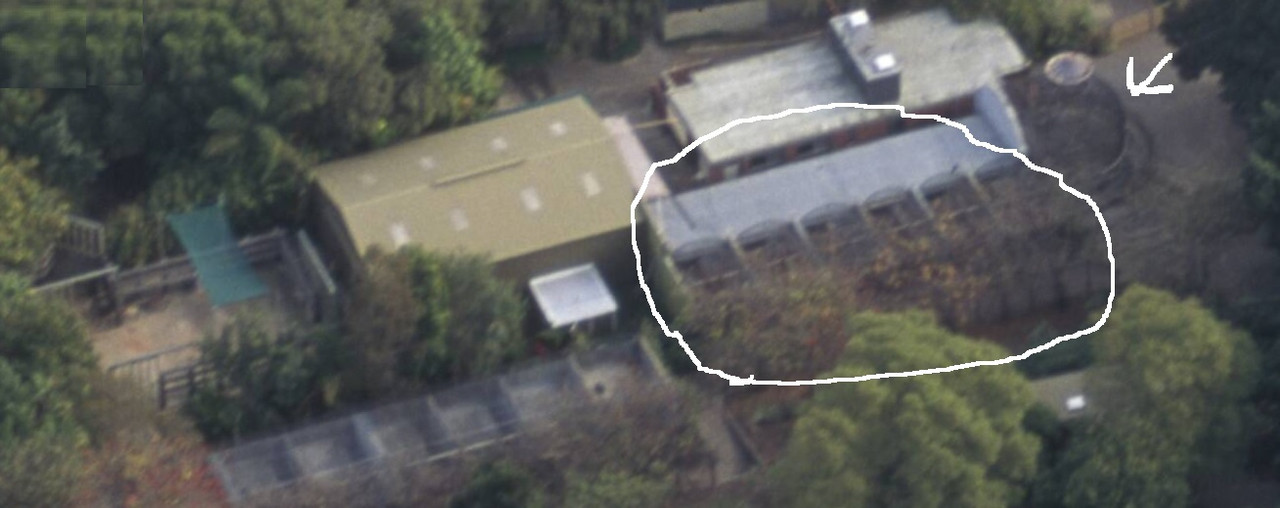
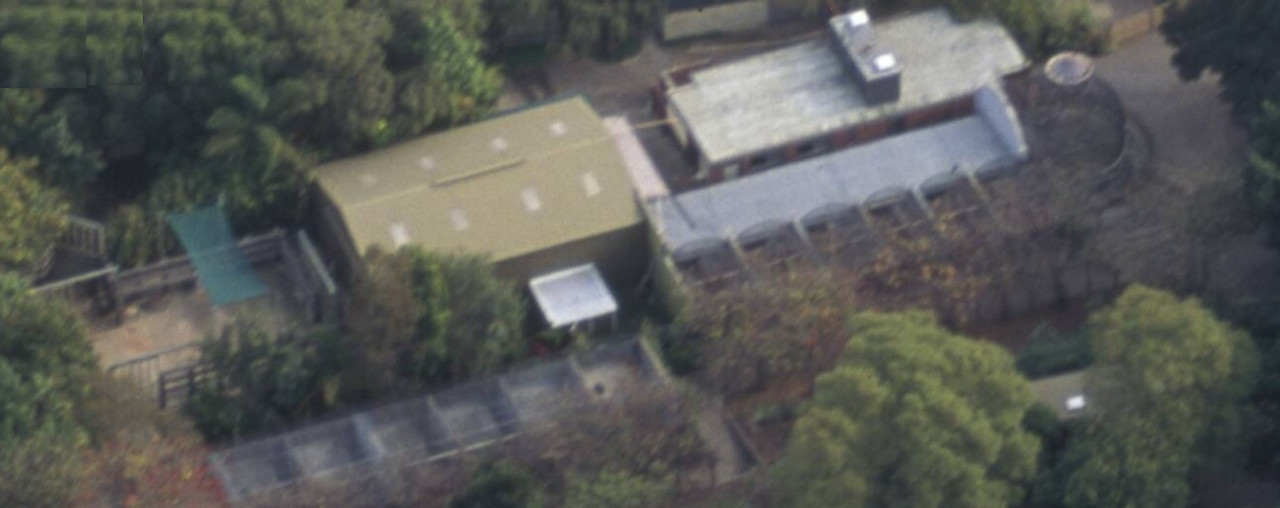
Yeah totally agree with you. Thought was unavoidable encountering between sire and offspring with this situation until recently. For context too, a 1993 aerial of the enclosure row that was their exhibits from 1968-1981 (when photo was taken in 1993 was Gibbons between post 1981 and 1999); the circle is the six enclosures that were female Orangutans (and Jamie & Lollipop the 1.1 Chimpanzees), and the arrow is the Dome enclosure that was Atjeh's exhibit as Dr Markham mentioned in a 2007 interview archived on Sth Perth Library website:

(source: Orangutans exhibits Perth Zoo 1968 to 1981 — Postimages|& Western Australian State Library)

Orangutans-exhibits-Perth-Zoo-1968-to-1981.jpg


Orangs-PZ-1993.jpg
 
Last edited:
@Zoofan15

Yeah totally agree with you. Thought was unavoidable encountering between sire and offspring with this situation until recently. For context too, a 1993 aerial of the enclosure row that was their exhibits from 1968-1981 (when photo was taken in 1993 was Gibbons between post 1981 and 1999); the circle is the six enclosures that were female Orangutans (and Jamie & Lollipop the 1.1 Chimpanzees), and the arrow is the Dome enclosure that was Atjeh's exhibit as Dr Markham mentioned in a 2007 interview archived on Sth Perth Library website:

(source: Orangutans exhibits Perth Zoo 1968 to 1981 — Postimages|& Western Australian State Library)

Orangutans-exhibits-Perth-Zoo-1968-to-1981.jpg


Orangs-PZ-1993.jpg

The opening of the new (current) exhibit was groundbreaking in that it recognised the solitary nature of the species that was overlooked by every other zoo in the region of that time. The prior dedication of multiple (albeit small) exhibits illustrated above indicates this was a necessity in the design of the new exhibit above anything else; but a progressive step nonetheless.

The fact the current complex allows females to observe each other raising young is clearly no accident and again influenced by the past. Since the early offspring were handraised, many had to learn mothering skills (Puteri watching keepers feed a gibbon infant etc). and so instilling a culture of good maternal behaviour was no doubt considered of paramount importance.
 
From the late great very expert Dr Rosemary Markham's research and works with the Orangutans at Perth Zoo for almost 40 years [her paper:
Breeding Orangutans at Perth Zoo: Twenty Years of Appropriate Husbandry published 1990].

(important to note, the life stories and names and date of births and parentage has all very much been elaborated on many times on here; its just adding with additional notes from Dr Markham on dates surrounding).

(**additional: this is partly conjecture surmising, but Dr Markham did mention the famous Dome enclosure on the end of that row {built 1900-1901} was Atjeh's home and based on her writing, it sounds like the female Orangutans went to his exhibit when they cohabitated rather than other way around).

According to Dr Markham the male and female Orangutans were kept separate except where recorded. Dr Markham mentions in her paper that former zoo director of the era Tom Spence was a veterinarian by training, who also kept up to date with research information into Orangutan's solitary natures (and in consultation with Dr Markham's expertees was early in acknowledging that Bornean and Sumatran Orangutans were likely separate species not simply subspecies of same species; albeit breeding between their individuals still until the beginning of 1980s). The Orangutans were kept in a row of seven to eight enclosures (of which the Orangutans had access to 6-7). Now under what is Permai the Asian Elephant's yard (her barns that stand today essentially the back-part of what this row of enclosures was):

Orangutan breeding interactions at Perth Zoo between 1969 and 1981:

Puan 0.1 (Sumatran Orangutan) cohabitated an exhibit with Atjeh 1.0 (Sumatran Orangutan) between October 7th 1969 and November 19th 1969. Believed to have had a successful conception on October 20th 1969 and began avoidance behaviour to one another five days later (October 25th). After a pregnancy gestation of approximately 242 days (212-255 day estimation range). Puan gave birth to Puteri 0.1 on June 12th 1970.

Binte 0.1 (Bornean Orangutan) cohabitated an exhibit with Atjeh 1.0 between February 6th 1970 and March 10th 1970. Believed to have had a successful conception on March 8th 1970 and began avoidance behaviour to one another a day later on March 9th. After a pregnancy gestation of approximately 247 days (245-277 day estimation range). Binte gave birth to Bintang 0.1 on October 9th 1970.


Puan 0.1 again cohabitated an exhibit with Atjeh 1.0 between July 8th 1971 and August 3rd 1971. Believed to have had a successful conception on July 12 1971 and the two began avoidance behaviour five days later on July 17th. After a pregnancy gestation of approximately 255 days (233-259 day estimation range). Puan gave birth to Puntjak 1.0 on March 24th 1972.

Binte 0.1 again cohabitated an exhibit with Atjeh 1.0; it was apparently only for one day, July 31st 1972. After a successful conception on that date and a gestation of 234 days, Binte gave birth to a (hybrid Bornean/Sumatran) male baby on March 22nd 1973. Unfortunately the baby male died the same day.

The exact dates are not recorded except to say for 'several months' Bornean Orangutan Mawas 0.1 cohabitated with (Taronga Zoo born) hybrid Bornean/Sumatran Orangutan Bobby 1.0. A baby (hybrid) female was born August 6th 1973. She unfortunately died the same day.

Puan 0.1 again cohabitated an exhibit with Atjeh 1.0 between January 7th 1983 and an unknown date in July 1973 (wow about 6 months). Additional conception and gestation data was not noted, but on February 25th 1974 Puan gave birth to a baby male Sumatran Orangutan 1.0. Unfortunately the baby died March 8th 1974.

Binte 0.1 again cohabitated an exhibit with Atjeh 1.0 from August 11th - August 30th 1973. After a believed successful conception on August 27th 1973 (followed by avoidance behaviour between the two 2 days later on August 29th) they were again separated on August 30th, and after a gestation of approximately 248 days (245-264 day range), Binte gave birth to a baby female (hybrid) Binar 0.1 in May 5th 1974.

Puan 0.1 again cohabitated an exhibit with Atjeh 1.0 between May 7th - May 28th 1974. After a successful conception on June 26th during that time, followed by avoidance behaviour between the two a day later on the 27th (additionally Puan's day of last menses also dated as May 12th) and a gestation estimate of 248 days (245-264 days); Puan gave birth to female baby Puspa 0.1 on January 30th 1975.

Binte 0.1 again cohabitated an exhibit with Atjeh 1.0 between April 4th-April 24th 1975. After a successful conception on April 12th, and a gestation of approximately 241 days (229-249 day estimation range); Binte gave birth to a hybrid Bornean-Sumatran female baby Bini 0.1 on December 9th 1975.

Mawas 0.1 cohabitated an exhibit with Atjeh 1.0 for one day on 20th October 1975. Successful conception occured and after a gestation of 229 days; Mawas gave birth to a hybrid Bornean-Sumatran male baby Majizat on June 26th 1976.

Puan 0.1 again cohabitated an exhibit with Atjeh 1.0 between April 7th - May 20th 1976. After successful conception on April 7th 1976 followed by avoidance behaviour between the two sometime in April after that date (and a gestation of about 246 days {223-255 day range]); Puan gave birth to another female baby (Sumatran Orangutan) Puas 0.1 on December 12th 1976 (exactly a year after Bini 0.1 was born to Binte). Unfortunately Puas died June 16th 1978.

Puan 0.1 again cohabitated an exhibit with Atjeh 1.0, for one day on July 10th 1977. After a successful conception and a gestation of 230 days; Puan gave birth to another male baby (Sumatran Orangutan) Pusung 1.0 on February 2th 1978 (second baby male Puan had who was born on 25th February).

Bintang 0.1 cohabitated an exhibit with (her sire) Atjeh 1.0 from May 13th - June 13th 1978. After a successful conception between June 6th-12th 1978 and a gestation of approximately 224 days; Bintang gave birth to a (hybrid Bornean-Sumatran Orangutan) female baby Indah 0.1 on either the 22nd or 25th 1979.

Puteri 0.1 cohabitated an exhibit with (her sire) Atjeh 1.0 from October 8th - November 19th 1978. After a successful conception between October 18th-20th during that time and a gestation of approximately 244 days; Puteri gave birth to a female baby (Sumatran) Utama 0.1 on June 19th 1979.

Binte 0.1 again cohabitated an exhibit with Atjeh 1.0 between February 28th - March 4th 1979. After a succesful conception between 28th Feb - 1st March and a gestation of approximately 223 days; Binte gave birth to a (hybrid Bornean-Sumatran) male baby Bingkis 1.0 on October 9th 1979.

Puan 0.1 again cohabitated an exhibit with Atjeh 1.0 (for a lengthy time) between April 9th - October 19th 1979. Conception was achieved between 18th-20th 1979 and avoidance between the two began on October 21st. After a gestation of approximately 261 days; Puan gave birth to female baby Putik 0.1 on January 15th 1980. Unfortunately Putik died on September 10th that year.

Puan 0.1 again cohabitated with Atjeh 1.0 for two days between September 26th-28th 1980. Conception happened and after a gestation of approximately 252 days, Puan gave birth to female baby Punya 0.1 on June 5th 1981.

Puteri 0.1 cohabitated an exhibit with her brother Puntjak 1.0 between April 12th 1981 and August 28th 1981. Between April 15h-17th her gestation started (and avoidance on the 18th April) and after approximately 238 days; Puteri gave birth to her second baby male on December 10th 1981 (born in the new exhibit complex opened to them in August/September 1981 just after her cohabitation with Puntjak ceased). Unfortunately the baby male died 10 days later on December 20th of that year.

tbc
(the original structure of their current exhibits {except several new ones built ≈20 years ago} was completed and became their home between August-September 1981)

Thank you so much for this information, @steveroberts ! Some very thorough research, and a fascinating insight as to how zoos managed breeding in the past, which is quite a contrast to today's practices!
 
From the late great very expert Dr Rosemary Markham's research and works with the Orangutans at Perth Zoo for almost 40 years [her paper:
Breeding Orangutans at Perth Zoo: Twenty Years of Appropriate Husbandry published 1990].

(important to note, the life stories and names and date of births and parentage has all very much been elaborated on many times on here; its just adding with additional notes from Dr Markham on dates surrounding).

(**additional: this is partly conjecture surmising, but Dr Markham did mention the famous Dome enclosure on the end of that row {built 1900-1901} was Atjeh's home and based on her writing, it sounds like the female Orangutans went to his exhibit when they cohabitated rather than other way around).

According to Dr Markham the male and female Orangutans were kept separate except where recorded. Dr Markham mentions in her paper that former zoo director of the era Tom Spence was a veterinarian by training, who also kept up to date with research information into Orangutan's solitary natures (and in consultation with Dr Markham's expertees was early in acknowledging that Bornean and Sumatran Orangutans were likely separate species not simply subspecies of same species; albeit breeding between their individuals still until the beginning of 1980s). The Orangutans were kept in a row of seven to eight enclosures (of which the Orangutans had access to 6-7). Now under what is Permai the Asian Elephant's yard (her barns that stand today essentially the back-part of what this row of enclosures was):

Orangutan breeding interactions at Perth Zoo between 1969 and 1981:

Puan 0.1 (Sumatran Orangutan) cohabitated an exhibit with Atjeh 1.0 (Sumatran Orangutan) between October 7th 1969 and November 19th 1969. Believed to have had a successful conception on October 20th 1969 and began avoidance behaviour to one another five days later (October 25th). After a pregnancy gestation of approximately 242 days (212-255 day estimation range). Puan gave birth to Puteri 0.1 on June 12th 1970.

Binte 0.1 (Bornean Orangutan) cohabitated an exhibit with Atjeh 1.0 between February 6th 1970 and March 10th 1970. Believed to have had a successful conception on March 8th 1970 and began avoidance behaviour to one another a day later on March 9th. After a pregnancy gestation of approximately 247 days (245-277 day estimation range). Binte gave birth to Bintang 0.1 on October 9th 1970.


Puan 0.1 again cohabitated an exhibit with Atjeh 1.0 between July 8th 1971 and August 3rd 1971. Believed to have had a successful conception on July 12 1971 and the two began avoidance behaviour five days later on July 17th. After a pregnancy gestation of approximately 255 days (233-259 day estimation range). Puan gave birth to Puntjak 1.0 on March 24th 1972.

Binte 0.1 again cohabitated an exhibit with Atjeh 1.0; it was apparently only for one day, July 31st 1972. After a successful conception on that date and a gestation of 234 days, Binte gave birth to a (hybrid Bornean/Sumatran) male baby on March 22nd 1973. Unfortunately the baby male died the same day.

The exact dates are not recorded except to say for 'several months' Bornean Orangutan Mawas 0.1 cohabitated with (Taronga Zoo born) hybrid Bornean/Sumatran Orangutan Bobby 1.0. A baby (hybrid) female was born August 6th 1973. She unfortunately died the same day.

Puan 0.1 again cohabitated an exhibit with Atjeh 1.0 between January 7th 1983 and an unknown date in July 1973 (wow about 6 months). Additional conception and gestation data was not noted, but on February 25th 1974 Puan gave birth to a baby male Sumatran Orangutan 1.0. Unfortunately the baby died March 8th 1974.

Binte 0.1 again cohabitated an exhibit with Atjeh 1.0 from August 11th - August 30th 1973. After a believed successful conception on August 27th 1973 (followed by avoidance behaviour between the two 2 days later on August 29th) they were again separated on August 30th, and after a gestation of approximately 248 days (245-264 day range), Binte gave birth to a baby female (hybrid) Binar 0.1 in May 5th 1974.

Puan 0.1 again cohabitated an exhibit with Atjeh 1.0 between May 7th - May 28th 1974. After a successful conception on June 26th during that time, followed by avoidance behaviour between the two a day later on the 27th (additionally Puan's day of last menses also dated as May 12th) and a gestation estimate of 248 days (245-264 days); Puan gave birth to female baby Puspa 0.1 on January 30th 1975.

Binte 0.1 again cohabitated an exhibit with Atjeh 1.0 between April 4th-April 24th 1975. After a successful conception on April 12th, and a gestation of approximately 241 days (229-249 day estimation range); Binte gave birth to a hybrid Bornean-Sumatran female baby Bini 0.1 on December 9th 1975.

Mawas 0.1 cohabitated an exhibit with Atjeh 1.0 for one day on 20th October 1975. Successful conception occured and after a gestation of 229 days; Mawas gave birth to a hybrid Bornean-Sumatran male baby Majizat on June 26th 1976.

Puan 0.1 again cohabitated an exhibit with Atjeh 1.0 between April 7th - May 20th 1976. After successful conception on April 7th 1976 followed by avoidance behaviour between the two sometime in April after that date (and a gestation of about 246 days {223-255 day range]); Puan gave birth to another female baby (Sumatran Orangutan) Puas 0.1 on December 12th 1976 (exactly a year after Bini 0.1 was born to Binte). Unfortunately Puas died June 16th 1978.

Puan 0.1 again cohabitated an exhibit with Atjeh 1.0, for one day on July 10th 1977. After a successful conception and a gestation of 230 days; Puan gave birth to another male baby (Sumatran Orangutan) Pusung 1.0 on February 2th 1978 (second baby male Puan had who was born on 25th February).

Bintang 0.1 cohabitated an exhibit with (her sire) Atjeh 1.0 from May 13th - June 13th 1978. After a successful conception between June 6th-12th 1978 and a gestation of approximately 224 days; Bintang gave birth to a (hybrid Bornean-Sumatran Orangutan) female baby Indah 0.1 on either the 22nd or 25th 1979.

Puteri 0.1 cohabitated an exhibit with (her sire) Atjeh 1.0 from October 8th - November 19th 1978. After a successful conception between October 18th-20th during that time and a gestation of approximately 244 days; Puteri gave birth to a female baby (Sumatran) Utama 0.1 on June 19th 1979.

Binte 0.1 again cohabitated an exhibit with Atjeh 1.0 between February 28th - March 4th 1979. After a succesful conception between 28th Feb - 1st March and a gestation of approximately 223 days; Binte gave birth to a (hybrid Bornean-Sumatran) male baby Bingkis 1.0 on October 9th 1979.

Puan 0.1 again cohabitated an exhibit with Atjeh 1.0 (for a lengthy time) between April 9th - October 19th 1979. Conception was achieved between 18th-20th 1979 and avoidance between the two began on October 21st. After a gestation of approximately 261 days; Puan gave birth to female baby Putik 0.1 on January 15th 1980. Unfortunately Putik died on September 10th that year.

Puan 0.1 again cohabitated with Atjeh 1.0 for two days between September 26th-28th 1980. Conception happened and after a gestation of approximately 252 days, Puan gave birth to female baby Punya 0.1 on June 5th 1981.

Puteri 0.1 cohabitated an exhibit with her brother Puntjak 1.0 between April 12th 1981 and August 28th 1981. Between April 15h-17th her gestation started (and avoidance on the 18th April) and after approximately 238 days; Puteri gave birth to her second baby male on December 10th 1981 (born in the new exhibit complex opened to them in August/September 1981 just after her cohabitation with Puntjak ceased). Unfortunately the baby male died 10 days later on December 20th of that year.

tbc
(the original structure of their current exhibits {except several new ones built ≈20 years ago} was completed and became their home between August-September 1981)

This is so fascinating, thank you for sharing! As others have said, it's interesting to know that Puteri was deliberately bred with her father and brother, rather than these being accidental matings as a result of sharing the same exhibit with her parents or a contraception failure. I suppose these would have been the only viable males at the zoo, despite being related.
 
This is so fascinating, thank you for sharing! As others have said, it's interesting to know that Puteri was deliberately bred with her father and brother, rather than these being accidental matings as a result of sharing the same exhibit with her parents or a contraception failure. I suppose these would have been the only viable males at the zoo, despite being related.

Perth Zoo received an unrelated hybrid male from Taronga Zoo in 1968. Bobby was born 1964 at Taronga Zoo and lived at Perth Zoo until 1976, when he was sent to Melbourne Zoo. He returned four years later in 1980; and was then exported to Hyderabad Zoo in 1986.

Bobby’s only offspring at Perth Zoo was a stillborn infant to Mawas in 1973. They didn’t cease breeding hybrids until 1979, so why he didn’t sire more infants prior to his move to Melbourne is a mystery. He sired the twins at Melbourne in 1978 (Bono and Suma).

Aside from the inbreeding with Puteri and her father/brother, I’m also aware of Horst, who bred with his half-sister Dara at Auckland Zoo. They apparently undertook DNA testing to confirm he was the sire of Intan and Isim (not Charlie); which suggests while it was unlikely Charlie would have sired Intan/Datuk at the age of seven, they weren’t intentionally trying to inbreed Horst/Dara. They went to extreme lengths to ensure Dara bred with Charlie (the unrelated male) for her next pregnancy in 1999/2000.
 
Thanks so much guys. Just thought was worth putting down what have learned from Dr Rosemary Markham's writings and interview archived on Sth Perth library. A fascinating person who did so so much for Perth Zoo, the Orangutans in particular were her passion from everything have learnt (was her doctorate focus and she was an early expert on their behaviours and the separate species. She could apparently tell them apart by looking at their hair under a microscope and told former director Dr Tom Spence that they had some hybrids in their 'collection'; so believe she was the identifier of which species Puan, Atjeh, Binte and Mawas belonged to). Believe too she was instrumental in their setup of their current exhibits too (as with their 1981 ones, though she said the public works architect had some stubborn ideas so didnt get quite the completed setup in the full facilitation she had hoped for; though not said by her with any complaints, think she was also just happy the Orangutans had better living spaces to the original row). Dr Markham had an approximately 40 year involvement with Perth Zoo (highly recommend her interview audio for listening).

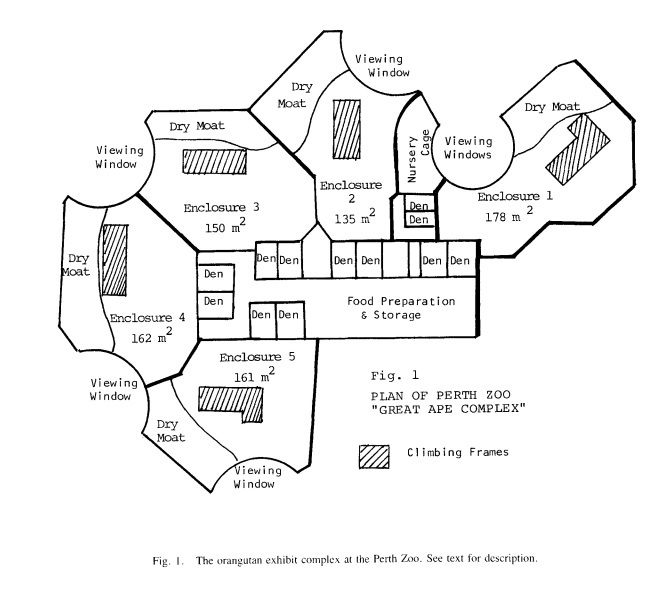
(sources below again all from Dr Markham's Breeding Orangutans at Perth Zoo: Twenty Years of Appropriate Husbandry {1990} paper, including the diagram of the complex)

In (August-September) 1981 the (Perth Zoo) zoo's ''Great Ape'' exhibits complex was completed and the Orangutans (and two 1.1 Chimpanzees) moved into the five exhibits.

Interestingly Dr Markham mentions that Puteri 0.1 the oldest Perth Zoo born Orangutan was shown by keepers nurturing skills on a baby Gibbon (not sure which species) in order to teach them the mothering techniques they themselves did not receive due to the practice of removing the Orangutan babies at a young age to be hand raised by keepers like Peter & Yoka Leeflang, due to a strongyloides infection problem in the ground of the old exhibits. Apparently Puspa 0.1 her younger sister stayed with her at times in her den to watch her mothering skills and be taught the same for their own babies. I believe Puan mother raised Punya; it is said that the hand rearing stopped with babies after the new exhibits, however will have to go back and find exactly when this occured as medication treatment for the strongyloides also occurred around this time so not sure when was successful (have a good feeling one of you guys know and can tell us :)):

(additionally perhaps all of the Bornean Orangutans and hybrid Orangutans stayed behind in the old exhibits, soon after over a number of short years, dates have been mentioned on here by our amigos, they went to live at zoos in India. Dr Markham was one of the team who personally went to India to decide which zoos had the best/most humane facilities of which Hyderabad Zoo and Poona Zoo were amongst the chosen).

Anywho so Aug'/Sep' 1971 the new complex opened and each individual Orangutan had their own night den where they were fed in the mornings and only mothers and infants shared dens. The daytime exhibits were on a bit of a time share thing where females would occasionally co-habitate an exhibit together (sounded like it was a fraction of the time only) and any signs of disputes between, separation for about three or four days would often dissolve signs of conflict issues between. Females would stay with males for short periods during planned breeding attempts. Heard information on here that for quite some time Mawas 0.1 was something of a surrogate aunt to 'teenage' Orangutans in the complex; and that Hsing Hsing 1.0 had a good bond with Utama 0.1 so wonder if that means they were housed together for quite lengthy periods of time? :

source: Orangutan Exhibit Complex '' Great Apes'' at Perth Zoo opened 1981 — Postimages (diagram is from Dr Markham's 1990 paper referenced above):

Orangutan-Exhibit-Complex-Great-Apes-at-Perth-Zoo-opened-1981.jpg


From October 1st 1982 - February 18th 1983 Puteri 0.1 again co-habitated an exhibit in the new complex with (her sire) Atjeh 1.0. After a gestation period of approximately 234 (232-238) days (avoidance between the two noted to have started on November 6th 1982): Puteri gave birth to a female baby (Sumatran Orangutan) on June 24th 1983. Unfortunately the baby died just over a month later on July 26th 1983.

On September 23, 1983, male Sumatran Orangutan Hsing Hsing 1.0 (born Singapore Zoo April 4th 1975) arrived at Perth Zoo. (thanks @Zoofan15 for the dates :)).

Once again Puteri 0.1 co-habitated with Atjeh 1.0 from May 14th 1986 - July 2nd 1986. After a gestation of 225 days starting on June 26th 1986 (avoidance behaviour began two days later on the 28th); Puteri gave birth to a female baby Udara 0.1 on February 6th 1987. I think perhaps this was one of the earlier pregnancies that involved pregnancy testing and such. Unfortunately Udara died just over four and a half years later on September 7th 1991.

From August 11th 1986 - March 3rd 1987, Puan 0.1 (and possibly infant Punya 0.1 with her) co-habitated an exhibit with Atjeh 1.0. After a 247 day gestation beginning on January 19th 1987 (avoidance between Puan and Atjeh began the next day the 20th Jan); Puan gave birth to another male baby Sumatran Orangutan named Puluh 1.0 on September 23rd 1987 (funnily enough 4 years to the day after Hsing Hsing {'Sing-'Sing} arrived at Perth Zoo).

Puluh's birth was the most recent at the time Dr Markham published her paper.

(in March 1992, Jamie 1.0 & Lollipop 0.2, Perth Zoo's two Chimpanzees were exported to live at Hyderabad Zoo in India, hence the daytime exhibits of the zoo's Orangutans were increased from four exhibits to five exhibits).
 
Last edited:
Thanks so much guys. Just thought was worth putting down what have learned from Dr Rosemary Markham's writings and interview archived on Sth Perth library. A fascinating person who did so so much for Perth Zoo, the Orangutans in particular were her passion from everything have learnt (was her doctorate focus and she was an early expert on their behaviours and the separate species. She could apparently tell them apart by looking at their hair under a microscope and told former director Dr Tom Spence that they had some hybrids in their 'collection'; so believe she was the identifier of which species Puan, Atjeh, Binte and Mawas belonged to). Believe too she was instrumental in their setup of their current exhibits too (as with their 1981 ones, though she said the public works architect had some stubborn ideas so didnt get quite the completed setup in the full facilitation she had hoped for; though not said by her with any complaints, think she was also just happy the Orangutans had better living spaces to the original row). Dr Markham had an approximately 40 year involvement with Perth Zoo (highly recommend her interview audio for listening).

(sources below again all from Dr Markham's Breeding Orangutans at Perth Zoo: Twenty Years of Appropriate Husbandry {1990} paper, including the diagram of the complex)

In (August-September) 1981 the (Perth Zoo) zoo's ''Great Ape'' exhibits complex was completed and the Orangutans (and two 1.1 Chimpanzees) moved into the five exhibits.

Interestingly Dr Markham mentions that Puteri 0.1 the oldest Perth Zoo born Orangutan was shown by keepers nurturing skills on a baby Gibbon (not sure which species) in order to teach them the mothering techniques they themselves did not receive due to the practice of removing the Orangutan babies at a young age to be hand raised by keepers like Peter & Yoka Leeflang, due to a strongyloides infection problem in the ground of the old exhibits. Apparently Puspa 0.1 her younger sister stayed with her at times in her den to watch her mothering skills and be taught the same for their own babies. I believe Puan mother raised Punya; it is said that the hand rearing stopped with babies after the new exhibits, however will have to go back and find exactly when this occured as medication treatment for the strongyloides also occurred around this time so not sure when was successful (have a good feeling one of you guys know and can tell us :)):

(additionally perhaps all of the Bornean Orangutans and hybrid Orangutans stayed behind in the old exhibits, soon after over a number of short years, dates have been mentioned on here by our amigos, they went to live at zoos in India. Dr Markham was one of the team who personally went to India to decide which zoos had the best/most humane facilities of which Hyderabad Zoo and Poona Zoo were amongst the chosen).

Anywho so Aug'/Sep' 1971 the new complex opened and each individual Orangutan had their own night den where they were fed in the mornings and only mothers and infants shared dens. The daytime exhibits were on a bit of a time share thing where females would occasionally co-habitate an exhibit together (sounded like it was a fraction of the time only) and any signs of disputes between, separation for about three or four days would often dissolve signs of conflict issues between. Females would stay with males for short periods during planned breeding attempts. Heard information on here that for quite some time Mawas 0.1 was something of a surrogate aunt to 'teenage' Orangutans in the complex; and that Hsing Hsing 1.0 had a good bond with Utama 0.1 so wonder if that means they were housed together for quite lengthy periods of time? :

source: Orangutan Exhibit Complex '' Great Apes'' at Perth Zoo opened 1981 — Postimages (diagram is from Dr Markham's 1990 paper referenced above):

Orangutan-Exhibit-Complex-Great-Apes-at-Perth-Zoo-opened-1981.jpg


From October 1st 1982 - February 18th 1983 Puteri 0.1 again co-habitated an exhibit in the new complex with (her sire) Atjeh 1.0. After a gestation period of approximately 234 (232-238) days (avoidance between the two noted to have started on November 6th 1982): Puteri gave birth to a female baby (Sumatran Orangutan) on June 24th 1983. Unfortunately the baby died just over a month later on July 26th 1983.

On September 23, 1983, male Sumatran Orangutan Hsing Hsing 1.0 (born Singapore Zoo April 4th 1975) arrived at Perth Zoo. (thanks @Zoofan15 for the dates :)).

Once again Puteri 0.1 co-habitated with Atjeh 1.0 from May 14th 1986 - July 2nd 1986. After a gestation of 225 days starting on June 26th 1986 (avoidance behaviour began two days later on the 28th); Puteri gave birth to a female baby Udara 0.1 on February 6th 1987. I think perhaps this was one of the earlier pregnancies that involved pregnancy testing and such. Unfortunately Udara died just over four and a half years later on September 7th 1991.

From August 11th 1986 - March 3rd 1987, Puan 0.1 (and possibly infant Punya 0.1 with her) co-habitated an exhibit with Atjeh 1.0. After a 247 day gestation beginning on January 19th 1987 (avoidance between Puan and Atjeh began the next day the 20th Jan); Puan gave birth to another male baby Sumatran Orangutan named Puluh 1.0 on September 23rd 1987 (funnily enough 4 years to the day after Hsing Hsing {'Sing-'Sing} arrived at Perth Zoo).

Puluh's birth was the most recent at the time Dr Markham published her paper.

(in March 1992, Jamie 1.0 & Lollipop 0.2, Perth Zoo's two Chimpanzees were exported to live at Hyderabad Zoo in India, hence the daytime exhibits of the zoo's Orangutans were increased from four exhibits to five exhibits).

Thanks for uploading this @steveroberts.

You’re correct that Punya (1981) was Puan’s first mother raised infant. Puan produced 10 offspring at Perth Zoo, which was a notably high number attributed to the removal of many of them for hand-raising. The birth interval following the birth of Punya (and Puluh) was therefore much longer than previous birth intervals.

I thought it’d be fun to calculate the birth intervals between Puan’s offspring, which are as follows:

1. Puteri (12/06/1970) 1 year, 9 months, 12 days
2. Puntjak (24/03/1972) 1 year, 11 months, 1 day
3. Unnamed (25/02/1974) 11 months, 5 days
4. Puspa (30/01/1975) 1 year, 10 months, 10 days
5. Puas (09/12/1976) 1 year, 2 months, 16 days
6. Pusung (25/02/1978) 1 year, 10 months, 21 days
7. Putik (15/01/1980) 1 year, 4 months, 21 days
8. Punya (05/06/1981) 6 years, 3 months, 17 days
9. Puluh (23/09/1987) 6 years, 2 months, 28 days
10. Pulang (21/12/1993) N/A (final infant)
 
Madju, Bornean orangutan born at Auckland Zoo, and now resident at Busch Gardens, Florida, has become the father of a baby girl. This very genetically valuable infant is the granddaughter of Charlie and Melur of Auckland Zoo, and the niece of two-year old Bahmi:

(2) It’s a girl! We are thrilled to... - Busch Gardens Tampa Bay | Facebook

That’s fantastic news. Madju (2005) remains the only Auckland bred orangutan to produce offspring. Intan (1989-2013) and Datuk (1989-1998) died without producing offspring; Isim (1994) has yet to sire a surviving infant; and a further three Auckland bred infants were stillborn or died as neonates.

That said, I’m sure Bahmi (2022) has a bright future ahead of him with regards to breeding. Even with the birth of his niece in Tampa, he remains a genetically valuable animal and it’s hard not to imagine him being paired with Daya (2012) in years to come.
 
Madju, Bornean orangutan born at Auckland Zoo, and now resident at Busch Gardens, Florida, has become the father of a baby girl. This very genetically valuable infant is the granddaughter of Charlie and Melur of Auckland Zoo, and the niece of two-year old Bahmi:

(2) It’s a girl! We are thrilled to... - Busch Gardens Tampa Bay | Facebook

Beautiful news, thank you for sharing! It's lovely to know Madju has a daughter. Hopefully the reunion of mother and baby will go smoothly. Seems like something of a dramatic delivery with a c-section required, but good to know that mother and baby are currently in as good health as could be expected in the circumstances.

Although I do note, the American inclination to pop a giant bow on a baby's head just to make sure we know she's a girl seems to extend to orangutans.... :p although I'll give them the benefit of the doubt that it might have been to keep the infant's head warm when she wasn't able to fully snuggle with her mama.
 
That’s fantastic news. Madju (2005) remains the only Auckland bred orangutan to produce offspring. Intan (1989-2013) and Datuk (1989-1998) died without producing offspring; Isim (1994) has yet to sire a surviving infant; and a further three Auckland bred infants were stillborn or died as neonates.

That said, I’m sure Bahmi (2022) has a bright future ahead of him with regards to breeding. Even with the birth of his niece in Tampa, he remains a genetically valuable animal and it’s hard not to imagine him being paired with Daya (2012) in years to come.

I hope all goes well with this infant, considering her dramatic arrival into the world, and am hoping for a speedy recovery for mother and baby and a happy reunion soon with Madju, who I am sure will be a great father! With the tragic loss of Madju and Luna's first offspring, son Malu, a lot of hopes for the future of the species will be on this little one. She has to be the jewel of the seven kingdoms when it comes to Bornean orangutans, as a female in Charlie's line! Bahmi, too, of course remains valuable and I hope to see him sire offspring with Daya and possibly another female in the future (he certainly seems to show more interest in her at the moment than Charlie does! :p)

@Abbey - I see what you mean about the bow. I assumed it was because they needed to keep the baby's head warm, but it's quite the coincidence that it just happened to be pink, right? :p
 
Back
Top