Australasian Sumatran Tiger Population

Fascinating conversation!

Given it's meaning and being a term of endearment, I'm surprised that Sayang isn't used more. Maybe it's an option for Perth with their S line of orangutans, although it was used at Adelaide for one of the late Karta's infants, who died a few days after birth.

Kemiri is one of Taronga's current (male) binturongs, and while there's a difference between a female tiger in the 90s from Sydney and a male binturong in the 2020s from Perth, I do think of the tiger every time I hear the name.

I too am surprised Sayang isn't used more, although ad you've mentioned, it's been given to orangutans several times. I believe one of the famous Ah Meng's daughters at Singapore Zoo was named Sayang.
 
Kemiri:

Kemiri enjoyed a very high profile, especially in her first year of life. Her birth was much anticipated, with articles reporting on Shiva and Selatan’s road to parenthood, which was complicated by Selatan’s irregular cycles. The announcement of Selatan’s pregnancy was a momentous occasion, being the first anticipated birth of Sumatran tiger cubs at Taronga Zoo in six years; and the first in Australia since Selatan had been born four years prior.

Even the stillbirth of her twin brother or the removal of Kemiri for hand raising did little to dampen spirits; with the overall mood being that of celebration Kemiri had survived. She was named by the wife of the then New South Wales Premier in a ceremony held at the zoo.

I thought of Kemiri recently when Zayana’s first pregnancy at Auckland Zoo had the same outcome as Selatan’s in 1994, with one cub being stillborn. Allowing nature to take its course is now recognised as the best welfare policy and so no intervention occurred. Had the same practice been applied to Selatan (whose milk had dried up), it’s clear Kemiri wouldn’t have survived. No judgement of either zoo/policy, merely an observation.

Whether to intervene or not is a difficult decision to make. I think that Auckland Zoo staff may be more reluctant to choose hand-rearing animals because of the sad outcome for Iwani, the siamang gibbon. And it would explain why they're taking a slow and cautious approach with the introduction of young Bornean orangutan female Daya, as very young mothers are more likely to reject infants or struggle to care for them. (Although in the case of great apes it's often easier to find foster mothers among their own kind, rather than resorting to human-raising - Dudley Zoo, for example, has young mother orangutan Sprout's baby son being cared for by Sprout's mother, Jazz, who also has an infant son. Seeing one female carrying two babies has caused quite a sensation!)

I can understand how hand-rearing a carnivore, such as a tiger, might be more difficult and fraught, so I see why Auckland let nature take its course with the first tiger birth, distressing as the idea may be to some.
 
Whether to intervene or not is a difficult decision to make. I think that Auckland Zoo staff may be more reluctant to choose hand-rearing animals because of the sad outcome for Iwani, the siamang gibbon. And it would explain why they're taking a slow and cautious approach with the introduction of young Bornean orangutan female Daya, as very young mothers are more likely to reject infants or struggle to care for them. (Although in the case of great apes it's often easier to find foster mothers among their own kind, rather than resorting to human-raising - Dudley Zoo, for example, has young mother orangutan Sprout's baby son being cared for by Sprout's mother, Jazz, who also has an infant son. Seeing one female carrying two babies has caused quite a sensation!)

I can understand how hand-rearing a carnivore, such as a tiger, might be more difficult and fraught, so I see why Auckland let nature take its course with the first tiger birth, distressing as the idea may be to some.

Yes, the zoo emphasised the importance of the cubs being mother raised with regards to their socialisation. These cubs are genetically valuable and will one day be paired with mates for breeding. To not equip them with adequate socialisation is setting them up to fail. There’s been several incidences around the world of hand-raised females failing to breed; or worse, being killed their mates.

The coincidence of Zayana and Kirana giving birth 24 hours apart meant there could have been the potential to attempt cross-fostering. Previously, peer-raising of Sumatran tiger cubs has taken place at Dreamworld and Australia Zoo, with many of these successfully breeding.

I agree in this day and age, zoos are more mindful of the legacy of issues hand-raising an individual can have - especially long-lived species. Auckland Zoo made a difficult decision, but the end result is that Zayana gave birth to another litter four months later that will now stand the best chance of learning all the necessary skills to be a tiger. Having opposite sex siblings apparently stands cubs in the best stead
 
Yes, the zoo emphasised the importance of the cubs being mother raised with regards to their socialisation. These cubs are genetically valuable and will one day be paired with mates for breeding. To not equip them with adequate socialisation is setting them up to fail. There’s been several incidences around the world of hand-raised females failing to breed; or worse, being killed their mates.

The coincidence of Zayana and Kirana giving birth 24 hours apart meant there could have been the potential to attempt cross-fostering. Previously, peer-raising of Sumatran tiger cubs has taken place at Dreamworld and Australia Zoo, with many of these successfully breeding.

I agree in this day and age, zoos are more mindful of the legacy of issues hand-raising an individual can have - especially long-lived species. Auckland Zoo made a difficult decision, but the end result is that Zayana gave birth to another litter four months later that will now stand the best chance of learning all the necessary skills to be a tiger. Having opposite sex siblings apparently stands cubs in the best stead

Cross-fostering could have been a viable option if a single cub was born in either situation, but thankfully all was well with both Hamilton and Auckland's cubs. It will be fascinating to see what gender combination Hamilton has - will be watching social media for any announcement!
 
Size of male tigers:

An interesting comment was made in this article following Ketambe’s recent operation regarding his size; and that of his father, who’s apparently one of the largest males in Australasia:


Cat-astrophe avoided for tiger cub Ketambe - Adelaide Zoo


Ketambe is easy to spot. He’s really big and by far the biggest cub. He’s taken after his Dad, Kembali who is one of the biggest male Sumatran Tigers in Australasia.

Kembali in turn appears to take after his father, who was noted to weigh 135kg in 2008 (aged four years); and was even heavier upon his import into the region in 2006 as an almost two year old.

Rokan (1996) and Jaka (2000) were much lighter - around 110kg from memory; with their father Jambi (1988) noted to have been around 120kg.
 
Size of male tigers:

An interesting comment was made in this article following Ketambe’s recent operation regarding his size; and that of his father, who’s apparently one of the largest males in Australasia:


Cat-astrophe avoided for tiger cub Ketambe - Adelaide Zoo


Ketambe is easy to spot. He’s really big and by far the biggest cub. He’s taken after his Dad, Kembali who is one of the biggest male Sumatran Tigers in Australasia.

Kembali in turn appears to take after his father, who was noted to weigh 135kg in 2008 (aged four years); and was even heavier upon his import into the region in 2006 as an almost two year old.

Rokan (1996) and Jaka (2000) were much lighter - around 110kg from memory; with their father Jambi (1988) noted to have been around 120kg.

Zayana's maternal side of the family has very large males weighing around 325-330 pounds (around 147-149kg), so perhaps the male Auckland cub will take after them.
 
Hamilton Zoo - Cub Health Check

Following a health check, Hamilton Zoo’s tiger cubs have been sexed with visitors invited to guess whether they’re male or female.

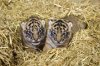
Due to the size disparity, my guess is a male (left) and female (right). For comparison, Auckland’s cubs weigh 3kg (male) and 2.3kg (female).

upload_2024-1-19_13-37-7.jpeg
 

Attachments

  • upload_2024-1-19_13-37-7.jpeg
    upload_2024-1-19_13-37-7.jpeg
    106.3 KB · Views: 91
Hamilton Zoo - Cub Health Check

Following a health check, Hamilton Zoo’s tiger cubs have been sexed with visitors invited to guess whether they’re male or female.

Due to the size disparity, my guess is a male (left) and female (right). For comparison, Auckland’s cubs weigh 3kg (male) and 2.3kg (female).

View attachment 680653

My guess was male and female too. They are certainly an attractive, healthy looking pair!
 
My guess was male and female too. They are certainly an attractive, healthy looking pair!

It’s interesting how different their markings are. Hamilton’s predicted female has much bolder markings versus the predicted male, which has a symmetrical paper plane shaped marking above his nose.

———————

The difference in markings is similarly evident between Auckland’s twins, with one having extremely bold marking on the forehead compared to the other. These will be useful identifiers as the cubs grow.

upload_2024-1-19_15-54-4.jpeg
upload_2024-1-19_15-54-24.jpeg
Source: Auckland Zoo’s socials
 

Attachments

  • upload_2024-1-19_15-54-4.jpeg
    upload_2024-1-19_15-54-4.jpeg
    52.1 KB · Views: 92
  • upload_2024-1-19_15-54-24.jpeg
    upload_2024-1-19_15-54-24.jpeg
    35.9 KB · Views: 86
It’s interesting how different their markings are. Hamilton’s predicted female has much bolder markings versus the predicted male, which has a symmetrical paper plane shaped marking above his nose.

———————

The difference in markings is similarly evident between Auckland’s twins, with one having extremely bold marking on the forehead compared to the other. These will be useful identifiers as the cubs grow.

View attachment 680654
View attachment 680655
Source: Auckland Zoo’s socials

That's interesting, thanks for pointing that out!
 
Hamilton Zoo Update

Kirana’s cubs have been sexed as two females!

We herby start 2024 with the addition of 1.3 cubs to the regional breeding programme:

Auckland Zoo:

1.0 Unnamed (02/01/2024) Ramah x Zayana
0.1 Unnamed (02/01/2024) Ramah x Zayana

Hamilton Zoo:

0.1 Unnamed (03/01/2024) Scout x Kirana
 
Hamilton Zoo Update

Kirana’s cubs have been sexed as two females!

We herby start 2024 with the addition of 1.3 cubs to the regional breeding programme:

Auckland Zoo:

1.0 Unnamed (02/01/2024) Ramah x Zayana
0.1 Unnamed (02/01/2024) Ramah x Zayana

Hamilton Zoo:

0.1 Unnamed (03/01/2024) Scout x Kirana

Thanks for the information! I had initially thought the Hamilton twins might be a male and female, but two females are also wonderful news and a game-changer for the breeding programme!
 
Thanks for the information! I had initially thought the Hamilton twins might be a male and female, but two females are also wonderful news and a game-changer for the breeding programme!

I was also misled into guessing 1.1 by the size difference in the cubs, which is noted in the media release:

Richard Sim, Head Veterinarian, reports that both cubs are healthy and doing well. The larger cub has a feisty personality and likes to vocalize, while the smaller one is quieter and observant.

Considering both cubs are females, it wouldn’t surprise me to see them transfer to an Australian zoo as a non-breeding sibling pair long term (Perth Zoo or Tasmania Zoo being strong candidates imo).

The cubs at Adelaide are essentially the same genetic match, so it makes more sense for their male to enter into a breeding pair somewhere in the future; with his sisters similarly maintained as non-breeding.
 
I was also misled into guessing 1.1 by the size difference in the cubs, which is noted in the media release:

Richard Sim, Head Veterinarian, reports that both cubs are healthy and doing well. The larger cub has a feisty personality and likes to vocalize, while the smaller one is quieter and observant.

Considering both cubs are females, it wouldn’t surprise me to see them transfer to an Australian zoo as a non-breeding sibling pair long term (Perth Zoo or Tasmania Zoo being strong candidates imo).

The cubs at Adelaide are essentially the same genetic match, so it makes more sense for their male to enter into a breeding pair somewhere in the future; with his sisters similarly maintained as non-breeding.
I don't see Hamilton's pair being given another breeding recommendation so we could also very well see these cubs remain at Hamilton long term in a grouping with mum, Kirana.

In any case, they may choose to pair one of the females down the line at a later age (similar to what was done with Kirana), but the male at Adelaide will certainly be the more likely of the five cubs at this point in time.
 
I don't see Hamilton's pair being given another breeding recommendation so we could also very well see these cubs remain at Hamilton long term in a grouping with mum, Kirana.

In any case, they may choose to pair one of the females down the line at a later age (similar to what was done with Kirana), but the male at Adelaide will certainly be the more likely of the five cubs at this point in time.

I agree. Hamilton Zoo’s pair weren’t a particularly valuable match imo considering the match of their respective littermates at Adelaide. Hamilton Zoo have two exhibits, so they could potentially work to integrate Scout and Sali as a non-breeding pair; with Kirana and her daughters remaining together in a trio.

I imagine Wellington Zoo will be a non-breeding facility going forward, so potentially they could receive the young females (and Kirana) when Bashi and Senja pass. Hamilton Zoo are still considering a third tiger exhibit, so this would free them up to either receive a new female to breed with Scout; or even a whole new pair down the line.
 
With the abundance of holders that will need tigers in the coming years. I wouldn't be surprised to see them spread out throughout our private zoos.
If the species coordinator isn't careful, and these zoos don't start getting tigers to replace the ones they have. We will see sumatran holder numbers dwindle as the zoos will turn to the bengals/hybrids. Which will inevitably see them starting to bred again.
 
With the abundance of holders that will need tigers in the coming years. I wouldn't be surprised to see them spread out throughout our private zoos.
If the species coordinator isn't careful, and these zoos don't start getting tigers to replace the ones they have. We will see sumatran holder numbers dwindle as the zoos will turn to the bengals/hybrids. Which will inevitably see them starting to bred again.
There aren’t many bengals/hybrids still being bred so I don’t quite see that being an issue. At the present time we have three litters within the last 18 months with potentially more soon (at Auckland). That’s more than enough tiger cubs as it is to satisfy the desire for new tigers by regional zoos. I think we can also see some new pairings as tigers at some of our mains zoos pass too.
 
With the abundance of holders that will need tigers in the coming years. I wouldn't be surprised to see them spread out throughout our private zoos.
If the species coordinator isn't careful, and these zoos don't start getting tigers to replace the ones they have. We will see sumatran holder numbers dwindle as the zoos will turn to the bengals/hybrids. Which will inevitably see them starting to bred again.
There aren’t many bengals/hybrids still being bred so I don’t quite see that being an issue. At the present time we have three litters within the last 18 months with potentially more soon (at Auckland). That’s more than enough tiger cubs as it is to satisfy the desire for new tigers by regional zoos. I think we can also see some new pairings as tigers at some of our mains zoos pass too.

Australia Zoo have phased out hybrids and now Dreamworld have moved to PC, they’ll be working to downsize their colony, not expand it. They may even cease breeding hybrids altogether and become a Sumatran holder once the remaining hybrids pass (albeit in 10-15 years). It’s more aligned with the conservation values they support (they contribute a lot to wild tiger conservation apparently).

I’d anticipate any of the following to be surplus to our breeding programme and strong candidates for transferring to non-breeding holders as their elderly tigers pass on (Tasmania Zoo, Sydney Zoo, Perth Zoo, Wellington Zoo etc.):

0.1 Mawar (17/01/2019) Clarence x Kartika
0.1 Tengah Malam (17/01/2019) Clarence x Kartika

0.1 Marni (21/12/2022) Kembali x Delilah
0.1 Susu (21/12/2022) Kembali x Delilah

0.1 Unnamed (03/01/2024) Scout x Kirana

Australia Zoo’s four youngest tigers could arguably be added to this list, though it’s clear they’d want to retain them as a large cohesive grouping to fill a decent sized exhibit.
 
Auckland Zoo - Tiger Cub Update

Auckland Zoo’s male cub was removed for assessment and supportive care, following a fall. He has since been re-integrated with his mother.

From socials:

If you’re visiting Auckland Zoo today or tomorrow, we just wanted to let you know that our tiger habitat is temporarily closed. As you may know through previous updates, Sumatran tiger Zayana is proving to be a great mum and her two cubs are growing fast and becoming increasingly active and mobile.

However, yesterday (Saturday 27 January) the male cub took a tumble (just as human toddlers are prone to do) while exploring. Unfortunately, he has hurt himself and our veterinary and carnivore teams needed to move him to the vet hospital for assessment and supportive care.


Today he is brighter and showing some signs of improvement, so we have carefully reintroduced him to Zayana and his sister to maintain the maternal bond and hope that he’ll continue to suckle normally and continue to recover.

So that we can provide the best possible conditions for this, including a quiet environment for Zayana and her cubs, we have temporarily closed the habitat to visitors.
 
Back
Top