Australian Asian Elephant Population 2025

My first thought was the same.

- Dubbo house seven elephants in four groups
- Werribee house nine elephants in two groups
- Monarto house five elephants in four groups*

*Aspiring to achieve two groupings long term

I’ve never once heard public criticism of Dubbo’s elephant complex with regards to space (in contrast to Taronga Zoo which did); and Dubbo’s complex is approximately a quarter of the size of Werribee’s.

If the funding was there to do it, Werribee absolutely could increase their holding capacity to the originally quoted number of 45 elephants. Subdivide the paddocks and add in additional barn facilities and they’re good to go. By merely adding a gate to the fenceline sub-dividing the paddocks they insure against the inevitable evolution of guidelines around exhibit size (which are currently exceeded beyond comprehension).
Werribee's exhibits are just huge. All of them (besides the fidget spinner exhibit) stretch way off into the distance.

One my visit to Werribee, the elephants had dinner in the semi off display paddock adjacent to the barn. The enclosure is about 7 acres in size itself according to google earth's rough measurements, but it's design isn't wide like the other enclosures; instead it stretches all the way back to the entrance road (where the elephants can also be spotted from the entrance road if they're on the hill at that end of the exhibit). The browse was spread over the whole enclosure, and it was just beautiful to watch the elephants slowly disappear into the far distance.

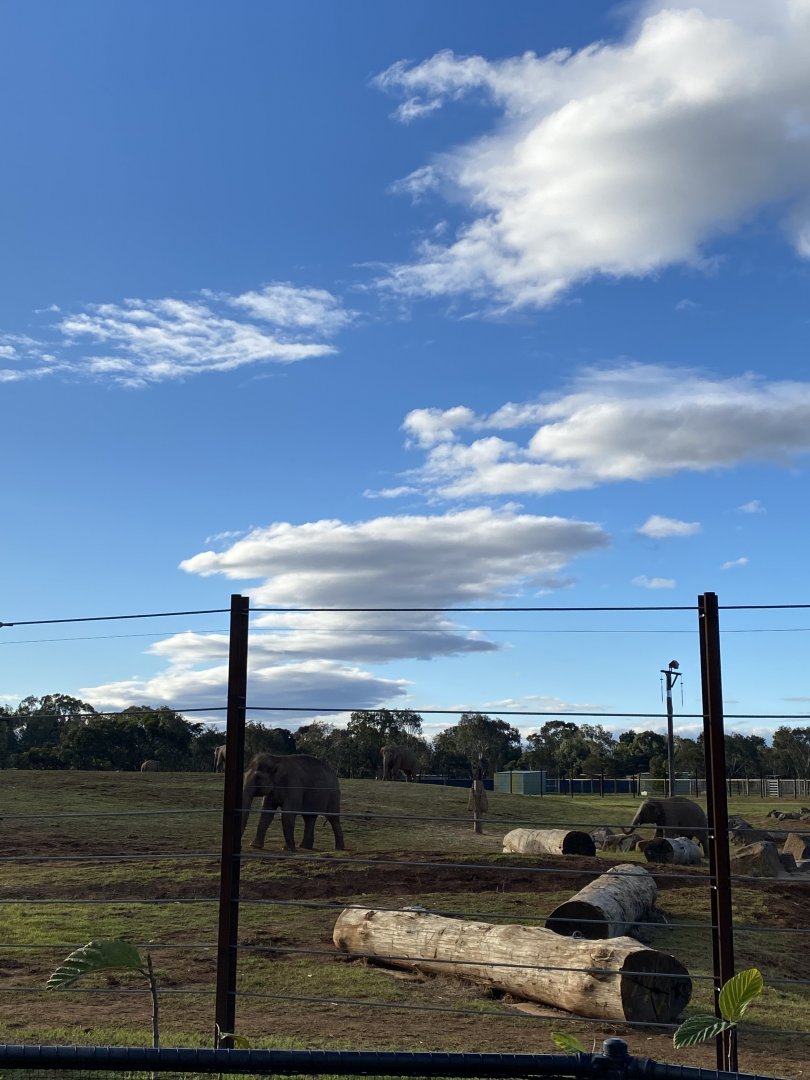
I was also told by volunteers that the elephants can also disappear in the two paddocks located next to the highway, with there being an invisible dip that the elephants can access before the fenceline (so the fenceline isn't visible at all). You can roughly see here (to the left of the image):
 
That would also be good to see. It’s unclear what use (if any) Monarto will have for Werribee bred bulls and Dubbo certainly won’t be in a position to take them on, so Werribee will have to manage whatever surplus they can’t export overseas. I’m hopeful North America will have an interest in at least one more Australian bred bull, but there’s clearly not a demand to the point it would enable anything close to unrestricted breeding.

It’ll be interesting to see how the reproductive futures of the cows in the Werribee herd track. Dokkoon and Num-Oi will produce their fourth calves in the next cohort; but their future granddaughters etc. would be lucky to get recommendations for two calves in my opinion. Some cows may even be designated non-breeding when we get to the stage there’s eight plus viable cows in their matriline.
The point is that if a need is to hold surplus bulls even if they are not wanted short or long term there is a place/home where they can be placed until other solutions are found
 
The point is that if a need is to hold surplus bulls even if they are not wanted short or long term there is a place/home where they can be placed until other solutions are found

It would be good to have that contingency. I know a number of us were fearful Putra Mas could have been exported outside the region unless Werribee were willing to take him on. Luckily Monarto arose as a new holder within that time and we were able to retain him within the region.

Being honest, I doubt the region will ever bulls (or cows) as genetically valuable as the ones we have/have had (Bong Su, Gung, Putra Mas). Europe and North America will only send us what they don’t want (i.e. surplus from well represented lines) and with the species breeding successfully in Australia, our lines will become increasingly represented. With that in mind, the point of being able to accomodate multiple bulls (including at short notice) will be more about working with what we can expect to be dynamic relationships within bachelor herds. Factions may form (especially as bulls mature); and they’ll be musth cycles to work around. Otherwise, the ideal would be the rearing of well socialised bulls that can cohabit most of the year in bachelor herds - something Dubbo has struggled to crack for various reasons.
 
It would be good to have that contingency. I know a number of us were fearful Putra Mas could have been exported outside the region unless Werribee were willing to take him on. Luckily Monarto arose as a new holder within that time and we were able to retain him within the region.

Being honest, I doubt the region will ever bulls (or cows) as genetically valuable as the ones we have/have had (Bong Su, Gung, Putra Mas). Europe and North America will only send us what they don’t want (i.e. surplus from well represented lines) and with the species breeding successfully in Australia, our lines will become increasingly represented. With that in mind, the point of being able to accomodate multiple bulls (including at short notice) will be more about working with what we can expect to be dynamic relationships within bachelor herds. Factions may form (especially as bulls mature); and they’ll be musth cycles to work around. Otherwise, the ideal would be the rearing of well socialised bulls that can cohabit most of the year in bachelor herds - something Dubbo has struggled to crack for various reasons.
I know we talk about what we can export and import from American and European zoos and yes some bloodlines are related but is if beyond being possible that perhaps a captive bred bull if needed could be imported from an Asian zoo/s, perhaps Singapore or other?, I recall at one point they were considering importing semen from the adult bull in the Singapore zoo not sure what happened with that idea, perhaps this is an option to look at?
 
I know we talk about what we can export and import from American and European zoos and yes some bloodlines are related but is if beyond being possible that perhaps a captive bred bull if needed could be imported from an Asian zoo/s, perhaps Singapore or other?, I recall at one point they were considering importing semen from the adult bull in the Singapore zoo not sure what happened with that idea, perhaps this is an option to look at?
If in the long term, we are looking for a new bull, Singapore could be an option. But it would be preferable to utilise the bulls we have in the region at the moment first and foremost.

I believe Melbourne and Taronga were planning to import semen to AI their cows, however this never eventuated. I'm assuming the priority was to get Bong Su (and later Putra Mas) represented before considering any additional options. Not to mention it would have been logistically far easier to utilise these bulls within the country.
 
I know we talk about what we can export and import from American and European zoos and yes some bloodlines are related but is if beyond being possible that perhaps a captive bred bull if needed could be imported from an Asian zoo/s, perhaps Singapore or other?, I recall at one point they were considering importing semen from the adult bull in the Singapore zoo not sure what happened with that idea, perhaps this is an option to look at?
If in the long term, we are looking for a new bull, Singapore could be an option. But it would be preferable to utilise the bulls we have in the region at the moment first and foremost.

I believe Melbourne and Taronga were planning to import semen to AI their cows, however this never eventuated. I'm assuming the priority was to get Bong Su (and later Putra Mas) represented before considering any additional options. Not to mention it would have been logistically far easier to utilise these bulls within the country.

Here’s the relevant document here:

https://www.agriculture.gov.au/bios...ephant_semen/importation-elephant-semen-draft

The elephants imported from Thailand in 2006 under the 2004 policy, and elephants already held in Perth and Melbourne Zoos, are to be bred as part of the Asian Elephant Captive Management Plan. The male imported from Thailand is just reaching breeding age. The other two males in Australia are considered unreliable for breeding. The zoos have sought the development of quarantine measures to import fresh, chilled semen from bulls in Singapore, the EU and the USA to address these issues and to ensure genetic diversity.

The comment around the unreliability of the other two bulls in Australia (Bong Su and Putra Mas) presumably referenced their inability to naturally mate the cows they were held with (Bong Su was also a behavioural non-breeder). It was established years prior to this (mentioned on a 2003 episode of the Crocodile Hunter Diaries) that Bong Su was one of the most fertile bulls in captivity. He was a highly successful AI donor.
 
Australia could always export their surplus cows. UK and USA would welcome them.
I doubt there'd be the need to; especially as all of the regions breeding herds are currently big enough to be able to accommodate any matrilineal splits in the future.

Even if Porntip and Thong Dee have been retired from the breeding programme, they still function to bolster numbers in the matriarchal herd; and Porntip most crucially is linked to her seven year old daughter (future breeding female).

Werribee’s herd is cohesive and in the event issues arose a decade or so down the line; they might even have one of the matrilines in mind for transferring to Monarto if/when they fail to generate succession within their herd. This is an alternative to the more likely scenario where they’d managed two herds - easy enough to do with the addition of a second herd barn the combined herd would have likely outgrown by that point.
 
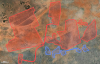
A further quick comparison I drew up comparing the size/shape of current and retired facilities
In Red (L to R) Werribee, Australia Zoo, Monarto, Sydney, and TWPZ
In Blue (L to R) Perth, Melbourne, Taronga, and Auckland
(These shapes encompass the general area of each elephant complex's barn and attached yards, thus are likely to include a bit of grey space too)
upload_2025-11-10_16-10-49.png
 

Attachments

  • upload_2025-11-10_16-10-49.png
    upload_2025-11-10_16-10-49.png
    779.3 KB · Views: 43
A further quick comparison I drew up comparing the size/shape of current and retired facilities
In Red (L to R) Werribee, Australia Zoo, Monarto, Sydney, and TWPZ
In Blue (L to R) Perth, Melbourne, Taronga, and Auckland
(These shapes encompass the general area of each elephant complex's barn and attached yards, thus are likely to include a bit of grey space too)
View attachment 841129

It’s hard to imagine that when it opened in 1992, Auckland Zoo’s elephant was considered the most progressive elephant exhibit in the region. For its time, it was considered a spacious exhibit and the sand and grass terrain was a welcome change from the concrete floors and yards of elephant houses. It was stated to have a capacity of three cows, which was clearly a reference to the barn having three stalls. The outside area would have initially been considered suitable for a large herd.

Melbourne’s complex is smaller than I imagined, though the multiple paddocks gave the impression it was larger than it was. Another exhibit that on opening day was considered state of the art and something for other zoos to aspire too. Its most innovative features included the fully submersible pool in the bull paddock; and the crossing gates that allowed the elephants to traverse the paddocks via the visitor path.
 
It’s hard to imagine that when it opened in 1992, Auckland Zoo’s elephant was considered the most progressive elephant exhibit in the region. For its time, it was considered a spacious exhibit and the sand and grass terrain was a welcome change from the concrete floors and yards of elephant houses. It was stated to have a capacity of three cows, which was clearly a reference to the barn having three stalls. The outside area would have initially been considered suitable for a large herd.

Melbourne’s complex is smaller than I imagined, though the multiple paddocks gave the impression it was larger than it was. Another exhibit that on opening day was considered state of the art and something for other zoos to aspire too. Its most innovative features included the fully submersible pool in the bull paddock; and the crossing gates that allowed the elephants to traverse the paddocks via the visitor path.

when is anjalee due?
 
when is anjalee due?

Staff have predicted the first week of December, but the calf could potentially be born anytime from this week through to late December.

Due to being her first calf, they don’t have a previous reproductive history to work from, so the estimate was based on the average gestation of other cows on record.
 
Melbourne’s complex is smaller than I imagined, though the multiple paddocks gave the impression it was larger than it was. Another exhibit that on opening day was considered state of the art and something for other zoos to aspire too. Its most innovative features included the fully submersible pool in the bull paddock; and the crossing gates that allowed the elephants to traverse the paddocks via the visitor path.
Melbourne's paddocks were indeed rather small; especially in the last two exhibits the dry moat design gives the impression of the exhibits being a bit larger than they actually were.

It was mentioned that the three enclosures in TOTE put together are almost as equivalent to just the fidget spinner paddock at Werribee, space wise.
 
It will interesting to see when Putra Mas enters the pool/pond in the new exhibit that he now has access to going by the resent videos of him at Perth zoo he appears to be a real water baby
Absolutely, he used to spend lots of time in the female elephant pool (larger), when he was younger and allowed with the females etc.... He then received his own pool is my understanding that is smaller but he loved doing tricks and training in the pool aswell... So the monarto pool- massive in comparison will be great.

I do wonder how the Monarto keepers will go with replicating the Perth keepers training...
As I was told he only does certain things with certain keepers, and the monarto keepers would have to build the trust with him. They use special words, his training name (Silup) and other things to help him cooperate.

But he is highly inteligent so they will probably teach new tricks and other things etc... :)
 

Attachments

  • F3CE3BF2-1852-4FDA-96A4-0FFFA5A16C94_1_102_o.jpeg
    F3CE3BF2-1852-4FDA-96A4-0FFFA5A16C94_1_102_o.jpeg
    106.4 KB · Views: 4
  • Image 13-10-2025 at 9.17 pm.jpg
    Image 13-10-2025 at 9.17 pm.jpg
    152.3 KB · Views: 4
Absolutely, he used to spend lots of time in the female elephant pool (larger), when he was younger and allowed with the females etc.... He then received his own pool is my understanding that is smaller but he loved doing tricks and training in the pool aswell... So the monarto pool- massive in comparison will be great.

I do wonder how the Monarto keepers will go with replicating the Perth keepers training...
As I was told he only does certain things with certain keepers, and the monarto keepers would have to build the trust with him. They use special words, his training name (Silup) and other things to help him cooperate.

But he is highly inteligent so they will probably teach new tricks and other things etc... :)
Its hard to see in the other video how large the pool is also they are building a large concrete pool in one of the paddocks which they should enjoy in the hot weather
 
Absolutely, he used to spend lots of time in the female elephant pool (larger), when he was younger and allowed with the females etc.... He then received his own pool is my understanding that is smaller but he loved doing tricks and training in the pool aswell... So the monarto pool- massive in comparison will be great.

I do wonder how the Monarto keepers will go with replicating the Perth keepers training...
As I was told he only does certain things with certain keepers, and the monarto keepers would have to build the trust with him. They use special words, his training name (Silup) and other things to help him cooperate.

But he is highly inteligent so they will probably teach new tricks and other things etc... :)

While all the bulls in the region enjoy their pools, I think we can agree none of them enjoy it more than Putra Mas. One theory I have is this is influenced by the temperatures in Perth, which are on average higher than Sydney and Melbourne. Monarto gets up there temperature wise, so I wouldn’t be surprised if all five elephants show a greater engagement with the pools than the other elephants in the region. Burma (from Auckland) has certainly increased her use of the pool.

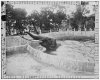
Elephants love nothing better than a swim on a hot day. When Auckland Zoo built their elephant house in 1923, a pool was dug out a short distance away, which the elephants were walked over to on hot days to enjoy a swim. Historic photos of Taronga’s exhibits show small concrete pools built into their exhibit, allowing them relief from the heat.

Gandhi (Taronga Zoo):

upload_2025-11-11_9-34-6.jpeg
Source: How to Move a Zoo: new Sydney Living Museums’ exhibition reimagines parade of animals through city in 1916
 

Attachments

  • upload_2025-11-11_9-34-6.jpeg
    upload_2025-11-11_9-34-6.jpeg
    201 KB · Views: 43
Putra Mas has entered musth:

Looks like they got him on site just in time; though his annual musth cycle beginning slightly earlier was potentially due to the upheaval of the transfer.

Clearly no breeding introductions will be undertaken between him and Pak Boon until at least next year (if that’s even on the cards).

From socials:

Putra Mas is still settling in well at Monarto Safari Park and is showing all the signs of a healthy young bull. He has now entered his natural musth period, a normal hormonal cycle for mature male Asian Elephants.

While he is in musth, Putra Mas will spend time in a separate habitat from the female elephants. Visitors will still be able to see him, and the cows will continue getting used to his presence nearby. Interactions between them will resume once this musth period naturally ends in the coming months.

You can still expect to see any or all of the five elephants out on habitat during your visit, but this varies throughout the day as they choose to move between their indoor and outdoor spaces.
 
Back
Top