Best natural history taxidermy dioramas

@Onychorhynchus coronatus

Akeley actually died during an expedition of Central Africa close to the national park he had advocated for to protect the mountain gorilla. So he was not even around to see the African hall open to the public. The North American hall was definitely inspired by him though. What sets it apart from the other halls is that it focuses on creatures large and small. Unlike earlier halls it put a focus on smaller mammal species like the groundhog and spotted skunk. The wolf one is also a personal favorite, yet the photos do it no justice online.

Yes, I remember reading about his encounters with the mountain gorillas and the guilt he felt about "collecting" them for the AMNH diorama and that he died from malaria during a trip to the Congo and was buried there.

I guess like many artists he didn't live long enough to see his work finished or appreciated by the public. He was a remarkable man in so many ways and I think he was way ahead of his time.

Its a long time since I saw the dioramas in the AMNH but I remember a couple of them featuring smaller animals like coyotes, beavers and armadillos. For some reason it is the dioramas of the larger mammals like the bison, jaguar, bighorn sheep, brown bear and wolf etc that stick in my mind though.

I agree with this: the dioramas in the Hall of African Mammals, in the American Museum of Natural History, New York, are definitely the most impressive I've ever seen. The North American and Asian exhibits are also excellent.

I also agree with you about the Natural History Museum in Paris: the Grande galerie de l'évolution is a favourite of mine too. And the Galerie de paléontologie et d'anatomie comparée is also fascinating.

I totally agree, was there a particular diorama that stood out to you at the AMNH Tim ?
 
Last edited:
For a long time, dioramas were the only way how people could experience wildlife of distant countries. They were constructed by experienced naturalists with genuine love of nature. It was the time where wildlife films, color photography, overseas tourism, naturalistic zoo exhibits did not yet exist or were too expensive.

I think dioramas are still of value, and don't especially like the modern abstract museum displays.

Also, dioramas had big influence on naturalistic displays in zoos. When you look at some of exhibits in Mouse House or World of Birds in the Bronx zoo, their style is based on dioramas in AMNH.

In mainland Europe, there are dioramas in the Museum of Natural History in Geneva.It sort of replaces the lack of zoo in Geneva. There is also a large diorama of Dutch coastal dunes in the natural history museum in Artis zoo. However, it seems to be closed most of the time.

Very true, I think it is important to remember that for visitors in the 19th and early 20th century dioramas were indeed the only way they could experience what the wildlife of a Himalayan plateau, African savanha or the Indian jungle looked like in their natural habitat or visualize predator prey relationships etc. I actually find it quite moving in some ways that these dioramas served to educate generations of people about natural history in places they would never visit in their lifetimes.

I also agree that dioramas still have an enormous value and especially a historic value due to these being part of the history of natural history, art and science. I also think that they can be useful in environmental education and even for modern efforts in conservation too. I definitely prefer dioramas to the modern abstract taxidermy displays in museums too but I think that these also have their value too.

I hadn't ever thought about the influence that dioramas have had on naturalistic style zoo enclosures and design so that is quite an interesting point. Are there more examples of this that you can think of ?

I haven't been to too many museums but my favorite animals dioramas I have seen are at the Milwaukee Public Museum. Their dioramas look very similar to the AMNH ones, and MPM actually invented the diorama (these types of dioramas with a curved mural back wall and taxidermy in the front are called Milwaukee Dioramas).

I've never been to the Milwaukee Public Museum but I was just having a look on google images at some of the dioramas that they have there and quite a few of them look excellent (the beaver dam and the African forest elephant dioramas in particular).

Is there a diorama in particular that you like or remember from the museum?

What I do know about the museum is that at the end of the 19th century Carl Akeley was there for quite a number of years and really pioneered / honed his craft at the museum before he went on to working on bigger projects for the AMNH and Chicago Field Museum.
 
Last edited:
Very true, I think it is important to remember that for visitors in the 19th and early 20th century dioramas were indeed the only way they could experience what the wildlife of a Himalayan plateau, African savanha or the Indian jungle looked like in their natural habitat or visualize predator prey relationships etc. I actually find it quite moving in some ways that these dioramas served to educate generations of people about natural history in places they would never visit in their lifetimes.

I also agree that dioramas still have an enormous value and especially a historic value due to these being part of the history of natural history, art and science. I also think that they can be useful in environmental education and even for modern efforts in conservation too. I definitely prefer dioramas to the modern abstract taxidermy displays in museums too but I think that these also have their value too.

I hadn't ever thought about the influence that dioramas have had on naturalistic style zoo enclosures and design so that is quite an interesting point. Are there more examples of this that you can think of ?


I've never been to the Milwaukee Public Museum but I was just having a look on google images at some of the dioramas that they have there and quite a few of them look excellent (the beaver dam and the African forest elephant dioramas in particular).

Is there a diorama in particular that you like or remember from the museum?

What I do know about the museum is that at the end of the 19th century Carl Akeley was there for quite a number of years and really pioneered / honed his craft at the museum before he went on to working on bigger projects for the AMNH and Chicago Field Museum.
The beaver dam and the forest elephant are some of my favorites as well. Some others I remember well are a Grand Canyon themed one with a Cougar stalking Mule Deer and very cool shorebird one with tons of species birds plus several more species on the mural. Of course, that's only a small sampling of the many amazing dioramas at the museum.

Unfortunately, the museums is moving locations soon and most of the dioramas will probably be lost. :( I wish that I had took photos of them all but by the time I learned of this the museum was closed for Covid (not sure if it still is or not - I might have to make a trip over there).
 
The beaver dam and the forest elephant are some of my favorites as well. Some others I remember well are a Grand Canyon themed one with a Cougar stalking Mule Deer and very cool shorebird one with tons of species birds plus several more species on the mural. Of course, that's only a small sampling of the many amazing dioramas at the museum.

Unfortunately, the museums is moving locations soon and most of the dioramas will probably be lost. :( I wish that I had took photos of them all but by the time I learned of this the museum was closed for Covid (not sure if it still is or not - I might have to make a trip over there).

That is sad to hear but I really don't think the dioramas will be lost because they are part of the patrimony of the United States and have enormous historical / artistic / scientific value. It would probably be a violation of several laws to destroy them.

I would imagine that they will somehow be moved to the new location of the museum.
 
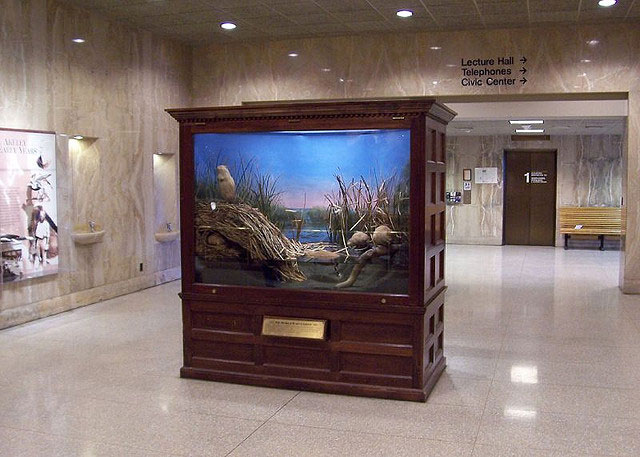
This Muskrat diorama at MPM was the first museum diorama ever made:

carl-akeley-muskrats-milwaukee.jpg
 
That is sad to hear but I really don't think the dioramas will be lost because they are part of the patrimony of the United States and have enormous historical / artistic / scientific value.

I would imagine that they will somehow be moved to the new location of the museum.
I can only hope so - then biggest issue is the background mural. They don't look like they were made on wallpaper, you would probably have to move the entire wall, which would of course be difficult. I very much hope this not the case and that these dioramas can be preserved.
 
This Muskrat diorama at MPM was the first museum diorama ever made:

carl-akeley-muskrats-milwaukee.jpg

It is a beautiful diorama indeed and I have to admit this is the one that I saw on google images and mistook for being beavers.

I can only hope so - then biggest issue is the background mural. They don't look like they were made on wallpaper, you would probably have to move the entire wall, which would of course be difficult. I very much hope this not the case and that these dioramas can be preserved.

I see what you mean but I think it would be ridiculous for them to destroy one of their finest exhibits and totally counterproductive. I truly hope that this isn't the case too.
 
They do have a beaver one, it is one of the highlights of the museum. I couldn't find any photos of it online but they wouldn't do it justice, as the best part about are the small herps and insects included in it.

Yes, actually that is another thing I love about dioramas, the small details and additions of smaller species that you don't see at first glance or only spot after several visits.

There are quite a few in the AMNH with the most famous one being the chipmunk in the Okapi diorama that was a practical joke by one of the taxidermists. When I was there I really looked for it but never did find it, it must be very well hidden.
 
.....was there a particular diorama that stood out to you at the AMNH Tim ?
Carl Akeley's African dioramas in the American Museum of Natural History are all so impressive it's impossible to select just one but the central group of eight African elephants is hard to beat. I also particularly like the mountain nyalas as that's a species I've never seen in life. (For many years the Natural History Museum in London had the type specimen of mountain nyala on display; I was very disappointed when it was removed from exhibit.)

Elsewhere in the American Museum of Natural History, I especially like the Sumatran rhino with calf and the two moose fighting.
 
Carl Akeley's African dioramas in the American Museum of Natural History are all so impressive it's impossible to select just one but the central group of eight African elephants is hard to beat. I also particularly like the mountain nyalas as that's a species I've never seen in life. (For many years the Natural History Museum in London had the type specimen of mountain nyala on display; I was very disappointed when it was removed from exhibit.)

Elsewhere in the American Museum of Natural History, I especially like the Sumatran rhino with calf and the two moose fighting.

Oh I agree, every one of those dioramas are masterpieces in themselves. I don't remember the mountain nyala diorama but I would have definitely seen it when I was at the AMNH.

The two dioramas that stand out for me and that I remember spending quite some time looking at probably don't usually stand out to most visitors amongst the other exciting displays but for some reason are vivid in my memory.

One of these is the klipspringer and baboon Veldt diorama in the African hall of Mammals. It just seemed like it was a snapshot moment caught in time with the animals posed so naturally amongst the rocks and vegetation as if they had been taken unaware by the viewer. The beautifully painted background conveyed a sort of early afternoon timing for the scene and the clouds sort of gave this impression of the passage of time.

The other is the dhole and sambar deer / Indian dry forest diorama in the Asian hall of mammals. There is just so much drama and tension in that scene with the deer bravely fighting a last stand against the pack which are portrayed as if they will inevitably end up overcoming it, pulling it down and disembowelling it.

There is a narrative of a desperate struggle for survival and you cant help feeling empathy for the deer and thinking that this must be the sort of terror that the prey of these canids experience when cornered. However you also simultaneously admire the dhole and their tenacity, cooperation and endurance while hunting (one of which is portrayed as having been killed or mortally wounded by the deer).
 
Last edited:
Thought I would add to this thread something that I enjoyed seeing a couple of years ago.

I haven't ever been to the Field Museum in Chicago (though I would like to) but I do enjoy watching the videos of the educator channel "The brain scoop" on youtube.

A couple of years ago there was a crowd funded project initiated by "The brain scoop" to complete one of Carl Akeley's unfinished dioramas of Striped Hyenas in Somalia.

There are a series of videos that show the process of painting, modelling the diorama, lighting and managing to keep it faithful to Akeley's vision etc.

It is really interesting so I'll post the videos below.

Enjoy ;)


Last edited:
The only taxidermy specimens of the now extinct mexican grizzly bear are in a nice Diorama at the Field Museum in Chicago. For me the highlight of the AMNH was the Sumatran rhinos, mother and offspring and also the Sambar Deer and dholes

Thank you for your reply @carlos55 !

I've never been to the Field Museum in Chicago but I would love to one day as the dioramas look excellent and many were also created by Carl Akeley.

I never knew that about the Mexican grizzly bear diorama over there I'm curious to see what it looks like so will check this out on google images.

Do you have a favourite diorama at the Field Museum ?

I remember seeing the Sumatran rhino and offspring and feeling moved by it as the fact that it has a plain background rather than an elaborate natural scene makes it somehow more poignant and especially considering how close to extinction the species is.

I also totally agree with you about the sambar deer and dholes as that one is also a big favourite of mine too.
 
Last edited:
https://cdn.quinto-poder.mx/wp-content/uploads/2019/04/1-oso.jpg
here is a photo of the original mexican grizzly bear diorama at the Field Museum. I have seen skeltal remains and skins of mexican Grizzlies at the mammal collection of the Universidad Nacional de Mexico where i Teach but they are Not on Public display. So the only taxidermy display of the extinct mexican grizzly bear Is in Chicago.
 
Last edited:
That's one of my favorite dioramas in the museum, but I didn't realize those were the only surviving specimens! There's also an Imperial Woodpecker in the same diorama.

That is quite interesting, thanks for sharing that !

So there are actually two extinct species (if of course the Mexican ivory billed woodpecker is indeed extinct... which I personally believe it to be) that are being represented in this diorama.
 
Back
Top