Best UK Penguin enclosure

Best UK Penguin enclosure?


  • Total voters
    59
  • Poll closed .
Living Coasts mixes African and Macaroni penguins, Inca terns, Spectacled eider and Bank cormorants. The mix also included King eider but they have recently been moved elsewhere in the collection.

Lotherton Hall also has Inca terns with their Humboldt penguins.

Banham house their penguins in an aviary with a couple of waterfowl or wader species (unsure of which species).

Inca Terns and Arctic Terns(strangely) appear to be the most common mixed species exhibit for penguins along with other penguin species.
 
Last edited:
I'm not so sure about that, Whipsnade has bred Indian Rhino, Asian Elephant, Pygmy Hippo, Scimtar Horned Oryx, African Penguin, Grevys Zebra, Amur Tiger, Wolverine and plenty more in the last few years!
I know but the only nationally recognised conservation projects are the Asian Rhinos and the Asian Elephants, although Amur Tigers and California Sea Lion have also became popular recently.

London Zoo is famous for Sloths,Tamanduas,Okapi,Hunting Dogs,Penguins,Tigers,Giraffes,Zebras,Butterflies and many more.
 
Good news (in Holland then, at least) - if it really is 'simply' that easy, then those major losses at Longleat and others should not have happened, and are a serious indictment on their management

Given that the penguins eat well it is not particularly hard to give them the medication. However, I do not know if it is 100% effective and whether it is available throughout the UK. One main disadvantage is that penguins rarely eat when they molt (and forced feeding can be very troublesome).
 
Penguins are notorious, along with otters, for sensing if medication has been placed in food and not eating it.Zoos such as Marwell and Chester have had to invest into more complicated medication due to this.
 
Good news (in Holland then, at least) - if it really is 'simply' that easy, then those major losses at Longleat and others should not have happened, and are a serious indictment on their management

It is not easy to keep out.It has destroyed breeding programmes and lead to losses like the event at Longleat.That is why you rarely see an advanced penguin enclosure with more than a pool,plants,rocks and a bit of detailed land space-it would all be a waste as soon as avian flu/malaria gets to them.
 
It is not easy to keep out.It has destroyed breeding programmes and lead to losses like the event at Longleat.That is why you rarely see an advanced penguin enclosure with more than a pool,plants,rocks and a bit of detailed land space-it would all be a waste as soon as avian flu/malaria gets to them.
A penguin enclosure is not simply a cheap piece of land with a pool and some rocks - the plant-room behind the scenes required to keep the water clean, is a six figure investment in itself...
 
A penguin enclosure is not simply a cheap piece of land with a pool and some rocks - the plant-room behind the scenes required to keep the water clean, is a six figure investment in itself...

I know but I am trying to say that significant exhibits themed to Penguins entirely but using large public buildings and complex water systems are rare due to the risk of Avian malaria
 
London's exhibit *is* pretty good...... but it doesn't hold a candle to the one at Edinburgh, which (as already noted by @Quincey ) is the largest outdoor penguin exhibit in Europe and - although this was not specified in the aforementioned post - I am pretty sure the main pool is also the deepest in Europe. As a result, the inhabitants of the exhibit have a lot of space within which to move around, and it is one of only two or three penguin exhibits where I have seen displays of prolonged porpoising due to the length and depth of the main pool. Add this to the breeding record of all three species within the collection (historical in the case of the King Penguins, as Edinburgh - the studbook holder for the species - refocused into keeping a batchelor group a few years ago) and the fact that the cool hillside location of the exhibit is highly-beneficial to the health of the inhabitants, providing some protection against the aforementioned increasing risk of avian malaria, and I think this exhibit not only deserves to win the title of the best penguin exhibit in the UK, but also the best in Europe.

A few photographs to better illustrate the exhibit:

full


full


full


full


There seem to be no images of the massive underwater viewing window situated downhill from the exhibit, so after I have finished work I will root through my own photos to see what I can add.

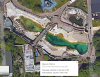
For now, this google maps shot shows the scale of the exhibit:

penguin.PNG
 

Attachments

  • penguin.PNG
    penguin.PNG
    1.1 MB · Views: 38
I am pretty sure the main pool is also the deepest in Europe.

I would have thought the King Penguin enclosure in Rotterdam is deeper (but much smaller overall off-course) and Wroclaw maybe too?

Having solely seen Belfast and London in person, I can't see anyone not voting for Edinburgh based on the information above.
 
It is certainly impressive but just too simple.Of course the effort put into the size and depth of the pool as well as how clean it is cannot go unnoted, it is not as good(in my opinion) as the exhibit at Marwell,which is small but very natural, with a large slope, many nesting boxes,some inside the hill, a great variety of plants, many rocks, a large pool, a large land area, much privacy and viewing from many angles make it my favourite.Unfortunately there are no photos to better illustrate my opinion, as I could not find any online.
 
London's exhibit *is* pretty good...... but it doesn't hold a candle to the one at Edinburgh, which (as already noted by @Quincey ) is the largest outdoor penguin exhibit in Europe and - although this was not specified in the aforementioned post - I am pretty sure the main pool is also the deepest in Europe. As a result, the inhabitants of the exhibit have a lot of space within which to move around, and it is one of only two or three penguin exhibits where I have seen displays of prolonged porpoising due to the length and depth of the main pool. Add this to the breeding record of all three species within the collection (historical in the case of the King Penguins, as Edinburgh - the studbook holder for the species - refocused into keeping a batchelor group a few years ago) and the fact that the cool hillside location of the exhibit is highly-beneficial to the health of the inhabitants, providing some protection against the aforementioned increasing risk of avian malaria, and I think this exhibit not only deserves to win the title of the best penguin exhibit in the UK, but also the best in Europe.

A few photographs to better illustrate the exhibit:

full


full


full


full


There seem to be no images of the massive underwater viewing window situated downhill from the exhibit, so after I have finished work I will root through my own photos to see what I can add.

For now, this google maps shot shows the scale of the exhibit:

View attachment 440278

I would quite agree that London and Edinburgh are the two that need to be compared as to the winner in this tie, but I think London has the edge. London has an exhibit of comparable size (2,086 m2) which has a sizeable underwater viewing area, some nice but not overdone theming, good viewing areas, and soft surfaces. I think another thing that has to be pointed out is that Edinburgh's exhibit is built from a mildly abrasive material for the areas that are on land. This can lead to Bumblefoot, 'an infection associated with abrasive surfaces that cause cuts in the feet which then become infected' to quote a passage from 'Zoo Animals' (by Sheila Pankhurst, Geoff Hosey and Vicky Melfi).

I think it is also important to think about the inhabitants. The Edinburgh exhibit holds multiple species, one of which is considerably larger than the rest. This means that they need more space. Pound for pound, London gives their penguins more space due to the similar areas and the larger species in Edinburgh despite the large group in London.

However, I am sort of playing Devil's advocate here because I am not really giving Edinburgh much credit in this post even though I think a lot is due, and that it is certainly in the top two in the UK. I just wanted to point out the surface issue and the area comparison :)
 
Edinburgh's exhibit is built from a mildly abrasive material for the areas that are on land. This can lead to Bumblefoot, 'an infection associated with abrasive surfaces that cause cuts in the feet which then become infected' to quote a passage from 'Zoo Animals' (by Sheila Pankhurst, Geoff Hosey and Vicky Melfi)

I've copied the below text directly from Edinburgh's website:

"Mock sandy beaches and rocky areas add great visual touches, but also provide the birds with different textures that are perfect for their feet."

Discover Penguins Rock on a family day out | RZSS Edinburgh Zoo | Edinburgh Zoo
 
Back
Top