From my visit today:
Best news: the Wild Asia monorail is running! (Although at reduced capacity and frequency--they space out passengers--I had a whole car to myself--and wipe down the whole train after each run.)
Second best news, despite the heat, it was not uncomfortable (except see the second worst news), thanks to the fact that much of the zoo is heavily shaded. The three block walk from and to the subway station, in the sun along Boston Road, was brutally hot.
Worst news: the one genuinely new exhibit I wanted to see, the Dholes, had a big sign in it: "Exhibit Closed Today." I was ticked.
Second worst news: On a day this hot, you sweat a lot under a mask.
I arrived shortly before 10 and was the second one through the Asia Gate. They are serious about social distancing. Two out of every three urinals in the Wild Asia men's room are taped off. Every staff person I dealt with, at the entrance and when I stopped for lunch at Somba Village, were delightful. Several others as I walked around were telling everyone how happy they were to see us back.
The Waldrapps were, well, the Waldrapps.
There's now a sandpile in the middle of the Slender-horned Gazelle exhibit, which they seem to like enough to lie on it in the direct sun.
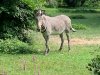
The Grevy's Zebras were grazing at the very front of the exhibit and seemed startled to see me, watching me warily, as if they expected me to jump over the fence at them. By the time I left, they were grazing at the back of the yard.
There was one hyena sleeping under the bush nearest the west viewing window. I didn't see the other.
Two of the Hunting Dogs were sleeping at the very front of the exhibit, and a third not far away, closest I have ever seen them. Clearly, the animals are used to there being no visitors.
Didn't see the ostriches. The giraffes looked fine.
They had given the gorillas their morning feeding at the edge of the yard nearest the viewing window on the main path towards the pheasants, so I got to see several of them even though Congo Gorilla Forest was closed. I have never before seen any of them anywhere close to that part of their exhibit.
The Seriemas are now in one of the pheasant cages, and one of them was making quite a racket. He or she is very loud up close.
A lot of the walks are now one way, which can mess you up a bit if you have a standard way of going through the zoo. You can see this on the current map.
White rhinos were both out, as were several of the giant tortoises.
First time I had ever seen one of the Komodo Dragons in the outside enclosure. I've always thought it is a really great exhibit, and it's even better with one of the lizards visible.
There are Black-faced Ibis in that corner cage of the old Bird House. I envied the sea lions their pool.
Just by dint of timing and luck got to see them feed the Andean Condors and the Cinereous Vultures--they really ripped into their dead rats, and seeing them spread their wings as they came down/over to get the rats from the keeper is really impressive. They are very, very big birds.
The walkway by the Caribbean Flamingos as you approach the Aquatic Birds Building is closed off, as is the Sea Bird Colony, probably because they couldn't work out one way access. There is one spot on the side from which you can view the flamingos.
There are at least two bison calves, maybe more.
There were a lot of bird calls audible from the World of Birds, which was frustrating.
The Pere David's deer were all lying in a big heap together in the shade, although I saw only one buck, and usually there's more than one. There is a pair of Whooper Swans in with them.
There was one tiger in each of the two exhibits in Tiger Mountain, one simply asleep, the other strolling very slowly around the yard.
The grizzlies were in their pool, of course. There's a new, large picnic area across from the grizzlies, and a food stand named "Grizzly Grounds".
The Himalaya Highlands revealed one sleeping Red Panda, one sleeping Snow Leopard (both oh so pretty), and a Tragopan.
One of the White-naped Cranes was in the pond, right up against the visitor's railing, closest I've ever seen one of those. I could have reached our and touched it, although it didn't look pleased we were there.
There are several young Geladas, all of which were by the viewing window, which was very entertaining. They didn't let the heat stop them from energetic play with each other. The ibex were up on the hill but looked great even from a distance. The hyraxes were all asleep but several were visible.
You can enter the Africa walkway that runs along the Nyala only from the south near Wild Asia. Almost all of the antelope were in the shade, most up against the wall that runs along the viewing path. The two male lions were out on lion island.
Has anyone ever seen the Thompson's Gazelles anywhere near the front of the exhibit?
There was a young Barasingha who also wasn't deterred by the heat and was bounding and galloping back and forth a very large stretch of the exhibit. Saw a lot of Barasingha at the beginning and the Blackbuck later, but never caught sight of any Axis Deer.
The Przewalski's Horses were all down front, too, as were the Brow-Antlered Deer. The Gaur were up on the hill. I'm pretty sure the guide said they have five calves.
One of the Amur Tigers was in the exhibit, posed as if for a picture on a rock overlooking the pond, and he was calling, one of the few times I've heard tigers at the Bronx Zoo make a sound.
They have put a fence down the middle of the elephant yard so Patty and Happy can both be out.
One of the Indian rhinos was in the bigger and older of the two wallows. She roused herself a little bit as we went by, as if curious to see us.
Saw the female babirusa but not the male. Saw the Sambar, the Nilgai and the Hog Deer. Didn't see the Musk Deer. All the Asian deer are in the early antler growth phase, only partially grown in and in velvet. Saw a second sleeping Red Panda.
Tahr and Markhor looked great in their exhibit as they always do.
And then went home and took a nap.