Pheasant Aviary-Congo Gorilla Forest
From the South side of the Zoo Center, you can head further South for a short while before reaching the Dancing Crane Café. This is the zoo’s main restaurant and serves general food such as chicken, burgers, fries, pizza, hotdogs, water, and soda. The café is found in a small plaza area along with the zoo’s main gift shop, a large group of eating tables, a popcorn stand, and a large gazebo complex where the zoo sometimes hosts events such as ice sculpturing in the winter.
If you keep South, you’ll find a small wooden walkway that goes around the café. If you’re to go down this, you’ll find a large pond home to a nicely sized flock of
Chilean Flamingos (Phoenicopterus chilensis) and
Coscoroba Swans (Coscoroba coscoroba). Just after this starts the Pheasant Aviary. This exhibit is a long stretch of multiple enclosures ranging in sizes from very large to a bit small. The enclosures are largely made of metal bar cages which unfortunately make for poor viewing and photographing sometimes. While the species exhibited here often change, the regulars/current residence include:
Yellow-Crested Cockatoo (Cacatua sulphurea)
Lady Amherst’s Pheasant (Chrysolophus amherstiae)
Golden Pheasant (Chrysolophus pictus)
Australian Magpie (Cracticus tibicen)
Plush-Crested Jay (Cyanocorax chrysops)
White-Throated Ground Dove (Gallicolumba xanthonura)
Superb Starling (Lamprotornis superbus)
Migrant Loggerhead Shrike (Lanius ludovicianus migrans)
Swinhoe’s Pheasant (Lophura swinhoii)
Blue Whistling Thrush (Myophonus caeruleus)
Mérida Helmeted Curassow (Pauxi pauxi pauxi)
Mountain Peacock-Pheasant (Polyplectron inopinatum)
Montezuma Oropendola (Psarocolius montezuma)
Lord Derby’s Parakeet (Psittacula derbiana)
Mariana Fruit Dove (Ptilinopus roseicapilla)
Elliot’s Pheasant (Syrmaticus ellioti)
Mikado Pheasant (Syrmaticus mikado)
Reeves’s Pheasant (Syrmaticus reevesii)
Cabot’s Tragopan (Tragopan caboti)
Satyr Tragopan (Tragopan satyra)
Past the aviaries in a slight East direction, you’ll come across the entrance to the Congo Gorilla Forest. Opened in 1999, this world class exhibit is still considered one of the best at the zoo and is arguably one of the best gorilla exhibits in the world. The exhibit is home to two large troops of gorillas and over the years the exhibit has produced at least 16 gorilla, 23 Red River Hog, 13 Wolf’s Guenon, and four Okapi babies. Unfortunately, this exhibit is one of the few at the zoo where you’re required to pay an extra entry to visit. These fees are used to fund some of the WCS’s conservation programs in Africa. That said, as mentioned earlier, one can avoid paying the extra fee by purchasing and all-experience ticket or by being a member of the WCS. The general set-up of Congo Gorilla Forest is a long, winding trail through a highly forested section of the zoo. Along with the trees, things like waterfalls and fake caves are set-up to make it feel as though you’re walking through a real rainforest. Additionally, a couple of small statue animals can be found hidden in the foliage. When you first enter, the first enclosure is home to a small troop of
Peters’s Angolan Colobus (Colobus angolensis palliatus) who live in a nicely sized, netted area with a large climbing structure set in the middle and made to look kind of like a large fallen branch or tree amongst several smaller trees. This enclosure also has a nicely sized floor area due to it previously housing duikers as well, although they’ve since been moved out. A little further down the path brings you to the enclosure for
Okapi (Okapia johnstoni). This enclosure has a bit of obscured viewing as the viewing areas are small and have large plants placed in front of them as well as being a bit distanced from the enclosure fence, probably to give this shy and elusive species some privacy and give the illusion that you’re spotting it through thick vegetation in the wild. The enclosure itself is largely open apart from a couple of mixed live and fake trees. Next you’ll go through a fake cave that leads into a large, generally square-shaped indoor room through a pair of glass doors. To your immediate left is a very large nocturnal enclosure for an
African Rock Python (Python sebae) and to the right is a smallish enclosure for
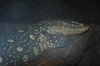
Ornate Monitor (Varanus ornatus) and
East African Black Mud Turtle (Pelusios subniger). In the center of the room, there’s a large, open-topped fish tank with a fake mangrove tree coming out of it, leading into the ceiling. In here you can find fish species such as the
“Congo River Tetra” (Phenacogrammus interruptus) and the
Yellow Congo Tetra (Hemigrammopetersius caudalis). The rest of the room is lined with various small terrariums hold to species such as:
Barbary Striped Grass Mouse (Lemniscomys barbarus)
Calabar Ground Python (Calabaria reinhardtii)
Common Egg-Eating Snake (Dasypeltis scabra)
Ball Python (Python regius)
Congo Dwarf Clawed Frog (Hymenochirus boettgeri)
African Bullfrog (Pyxicephalus adspersus)
Lake Victoria Cichlid (Haplochromis ishmaeli)
Common Electric Catfish (Malapterurus electricus)
African Butterflyfish (Pantodon buchholzi)
Spotted African Lungfish (Protopterus dolloi)
African Giant Millipede (Archispirostreptus gigas)
“Central African Tailless Whip Scorpion” (Damon diadema)
“Mozambique Goliath Beetle” (Goliathus albosignatus)
Cameroon Red Tarantula (Hysterocrates gigas)
Two-Spotted Assassin Bug (Platymeris biguttatus)
Facing into the room from the doorway, the cichlid and aforementioned python enclosures are to your left along that wall. After these, there’s another open doorway leading into a small hall. In front of you is a large glass wall and this is the viewing for the
Red River Hog (Potamochoerus porcus) and
Mandrill (Mandrillus sphinx) enclosure, both of which alternate on and off-exhibit. The signage also claims that
Eastern Black-and-White Colobus (Colobus guereza kikuyuensis) and
De Brazza’s Monkey (Cercopithecus neglectus) are found in here although I’ve not seen either in a very long time. The enclosure is large and netted over, with some large climbing structures leading up to slightly elevated areas. The floor of the enclosure is largely bare and there’s a small stream-like pool to one side. After this short little hall is a right turn. Right at this turn is a nice enclosure for a breeding pair of
Wolf’s Guenon (Cercopithecus wolfi wolfi) who actually had twins not too long ago. The enclosure has some good height to it and it's nicely vegetated and branched for these active monkeys. Directly next to this is a large enclosure for
African Pygmy Goose (Nettapus auritus),
Black Crake (Amaurornis flavirostra),
Congo Peafowl (Afropavo congensis), and
White-Crested Hornbill (Tropicranus albocristatus albocristatus). This enclosure is very similar to the guenon one except it's larger with a little less branching and a small pool home to several small fish species, although I don't know which ones. A little further past this is finally the complex for the
Western Lowland Gorillas (Gorilla gorilla gorilla), complete with large open-aired, glass, and even a small tunnel viewing, a small movie about gorilla conservation, a place for donations, and multiple displays about gorillas and some of the other endangered species of the African rainforests. The first room you enter into is a large space with the majority of the displays and the largest gorilla viewing. As mentioned before, the zoo has two troops; both living is very large and very naturalistic enclosures. The enclosures have slight variations in elevation throughout as well as multiple fake and even a few small live trees. The glass viewing allows you to get face to face to some of zoo’s gorillas, especially their silverback who likes to sit right up against the glass. This room is also home to another small indoor enclosure previously home to marmosets but it currently sits empty. After this you head through a glass tunnel-like hallway with gorilla viewing on both sides. Next up is another small room with some conservational and donation displays, after which you go back outside. From here you’re on a bit of an overlook, looking down into the gorilla enclosure. For whatever reason, though, I’ve never seen a gorilla in here. In my opinion, if the gorillas don’t use it I’d like to see maybe either Eastern Bongos or Sitatunga go in here. After this enclosure, you exit Congo Gorilla Forest with a small gift shop to your left (the direction the Pheasant Aviary is on from your location). There’s also a small viewing for that seemingly empty gorilla enclosure next to the gift shop as well. After this, you’ll be turning right and heading to African Plains….
(Below are images for Wolf's Guenon, Western Lowland Gorilla, Peters's Angolan Colobus, Elliot's Pheasant, Coscoroba Swan, and Ornate Monitor)
~Thylo


 Oh bronx Zoo never change!
 Being as African Plains is a pretty big area in itself, I think that'll all be one separate section.




 I would love to see another duiker species or maybe even Royal Antelope in with the colobus, though. I'm not familiar with that log terrarium you're speaking off..