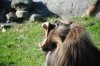
Bronx Zoo Bronx Zoo Walkthrough

I have seen a gorilla or two in the exhibit back here, but the gorillas have enrichment and incentives to stay in the front area of their exhibits (where visitors are). This view is at the very end of Congo with several giant waterfalls. This view is also nearby a "Forest Clearing" view that is for free and alongside the Congo gift shop. I have never seen gorillas from that viewing so I am not sure if the gorillas can get back there. However it is a large and heavily landscaped space so I wonder why it couldn't be used. It would be great for another African primate (mangaby, guenon, drills) and an upper view for bongos or other ground dweller.

One small bone to pick I have with Congo is that before Congo was built the area of the zoo was the South America area and 3 moated exhibits for Malaysian tapir, babirusia and pygmy hippos. The pygmy hippos used to breed and when Congo was announced I assumed they would be a part of the exhibit. And then they weren't. I have always been curious why the zoo did not add them in since they were already a part of the collection. And are endangered and if I remember correctly they bred well at the Bronx. They could have also gone to Zoo Center before the Island Giant renovation.
 
This isn't meant to be offensive in any way but I just realized something,at the beginning of this thread Zooboy28 said he didn't want Thylo to take months between sections like TLD's Berlin trip...
Cookie for observation!!!:D:cool:
 
African Plains-Baboon Reserve
Moving to your right after Congo Gorilla Forest, you’ll find yourself almost immediately in African Plains. After heading up a slight hill with a few signs about endangered Congo wildlife on the side, you’ll find yourself at the entrance to a small branching off path. Go down it and, after a very nice interactive display about how Human activity disrupts the wild order of large African predators and forces them into contact with people, you’ll come across a very large and very nice enclosure for South African Wild Dogs (Lycaon pictus pictus). The viewing is a small wooden hut with glass walls and then enclosure is a large hilly space complete with some large trees. After this, you’ll continue down the small path until, right before it turns back onto the main path, you come across a small glass viewing into a smaller, but still very large and vegetated Spotted Hyena (Crocuta crocuta) enclosure. The viewing here is tiny and is just two small glass windows looking into it, although as you head back onto the main path, the enclosure can be viewed through some vegetation and the wired fence. At this point you’ll begin your decent East, down a very large and pretty steep hill.

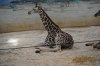
You’ll walk down the path for the length of the hyena enclosure before turning up either the ramp or steps of the Carter Giraffe Building. Here, you’ll find the best and largest view of the hyena enclosure. From the elevated standpoint, you overlook the entirety of the enclosure, giving a much better look than the previous viewings. Enter inside and you’ll be in a large room with an obviously high ceiling and not so pleasant smell:p The viewing path goes in a sort of circle, starting to your right. First you’ll come across a long and narrow enclosure for Common Dwarf Mongoose (Helogale parvula) and Von der Decken’s Hornbill (Tockus deckeni). The enclosure is netted and tall for the hornbills as well as having a nice dirt floor and a multitude of fake termite mounds for the mongoose. After this, you’ll be in front of the on-show giraffe stall for the zoo’s Baringo Giraffes (Giraffa rothschildi). A black eye for the zoo, this stall is quite small, has a hard concrete floor with some sand thrown on top, and holds in excess of 8 giraffes for months at a time during the winter. I believe this enclosure also holds a male during the summer months. I find myself in agreement with many other members on here who say this enclosure is very outdated and does not hold up to the quality a modern zoo of this stature should have. After this, you enter through some large, hanging black straps into an extremely dark room. After allowing your eyes to adjust for a moment, you’ll find one decently sized nocturnal enclosure. The floor is made of deep dirt and it’s complete with a couple of hollowed out termite mounds and a couple of small trees. In here you’ll find the zoo’s Aardvarks (Orycteropus afer), Maxwell’s Duikers (Philantomba maxwellii), and Southern White-Faced Owl (Ptilopsis granti). Personally, while the enclosure is ok in its size, I feel it’s a little cramped with both the Aardvarks and duikers on-exhibit at the same time. Next you'll head out the other end of the room and you’re back at the entrance/exit of the building.

Once back on the main path of African Plains, you’ll head further down the hill a little bit more until you come across the Grévy’s Zebra (Equus grevyi) enclosure. This enclosure is quite large and grassy and it gives the animals plenty of space to roam around. After this, you follow the hill all the way to the bottom, and then proceed North past the zoo’s Asian complex until you come across where the path begins to move more uphill again in a Westward direction. Until this point, there are no animals but multiple empty enclosures which have fallen into a bad state. Before 2009, these enclosures held species such as Blesbok and Arabian Oryx but thanks to budget cuts the animals were sent off and the enclosures have been left empty ever since. Soon after you begin heading back West, you’ll come across a very large and nice enclosure featuring a large grassy area, a section with some small trees, and a nicely sized pond in the center. The viewing here is largely over some small hedges and plants, which gives it a much more natural feel. Inside this enclosure you’ll find a large breeding herd of Lowland Nyala (Tragelaphus angasii) along with Marabou Stork (Leptoptilos crumeniferus), East African Crowned Crane (Balearica regulorum gibbericeps), and Blue-Winged Goose (Cyanochen cyanoptera). Neighboring and overlooking this enclosure, is a smallish but still nice enclosure for Transvaal Lions (Panther leo krugeri). Despite its smaller size, the enclosure still manages to produce quite a good amount of cubs every so often. However, as the cubs mature, the space quickly gets overcrowded and often times the male gets stuck inside all day while the female and the cubs stay outside. Across from the Lions, you overlook a nicely sized but pretty bare space (apart from a tree or two) for some surplus nyalas. Supposedly they alternate on and off-exhibit with a herd of Slender-Horned Gazelles (Gazella leptoceros leptoceros) but I haven’t seen those since 2011 despite several other members claiming they’re still there.

After heading up the path a bit more, you’ll soon find yourself in Somba Village. This collection of mostly closed or seasonal buildings is designed to look like an West African village of sorts. The walls of the buildings are made to look like they're made of dry clay or mud and the roofs are suppose to be straw. A couple of the buildings also are fitted with wood made to appear as acacia wood. Depending on the time of year you visit, one of these buildings is a small gift shop and another is a small café. While the food is adequate, the great thing about this café is that its eating area overlooks the magnificent Baboon Reserve.

Baboon Reserve is one large, grassy, rocky, and hilly enclosure which offers two acres of open space to its three species: Gelada (Theropithecus gelada), Nubian Ibex (Capra nubiana sinaitica), and Rock Hyrax (Procavia capensis). In the past I've seen Cape Teal (Anas capensis) here as well but not in some time. This large enclosure is designed to simulate the mountainous environment of the Ethiopian highlands and features a large hilly expanse allowing visitors to see the majority of the space while still being unable to see the back fencing or animal holdings. Throughout the enclosure there are many large groupings of rocks and towards the front there’s a mock rock structure- this being primarily where the hyraxes stay- and a stream, allowing for an open air view between the animals and people. Along with this, visitors also have a glass viewing hut to get an even closer view of the species. The pathway along this enclosure heads North and is marked with fake dried mud banks. It features a fake archaeological dig site with the fake skulls of various Extinct primates including prehistoric Humans. My favorite part of the visitor area is still the aforementioned café viewing as, in my opinion, nothing beats being able to sit down with your family and eat a cheeseburger while watching Geladas and ibex graze in an extremely naturalistic setting:) A historical fun fact I found out about this exhibit while skimming through the ZooLex article about it: this enclosure used to be home to the actual skeletal remains of a bull elephant poached in Kenya and was accompanied by a sign talking about the decline in African elephant populations.

If you loop back South into Somba Village, you’ll pass the now closed and empty World of Darkness building. Once home to a fantastic collection of nocturnal species such as Chinese Leopard Cat, Bay Duiker, and Common Genet, this exhibit unfortunately was another victim of the 2009 budget cuts.

Once back in Somba Village, heading West will put you back on the African Plains trail. Before entirely leaving the village, however, you’ll find another small eating area overlooking a huge grassy space. Now this enclosure is kind of tucked into a corner of Somba Village so it’s quite easy to miss. In here, you’ll find the zoo’s new Southern Lesser Kudu (Tragelaphus imberbis australis) and Blue Cranes (Anthropoides paradiseus) along with a huge herd of gazelles. Now officially the zoo holds “Thomson’s Gazelles” but this species has recently been split into two new species and from what I’ve been told both species are present in American zoo populations. I believe it is thought the zoo holds the split species of Serengeti Gazelle (Eudorcas nasalis) but it is entirely possible this is incorrect so anyone who may know more please feel free to correct me either on this thread or via PM. Heading West again, you’ll move back uphill a ways through a forested area until you come to another large, grassy enclosure. Here you’ll find the outdoor enclosure for the zoo's breeding herd of Baringo Giraffes (Giraffa rothschildi) and a couple of Southern Ostriches (Struthio camelus australis). This enclosure is fairly simple but very nice. It’s a good sized, grassy space that has a small grouping of trees to one side, offering some shade for the animals. It also borders the wild dog enclosure and it’s not uncommon to see the wild dogs and Ostriches chasing each other along the dividing fence. The viewing is made to be low and covered in vegetation so as to make it appear nonexistent. And with that, you’ll have finally rounded out African Plains and it’s off to the Mouse House…

(Below are images for Maxwell's Duiker, a Baringo Giraffe calf, Lowland Nyala, two Transvaal Lion cubs, Nubian Ibex, and Gelada)

~Thylo:cool:
 

Attachments

  • 337.jpg
    337.jpg
    546.9 KB · Views: 7
  • 339.jpg
    339.jpg
    1.3 MB · Views: 5
  • nyala.jpg
    nyala.jpg
    268 KB · Views: 6
  • lion.jpg
    lion.jpg
    329.7 KB · Views: 5
  • ibex.jpg
    ibex.jpg
    273.7 KB · Views: 5
  • gelada.jpg
    gelada.jpg
    249.6 KB · Views: 6
Last edited:
ThylacineAlive said:
After this, you enter through some large, hanging black straps into an extremely dark room. After allowing your eyes to adjust for a moment, you’ll find one decently sized nocturnal enclosure. The floor is made of deep dirt and it’s complete with a couple of hollowed out termite mounds and a couple of small trees. In here you’ll find the zoo’s Aardvarks (Orycteropus afer), Maxwell’s Duikers (Philantomba maxwellii), and Southern White-Faced Owl (Ptilopsis granti). Personally, while the enclosure is ok in its size, I feel it’s a little cramped with both the Aardvarks and duikers on-exhibit at the same time.
it seems odd to have the duikers in a nocturnal exhibit, no?

ThylacineAlive said:
If you loop back South into Somba Village, you’ll pass the now closed and empty World of Darkness building. Once home to a fantastic collection of nocturnal species such as Chinese Leopard Cat, Bay Duiker, and Cape Genet, this exhibit unfortunately was another victim of the 2009 budget cuts.
two words immediately leapt out at me there: cat and bay! Too bad they were the wrong way round :p

What is happening with this house do you know? Any future plans to re-open it as a nocturnal house, or renovate it into something else?
 
Last edited:
it seems odd to have the duikers in a nocturnal exhibit, no?


two words immediately leapt out at me there: cat and bay! Too bad they were the wrong way round :p

What is happening with this house do you know? Any future plans to re-open it as a nocturnal house, or renovate it into something else?

I agree. They used to be displayed in the colobus enclosure in CGF and then went off-show for a long period before turning back up here last year. All the inhabitants on that enclosures usually just stay in the same spot every time I visit. The owl sits on a branch, the Aardvark inside one of the termite mounds, and a pair of duikers sitting in the open center.

Agreed:p Though not sure how I'd react if they had a Bay Cat in there and I never saw it!:eek: Still beating myself up over the Proboscis Monkeys that were in JungleWorld.

Absolutely no idea. The zoo has several closed buildings including WOD and the Monkey House and while I'd imagine they have eventual plans for them and I've heard rumors, I believe there are no immediate plans. In fact, I believe WOD sits completely empty now apart from when its used as a haunted house for Halloween (unless they no longer do that?). It'd be pretty wonderful if they were to reopen it as a nocturnal house but I doubt it'd ever go back to its former glory. The zoo still has plenty of nocturnal enclosures as it is, though, so it's not as though this aspect is absent from the zoo.

~Thylo:cool:
 
First off:
Wonderful to see you back to this post. It's terrible having a life and not being able to post as quickly as you would like!

I feel the African Plains area of the zoo should have the most promise since I feel a lot of land is not used. And a quick aside: the African elephant skeleton is still there, just to the side of the gazelle/kudu exhibit. Look for it next time you are there. That exhibit also used to have blesbok and secretary birds so I wonder if eventually more species could be held.
I agree with you that the indoor giraffe space is too small and the aardvarks could be larger. When they had the baby aardvark a couple years ago it was nice to see them active.
The lion exhibit could be larger; but seeing the cubs the past year or so running all over the exhibit has been a joy.
And the baboon reserve is a favorite. I have seen cape teal and Egyptian geese before in the water there.
And the World of Darkness :( leopard and sand cats, slow and slender loris, two galago species, two small lemur species, night monkeys, sloths, bay duiker, three porcupine species, naked mole rats, black caimen and at least five bat species. It is still used as a haunted house during Halloween and the jack'o lantern display this year was great; but not compared to the old WoD. Can't wait to read the next part!
 
First off:
Wonderful to see you back to this post. It's terrible having a life and not being able to post as quickly as you would like!

I feel the African Plains area of the zoo should have the most promise since I feel a lot of land is not used. And a quick aside: the African elephant skeleton is still there, just to the side of the gazelle/kudu exhibit. Look for it next time you are there. That exhibit also used to have blesbok and secretary birds so I wonder if eventually more species could be held.
I agree with you that the indoor giraffe space is too small and the aardvarks could be larger. When they had the baby aardvark a couple years ago it was nice to see them active.
The lion exhibit could be larger; but seeing the cubs the past year or so running all over the exhibit has been a joy.
And the baboon reserve is a favorite. I have seen cape teal and Egyptian geese before in the water there.
And the World of Darkness :( leopard and sand cats, slow and slender loris, two galago species, two small lemur species, night monkeys, sloths, bay duiker, three porcupine species, naked mole rats, black caimen and at least five bat species. It is still used as a haunted house during Halloween and the jack'o lantern display this year was great; but not compared to the old WoD. Can't wait to read the next part!

Thank you:) Yea it's been a stressful few months and likely to be a stressful few more but I'll try and get this done more.

Where is it in proportion to the enclosure? I'd definitely love to see it as it is a powerful educational tool.
The enclosure is probably the largest in African Plains and even with well over a dozen gazelles it still looks like it was room to spare! With the exception of the Blue Cranes it seems it's themed as an East African enclosure so I feel Giant Eland could easily be a cool addition to it.

Funny thing about WOD is I've actually managed to see most of the species held at the time of closing just along my other zoo visits:p Which porcupine, lemur, and bat species were held?

~Thylo:cool:
 
I remember seeing prehensile-tailed, African brush-tailed, and Indian crested porcupines in the WOD. I believe, lemurs were grey mouse lemurs and fat-tailed lemurs (also galagos and lorises). Not sure about bat species...
 
Funny thing about WOD is I've actually managed to see most of the species held at the time of closing just along my other zoo visits:p Which porcupine, lemur, and bat species were held?
there's a list on this thread: http://www.zoochat.com/22/world-darkness-77002/
Zebraduiker said:
Rodriguez Flying Fox
Long-Tongued Bat
Short-tailed Bat
Jamaican fruit bat
Lesser speared Nosed Bat

Fat tailed lemurs
Lesser mouse Lemurs
Moholi Bushbaby
Slow lori
Lesser Slow Loris
Grey legged Night monkeys

Leopard Cats
Sand Cat
Small spotted genet
Stripped skunk

Cloud Rat
Spiny Mouse
Striped Mouse
Rock cavies
naked Mole Rat
Hoffman's Sloth
Brush-tailed pordupine

Bay Duiker

Broad snouted caimen
Corn island Boa
Sand boa
Marine Toads
Scorpions
 
I see someone answered the question on what species were held at the WoD; the only one I question never seeing was the genet. Which has me believe they were not exhibited at the WoD anytime after the late 1990's. Ringtails, kit fox, nine banded armadillo, greater galago, Egyptian fruit bats and other species did rotate out and for a year they had aye ayes on loan.
I think eland would be great on the plains. I wish another species could get along enough with the zebras too since they have ample space in their exhibit. I also wonder why the slender horned gazelle could not share the space alongside the nyala, realistic geography be damned!
As for the elephant skeleton. When looking at the gazelles/kudu, on the far left hand side is the skeleton with signs about elephant poaching. When somba village first opened this area was more prominent. Now the grass is more overgrown, but the signage and skeleton are still there The large tree with the nest on that exhibit also was built for nesting secretary birds who used to use it.
 
I see someone answered the question on what species were held at the WoD; the only one I question never seeing was the genet. Which has me believe they were not exhibited at the WoD anytime after the late 1990's. Ringtails, kit fox, nine banded armadillo, greater galago, Egyptian fruit bats and other species did rotate out and for a year they had aye ayes on loan.
I think eland would be great on the plains. I wish another species could get along enough with the zebras too since they have ample space in their exhibit. I also wonder why the slender horned gazelle could not share the space alongside the nyala, realistic geography be damned!
As for the elephant skeleton. When looking at the gazelles/kudu, on the far left hand side is the skeleton with signs about elephant poaching. When somba village first opened this area was more prominent. Now the grass is more overgrown, but the signage and skeleton are still there The large tree with the nest on that exhibit also was built for nesting secretary birds who used to use it.

The only species I know I saw in WOD are the Leopard Cats, other species I either saw at the zoo or at different zoos after the closing.

I believe Southern White Rhinos get along with Grevy's Zebras (at least they did at Lowry Park) and the area is large enough for both species to be in and still get away from each other so it's probably more a question of indoor space. Yeah at least one other ungulate species should share with the nyalas and the gazelles would work fine.
Yeah that whole area seemed like it was a much more prominent and overall better exhibit than it is now (as amazing as it still is). I will definitely keep a look out for that, though, as I'd love to see it.

~Thylo:cool:
 
I see someone answered the question on what species were held at the WoD; the only one I question never seeing was the genet. Which has me believe they were not exhibited at the WoD anytime after the late 1990's. Ringtails, kit fox, nine banded armadillo, greater galago, Egyptian fruit bats and other species did rotate out and for a year they had aye ayes on loan.
the list was from a visit in 2009.
 
Back
Top