United States Brookfield Zoo Chicago: The Definitive Timeline

JVM

Well-Known Member
10+ year member
Introduction

This July, Brookfield Zoo Chicago celebrates its ninetieth anniversary.

It almost didn't happen. New York and Germany provided inspiration towards the formation of the Society and the dream of a world-class barless zoo in Chicago, but it still took the Chicago Zoological Society over a decade to complete construction and open the facility to the public. Wealthy benefactors gifted land and wildlife alike to furnish the facility that would bring Giant Pandas to the west, breed the first Black Rhinoceros and Okapi born in captivity, built the first inland dolphinarium and invested a decade into the planning and construction of one of the country's first indoor rainforest buildings.

This project began as an attempt to cross reference two official timelines of Brookfield Zoo Chicago, one published in Andrea Friederici Ross’ Let the Lions Roar! The Evolution of Brookfield Zoo (one of my favorite books of all time, to be frank with you) and one published by the zoo’s Gateways magazine in Summer 2021 for the Society’s centennial anniversary. I found it neat to compare how different events were covered between both sources - while verifying some points though, I found other sources to contrast, and then found information I felt should be included but wasn’t, such as some collection notes, and the next thing I knew, it was becoming a much bigger project, with newspaper archives, guidebooks and more. I have used these resources to compile a timeline I think will be pretty definitive, with lots of collection and exhibit notes as well as information about the Society and its programs.

I want to extend some thanks to @pachyderm pro for reviewing the timeline a few times and giving useful feedback, and occasionally helping me narrow down confusing dates, and @TeaLovingDave for providing some really useful reference material as well, and finally I absolutely must credit Ross’ wonderful book which really forms the backbone of this thread.

I hope those of you who are only gently acquainted with the facility find this project fascinating and I hope this thread inspires someone to make their own timeline thread. :)

Formatting Notes
When possible, I have tried to specify when a species’ last individual has died, been sent away, or when they have been removed from a specific exhibit. I use ‘left the collection’ when I am absent from specific information and 'last reported' when the date is especially shaky or uncertain. A few animals of special interest I used their last mention in zoochat reports, which may not be the actual date they left the collection; in these cases it will marked 'last reported'.

The full list of works cited and sources is available here. I may continue to update it as the thread progresses. Links have been provided wherever possible, however, some newspaper archived items were accessed via tools. If you are looking for a source for specific information, or have information you think would be worth including in future posts, please feel free to ask or contact me.

This timeline may appear to put unusual focus on certain large mammals, such as apes - these were largely species which received more news coverage and press or attention, or for which I had a specific detailed source.

Exhibit names are capitalized, as in the Gateways issue, as to make these a little easier to follow. Animal species are often referred to as identified in the original source text to minimize the chance of identification errors on my own part.
 
Last edited:
1919
  • Edith Rockefeller McCormick, a socialite and daughter of magnate John D. Rockefeller, donates 83 acres of land gifted to her by her father for the purpose of establishing a zoo. Known for supporting young writers and artists, she suggests in a statement that “it is important that we have the opportunity for scientific studies of the processes in animals that we may better understand the processes in ourselves and thus be of material aid to those whom we call neurotics”.
  • The gift is formally made on May 3, 1920, conditional that a zoo be completed on the land within five years or it would be returned to McCormick or her heirs.
1920
  • Members of the Cook County Board, including Commissioner Frank J. Wilson, Emmet Whealan, Bartley Burg and Emmett J. Flavin, chief engineer of the Forest Preserve District, referred to in many sources as the “Wilson Committee”, tour the Bronx Zoo, the Cincinnati Zoo, Smithsonian National Zoo, Philadelphia Zoo, Buffalo Zoo and Saint Louis Zoo. They select the Bronx Zoo in New York as their model.
1921
  • Daniel J. Ryan becomes President of the Forest Preserve District of Cook County shortly after the death in February of Peter Reinberg, an early supporter of the zoo.
  • In February, the Forest Preserve District of Cook County established the Chicago Zoological Society as a private nonprofit to plan, build and operate the zoo on land owned by the Forest Park District, in an effort to remove management of the facility from local politics. The society is modeled on the New York Zoological Society, and consists of local citizens including civic and business leaders. Forty-nine governing members are selected to elect twenty-five trustees.
  • Political cartoonist John T. McCutcheon is elected the first President of the Chicago Zoological Society. Governing members also included John G. Shedd, Marshall Field, newspaper editor Robert McCormick, Art Institute president Charles Hutchinson, baseball team owner William Wrigley Jr., future Secretary of Commerce Robert Lamont, and future Vice President Charles G. Dawes.
  • The Park District agrees to own the land and use tax revenue to pay for construction and maintenance while the Society would raise money relating to the purchase and care for animals.
1922
  • Anton Cermak becomes President of the Forest Preserve District. (He would later become Mayor of Chicago and die in an assassination.)
  • The Wilson Committee Cook County Forest Preserve District members tour European zoos, with a focused interest in visiting the Tierpark Hagenback, still a new institution and considered the foremost pioneer of natural landscapes and barless exhibits and inspiring the development of facilities in Denver and Saint Louis, though also controversial and vocally opposed by William T. Hornaday, director of the Bronx Zoo, who felt moats created too much distance between animals and visitors and resulted in fewer species.
  • Heinrich and Lorenz Hagenback acted as their guides; zoos visited include London, Rotterdam, Amsterdam, Berlin, Frankfurt and Munich, however, the group spent three days studying the Tierpark and were accompanied by Heinrich and Lorenz Hagenback. The Hagenbacks would agree to help plan the zoo for $5,000.
  • On October 27, a groundbreaking ceremony is held, with Forest Preserve District President Daniel Ryan using a spade to mark the first dig. Speakers include John McCutcheon and Charles Wacker. The date is chosen to honor the birthday of recently deceased former President Theodore Roosevelt, considered the country’s leading naturalist at this time.
1923
  • George Frederick Morse, Jr. is hired as the Chicago Zoological Society’s first manager, coming from the Boston Zoological Garden and recommended by William T. Hornaday.
  • In May, zoo advocate Daniel J. Ryan dies of a stroke.
  • In June, the Illinois House approves a proposed tax to fund the zoo, should local referendum approve. The tax would provide $500,000 a year for five years of construction and $250,000 every year after for maintenance.
  • The Hagenback-designed plan for the zoo includes a focus on a refectory, modeled on the design at the Tierpark in Spellingen, allowing visitors to watch wildlife while dining. Some writers criticized this design after it was published in the Chicago Commerce in May.
  • On November 6, a Cook County-wide referendum to fund the zoo fails to pass. Much opposition is based on a separate referendum on funding schools, which was portrayed as mutually exclusive. Some opposition is also rooted in suspicion that McCormick’s gift was done to evade taxes or raise real estate value on the donated or nearby land.
  • The deed for the zoo is amended by all parties - a new tax referendum is set for December 1, 1926, with the condition that if the zoo did not open to the public by July 31, 1934, the land would be returned to McCormick or her estates.
1924
  • Many early supporters back out of the project, with advocates such as Daniel J. Ryan and Charles Hutchinson having passed away. Total revenue from membership dues from governing members of the Chicago Zoological Society are less than $100 this year.
1925
  • No news to report.
1926
  • On April 13, a second “zoo tax” referendum passes and is approved by Cook County voters, with over 295,000 voting in favor of the zoo.
  • Stanley Field is chosen to be chairman of the Buildings and Grounds Committee, tasked to supervise construction of the zoo. He is known for keeping detailed records and notes.
  • Although tax money is set for the next year, the Forest Preserve District allows the zoo to borrow money for future repayment, allowing work to begin immediately. Grading, dredging, construction and underground work begins immediately.
  • Land also owned by the Park District as well as privately owned parcels purchased nearby lead to an additional 98 acres (400,000 meters) to become available for development of the zoo, with a total of 196 acres initially available.
  • In May, architect Edwin H. Clark is selected to design the physical layout of the park, based on his acclaimed work on Lincoln Park Zoo’s Small Animal House (current Primate House) and Aquarium (currently a restaurant). The trustee meeting where Clark was appointed agrees on two formal malls with a circular motif at the intersection, with the north-south mall connecting both zoo entrances.
  • Clark retains most of the dimensions suggested by the Hagenbacks including the use of moats and layouts of the barless enclosures, using the Zoo in Rome’s Villa Borghese, also designed by Carl Hagenback, as an inspiration.
  • Clark designs all of the zoo buildings using Art Deco and Italian Renaissance influences. The Zoo Guide (1939) describes this style as based on”the informal Italian farm style of the fifteenth century” with “soft and antique texture of the walls, and the autumnal colored roof tiles ”to resemble a “country setting”. The Italian influence is shown in buildings designed with stuccoed walls painted white, gray stone trim, and earth colored tile roofs. Classical Revival influence is favored for projects like the potential LION HOUSE. The SOUTH GATE has remained largely unchanged.
    • In contrast, at this time many zoos construct animal houses in style similar to their origin countries, such as the Taj Mahal-inspired Elephant House at the Cincinnati Zoo and the Hindu-inspired Elephant House in Berlin. However, historical revival styles were being used at Philadelphia and the Bronx Zoo at the time.
  • George F. Morse leaves to become the first director of the Shedd Aquarium, having remained with the zoo as manager and intended director between referendum.
  • In December, the zoo signs a contract with Cyclone Fence Company of Chicago and Waukegan for $19,465.72 to construct an eight-foot high fence with three strings of barbed wire.
  • J. P. Miller Well Company drills a well for the zoo capable of supplying 750,000 gallons every twenty four hours, at a cost of $16,566.96
1927
  • Edward H. “Ed” Bean, director of the Washington Park Zoo (predecessor to the current Milwaukee County Zoo) from 1906 to 1972 becomes the first director of Brookfield Zoo, and his son Robert Bean becomes assistant director, having studied zoology at the University of Wisconsin before moving to become director at San Diego. The Beans are Chicago natives, with Ed Bean having previously worked at Lincoln Park Zoo.
  • Stanley Field relates that:
  • “During this [1927] season, we hope to complete all of this underground work, get all the piping and sewerage plants in, etc. We expect to build a power house, an administration building, the main entrance, a comfort station, and one animal house. The trustees have decided that the first animal building shall be the REPTILE HOUSE.”
  • The first tax money arrives to fund construction of the facility.
  • The SOUTH GATE and REPTILE HOUSE are constructed.
  • The zoo’s artesian well and first power house is constructed. Per the Library of Congress:
  • The 1927-drilled artesian well was certainly a necessity, as was the power house. Here the water was fed to the coal-fired steam heating system that would distribute warmth to every building in the zoo through miles of pipes running underground. Originally, the plan was that a siding track would be built, connecting up to the West Towns streetcar line, operating just on the other side of the southern cyclone fence. On this siding, trolley freight cars would be brought in full of coal for the power house. This never came to pass. Instead, the coal was trucked in. The power house was still using coal-fired steam heating as late as 1961-62. It was at this time that the system was finally converted to gas power.
  • The zoo’s “comfort station”, better referred to as its first bathrooms, are constructed.
  • The east, west, north and south malls are graded into shape. The center spot is empty at this stage, but maps, models and plans show a pool to be constructed at the spot.
  • A small railroad is constructed between the future sites of WATERFOWL LAKE and the REFECTORY, moving mud and soil both for the purpose of deepening the lake site and building up the site of the REFECTORY construction.
  • It is originally intended that guests could drive around the perimeter of the zoo to view animals outdoors for free and then enter from any of eight parking areas aside from the SOUTH GATE from these lots. Logistical concerns about selling tickets at eight entrances and winter maintenance lead to this plan not coming to fruition.
  • At the end of the year, the Beans acquire the first animal inhabitants to reside at the park - five young, unnamed baboons.
  • Field declares that the coming year’s funds will be spent “on buildings, so that the Animal Committee can get some animals, and then there will be something to show the public.”
  • The Board makes the wise decision to only do construction work when funds are available, rather than on credit.
1928
  • The REPTILE HOUSE is completed. There is some discussion whether to acquire more animals and open it to the public as a “preview”, but this does not occur.
  • The Chicago Zoological Society administrative offices are moved to the zoo grounds.
  • Norway maples are planted along the walls of the zoo. The majority die due to poor drainage.
  • The PERCHING BIRD HOUSE is under construction.
  • Zoo officials optimistically forecast a possible opening in 1930 at the current rate of progress.
1929
  • Construction on WATERFOWL LAKE, adjacent to the 10-acre SALT LAKE WILDERNESS nature preserve, is completed. An inlet initially connects the natural creek to the manmade lake, allowing water to be poured in.
1930
  • Swiss sculptor John Hurliman begins to construct the extensive rock work for the Hagenback-inspired barless bear and lion dens for the future BEAR GROTTOS and LION HOUSE. The big cat rock work is to be sixteen feet high at its lowest point, with a moat twenty feet deep and twenty-four feet wide. The overall grottos are seventy-five feet long and eighty-five feet deep. His work and methods were later described by the zoo:
    • “In order to replicate the topography of an animals' exotic home, [Edwin Clark] relied on John Hurlimann, an influential Swiss artist and sculptor, to recreate the mountains and valleys of habitats in the wild. Hurlimann used gunite, a sprayable concrete mixture, to mimic the home of monkeys living on the former Baboon Island. The innovative use of gunite not only allowed guests to view the animals in the most naturalistic way available, but it gave the animals an area to explore in a more natural setting.”
  • The onset of the Great Depression brings new construction at the zoo to a grinding halt.
1931
  • Stanley Field reports to the Chicago Zoological Society that construction is “two to two and a one-half years behind schedule”, elaborating:
  • “Due to non-collection of taxes resulting in no money being paid to the Society during the year 1929, or during the first half of the year 1930, no constructive work was undertaken during that period… it is going to be absolutely impossible to have the buildings and grounds completed or in presentable shape for 1933, unless there is a substantial increase in the money at the disposal of the Society.”
  • Korongo, a male African Black Rhinoceros, is born in the wild near Mount Essiminger and Lake Tanzania. He would later be held at Brookfield Zoo.
1932
  • Edith Rockefeller McCormick dies of cancer, aged 59. She is never known to have set foot on the site that later became Brookfield Zoo.
  • PACHYDERM HOUSE, INSECT HOUSE and PARAKEET HOUSE are completed.
    • The PACHYDERM HOUSE is known for its artificial rock formation-styled long facades, resembling a mesa, as well as a minimalist, modernist interior, with full height arches measuring 30 by 40 feet and a total of twelve stalls for displaying pachyderms. Remote, mechanical doors allow animals in and out with minimal keeper involvement for safety reasons.
  • Construction work begins on SMALL ANTELOPE HOUSE, PRIMATE HOUSE, AUSTRALIA HOUSE, AQUATIC BIRD HOUSE and the NORTH GATE.
  • Guests are invited into the developing park to inspect the construction work in progress, including the still empty BEAR GROTTOS.
1933
  • The Century of Progress World’s Fair is held in Chicago, previously considered as a potential deadline for the zoo’s opening.
  • New Deal programs, such as the Civil Works Administration (CWA) and Works Progress Administration (WPA) are created to put as many people to work as possible, particularly manual laborers, providing temporary relief for millions of unemployed workers. Many of these laborers help build the zoo’s infrastructure, while artists and photographers help create murals, posters and statues. Other beneficiary zoos include Toledo and Detroit.
  • Herpetologist Grace Olive Wiley arrives and becomes the curator of Reptiles, bringing a collection of 236 reptiles and amphibians with her, which the Society purchases.
  • Ed Bean expresses intent to display animals in mixed exhibits replicating their natural habitats and environments:
    • “An African veldt will adjoin the Antelope house, in which an association of antelope, zebra, ostrich and other birds may be seen. The summer enclosure for the Australia house will be barless, spacious 150x450 feet, and is reproduced in accurate detail. An aggregation of kangaroo, wallaroo, wallaby and the large native birds will mingle together here. These will be kept in a large paddock of similar nature in the adjoining house in the winter.”
  • Industrialist and civil leader George F. Getz donates his private collection of more than 400 animals, transported directly from Michigan, including giraffes, elephants and elephant seals, including 143 mammals, 123 birds, and 4 reptiles.
  • The zoo’s animal collection is assembled from a variety of sources:
    • The Field Museum donates five geladas.
    • Thomas Howell donates multiple Galapagos species including penguins, albatrosses and tortoises.
    • Six lions are sent by EL King from Minnesota.
    • Three further lions are sent by Thomas Wheelock.
    • Twenty wood pigeons and stock doves are sent by Boardman Conover.
    • Two "indefatigable island tortoises" arrive from Commander Eugene McDonald.
    • A Virginia oppossum arrives from John. G. Kellogg.
    • Six kodiak bears from trustee John T. Pirie; three kodiak bears are acquired directly from Kodiak Island. The zoo was the first to have kodiak bears reproduce.
    • Two arctic foxes from Donald MacMillan.
    • Twelve mallard ducks from the St. Joseph, Missouri Department of Parks.
    • The Bronx Zoo donates two yaks.
    • The National Zoo donates a silver gull and a night heron.
    • The San Francisco Zoo provides African leopards and Bengal tigers.
    • Multiple alligators arrive including a Mississippi alligator from F. Williams. (At one point, Ross writes, the zoo held sixty alligators, all but one of which were gifted.)
    • Bebe, a two-and-a-half-year-old common hippopotamus, arrives in October.
    • Female orangutan Tia arrives, is generally considered the zoo’s first orangutan.
    • The Taronga Zoo in Sydney, Australia provides 98 mammals, 746 birds, and 32 reptiles, forming the backbone of the new zoo’s avian collection. One of the birds is a one-year-old Major Mitchell’s pink cockatoo named Cookie.
    • Egyptian cobra, a blue and gold macaw, and western gray kangaroo also are part of the initial collection.
  • The moats at BEAR GROTTOS are widened after a grizzly bear successfully escapes.
  • In December, the Chicago Tribune reports:
    • “Forty CWA laborers are doing grading and other outdoor work, thirteen CWA skilled men are painting the inside of the buildings, and two metal lathers are constructing the steel framework of habitat scenes which will be coated with a cement mixture.”
1934
  • In April, zoo officials formally request “65 common laborers, 3 plasterers, 3 metal lathers, 12 painters, 5 building trades laborers, 3 plasterers, 3 metal lathers, 12 painters, 55 building trades laborers and one cement finisher,” to help complete work on the zoo.
  • On July 1, the Chicago Zoological Park, better known as Brookfield Zoo, opens to the public for the first time to over 58,000 enthusiastic visitors. Illinois Governor Henry Horner attends the event, as does Lorenz Hagenback.
    • Extreme heat causes thirteen women and two children to require medical care.
    • A gang of pickpockets are arrested at the PACHYDERM HOUSE.
    • The initial parking available for the zoo proves unsatisfactory and plans begin almost immediately for a parking lot expansion.
  • Buildings and exhibits completed and ready opening day included REPTILE HOUSE, PRIMATE HOUSE, AUSTRALIA HOUSE, AQUATIC BIRD HOUSE, BEAR GROTTOS, LION HOUSE AND DENS, PACHYDERM HOUSE, FORMAL POOL and PARAKEET HOUSE.
    • The LION HOUSE has “retiring dens” for animals to have privacy and calm their nerves, specifically intended for pregnant animals, and can be temperature regulated.
    • Skylights and steel mesh are already in use. The central hall has terrazzo floors, marble wainscoting and alcoves for tropical plants. The south side of the building (the current FRAGILE KINGDOM exhibits) has elevated animal cages and skylights
    • All animal exhibits are designed with separate ventilation for public spaces for animal stalls.
  • MONKEY ISLAND, PERCHING BIRD HOUSE, SMALL MAMMAL HOUSE, the REFECTORY, SEAL ISLAND and PARROT HOUSE remain unfinished and under construction.
  • Animal residents reported to be present at this time:
    • Male orangutan Charley is reported to have arrived this year.
    • Minnie the Asian elephant and Melshie the chimpanzee, who briefly lived with zookeeper Sam Parrott, are early residents.
    • West African mandrill are a reported resident at PRIMATE HOUSE.
    • Tasmanian devils, armadillos and Mexican fruit bats are held in SMALL MAMMAL HOUSE.
    • Flamingos, pelicans and waterfowl are reported as being held at the FORMAL POOL at this time.
    • A Central American tapir calf from Honduras arrives who lives at the zoo for twenty years.
    • Free foaming peafowl are already a fixture.
    • The PACHYDERM HOUSE at this time includes an Indian elephant and calf, and an elephant given to the zoo by George Getz. Three hippopotamuses and a tapir (possibly same as above) are also mentioned. A postcard sold this year includes three African elephants.
  • Promotional material claims Brookfield is the “first zoo in the country” to feature animals from Australia.
  • PRIMATE HOUSE is described in promotional material as having thirty-two enclosures around the western outer walls that can be used for seven months of the year. The interior is said to have a “lush garden” in the middle with a monkey cage.
  • Marshmallow and peanut sales begin, which guests can feed to bears and monkeys respectively, a practice that continues for decades.
  • The zoo’s attempts to acquire flying foxes fails as federal law forbids the admission of the animals to the United States if propagated.
  • The future ROOSEVELT FOUNTAIN is not yet constructed, but the empty space in the zoo center is sometimes used for concerts and other events.
  • The Chicago Zoological Society’s Scientific Advisory Committee is formed in hopes of eventually building an ANIMAL HOSPITAL/research facility. Dr. Wilfred Osgood for the Field Museum and Dr. Frank R. Lillie of the University of Chicago are leading members of the committee.
  • By December, the zoo has already welcomed 1,292,720 guests and its operating costs remained “less than ”$250,000 dollars.
  • The December 1934 issue of the Architectural Record writes:
    • “Although one of the principal requirements of this Zoo was a barless naturalistic environment, it was also considered essential to display many and rare varieties for scientific interests. This factor, plus the Chicago winters, necessitated many public exhibition houses. The wooded west end of the site offered poor building sites. An artificial lake was developed here with adjacent picnic grounds and a large future North American scene and bird sanctuary. The fill from this lake was utilized to raise the east end of the long mall. The type of architecture is Italian Peasant with common brick walls painted white, Bedford stone trim, and red tile roofs, and with fireproof construction throughout.”
  • The total collection at this time is 394 mammals of 110 species, 392 birds of 149 species, and 586 reptiles (of 155 species)
  • The zoo is not yet considered complete and maps at the time (see below) reflect a desired master plan including an extensive North American Panorama on the eastern edge of the zoo, below the REFECTORY, a Goat Mountain in the center of the North Mall, an “ostrich house”, additional grottos for small carnivores near the BEAR GROTTOS and additional buildings in the southwestern section of the zoo.
The zoo’s original map, designed by artist Edgar Miller, could be considered its “master plan” at the time, containing many exhibits still under construction at the time but also a great variety of exhibits and buildings intended to be constructed in the future. This map was reprinted in Let the Lions Roar: The Evolution of Brookfield Zoo.

Map%2Bof%2Bthe%2BBrookfield%2BZoo%2B-%2BEdgar%2BMiller%2B%252B%2BAndrew%2BRebori%2B-%2Bc.%2B1934%2B-%2BEdgar%2BMiller%2BLegacy%2BArchive.jpg

(full link / backup link)

Key:
1. South Entrance Gate and Offices of Administration
2. Small Tropical Mammals
3. Northern Bears
4. Mink, Otter, Fisher*
5. Hospital and Zoological Research*
6. Opossum, Prairie Dog, Etc.*
7. North American Panorama*
8. Lions, Tigers, Leopards, Jaguars
9. Large Antelopes*
10. Wolves, Foxes, Hyenas*
11. North Gate and Comfort Stations
12. Northern Tigers*
13. Scene South American Animals*
14. Elephants, Giraffes, Hippos, etc.
15. Australia House and Scene
16, 17, 18, 19, 20. Zebra, Yak, Antelopes, Etc
21. Storage Barn*
22. Buffalo and Wild Cattle enclosures*
23. Director's Residence
24. Children's Playground
25. Refreshments
26. Small Antelopes, Gazelles
27. Contemporary Illinois Mammals
28. Yak Enclosure*
29. Zebras, Wild Asses, Horses*
30. Wild Bird Sanctuary
31. American Water Fowl Lake
32. Sea Lions, Seals, Walrus
33. Refreshments, Luncheons
34. Aviary, Eagle-Like Birds*
35. Cranes, Storks, Upland Birds*
36. Cage for Large Birds of Flight*
37. Tropical Aquatic Birds
38. Formal Basin for Exotic Water Fowl
39. Reptile House
40. Apes*
41. Monkey Island
42. Primate House
43. Aquatic Reptiles*
44. Birds, Insects and Lower Forms
45. Ostrich-like Birds*
46. Pheasants, Quail, etc.*
47. Power House, Well, Water Su-
48. Commissiary, Garage, Stable
49. Raccoons
50. Green House*
Cs. Comfort Stations
P. Picknicking Area
* Future Developments
 
....first Black Rhinoceros and Okapi born in captivity....
Thank you for an extremely interesting thread.

However I think Brookfield Zoo bred the first okapi in North America not the first in captivity. I'm sure Antwerp Zoo bred okapi before Brookfield did.
 
Thank you for an extremely interesting thread.

However I think Brookfield Zoo bred the first okapi in North America not the first in captivity. I'm sure Antwerp Zoo bred okapi before Brookfield did.
Thank you for pointing this out. I originally only mentioned the rhinoceros birth and when rewriting the introduction, added "okapi" to the sentence late, losing the context.
 
Very enjoyable read so far! Interesting to see how much has changed and how much has remained since that first map. The seal island reminds me of the seal exhibit for Lincoln Park.

Thought it was pretty ironic that most of that extra parking they built remains unused half the time to this day.
 
  • Like
Reactions: JVM
Thank you for the kind words! I am hoping to update weekly (no promises!) so here is the next section. :)

1935

  • Leading aviculturist Karl Plath, who achieved the first American breedings of Nyasa Lovebird (A. lilianae) and Green-rumped Parrotlet (Forpus passerinus), becomes Curator of Birds.
  • Assistant director Robert Bean is appointed Curator of Mammals.
  • SMALL MAMMAL HOUSE, PERCHING BIRD HOUSE, PARROT HOUSE, SMALL ANTELOPE HOUSE and the ILLINOIS EXHIBIT are completed and open to the public.
    • The opening of both bird houses is delayed partly due to fears of psittacosis, with the Australian birds making up much of the collection being placed in quarantine.
    • On open, Plath reports that the PARROT HOUSE includes 41 parrot taxa across 35 aviaries, with all but 12 taxa Australian in origin. The total number of specimens at the zoo is 259.
    • At this time, Brookfield is the only zoo with a dedicated parrot building in the United States, though Seattle has a parrot hall in their build house and San Diego has outdoor parrot exhibits.
    • The ILLINOIS EXHIBIT, compared in some sources to a “patio” and a “sunken, open-air grotto” includes coyotes, red foxes, squirrels, skunks, minks, ferrets, bobcats, opossum and woodchucks. Murals nearby depict bison, elk, bear and cougars’ former ranges in the state. The squirrel are particularly popular.
  • GIRAFFE HOUSE, MONKEY ISLAND and SEAL ISLAND near completion.
  • The first babies born at the zoo include seven lion cubs, one yak, numerous wallabies, kangaroos and monkeys. Of special interest, a Caspian tiger is born on May 7th, 1935 to parents acquired from Russian Turkestan.
  • Admiral Robert Byrd brings back nine live Emperor penguins which arrive in Brookfield, but they subsequently die of aspergillosis.
  • Pharaoh and Mary the Black Rhinoceros are captured in Tanzania.
  • Grace Olive Wiley is fired from her position after allowing nineteen snakes to escape from their enclosures. The zoo retains her collection, having purchased it when she was hired.
  • Plans for an ANIMAL HOSPITAL are set out to bid but the estimated cost of $35,000 is considered too high and the project placed on hold until funds are available.
  • Rubber executive George B. Dryden offers to pay the zoo $20,000 for Greater Indian Rhinoceros; at this time, only 500 are believed to exist. The animals are unable to acquired at this time.
  • Robert Bean collects unspecified animal specimens from Sudan.
1936
  • The first zoo guidebook is published. One of the primary artists for these guidebooks is Ralph Graham.
  • The first children’s merry-go-round begins operation.
  • MONKEY ISLAND opens to the public.
    • At the time, Monkey Island exhibits are common but most examples rely on playgrounds and other man-made equipment, or sunken ships in the middle of moats. Bean pioneered a more naturalistic Monkey Island at Milwaukee. Hurliman and Clark designed the rockwork island for Brookfield.
    • The total exhibit is 180 by 130 feet. The moat itself is twelve feet deep with thirty-five feet of water between visitors and the central grotto. Electrically-heated cages are hidden inside the rockwork but the monkeys are moved to PRIMATE HOUSE in the winter, which it faces to the east.
    • While many reports claim variably the exhibit’s first inhabitants were Rhesus monkeys or West African Guinea baboons, reports submitted to the Library of Congress says the first inhabitants were nine baby "Doguera" baboons from Arushu, Tanganyika territory, and some bear cubs. (Possibly Malayan sun bears, which were elsewhere reported to have been held at this exhibit at an unspecified time.)
  • A baby hippopotamus named Puddle is born to Bebe and Toto and becomes the focus of a children’s book, Puddle: The Real Story of a Baby Hippo. Runner-up names include Hippotobias and Wimpy. He is later exchanged to the San Diego Zoo for Reggie the elephant seal.
  • In July, SEA LION GROTTO opens to the public, holding twenty California sea lions and a single elephant seal, Reggie, at opening. A bridge allows guests to cross the moat to a snack shop, the Igloo, located inside the island, to buy snow cones and pies.
  • New animal arrivals include sixteen-year-old bull Asian elephant Ziggy, gorillas Miss Congo and Miss Suzette “rescued” from the Belgian Congo, and the first Addax antelope exhibited in the United States.
    • Ziggy, a sixteen-year-old Asian elephant, is acquired from Ringling Bros. Circus after hurtling a trombone player to his death. Robert Bean buys him for $800. He remains known for his temperamental and aggressive nature.
    • Other arrivals from San Diego include two Asiatic sheep, a fennec, seven brown pelicans, two white pelicans, six cormorants, six western gulls, two blueheaded parrots, two Derbyian parrots, two parakeets, a trumpeter, a boat-billed heron, six red shouldered finches and a giant Wydah finch, reported by the Chicago Tribune.
  • The north parking lot is constructed at this time by a large labor force from New Deal programs.
  • At this time, the interior of the free-flight enclosure at AQUATIC BIRD HOUSE houses pelicans, flamingos, storks, and ducks.
  • It is reported that three reticulated giraffe (one male, two female) are present, having arrived at ten months old.
  • Ostrich are held at the ANTELOPE YARDS at this time.
  • Artists Edgar Miller and Andrew Rebori design a colorful zoo map at this time, while other artists like Mildred Waltrip design more stylized posters in Art Deco-style.
  • Internationally renowned Czechoslovakian artist Peterpaul Ott becomes Works Progress administration for sculpture and woodcarving. He suggested the creation of sixty zoo directional signs with pictures rather than text as “children can see that and grown-ups too, of course, without reading.” Working with seven other artists, each carving took place over two to four weeks from fir. Ott also supervised Warren Anthony Gilbertson and Emmanuel Viviano’s creations of statues such as a doe and mountain sheep, and sculptor John Wallace’s creation of cast stone fountains, some with birds. Many of these used Art Deco styles.
1937
  • The media extensively reports on dress designer Ruth Harkness’ discovery of the first giant panda brought to the United States. Su-Lin, whose name means “a little bit of something wonderful” and was thought to be the female, is named “Animal of the Year” by Time magazine. His name means “a little bit of something wonderful”.
  • In April, Brookfield Zoo purchases Su-lin for $8,750.44 after the Bronx Zoo rejects a higher price ($20,000) from Harkness. Su-Lin becomes the first giant panda exhibited in a North American zoo and a sensation.
    • Su-Lin is initially held in the ape enclosure of the PRIMATE HOUSE on a temporary basis, before a larger pen measuring eighty by fifty feet was completed in the western region of the zoo (near the current Habitat Africa exhibits) with an adjacent air-conditioned indoor room.
    • Pandas at the zoo are fed spinach, raw carrots, apples, whole wheat bread, milk and porridge.
  • The zoo acquires the first Giant eland captured alive, which are held at the SMALL ANTELOPE HOUSE.
  • In spring, MONKEY ISLAND is inhabited by 250 Rhesus monkeys which were rented for the season. Used to a forest environment, they prove less active than baboons and are phased out.
  • The zoo begins breeding zebra.
  • Keeper Arthur Aitken is attacked through cage bars by chimpanzees Mike and Melshie, sustaining injuries that required amputation.
  • Craftsman Edgar Miller paints background scenes in the GIRAFFE HOUSE and PACHYDERM HOUSE.
  • At this time, the PARROT HOUSE has been reduced to 23 aviaries instead of 35, and holds 52 taxa.
1938
  • In February, Harkness returns to Brookfield with another panda, named Mei-Mei, intended as a playmate for Su-Lin. The two pandas do not get along.
  • Su-lin later dies of pneumonia.
  • KODIAK ISLAND opens to the public, exhibiting rare Kodiak bears. The exhibit is designed by architect John Wentworth. The bears arrived at seven months old years earlier. Brookfield would claim to be the first zoo to breed Kodiak bears.
  • A series of twelve off-exhibit breeding runs is constructed and stocked in June: seven Australian bird species hatch, including the first American breeding of the Princess Parrot Polytelis alexandrae (from a pair which arrived in Chicago on July 14th, 1938 - one of three pairs which marked the species' first importation into North America).
  • In separate incidents, Minnie the elephant and a kangaroo both escape their enclosures.
  • Ziggy the elephant tosses keeper George “Slim” Lewis and chases him into a moat, the first high-profile of multiple instances.
  • BABOON ISLAND becomes home to 70 West African Guinea baboons, which become the permanent resident species.
  • In April, Brookfield becomes the first zoo in the world to successfully breed a baby addax antelope, Mhada, born to Sherif and Sahara, become the start of a breeding program that continues today.
  • In August, 24 kangaroos are released at AUSTRALIA HOUSE, establishing Brookfield's claim as having the largest kangaroo colony in the world.
  • At this time, the REPTILE HOUSE has a mixed exhibit including Galapagos giant tortoises, penguins, marine iguana, and an unspecified turtle. (Possibly a North American box turtle.)
  • Some sea lions are imported from New Zealand and travel via United Airlines. The fate of these animals is not known as most references before and after only mention California sea lions as present.
  • Zoo attendance reaches 2,089,223 this year.
1939
  • The 31st Street tunnel and north parking lot are introduced at the NORTH GATE, expanding the zoo’s capacity to welcome guests.
  • The zoo REFECTORY restaurant, later known by names such as Safari Grill and BZ Red Hots, opens to the public. Tabletops with colorful art of animals (”seals, birds, tigers, gazelles, monkeys, chipmunks, pandas, raccoons, horses, armadillos, cobras”, per Ross) are designed by Ralph Graham.
  • This is the most recent year in which the zoo is confirmed to have received assistance from the Works Progress Administration.
  • In November, Mei-lan arrives at the zoo as a second giant panda - though once again, does not get along with existing panda Mei-Mei. Mei-lan eventually reaches a height of six feet two inches and a weight of nearly four hundred pounds.
1940
  • Brookfield Zoo successfully breeds sitatunga, a swamp-dwelling antelope native to Africa, for the first time.
  • At this time, Brookfield holds eight elephants at PACHYDERM HOUSE, all held on the southern side with doors that close or open automatically for safety purposes. Their names are Honey, Judy, Minnie, Nancy, Tembo, Ziggy, Zombie and Zombini. At one time this year, Nancy is mistakenly thrown a baby shower
  • In October, boxing match with a kangaroo is held, with keeper Lindsay Fabre and kangaroo Digger fighting for three rounds before Digger joined the kangaroo colony at AUSTRALIA HOUSE.
  • Twin brown bear cubs inspire a Twin Day celebration at Brookfield which includes a picnic and photo opportunities.
1941
  • Katejung, a male orangutan from Borneo and supposedly the largest in the United States at the time, arrives from San Diego Zoo on or before this time. (Sources conflicted.)
  • Georige Joe, the first live black rhinoceros bred in captivity, is born alive at Brookfield Zoo to parents Pharoah and eight-year-old Mary.
  • Between September of the previous year and October 1941, births include a Tibetan yak, zebra, sea lion, alpaca, two elands, and four bear cubs of unspecified species.
  • Ziggy the elephant attacks keeper George “Slim” Lewis in front of guests. Ziggy struck Lewis with his trunk, chased him and grazed him with his tusks amid repeated attempts, and tried to chew his leg. Lewis only escapes when Ziggy plunges his tusks so hard towards him he briefly becomes stuck. After the attack, Lewis pleads for Ziggy’s life and Bean agrees not to allow the animal to be killed, electing to keep the animal indoors only as a safety precaution.
1942
  • The zoo suffers drops in guest attendance, and in staffing, as zookeepers and guests alike are drafted or resign and enlist in the war effort.
  • Giant panda Mei-mei dies.
1943
  • Attendance drops to 669,769 visitors and amid high maintenance costs to maintain the zoo and desperate, the Chicago Zoological Society offers to sell animals to private citizens to raise money. Over $23,3000 is raised by all sales of excess animals.
  • To avoid high costs, SMALL MAMMAL HOUSE is closed temporarily.
  • Judy the elephant refuses to enter a truck for a move to nearby Lincoln Park Zoo; instead, she is walked the eighteen miles from Brookfield.
  • The zoo’s master plan remains incomplete, and the wishlist includes a long-desired extensive North American panorama, a new barless panda enclosure, a gorilla house, new hoofstock yards, new ventilation for SMALL MAMMAL HOUSE, underground telephone wiring, a small hospital, a library, and buildings for animal art and hunting trophies.
1944
  • Attendance begins to recover, increasing by 200,000.
1945
  • Zoo director Ed Bean dies as a result of a concussion suffered in a car crash while on vacation after skidding on loose gravel and causing the car to flip three times.
  • Robert Bean is appointed acting zoo director.
  • Ralph Graham is first hired in-house as an artist and photographer on return from the Army. He paints large murals in the REFECTORY of the world with the animals that live there.
1946
  • The zoo purchases a 13-foot, 9-inch long Green Anaconda named El Diablo for $450. She is unfurled by staff for a public measurement. In August, she gives birth to 21 baby anacondas and is renamed La Diabla.
  • George Spiedel, head of security, and his wife Mary Bean, Robert’s sister, leave for the Racine Zoo. Spiedel later becomes director of the Washington Park Zoo.
  • Curator of Reptiles Robert Snedigar joins the staff from the American Museum of Natural History, overseeing both the reptile and invertebrate collections.
  • The building at the end of “Bird Terrace” (located next to PERCHING BIRD HOUSE, later WOOF-FIELD GIFTS) becomes a special presentations building. One of these first presentations is ‘Animals Without Backbones’, also often known as the INSECT HOUSE.
    • The exhibit is promoted as “the first exhibit in the US that features invertebrates”, naming “tarantulas, scorpions, centipedes and bed bugs” among the residents, and special, oversized moveable lenses and a microprojector to view “amoebas, hydras, water fleas and other insects”.
    • Fifty invertebrates are present, including tarantulas, scorpions, Louisiana centipedes, leeches, diving beetles, caterpillar hunter beetles, black widow spiders, wolf spiders, tomato worms, water fleas, South American cockroaches, crickets, and honeybees. During summers, the honeybees have outdoor access to collect pollen. Bean issues a public plea for bed bugs, head lice and body lice, and receives excess numbers of the former.
    • Also included are a saltwater tank with crabs, sea anemone, starfish, and sea urchins, a pair of tarsiers and and a pair of Phillipine tree shrews.
  • In April, one of Topsy bear’s cubs falls into the dry moat in front of their enclosure at BEAR GROTTOS.
  • To alleviate concerns about primates being susceptible to colds or diseases brought in by the public, one-inch plexiglass is trialed between orangutan and chimpanzee cages at PRIMATE HOUSE. After two weeks, neither animal was able to break the glass or hurt each other, but it was scratched beyond visibility.
1947
  • Robert Bean is officially made director, and Ralph Graham is appointed assistant director.
  • The first photography contest is held and proves popular.
  • An Andean spectacled bear injures a three-year-old guest who climbs a fence to offer it popcorn through the cage bars, then tries to pat his head. An off-duty fireman saves the child.
  • The ‘Question House’ located south of FORMAL POOL is opened, where Alexander Lindsay answers questions from guests about the zoos, parks, and wildlife.
  • The Philippine tree shrew are reported as expecting babies.
1948
  • After a decade of effort, a collecting trip in India by Ralph Graham successfully acquires Kashi Ram and Kamala Rani, two rare Great Indian Rhinoceros and some of the only ones in captivity at the time. A calf is lost during the journey. This trip later leads to the publication of Rhino! Rhino!, a book documenting the adventure using Graham’s own photographs and letters to Robert Bean. Birds, reptiles and other mammals are also collected. United States Steel sponsors renovations to their exhibit at PACHYDERM HOUSE.
  • A eight-year-old child falls into the ten-foot-deep moat at MONKEY ISLAND and is rescued by an off-duty police officer. At this time, the exhibit is inhabited by Guinea baboon and Barbary sheep.
  • A two-year-old orangutan named Pieter arrives at the zoo, living for fourteen years and spending some of this time in the SMALL MAMMAL HOUSE, famously being photographed laughing at a photographer. One-year-old Tia also arrives and remains at Brookfield for twenty years.
  • Guidebooks published this year include reference to species such as "Vaughan's White-eared Cob", Galapagos Penguin, Philippine Eagle and Resplendent Quetzal.
  • The Caspian tiger born in 1935 is still at the zoo on this date, as reported by Weigl in "Longevity of Mammals in Captivity".
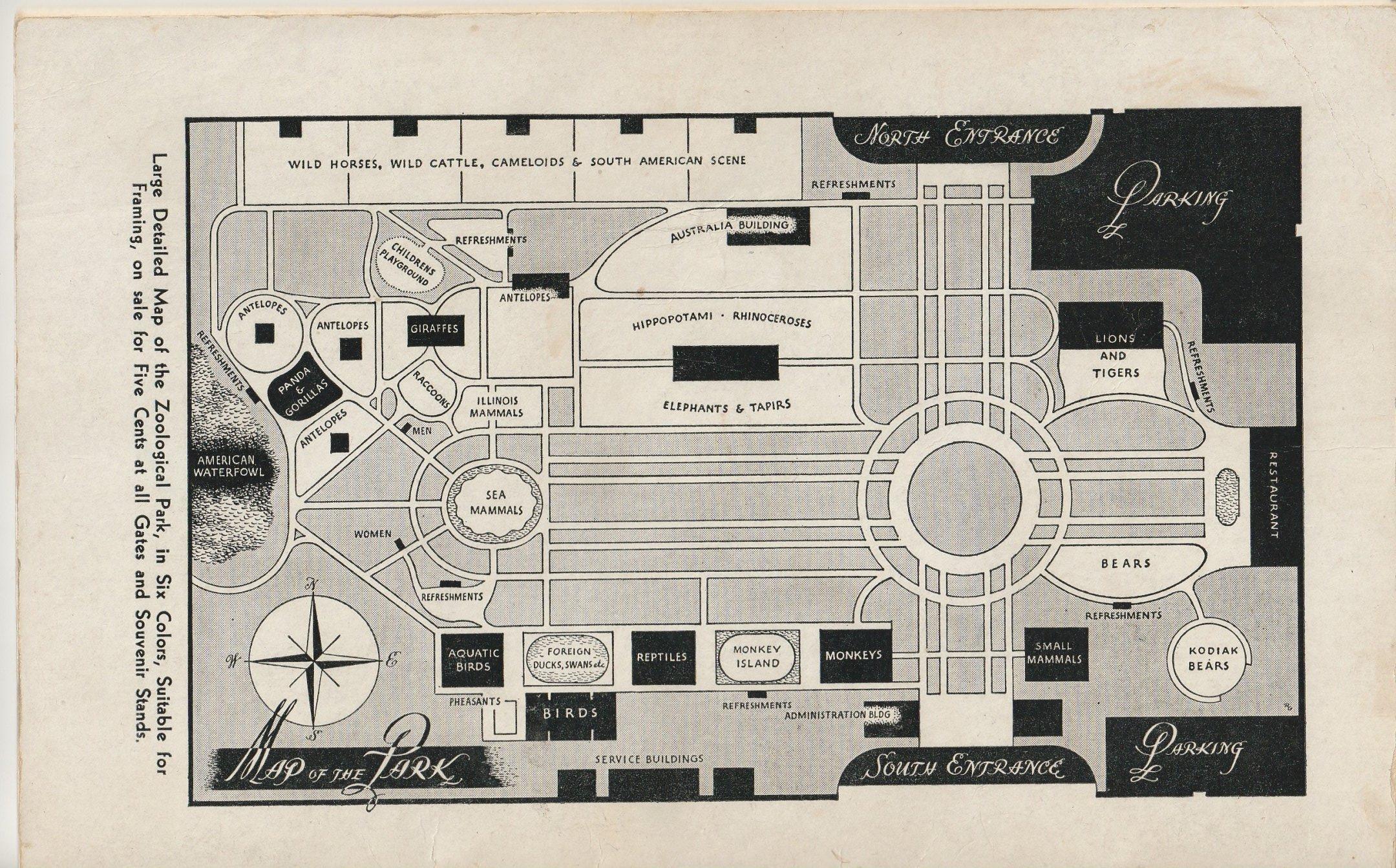
Ralph Graham was responsible for much of the zoo's art in this era, including guidebook covers as well as the zoo map. This map reveals the presence of enclosures for pandas, gorillas, walruses[!] and raccoons amid the zoo's hoofstock collection and ANTELOPE YARDS, that antelopes mixed with wading birds, and that the current HOOFSTOCK YARDS at this time held only North American range animals, such as bison and deer. The current FORMAL POOL is identified for foreign birds. and a PHEASANTRY is located alongside PERCHING BIRD HOUSE, of which both wings are used by animals. The map provides a much more realistic contrast to the above "master plan" map.

57331.jpg

( Full link / backup link )

Thanks to @TeaLovingDave here is a simplified map from the zoo's 1948 guidebook, for which he provides some excellent information here. While providing slightly more information on the northern HOOFSTOCK YARDS, and missing the walrus enclosure, it otherwise mostly provides a simplified version of the above information without the delightful art. It does, however, help emphasize how much empty and undeveloped space still existed in the park at this time, especially before the additions of ROOSEVELT FOUNTAIN and TROPIC WORLD.

guG54i3.jpeg


( original post link ) ( full / back up link to image )
 
There may be a delay between this and the next update.

1949

  • John T. McCutcheon resigns from the zoo amid ill health, then dies shortly after. Brief discussion suggests renaming the zoo in his honor. His family declines.
  • Clay Judson becomes the new President of the Chicago Zoological Society.
  • The first zoo newsletter, the Bandar-log (in reference to The Jungle Book’s monkey troop) is published.
    • The inaugural article discusses Tia and Pieter, two twenty-month-old baby orangutans.
    • An early article mentions recent animal purchases including 2 black leopards, 2 reticulated pythons, 2 monitor lizards, mangrove snakes, 2 binturongs, Capuchin and squirrel monkeys, Coscoroba and white swans, a white fronted goose, toucan barbets, and waxbills.
  • Karl Plath escorts a large shipment of animals, mostly birds, from Australia amid an animal exchange with Taronga Zoo in Sydney, Australia. The shipment includes 42 mammals (including 19 kangaroos) as well as 14 lizards and 283 birds including two birds of paradise, black swan, blue fairy penguins, maned geese, Nankeen night herons, blue swamp hen, ibises, spoonbills, giant kingfishers and a plumed tree duck. Taronga receives two kodiak bears, two polar bears and alligators in exchange.
  • The zoo opens a new outdoor flight cage at AQUATIC BIRD HOUSE that includes the zoo’s three shoebill storks, one of which is named Bubbles and featured in guidebooks for many years, at a cost of $44,000.
1950
  • Construction begins on an ANIMAL HOSPITAL, including an office and a laboratory for studying diseases, based on plans by architect Edwin Clark when the zoo first opened.
  • The zoo receives a $35,000 gift from local philanthropist Charles Ward Seabury, inspired by London’s Zoo children’s zoo, suggesting a miniature zoo for children emphasizing contact with animals exotic and domestic. Edwin H. Clark returns to design the new CHILDREN’S ZOO exhibit.
  • Kashi Ram and Kamala Rani are separated after Rani exhibits aggression towards Ram during multiple, separate efforts to introduce them.
  • Hippolyte or “Hippy”, a two-year-old wild-born orangutan, arrives at the zoo, and remains at Brookfield for sixteen years.
  • The off-exhibit breeding runs now number twenty-three, and hold 20 species of birds and two “hybrid pairs”. Plath reports 53 parrot taxa. Species maintained include Australian King Parrots (Alisterus scapularis), 35 Swainson's Lorikeets, 27 Princess Parrots, 21 Bourke's Parrakeets, and 18 Crimson-winged Parrots (Aprosmictus erythropterus). The zoo also boasts the first captive breeding of Goldie's Lorikeet (T. goldiei) this year.
1951
  • Film footage recorded in July of this year and held at the Chicago Film Archive shows the zoo at this time, including Eland, Greater Kudu, Raccoon, Grevy's Zebra, the Formal Pool without animals, an outdoor cage for dimorphic gibbons, pelican, flamingo and other water birds in an indoor pool, baboons, chimpanzee, giraffe, Asian and African elephants, Indian and Black rhinoceros, Dall Sheep, polar bear being thrown marshmallows, tigers, lions, kangaroo, river hippopotamus, and white peafowl.
1952
  • Brookfield Zoo’s veterinary animal hospital opens, becoming the third facility in the country with a dedicated animal hospital (following New York and Philadelpha) allowing for both research and immediate care of animals, and employing the zoo’s first full-time veterinarian. It is located south of MONKEY ISLAND and cost $260,000 to build, largely raised through peanut sales.
  • In November, a parrot at the zoo is accused of using excessive foul language. Though the animal is known to keepers, Robert Bean jokes an investigation found no such bird.
1953
  • In August, the CHILDREN’S ZOO opens. Children are offered contact opportunities with a wide variety of animals including domestic and farm species like cows, rabbits, goats, llamas, ducks, wildlife like skunks, as well as a nursery for young exotic animals including a Kodiak bear cub, a leopard cub, baboons, kangaroos, and famously Caesar the lion cub and Melinda the baby elephant. Sheepherding and other animal demonstrations are held and ducks are present at the entrance. It is initially only open in the summer months. Baby elephants are purchased periodically to maintain stock, while Giant tortoises are sometimes used to give children rides and Cheetah are also sometimes shown on display here.
    • At an unknown date in the future, the CHILDREN’S ZOO expands into the KODIAK ISLAND exhibit.
  • Around this period, the zoo’s merry-go-round, previously a children’s favorite and paired with domestic animal petting areas and now rendered obsolete, is discontinued due to a rise in the cost of liability insurance.
  • The zoo continues rescuing and receiving juvenile American alligators when they become too large or old for pet owners. At this time only one alligator present at the zoo did not arrive in this manner. Green mamba are also mentioned.
  • A quartet of young bonnet monkeys escape repeatedly from their enclosure in PRIMATE HOUSE, stealing baby bottles, sunglasses, popcorn, ice cream cones, gum, pens, pencils, and lipstick before returning to their enclosures.
  • Jasper the monkey escapes to Riverside Brookfield High School.
  • At this time, Dall Sheep live alongside guinea baboons at BABOON ISLAND, reported in Images of America: Brookfield Zoo and the Chicago Zoological Society; though contemporary reports from before and after this year only mention Barbary Sheep.
  • Mei-lan, the last giant panda in captivity in the United States at the time, dies in September, aged fifteen, shortly after receiving a brand new grotto exhibit.
  • In December, Reggie the elephant seal dies at SMALL MAMMAL HOUSE; the Chicago Daily Tribune reports he was valued at $1,000.
1954
  • THEODORE ROOSEVELT MEMORIAL FOUNTAIN is installed as the centerpiece of the zoo, named to honor the former president for his work in conservation. The fountain is designed once again by Edwin H. Clark. Sylvia Shaw Judson, artist and sculptor and husband of Clay Judson who famously sculpted “Bird Girl”, donates four bronze animal head sculptures around the fountain, as well as additional sculptures now on display near BRAMSEN ANIMAL AMBASSADOR PAVILION.
  • The “free flight” gallery at PERCHING BIRD HOUSE is added at a cost of $125,000 and initially contains over fifty species.
  • A new MINK EXHIBIT opens, with animals gifted by Paul Serbar and a $3,000 donation from trustee James Simpson.
  • Renovations are done to PRIMATE HOUSE including adding plexiglass and electrified glass to prevent apes from smashing the glass to escape, as well as unspecified renovations to SMALL MAMMAL HOUSE.
  • Dr. Weaver Williamson is hired as a veterinarian, succeeding Dr. Donald A. Schmidt.
1955
  • The first okapi exhibited in North America arrives, a male donated by Ringling Bros. circus on condition that they own the first offspring born.
  • The zoo declines to be featured and promoted on Zoo Parade, amid concerns the program’s emphasis on handling animals would undermine Brookfield’s focus on barless enclosures and minimal interference.
  • In June, another elephant seal, Reggie II, is captured in California and placed on display.
  • Due to a zookeeper mistake, five lions are lead into an enclosure at the same time as two leopards; the male leopard is killed after attacking the lions, but the female leopard is left unharmed.
  • The zoo rents a white python named Senta discovered in Pakistan and featured in Life magazine, on temporary display in REPTILE HOUSE.
  • Felix the Sumatran orangutan arrives.
1956
  • Dr. George B. Rabb is hired as the zoo’s first curator and coordinator of research, one of the first full-time employees at any American zoo with a PhD.
  • SEAL MOUNTAIN is drained and the seals and sea lions moved elsewhere in the zoo; the exhibit becomes home to Dall Sheep and is renamed DALL MOUNTAIN. The zoo’s earliest sheep were lambs captured in Alaska at “days old” which were hand-reared. The first captive birth was two years after capture.
  • Melinda the baby elephant, the star attraction at CHILDREN’S ZOO, is moved to the PACHYDERM HOUSE; unused to the sudden presence of a moat, she injures herself and dies.
  • Ralph Graham successfully collects a female okapi from the Congo and brings it back to the zoo.
  • The zoo changes from a six-day work week to a five-day work week to fend off a potential workers’ strike.
  • At this time, the zoo’s operating costs are $1 million dollars.
1957
  • A forested area in the southwestern section of the zoo is set aside and converted into WOLF WOODS, offering a naturalistic environment for red wolves. Society staff, including the Rabbs, begin studying wolf behavior as well, charting their status from birth to death, beginning groundbreaking studies that would challenge conventional wisdom and understanding about wolf behaviors.
    • George Rabb would later cite one of the most significant outcomes of his research: “In any pack, there can be a male who sires the pups, brings food to the female, and yet there also is a dominant male who watches over the family, a father in name only…. the alpha male is not necessarily the biggest, strongest and most aggressive wolf. He is elected by the others. Watchfulness and tact are among his best qualities—the ability to get along.”
  • Orangutans “Mary”/”Suzy” and “Ginger” arrive at the zoo. The former moves to Racine the next year, while Ginger goes on to breed at the Como Zoo, having 5.4 hybrid offspring, and lives to be fifty-four at the Sacramento Zoo.
  • During this period, the zoo briefly holds fishers, which die of viral infections while in quarantine at the animal hospital, and Pronghorn antelope, which defy any efforts to keep them healthy.
  • Robert Bean’s wife Jean Campbell Bean dies.
1958
  • Clay Judson steps down as President of the Chicago Zoological Society and is succeeded by William R. Dickinson.
  • Discovery at Brookfield Zoo premieres on local public access television’s WTTW Channel 11, produced and narrated by Mary Lela Grimes.
  • The zoo offers $25,000 for Chi-Chi, a panda owned by Austrian animal dealer Heini Demmer after trading with the Beijing Zoo. The United States Treasury Department, however, claims this violates the embargo with the People’s Republic of China; she is later purchased by the London Zoo.
  • At this time, PARROT HOUSE has parakeets from Haiti, now believed extinct, which are photographed with keeper Ed Holst.
1959
  • On September 17, the first baby okapi born in North America, Mr. G, is born at the zoo to parents Museka and Aribi. He is eventually shipped out to Ringling Bros. Circus per the agreement.
  • West of SALT CREEK WILDERNESS, the zoo intends to build a North American Panorama exhibit with a terraced restaurant and a 150ft artificial mountain allowing mountain-top viewing of animals. Though local donations try to support building the mountain, the expenses ultimately prevent the exhibit from coming to be.
  • The off-exhibit parrot breeding facility is demolished to make room for the dolphinarium. 9 Swainson's Lorikeets, 28 Princess Parrots and 26 Crimson-winged Parrots were raised here, while 11 Goldie’s Lorikeets had grown in PARROT HOUSE. The total number of parrot taxa raised at the zoo from 1938 through 1959 totaled 19.
  • In April, the zoo holds a hooded seal named Grouchy who refuses to eat squid, mackerel, herring, clams, sardines or anything but live grass eels.
  • Ground is broken on the SEVEN SEAS PANORAMA DOLPHINARIUM in December. The project is the brainchild of director Robert Bean, who extensively researched maintenance for the sea water required. Campbell, Lowrie and Lautermilch act as contractors, with Olsen, Vrbain and Russell Read as architects. The groundbreaking is done by Daniel J. Ryan, Jr. just as his father did at the zoo’s original groundbreaking. Early reports suggest a “twenty-two-foot blackjack whale” (orca) was an intended resident.
1960
  • The zoo’s first bottlenose dolphins arrive from the Miami Seaquarium in Florida. The zoo proudly proclaims that the facility will have enough space to house “dolphins, sea lions, elephant seals, sea otters, and even a fair-sized whale” though the latter never occurs. Two dolphins die during the journey.
  • SEVEN SEAS PANORAMA DOLPHINARIUM misses its original projected July 4, 1960 opening as the expected 182,000 gallons of sea water are not able to arrive sooner than September. The zoo’s original intent to use real sea water is abandoned, and instead water from Lake Michigan and the zoo’s own well is filtered through chlorine purification and added salt to create ‘artificial sea water’, provided by Morton Salt Company. Ten percent of this water is replenished daily and a 2% salinity is maintained, below true sea water levels.
  • Clay Judson dies.
  • During this decade, orangutans held at the zoo include Sam (Sumatran male) Stanley (Bornean male) Spook/Rose (Borean female) Alice (Borean female) Connie (Sumatran female) Katie (Sumatran female) Conrad (Sumatran male) and Kelly (hybrid male) - per SSP sources.
  • Sometime during this decade, the moat at MONKEY ISLAND is permanently drained.
  • Species held during this time include Yak and Bolivian Jaguar.
  • Sometime this decade, Leland la France is hired as official zoo photographer.
1961
  • In April, multiple longtime trustees pass away including animal committee chairman Tappan Gregory and Daniel Ryan, Jr.
  • SEVEN SEAS PANORAMA DOLPHINARIUM, the first inland dolphinarium in the United States, opens on August 1. Vickie/Vicky/Vicki, Maggie, Power and Tommy are the only dolphins held in the midwest at this time. The building is at the site of today’s LIVING COAST building and is affectionately compared to a flying saucer.
    • There are four daily performances with an additional performance added on Sundays and holidays, costing 50 cents for adults and 25 cents for children.
    • Underwater viewing windows are free and give many visitors their first peek at bottlenose dolphins. West of the main dome are smaller tanks and underground grottos where sea lions, walruses and other aquatic life are held.
    • Construction on the exhibit costs $1 million, raised by peanut sales at the zoo. The main pool, held under a plexiglas dome, is 100 feet long by 25 feet wide and 16 feet deep, holding 182,000 gallons of water, holding 182,000 gallons of artificial sea water.
  • Ron Blakeley (later founding director of Sedgwick County Zoo) is hired from Lincoln Park Zoo to replace retiring bird curator Karl Plath.
  • Fredericka, the zoo’s second okapi calf, is born.
  • Dutch elm disease devastates numerous trees around the zoo, beginning with a single tree near the AUSTRALIA HOUSE and leading to trees being taken down throughout the grounds.
  • The zoo ‘s central, coal-fired powerhouse steam distribution system begins to fail and is upgraded to a gas system.
  • The zoo is gifted 60 rare birds from 42 spaces by artist Edward Marshall Boehm, including wood hoopoe, cape sugarbird, three species of sunbird and two species of solitaire.
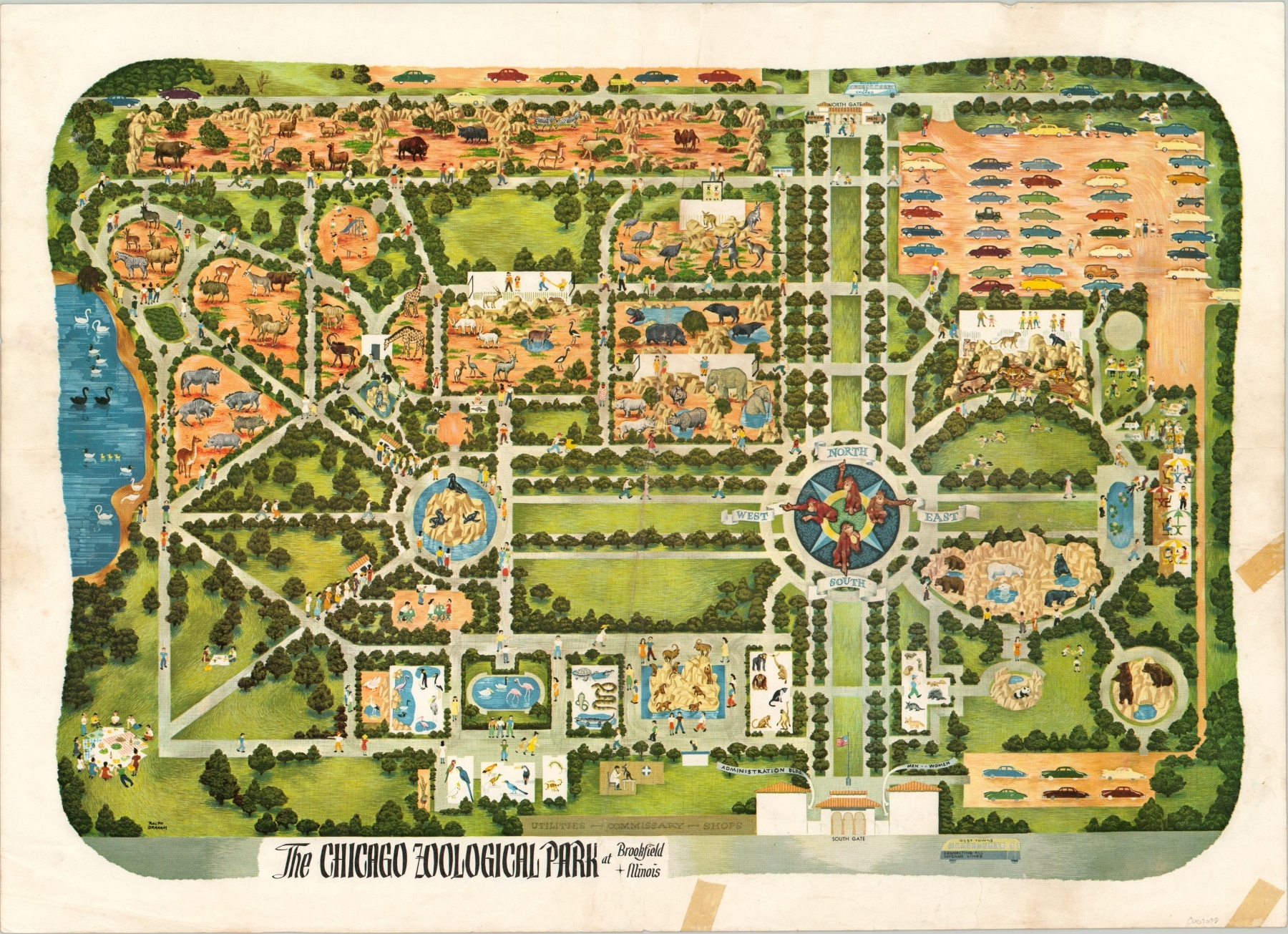
By this time, the zoo's main pictorial maps were being supplied by the great Ralph Graham. The following map is from the early 50s, still featuring the SEAL MOUNTAIN and the PANDA GROTTO built for Mei-lan, who would die in 1953. These pictorial maps also do an excellent job illustrating the zoo's massive hoofstock collection at this time.

map_09-26-21_240dpi_15.91x21.95_invc9108c.jpg

(full link / backup link)

Following is a later revision of the same map. I'm not sure if the colors being dulled is a difference in the printed maps themselves or perhaps just in how they they are displayed online. ROOSEVELT FOUNTAIN is now present, a black bear species is at the former PANDA GROTTO, the former seal grotto is now DALL MOUNTAIN, and SEVEN SEAS has been added. WOLF WOODS is added as well, barely visible.

8395000.jpg

( full link / backup link )

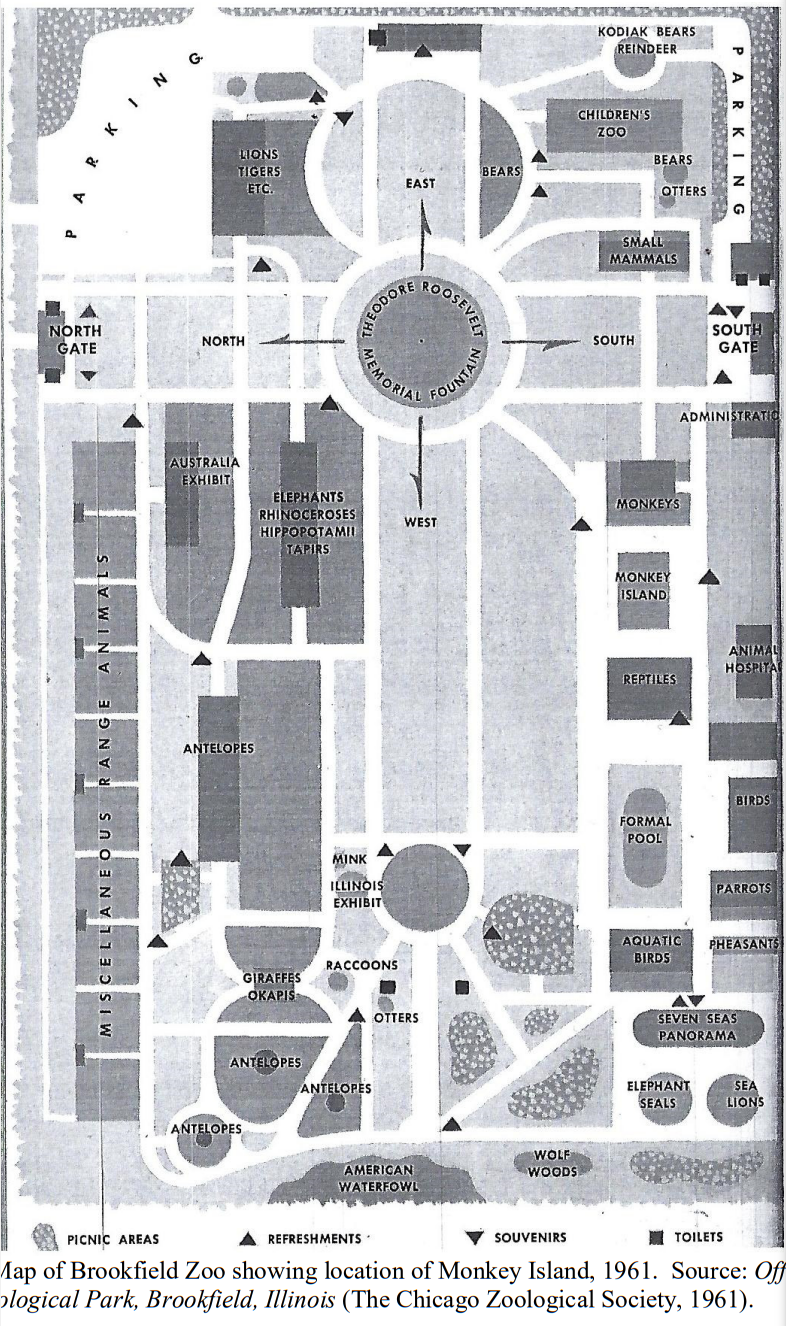
This is a simplified map provided to the Library of Congress intended to show the location of historic Baboon Island in 1961. It has an orientation unusual and unique to all other maps of the zoo.
kQ0ckDP.png

( full link / backup link )
 
West of SALT CREEK WILDERNESS, the zoo intends to build a North American Panorama exhibit with a terraced restaurant and a 150ft artificial mountain allowing mountain-top viewing of animals. Though local donations try to support building the mountain, the expenses ultimately prevent the exhibit from coming to be.
It's pretty remarkable that over 60 years later this exhibit concept has returned and will be done in the exact location once planned -- even with a large restaurant alongside it. Never realized the desire to expand west of Salt Creek has been around for so long.
 
The thread resumes after a hiatus! Special thanks to Grayson Ponti of Zoophoria, which provided some really critical information in the next couple of updates via his extensive interviews, and to @Tim Brown who provided some crucial information on one of the topics covered during this post. All included in the Works Cited, of course, but don't want to look to be taking credit for their work.

1962
  • Stanley Field steps down as chair of the Buildings Committee after almost thirty years in the role from the zoo’s founding.
  • Olga the walrus arrives from the Copenhagen Zoo and quickly becomes a fan favorite at the zoo, performing in shows and known for waving, splashing and blowing kisses to guests, becoming a local icon for her larger-than-life personality and charisma.
  • Brookfield Zoo is awarded an AZA citation for remarkable achievement for the birth of Dall Sheep.
  • A miniature narrow-gauge railroad is installed for small children that runs halfway around the park and proves popular, costing only 50 cents and bringing in $50,000 annually. The money for the acquisition, establishment and maintenance of the train is provided by local stream train enthusiast Elliott Donnelly, who also worked with the Illinois Bell telephone book publishing company.
    • The train took a westward then southern route around the “range animals” and hoofstock exhibits, “WILDFOWL POND”, behind WOLF WOODS, and reaching SEVEN SEAS PANORAMA DOLPHINARIUM.
    • The first locomotive on the ‘Zoo Line’ is a replica of a Union Pacific #1 engine, complete with diamond-shaped smokestack, bell and cowcatcher, though small enough the engineer’s head and shoulders are visible above.
  • An animal show at the CHILDREN’S ZOO includes Connie orangutan riding on the back of six-month old elephant calf Cookie. Connie’s cohorts include orangutans Stanley, Stella, Spooky, Alice, Katie and Sammy.
  • In May, six five-month-old polar bear cubs fall into their moat in quick succession. In anticipation, the bottom of the moat is covered in hay.
  • A shipment of new animals from Africa arrives including a White Rhinoceros named Mshwanee.
1963
  • Curator of reptiles Robert Sendigar retires.
  • Alongside the departures of Field, Sendigar, and Plath, multiple trustees’ passing away in previous years and the passing of Walter Soderstrom, original head of the Grounds Department, the zoo enters a period of transition.
  • Encil Rains is hired as assistant director for management.
  • Attendance peaks at 2,280,292.
  • Alpha the gorilla arrives and is delivered to the zoo, biting Police Lt. Henry Smith at O’Hare Field during the process.
1964
  • Robert Bean’s drinking problem becomes too severe for him to remain onboard as director, with decisions being made by longtime secretary Mae Jose Jana, George Rabb, Weaver Williamson, and Ron Blakeley without him; he is instead made director emeritus and Ralph Graham is made assistant director emeritus.
  • Ron Blakeley, George Rabb, Encil Rains and Weaver Williamson are appointed associate directors, with some sources identifying them as each specializing in a different aspect of the zoo. The situation does not last long and ultimately Blakeley is placed in charge of animals and Rains in charge of business.
  • Admission for adults is increased to fifty cents per person.
  • The zoo celebrates thirty years in operation.
  • One of the BEAR GROTTOS is refurbished for Asiatic black bears from the Himalayas, which spend a year caged while waiting for the accommodations.
  • Ron Blakeley hires Ray Pawley as the General Curator, with responsibilities including Curator of Herpetology, Curator of Birds, Public Relations and Special Projects. Small renovations and infrastructure changes are made to REPTILE HOUSE despite its small budget, with Pawley putting an effort to keep animals happy, averting previously high mortality rates, but also keeping guests engaged and moving.
  • Four Galapagos marine Iguanas arrive at the zoo, which are held in REPTILE HOUSE and the zoo makes several advances in keeping them. The three males, as well as iguanas of other species, became noticeably unruly in fall months according to curator Ray Pawley.
1965
  • In January, an annual meeting is held.
    • Blakeley and Rabb decide to elevate education as one of the zoo’s primary goals, agreeing that all exhibits should have educational displays for guests. Rabb expresses that the role of the zoo should be to connect urban people with the natural world.
    • Conservation is also stressed by Blakeley who discusses the increased role of ethics in procuring animals, such as asking to view sellers’ permits for protected species and a ‘blacklist’ among zoos of species so rare they should not be procured from the wild.
    • Robert Bean, having toured zoos in Asia, proposes a hummingbird exhibit.
  • Ralph Graham retires as assistant director emeritus to focus on painting.
  • Elliot Donnelley joins the Chicago Zoological Society.
  • The trustees initiate a fundraising program, realizing that the zoo tax was no longer covering maintenance costs. The first fundraiser intends to raise $5.5 million over three years.
  • The INSECT HOUSE is converted into a SPECIAL EXHIBITS BUILDING with displays based on various animal behaviors.
  • SMALL MAMMAL HOUSE is also renovated.
  • The closed ILLINOIS EXHIBIT and MINK EXHIBIT are both razed due to disrepair.
  • The zoo acquires a 3-year-old male gorilla, Mighty Omega, captured in Cameroon by an animal dealer in Holland, intending to mate him with Alpha and Beta.
  • The zoo’s current wishlist is extensive, with a new Great Ape House at the top of the list, as well as a breeding farm, a new REPTILE HOUSE due to ventilation problems, hospital upgrades or an entirely new hospital, general maintenance of roofs, plumbing and railings, an expanded freedom gallery in PERCHING BIRD HOUSE, an outdoor predator exhibit, remodeling to LION HOUSE, a building for jungle animals, a predatory bird exhibit, new restrooms, more dolphin holdings, and some further consolidation of aquatic exhibits.
  • In December, the zoo acquires one male and three female Siberian ibex, exhibited by only three other institutions in the United States at the time, and releases them on MONKEY ISLAND.
1966
  • In August, zoo employees go on three-day strike to demand higher pay and union membership, though some keepers do not participate; the animals are fed by other staff. Zookeepers, groundskeepers and craftsmen sign on with the Teamsters’ Union in October.
  • A special self-guided tour and brochure encourage guests to visit the zoo in winter and focus on animals active in cold weather.
  • An Indian Python captured in Vietnam and used as a mascot is donated to the zoo and displayed in REPTILE HOUSE.
  • The zoo’s first Curator of Education is hired.
  • The zoo guidebook is rewritten for the first time in thirty years.
  • The travel program begins; the first program is a four-week safari in fall including the London Zoo, Whipsnade Zoo, Hagenback Zoo, and a Kenyan Game Reserve.
  • John Conrad begins hosting Zoo World, a 10-minute radio program interviewing zoo officials on grounds near animal exhibits.
  • At this time, the zoo holds two grizzly bears and two Alaskan brown bears.
  • The first Mold-a-Rama machine is installed. The zoo has over eleven of these machines in the park today, with past and present molds including a brown camel, yellow lion, black rhinoceros, white polar bear, orange walrus, green crocodile, blue dolphin, kangaroo, and more. The zoo also has molds for up to six dinosaurs and six Halloween animals that are sometimes swapped in.
  • Olga the walrus retrieves a cigarette lighter dropped into the walrus pool.
  • Despite problems with the aging building, Pawley makes major changes to REPTILE HOUSE, including a Swamp exhibit with marmosets and finches alongside reptiles, to bring it in line with the zoo’s new educational goals and engage visitors.
  • By this time, Ziggy the Elephant is credited with having killed four men.
1967
  • Robert Bean is no longer involved at the zoo and does not attend the annual meeting.
  • Drawin’s rhea and Russian ratsnakes are bred in captivity in the United States for the first time at Brookfield Zoo.
  • The zoo’s first okapi, Museka, dies. Former mate Aribi is sent to Florida.
  • Fifteen sitatunga are born.
  • Ron Blakeley leaves to become the director of the Sedgwick County Zoo. Encil Rains also leaves.
  • The trustees create a new category of nonvoting membership in hopes of raising further revenue without expanding the governing body of the Board.
  • Tuesday becomes the only day with free zoo admission; the previous year over 85% of guests paid no admission and revenue is needed.
  • Some renovations are made to FORMAL POOL.
  • AQUATIC BIRD HOUSE is renovated to include a cypress swamp, a penguin exhibit, and a riverbank scene.
  • PRIMATE HOUSE is temporarily closed when necessary maintenance to the roof cannot be afforded.
  • By this time, the salinity at SEVEN SEAS adheres to a 3% salinity standard, closer to actual sea water, in an effort to make the animals more comfortable.
  • Triplet dwarf goats are born to mom Penny at the CHILDREN’S ZOO.
  • Brookfield Zoo was awarded the AZA Edward H. Bean Award for the most notable birth of a Phillpine tarsier, one of the world's smallest primates.
  • Three trackless, rubber-tired “Safari Trams” are purchased from the Chance Manufacturing Company, outfitted with animal print designs including zebra stripes, cheetah spots, and tiger stripes, and prepared for service.
  • Elliot Donnelley oversees the installation of a new diesel-switch zoo train, utilizing a new railbed route built on 2.5 miles around the zoo perimeter. Donnelley shuns publicity for his contribution but donates every cent.
    • Donnelley obtains two authentic, rebuilt steam engines with six new 28-35 passenger excursion cars, and a diesel switching engine, the Burlington No. 9999, and Milwaukee Road steam engine “Hiawatha” No. 1. Each engine is painted with authentic colors used on full-size trains.
    • The 24-minute train ride costs 60 cents for adults and 45 cents for children.
    • A signal system is used to bring down crossing gates where the train tracks intersected with guest paths.
    • The “Brookfield, Salt Creek and Western Railroad” is dedicated on October 11 by Crowcroft and Cook County Forest Preserve District officials.
    • Crowcroft promises the train will travel through a new, not-yet-developed western section of the zoo.
  • The SPECIAL EXHIBITS BUILDING is reconstructed as a new natural history book store, run by Mary Rabb.
  • The grounds crew begins a seven-day, rotating schedule in hopes of keeping the park clean regularly.
1969
  • In May, the zoo opens a new “bunny hutch” in the CHILDREN’S ZOO with Playboy bunnies attending the opening of the new exhibit.
  • In August, Crowcroft announces the development of an American prairie exhibit, to be developed west of Salt Creek. “Deer, elk, moose, buffaloes, coyotes and other indigenous and compatible animals will be allowed to roam at will,” he explains to the newspaper The Citizen. Animals can be viewed from the train.
  • William Rutherford offers the zoo a 400-acre breeding farm in Peoria, named the McCutcheon Animal Park; though the Society is initially excited, the lack of revenue makes it difficult to support.
  • Weaver Williamson retires after fifteen years as veterinarian.
  • After being chained to the wall for thirty years due to his past aggression, local newspapers and school children campaign to allow Ziggy the elephant outdoor access, with schoolchildren sending in letters and money. The zoo offers to let him outside if a new door could be constructed without any risk of human contact.
  • The zoo’s Hycanith Macaw pair produces a chick which dies two days later. The unsuccessful breeding is not reported.
  • Seven polar bears escape in July after an unexpected downpour filled their moat at BEAR GROTTOS entirely with water. The bears attack a marshmallow cart, with one reaching as far as the REFECTORY and another entering the grizzly bear grotto. All bears were safely returned. Firemen are called to drain the moats and the zoo opens midway the next day, the first time it was not open all day. A book is later published on the incident and the sale of marshmallows is soon discontinued.
    • Recollections from the era recount that marshmallows were sold all across the facility and fed by guests to nearly every kind of animal, including hoofstock like waterbuck and fringe-eared oryx. Polar bears stood on their back legs and “begged”, and so many marshmallows were tossed into the exhibit they only ate those that landed closest.
  • A bond issuance for more than $15 million is granted by the Illinois State House amid the zoo’s financial struggles. The tax rate benefiting the zoo is also increased by ten cents.
1970
  • Zoo admission is increased to $1 per adult for the first time; thankfully no drop in attendance is recorded.
  • The first installment of the bond issuance is received; much is repainted, reroofed and rewired due to years of deterioration. BABOON ISLAND and SEVEN SEAS receive renovations. Greenhouses are built to help manage plants and beautify the grounds.
  • The REFECTORY is renovated and renamed SAFARI LODGE.
  • The PARROT HOUSE closes and is converted to studio space for the zoo’s design department. Some inhabitants were moved to PERCHING BIRD HOUSE but most were sold or loaned to other facilities. A male Lear’s Macaw is loaned to San Diego Zoo, a St. Vincent Amazon is sent to Houston, and a pair of Hycanith Macaw are sold to longtime PARROT HOUSE keeper Ralph Small, who would go on to successfully breed the species at home from 1971 to 1973, years before the first successful zoo breeding. The zoo continues breeding Nyasa lovebirds.
  • In April, female Sumatran orangutan Annie is born.
  • The zoo acquires ten American bison from Cheyenne Mountain Zoo, the first to arrive in sixteen years, and holds them temporarily at the ANTELOPE YARDS.
  • A 32-foot fiberglass trachodon (modeled closest to Edmontosaurus regalis, then viewed as a junior synonym) named “Archie” is placed on display at WATERFOWL LAKE. The model is a gift from the Sinclar Oil Company after the 1964 World’s Fair.
  • In September, after a passionate campaign, Ziggy the elephant is lead outside for the first time in decades by his old keeper, George “Slim” Lewis, who flew in from Seattle for the occasion.
  • At this time, Sooki the baby elephant is CHILDREN’S ZOO’S star attraction and appears with the La Grange Junior Woman’s Club for a fundraiser. The successful fundraiser leads to an import of meerkats for the zoo.
  • After an incident in which over 300 buses of schoolchildren were present, a reservation program for school groups begins to limit the number on field trip at the zoo at a single time.
  • Dr. Ben Beck becomes a research curator at Brookfield Zoo on invitation from Dr. George Rabb. Beck focuses on animal behavior and tool use, focusing much of his research on primates although as looking into polar bears’ tendency to use objects for play and Père David’s deer adorning themselves with objects.
    • Beck would later reflect to Zoophoria that zookeepers sometimes viewed on-exhibit research as an inconvenience and added complication and did not want to alter their routines to accommodate his behavioral research.
  • CZS receives the AZA Edward H. Bean Award for its work with the green-crested basilisk, one of the results of Pawley’s work at REPTILE HOUSE.
  • The zoo’s last marine iguana dies. The longest-lived individual survived at six years, five months and eighteen days, as Pawley reported to Tim Brown.
 
Back
Top