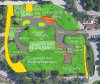
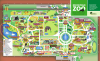
I have updated my previous master plan, although the broad strokes remain alike. I think the majority of it is relatively realistic besides the restoration of some previously phased out species that I concede aren't likely.
I have attached a new edited version of the master plan map corresponding to these plans; though some of it is hasty, especially the desert, I did try to add new animal silhouettes, modify buildings and add enclosures in many areas to give an idea how it would look.
Goals
- To fully establish clear biogeographic theming for each quadrant of the zoo, as has been the intention for many years. This lead to some difficult decisions, particularly breaking apart Tropic World.
- To invest in the eastern side of the zoo, which has always been lacking in animal attractions since the zoo opened but has suffered especially in the last decade with the closure of bear grottos and the ridge.
- To avoid downsizing the collection and when possible restoring previous species, including the return of the much requested elephants.
- To ensure no animals end up in exhibits smaller than their current holding.
Overview
It would be ideal to add more substrate to indoor exhibits, clean paths, and replant trees, all throughout the zoo. I think these are all a 'given' that nobody here would argue against.
North Gate
The main entrance to the zoo is not particularly impressive to a new visitor and could use some improvement - we need guests to feel excited as soon as they enter the zoo. The existing North Gate Shop and the outdoor North Shop will be fully renovated into a single larger shop building with a wider array of merchandise, with the 'Stuffed Animal Kingdom' branding returning for the section of the store with stuffed animals. Beans, Sprouts and Cones will be expanded to include an indoor restaurant as well, overlooking a nearby exhibit. (see Northwest)
Ahead of the carousel, Butterflies, and Discovery Center, which will remain, it would be ideal to feature an interesting smaller animal exhibit here to 'welcome' guests to the zoo, as is common in many facilities. I think one of the perfect candidates is an exhibit for otters. There are currently two species present at the zoo, neither of which has outdoor access, and both of which may be threatened by biogeographic theming mentioned below, which will renovate Tropic World and possibly the Swamp.
The new entrance exhibit will focus on Asian Small-Clawed Otters, tying into the northwestern region's Asia theming, in a brand-new outdoor habitat, including both land and underwater viewing from multiple angles and heights between eye level and ground level.
Asia (Northeast)
The northeastern section of the zoo will be themed around the Asian continent, which is well-represented at the zoo in terms of species but not so much in themed exhibtry.
At Big Cats/Fragile Hunters, the lions will be removed and the existing outdoor habitats will be renovated into four habitats instead, featuring more substrate, less rock work, and more viewing opportunities. Amur Tiger, Amur Leopards, Sloth Bears and Snow Leopard will remain featured animals here.
Across the mall from those grottos and a rebuilt path, new enclosures will be constructed for Asian Hoofstock -- Przwalaski's Wild Horses, Bactrian Camels, Siberian Ibex, and hopefully as a new species, Sichuan Takin, with allowance for the species to be rotated between multiple grassy yards and steeper spaces; they will be similar in size to the current hoofstock yards. The paths will be themed to emphasize the diversity of habitats on the continent.
(I gave some consideration to narrowing focus on Siberian/Himalayan animals only, but I felt camels, wild horses and sloth bears were too important to discard.)
Clouded Leopard Rainforest will be renovated significantly and expanded into Desert's Edge (those animals will remain; see Northwest) to include new holdings for the existing species, such as binturong, clouded leopard, fishing cat, prevost's squirrel, and new exhibits for slow loris, birds and reptiles. The building will also link to outdoor habitats for orangutans and gibbons as well as a langur exhibit, with all three primates rotating through two yards and indoors. New signage will emphasize the role these rare primates play in Borneo's ecosystem.
There will be an additional exhibit for Red Panda, if possible and if space allows.
Seven Seas and Pinniped Point will, for these plans, remain untouched. As aquatic exhibits, they are not continent-specific in my mind, even if the relevant pinnipeds do not live on Asian coasts; switching to a more 'relevant' species would be very difficult in the current climate. If bringing back walrus and fur seals became an option, it would be done immediately, since they are slightly more relevant than the sea lions.
The space for the Castaway Grill will remain between Asia and Islands. BZ Red Hots will also undergo renovation, returning to the 'Safari Grill' branding and adding new meal options and a new version of the historical mural of the animals on the continents, focusing on animals from the zoo. New picnic seating will be added near both nearby exhibits so guests can enjoy their food in view of the animals. I would love to add an exhibit to this space but I don't want to compromise the restaurant too much.
Islands (Southeast)
The southeastern section of the zoo will be focused on Island ecosystems, but primarily on Oceania and Madagascar to utilize the existing space and habitats.
The former bear grottos will be knocked down immediately and replaced by a new, expanded Australia House, preserving everything cool about the current building while advancing considerably. The outdoor habitats include a mixed exhibit for Gray Kangaroo/Emu and separate enclosures for Bennett's Wallaby, Wombat, Cassowary, Barren Goose, and Tasmanian Devils. There will be a small new barn for viewing Koala in an outdoor/indoor enclosure.
The interior to the expanded building will include an initial area with indoor viewing for kookaburra and skink, as well as viewing for kangaroo, emu, and wallaby, as well as a window to the koala, followed by an updated nocturnal room with echnida and wombat, the walkthrough bat exhibit, a new interior habitat for Tasmanian devils and kangaroo rats, and a final main room focused on New Guinea, with Matchie's Tree Kangaroo and Kea, with a small side room for viewing Kiwi. Signage will direct visitors to the Koala barn or to Wild Encounters' walkabout area.
Hamill Family Play Zoo and Hamill Family Wild Encounters will remain much the same, though some small animal species will be moved to other parts of the zoo such as raven, kestrel and Red Panda. I am unsure what species to replace these with at this time, but I am thinking a raccoon would be a strong replacement for the panda exhibit, and fit better with caribou, llama, and goat as a more 'native' animal. The former raccoon enclosure in the Children's Zoo was popular.
There would also be a new, small exhibit between the Hamill exhibits, near the former beer garden, dedicated to Madagascar and primarily carnivores, with small terrariums for hissing cockroaches and Malagasay ground boa, with two exhibits on each side for Malagasay Giant Rat and Fossa, and then a nocturnal room for Aye-Aye. Signage would highlight the presence of nearby lemurs in the zoo as well. It would be cool if this building could include at least one species of lemur (besides aye-aye) as well but I am hesitant to suggest too many species in such a small space.
South Gate
In an intentional and direct mirror to the new front gate, a new exhibit will be constructed near the south gate as well to welcome visitors with an animal attraction.
I recommend the construction of a new lemur exhibit with a species not currently held at the zoo (I am not up to date on which ones were or are held in the Play Zoo) allowing at least the existing and iconic ring-tailed lemurs to remain unique to the Play Zoo while also ensuring there are lemurs all guests can enjoy without additional payment and allowing the suggestion of a greater Madagascar theme, alongside the Fossa exhibit and Play Zoo.
In the event there is space to include lemur in the small proposed Madagascar exhibit mentioned above, replace this idea with a holding for a species native to an island not otherwise covered here.
(The omission of the Galapogos from the Islands section bothers me here, but Galapogos tortoises would not fit as a welcome attraction if they would need to be moved part of the year to a building, I feel. There are no other Galapogoes species who are within institutions right now to my knowledge, otherwise I would love to feature them here.)
Americas (Southwest)
The southwest will be themed to North and South America, though this was the most challenging area of the zoo to keep any illusion of theming.
Great Bear Wilderness will remain mostly unaffected, of course, being such a recent exhibit, but behind the Bald Eagle aviary a new building will be constructed containing small mammals and birds from North America, including prairie dogs in an innovative system allowing guests to view them in their tunnels, as well as nine-banded armadillo, an owl species, American Kestrel and Raven, with some outdoor access. It is possible the desert free-flight aviary from Feathers and Scales could be moved or reconstructed here. It will be accessible by the entrance to Wolf Woods and can be visited without entering the Great Bear Wilderness loop.
The Living Coast will remain quite similar, although vampire bats and chinchilla will be restored to display and additional changes relating to Peru may be made, as other zoochatters have suggested. In addition, a new outdoor exhibit will be added for the Humboldt penguins to the side of the building, via a path near the above new building and Wolf Woods. The outdoor exhibit will use low fences to include eye-level land viewing and some underwater viewing. The penguins will have access to this habitat as well as their indoor area and the larger tanks.
'Birds and Reptiles' to the south will be expanded significantly, and retitled as 'Reptile House' as no birds will be kept there any longer. The new expansion will more than double the size of the current hall, continuing the terrariums on one side of the building while on the other side featuring larger outdoor habitats that visitors view from safely indoors, though these reptiles will have access to indoor rooms as well. The new exit will include a final exhibit space as well, since reptiles are not as likely to escape as the free flying birds previously held here.
The former free flight area from Perching Bird House will be refurbished into an exhibit for a crocodilian species, possibly the Orinoco crocodiles currently held in the Swamp or a new species, where visitors can view them from above in an open-air area from a safe height. The outdoor exhibits will include a space for another crocodilian species, a new exhibit for Komodo Dragon, and an outdoor exhibit space for Galapagos Tortoise. The tortoise will have an indoor exhibit near the exit wing of the building for winter months as well.
The most ambitious aspect of this plan is to close Tropic World and pretty much completely gut the building. The apes are being moved to other areas of the zoo as discussed elsewhere. The exhibit is out of date, full of ugly concrete, and wildly unpopular. The roof will be completely redone to allow better lighting so real trees and plants can be grown inside the building, with real soil and substrate throughout, while the off-exhibit aviaries and hopefully the artificial waterfall are all that will remain exactly alike. The building will be rethemed to focus solely on the Amazon rainforest, under a new name, and use Tropical Discovery at Denver as a key source of inspiration for theming.
The building will now include a multi-room path for visitors allowing them to view many animals at eye level in terrariums, tanks, and small naturalistic exhibits, while bridges similar to those in the current exhibit will allow them to view a handful of animals from slightly above, such as sloths, tamarins and marmosets, allowing them to climb up to eye level for guests. Some climbing structures from the original building may be preserved as well. Outside the building there will be multiple outdoor habitats for as many species as space allows, with a Jaguar as the definitive new species, visible behind glass inside and over a moat outside.
The interior exhibits will include a variety of birds, including both current Tropic World residents, macaws, golden conure, toco toucan, and a free-flight aviary equivalent to the one currently in Feathers and Scales, for the same species. There will also be a large 60,000-gallon Amazon tank including Arapaiama, cichlids, catfish, Tambaqui, possibly stingrays or Yellow-spotted Amazon River Turtle, and an additional tank for red-bellied pirahna. Some species from the Swamp, such as Orinoco crocodile may be moved here as well.
The exhibit will also include new homes for the Ocelot and Coati currently at Desert's Edge, the Capybara, Giant Anteater and Tapirs (Baird's and/or Brazilian) at Pachyderm House, as well as exhibits for the woolly monkeys, black-handed spider monkeys, squirrel monkeys, golden lion tamarins, marmosets, sloth, and tamandua currently present at the zoo, all of which will have access to outdoor habitats if possible. Possible new species include howler monkeys, capuchins, caiman, and giant river otter, maybe the return of red-faced spider monkey if extremely lucky.
The above species list is probably one of my most ambitious in this post; it is very important to mention the intent is for the majority of the mammals in the building to have outdoor access and to favor current zoo residents before adding new species. Species from the Swamp and Feathers and Scales can remain in their current exhibits if space is not adequate to move them to this building. I assume moving the Asian and African residents elsewhere will hopefully allow for everything described above, but I am aware that 40+ species is a lot to suggest!!
The Hamill Family Nature Plaza will include an outdoor primate habitat relating to the Amazon building, probably for black-handed spider monkeys.
Feathers and Scales has the most uncertain future here; most of the reptiles will be moved to the refurbished Reptile House, and its keystone aviaries may both become part of new buildings as mentioned above; but these elements may remain if space is not adequate to move them. I would really like to add new signage will encourage visitors to think about the connections between birds and reptiles and discuss the evolution of dinosaurs, and possibly focus on this as a theme. I do think if the other animals are moved out, it would be really cool to renovate the outdoor Andean Condor aviary to allow the birds some more space and possibly open them up to being viewed from indoors. I am not opposed to continuing to retheming this exhibit entirely around birds from the appropriate biogeographic region or from around the world.
The Swamp has a similarly uncertain future as again as similarly, I have explored the idea of moving its residents to other buildings. If the orinoco crocodiles are moved to the new Reptile House or the below exhibit, then their old exhibit will return to housing American alligator. Similarly if South American residents leave, the building will be themed more around North American species to compensate. It would be nice to add an outdoor space for North American River Otters but I do not believe the current footprint can be altered.
The Formal Pool could hold flamingo as many have suggested; otherwise, if this is not possible, they would be a great candidate to fill empty space in Feathers and Scales or the Swamp should the other moves prove successful. They are a rather major species for such a large zoo to miss out on!
Africa (Northwest)
The northwestern section of the zoo is already fairly focused on Africa, but there is plenty of room to double down on this and create a more focused African collection.
Habitat Africa! The Forest will be expanded to the north, opening a second loop off the current pathway and three new enclosures, all linked to a new building, which fill function primarily as the new home for the zoo's gorillas, which will have a large outdoor accomodation as well as an indoor exhibit as well. There will also be a mixed exhibit for Angolan colobus, Schmidt’s Red-tailed Guenon and Allen's Swamp Monkey and if space allows, an exhibit for Mandrill. There will also be a new enclosure for pygmy hippopotamus with a large pool and much more grass and plants than the current holding, with an elevated viewing similar to the current one, off the main hoofstock path.
In addition to the above tropical species being moved to the existing African forest area, Congo buffalo will return to the collection, sourced from Europe, with a new enclosure to help restart the captive breeding program here in collaboration with San Diego. They will recieve a new enclosure, with Bongo as a backup plan should buffalo not be possible to acquire.
The former Aardvark House will also be reopened to the public, and nearby a new enclosure will be added for Addax antelope, and a new Desert's Edge building will be added, bringing back caracal, hyrax, black-footed cat, bat-eared fox, meerkat, porcupine and mole rats, with caracal now having outdoor access. A new warthog enclosure will also be added. These two buildings and four outdoor enclosures will function as a new African Desert complex.
Habitat Africa! The Savannah will reintroduce Ostriches to the waterhole habitat alongside a new antelope or gazelle species, and Mountain Zebra will be explored as an alternative for mixed exhibits. The generic giraffe and ostrich will someday be replaced by AZA subspecies. A small exhibit will be constructed for baboons, more naturalistic than their previous island and with an SSP subspecies, south of the Nyala enclosure near the bison. They can be substituted by another Savannah primate.
Pachyderm House, the former Australia House, and the eastern hoofstock yards will all be torn down to allow for a massive, multi-acre pachyderm complex. Two former hoofstock yards acros from the Saannah will be replaced by new exhibits exclusively for use by Black Rhinoceros, which will also be able to rotate through several further exhibits with a river hippopotamus and a breeding herd of African elephants. The pachyderms will all have access to multiple, massive pools of water for keeping cool in the summer as well as enrichment, and a large heated barn for winter. Toyota Elephant Passage from Denver will serve as a partial inspiration here.
An additional hoofstock yard may remain relatively unmodified for Grevy's Zebra, which need to be separated due to their known aggression, until another zebra species can be mixed into the waterhole as discussed above. The remaining hoofstock yard space will be converted into a new exhibit for African Lions, hopefully with enough room for a breeding lion pride and multiple glass viewing opportunities. Should the zebra be phased out from here or additional space be available beyond the lion's needs, I would love to create a rotational exhibit with other African predator species, such as Spotted Hyena or Cheetah, but this is only a stretch goal.