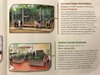
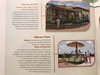
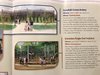
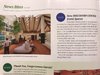
The concept art for these exhibits is really reminding me what a big deal these exhibits are, these renovations are finally starting to feel *real* and not like stuff we've discussed in dreams and hopes. There are two clearly underlying themes, which is introducing more bird habitats to the zoo, and more native species.
They are both worthy goals. The former Children's Zoo and the Indian Lake / Salt Creek Wilderness trail acted as the zoo's 'native species' spaces for a very long time, but they were both skippable for a majority of visitors, and the former was dismantled close to a decade ago, leading the zoo to lose a lot of local species like raccoons, skunks, groundhogs, opposum, and owls. The zoo's bird collection has also suffered some in the last two decades, with ostrich, toucans and owls among abc birds that have disappeared from the zoo and macaws although that absence was ultimately brief. A lot of the zoo's bird collection is held in mixed species free-flight biome spaces (several rainforest, savannah, coastal) which while impressive, I find can somewhat underserve the individual species as attractions, and it's come up here before that Tropic World's bird inhabitants can be hard to find. The condor and eagle exhibits are some of the only really 'headliner' exhibits for birds, and even the Bald Eagle aviary, one of the only outdoor mesh aviaries in any of Chicago's major zoological attractions, can sometimes feel overshadowed by the nearby mammals.
None of this is to say the zoo lacks a bird collection entirely, but I do think it has needed a few dedicated bird spaces that are not part of a larger complex and allow the birds to be a primary attraction.
The Sandhill Crane aviary represents both of these goals in action -- highlighting a native species, probably several, as well as providing an dedicated outdoor exhibit for a majestic water bird. It's also just a really different kind of exhibit -- the zoo houses almost all of its birds indoors, but this is going to be a full outdoor aviary with mesh, dedicated solely to water birds, something that will sound dreadfully unoriginal and common to most zoochatters but has not actually been done at either of Chicago's zoos. I think it's really going to stand out as a uniquely modern exhibit in that respect. It compliments the zoo's existing North American and bird collections well, and compliments the turtle exhibits specifically in creating a dedicated 'Illinois' space at the Hamill Family Nature Plaza. It really feels like the centerpiece of these projects.
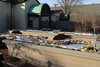
I really, really like the look of the Native Turtle Habitats. The concept art is really bringing out how creative the flower bed conversion idea was. Bringing the animals upward is a really smart strategy and I think will really let these turtles shine in a way they wouldn't in an exhibit lower to the ground; it's something I'd like to see done more often. It's also a great way for Brookfield to draw attention to a local conservation story they have personal involvement in, something I think the zoo has not always been able to communicate clearly.
The Eurasian eagle owl aviary is also fascinating to me. It looks like a great aviary for a really interesting and unexpected species, it helps the zoo buff out the northeastern Asia quadrant which is currently devoid of any birds, and we needed an owl. I think it's a really inspired choice and again, like the crane exhibit, I think it will feel surprisingly modern compared to the zoo's indoor bird exhibits. Great to see them embracing mesh.
I have to confess to finding the toucan aviary underwhelming. I'm glad the species is returning to the zoo but I think it is better housed in Feathers and Scales. I don't think Toucan Sam is enough to justify moving it into the Children's Zoo and I don't think the exhibit is a good space for tropical birds. The only 'plus' is that it is more colorful and visually striking than the raven. I want to assume it is simply being placed here out of pure convenience.
I don't want to renew the macaw discourse as my opinion has been made clear, but the conteast between the native birds, turtles and owl with the macaws and toucan is disheartening, and it leaves me hoping someday they may give us a true South American aviary space where macaw and toucan can be in naturalistic habitats.