Persephone
Well-Known Member
Lincoln Park ran out of stuff to buy with donor money. Brookfield's turn. I look forward to an exciting future until Lincoln Park finds more stuff to build.

Even the Brookfield low point you describe I don't think was bad at all. Sounds like you share that opinion though anyways.This really is a new development; Brookfield was in the same boat as the other three not too long ago, before the exciting news of all the new additions being built. I think this map does provide some insight to what we can expect the full potential of Brookfield to be like.
Brookfield was still good even in its more troubled days of the mid 2010s, and has really been on an upward trajectory since then, adding many very nice smaller animals.
What does the line-up for Tropic World look like these days? A number of losses here would've been inevitable (e.g., sooty mangabeys), and the zoo did historically have problems with certain species hybridizing, so I'm curious what's left and/or what has left in recent years you'd like to return.I pretty much just wish Tropic World was back to its old, full-of-life self.

As of my visit last month it was the following:What does the line-up for Tropic World look like these days? A number of losses here would've been inevitable (e.g., sooty mangabeys), and the zoo did historically have problems with certain species hybridizing, so I'm curious what's left and/or what has left in recent years you'd like to return.
There is still a tremendous amount to see and do at Brookfield, and I definitely don't want to downplay that there is still a lot to experience. Still, for me, what underlines Brookfield's sense of decline is not a lack of species overall but the overall sense of empty space, largely because the negatiive and positive collection changes have not really affected the overall layout of the facility. The major gains in the last several years, like the flamingo, tufted capuchin, sand cat, toco toucan, red-legged seirema, and Kemp's ridley sea turtle, cape barren goose, even the short-lived pygmy slow loris exhibit, even the pangolin, have all utilized existing spaces. In contrast, it's worth keeping in mind that for the losses of congo buffalo, elephants, common hippopotamus, aardvark, baboon, mandrill, vampire bat, ostrich, baird's tapir, possibly walrus, and more, we've gained no new exhibits or brand new species in those particular spaces, though some have been reused for species already in the collection. The bear grottos and ridge exhibit has been empty for going on fifteen years and have left the southeastern portion of the zoo entirely skippable if you aren't doing upcharge attractions. The vampire bat alcove in the Living Coast and the former aardvark building were not converted for new species; the former was filled in and the latter blocked off. The total amount of species in the hoofstock yards has declined considerably. The former baboon exhibit is a play space and while turtles are coming later this year, it's not happened yet. We also lost red panda which were a fairly recent addition. The reptile building became much-needed office space - completely understandable and probably unavoidable, fine by itself, but unfortunately a forerunner for a lot of these subsequent changes of animal spaces into empty or non-animal spaces.
It's not the same as losing species because you're replacing them with superior exhibits or new species; in Brookfield's case the exciting gains don't feel like they relate to the negative changes that came beforehand, they feel more incidental. The zoo has built back up it's reptile collection very impressively in the last decade (after letting it dwindle quite low!) and I'm more pleased about that than it sounds, but I hope this would have happened regardless if the zoo kept half of those species mentioned above.
What does the line-up for Tropic World look like these days? A number of losses here would've been inevitable (e.g., sooty mangabeys), and the zoo did historically have problems with certain species hybridizing, so I'm curious what's left and/or what has left in recent years you'd like to return.
Definitely the case. I think a great contrasting example is nearby Lincoln Park Zoo -- while they have also seen some reduction in species with the closure of two former exhibits (the former Bear Line, the Penguin-Seabird House) they still utilized the space to make expansive new habitats for Polar bears, African penguins, and Japanese macaque, so the zoo still feels full and complete. The losses were directly offset by gains in the same spaces and nothing was left empty or underused afterward.In my opinion, unfortunately or fortunately depending on perspective, a decline in animal numbers is inevitable for all major zoos. I think maintaining a fuller zoo for the foreseeable future will mean larger exhibits for fewer species and more usable space.
It really is. I wonder if they were indeed held there. I do want to mention I've never found a contemporary source indicating they were actually present, though sources do indicate it was intended.It's wild to see what look like drawings of caiman in the South American section.

For a measly $200 U.S. ($269 Canadian for me!) one can buy the Brookfield Zoo 'poster map' being discussed here. I was surprised to find out that it wasn't published until 1984:
The Brookfield Zoo | Curtis Wright Maps
There are some really neat zoo maps on that site, which includes Brookfield, Bronx and San Diego.
Shop 2 | Curtis Wright Maps

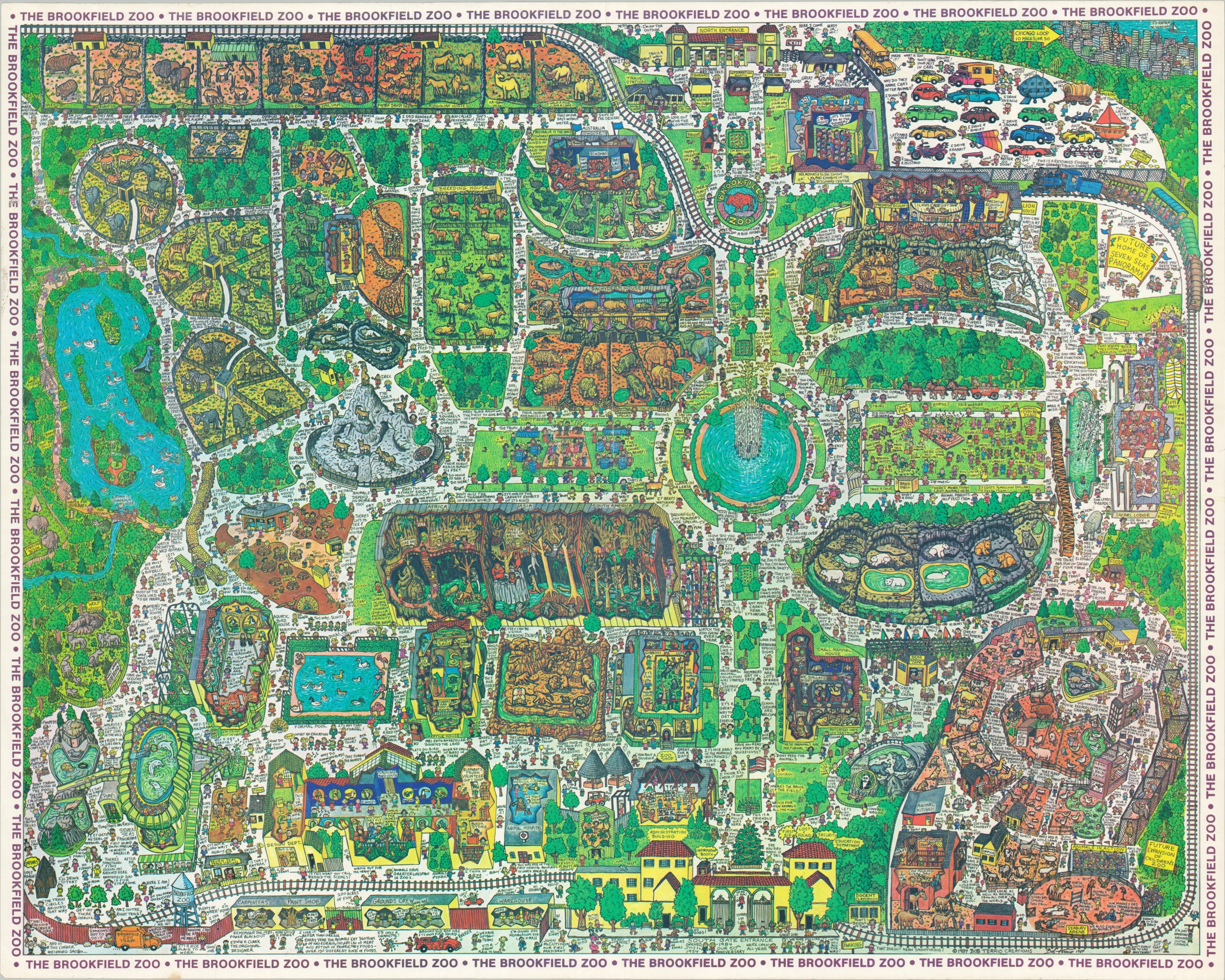
I don't know if this is newsworthy, but it's moreso an interesting look at Brookfield Zoo's history (from Curtis Wright Maps, there's some genuine artistry here!). Here are some highlights, although this may just be me discovering stuff about the zoo's history for myself, hopefully I'm not preaching to the choir.
- If there's anything I missed, feel free to let me know!
Yeah, I've put it on a wishlist for myself even though I lack the wall space but I'm having a lot of trouble imagining purchasing it or receiving it as a gift considering the price.Their prices seem really excessive, but I guess that's to be expected with any "antique dealer" type place.
According to the 1980 guidebook:In the lower section of the dolphin stadium it looks like there is an aquarium. Does anybody know how extensive the aquarium was? What kind of species did they keep there? I can't tell from the map.