Review based on visit July 9, 2017
The California Wolf Center was established at a rural residence in 1975 and opened for public tours in 1977 (if I remember correctly the dates the guide told me). It is located in a hilly region near the quaint small town of Julian, in the mountains east of Escondido (San Diego County).
The facility can only be visited by booking a tour in advance. I did the general tour along with fellow ZooChat member snowleopard. These are offered on weekends for larger groups. On select weekdays they offer a similar tour with a smaller number of guests for a slightly higher fee. If you have deep pockets I believe you can also schedule a one-on-one tour.
Visitors meet at the bottom of their (very rough) dirt access road and wait for staff to check them in. The entire entourage then travels the one mile bumpy road to the parking lot. Visitors gather in a room with folding chairs in the education center, which appears to be a modest house that was modified. Visitors are then given a lengthy (40 or 45 minute?) lecture on wolf natural history and biology and historic and current status in the United States.
My opinion is that the lecture was too dry and scientific and not suited for a general audience, particularly one with children (for whom I felt truly sorry). The lecture did feature skulls and a Powerpoint, but still it could have been simplified. When I used to do a cat lecture at my local zoo as a docent, the education curator told me to keep it to fifteen minutes as this is the attention span of an all ages general audience (based on research). The most interesting part of the wolf center presentation is the end when they discuss the recent natural return of wolves to northern California.
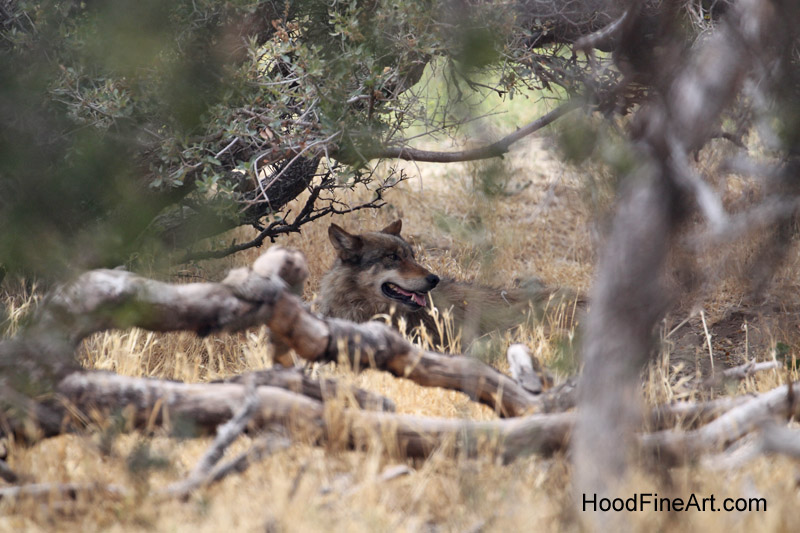
Visitors are then taken outside to see two of the six large wolf exhibits. The first features a pair of Mexican gray wolves and is just over an acre in size. The second features six North American gray wolves and is over two and a half acres in size. A guide discusses the animals and visitors are free to ask questions (with a certain former docent from Arizona asking the most questions). The exhibits are built by adding fences to the existing hillside vegetation, which holds up very well.
I did not track the time closely, but as a very rough guess I would say we spent 15 minutes at the first exhibit and 10 minutes at the second. After this the guide said we were free to leave or to stay with him for a little longer to see if the shy wolves would show themselves better. The vast majority of the group left, including a certain Canadian who rushed off to see some obscure San Diego area facilities. I stayed along with half a dozen others and we enjoyed the wolves for another ten minutes or so. Since the wolves really did not show themselves much at all for the large group, we got the better view. I also had lots of time to speak more intimately with the guide, which I found quite enjoyable. I even learned that the Oakland Zoo consulted them on the design of their upcoming wolf exhibit.
After this we went back to the education center and were invited to visit the small gift shop or just leave. Only a couple of us went into the gift shop and I was the last one there. I spoke at length with the staff member who had given the lecture. I ended up buying a card (based on a painting of one of their resident wolves) and a book (
Wolf Land by Carter Niemeyer). It was during the lengthy discussion that I learned they have six paid staff members (and dozens of volunteers). Four of the staff work on-site caring for the resident wolves. The other two staff are living in northern California working with ranchers and other affected parties to prepare the area for wolf recolonization. This facility exists solely to promote wolf conservation in the United States and I am duly impressed with their dedication. They also work with my own state's Game and Fish Dept (Arizona) on the Mexican wolf recovery program. They are a key breeding facility for the Mexican wolf. The staff member even confided that the reason the visitor facilities are so minimal is that they spend most of their money on conservation efforts.
The tour (including lecture) started officially at 10am and I think the majority of the group left around 11:15am. I was there until 12noon and was the last visitor on site. Honestly the most enjoyable part of the entire tour was the part after the main group left. Having personal access to staff members and learning about conservation firsthand was great. If it wasn't for this extra time, I don't think I would rate the facility as highly as I do. While the overall visitor experience is, to be blunt, mediocre, the amount of time and money put into conservation is nearly unsurpassed. This is an organization that I would feel very comfortable supporting.
It is a place that everyone in the area should visit at least once. Unfortunately the extended lecture discourages repeat visits. Once you have heard it there would be no reason to go back and sit through it again. The views of the wolves are also minimal, as the wolves can and do choose to spend a lot of time hiding. The photo opportunities are severely limited, but I knew this ahead of time so I had low expectations going in. I am sure they would arrange a private photo tour for a substantial fee. The visitor facilities need to be improved, starting with paving (or at least grading) the entry road. So I would say as far as visitor experience it is decent at best (compared to a regular zoo), but for a conservation-minded individual with an interest in learning from experts, it is a nice day out indeed.