You are using an out of date browser. It may not display this or other websites correctly.
You should upgrade or use an alternative browser.
You should upgrade or use an alternative browser.
Chlidonias Goes To Asia, part seven: 2024-2025
- Thread starter Chlidonias
- Start date


Fanjingshan - day two
Another drizzly day. With an entire day at my disposal rather than just a half-day, today was a better day bird-wise and I saw 32 species in total, almost twice yesterday's 17 species.
Before even leaving my room I had an interesting bird on the powerline running across the river, a Cuculus cuckoo. There are several similar-looking cuckoos in China. I had a good look at it because it sat there for some time but I wondered if I would be able to identify it from appearance. Just after it left I could hear it calling from the trees on the other side of the river - "wuck-koo, wuck-koo". That would be the Common Cuckoo then. But when I looked at the eBird list there was only the Indian Cuckoo recorded here. I listened to the call - that wasn't it at all. I had a look at the whole list for Guizhou (the province Fanjingshan is in) and Common Cuckoo isn't on there at all. The next morning I saw the bird again calling from on top of a temple, and it was definitely a Common Cuckoo. I had a Google and the species is found all over China, so it seems Guizhou must just be under-birded. I don't know if there was just the one bird, but I could hear the call every day.
It took me quite a while to walk to the tourist area of the mountain this morning because there were loads of birds along the river on the way, including a pair of Mandarin Ducks in a tree. Russet Sparrows and Japanese Thrushes were nesting abundantly in the area, and of course there were all the White-browed Laughing Thrushes and Brown-breasted Bulbuls and Black-throated Tits and everything else, so I had to keep stopping to check every bird flying through the trees just in case it was something less ordinary.
There was no entry fee for me today (it seems that if you are returning on consecutive days you don't need to pay that initial 100 Yuan again), so it was just 58 Yuan for the shuttle, and then - reversing yesterday's strategy - I took the cable-car up to the top for 70 Yuan and walked back down the staircase. It also transpired that the cable-car would be out of service for safety checks for the following four days, meaning I had got back to Fanjingshan just in time to avoid another "arriving at the wrong time"!
The road between the entrance and the cable-car seems really long. The sign says 9.5km but it seems much longer. In 2013 I had walked down that road from the cable-car least a couple of times (I saw Elliot's Pheasants while doing so) but I couldn't imagine how I managed that after walking down all those mountain steps. Coming down today my legs were like jelly. The road can only be driven by the park vans and you're not allowed to walk it now - from memory the only reason they let me walk it back then was because there weren't any other visitors.
The cable-car is very high. The cabins are enclosed which makes them feel a lot safer than the open chairs on the cable-car in Dali, but I still don't like heights! During the ascent you can see how rugged the mountain is, and how much forest there is which there is no way to reach - or to even see - when on the staircase. Finding snub-nosed monkeys here would be an infinitesimally small chance. Finding Tibetan Macaques here is no problem, but they are much more common and also are not afraid to come to where the people are. I know I'm probably making this sound like I'm building up to a reveal that I found snub-nosed monkeys - but I did not. I didn't really expect to (at all) but it was worth coming here nonetheless. The thing is, it would be possible to see them here, but it would be blind luck rather than by any sort of plan.
From the upper cable-car station I went up the steep set of boardwalk stairs, basically in a continuous line of people because this is the route which leads to the mushroom rock and other scenic attractions at the top. You can even be carried up the staircase in a bamboo sedan chair.
There is another laughing thrush up here, the Elliot's Laughing Thrush, which is a common montane species in China but here I was seeing for the first time on this trip because I hadn't been to any suitable areas until now. There were so many people moving up the stairs that I couldn't get photos, even though these laughing thrushes are typically pretty relaxed, because every time I went to take a photo someone would either shove past me, walk in front of the camera, or simply scare the bird away.
I also saw a mixed flock of White-collared Yuhinas, Pekin Robins, and some grey-capped yellow warblers with yellow eye-rings. There are a whole set of these warblers in China which all look almost the same and mostly overlap in distribution, although being partly separated by breeding altitude (but not by non-breeding altitude when they all mix together). One of the ways to identify them is that some have the eye-ring broken at the back or the top, instead of being fully enclosed. How you are supposed to see that when the bird is zipping through the branches I don't know. The only one of the group listed on eBird for Fanjingshan is the White-spectacled Warbler, but the mountain is so little catalogued on there that I wouldn't put faith in there not being other species there as well.


A couple of bulbuls seen at Fanjingshan - Black Bulbul in the upper photo and Chestnut Bulbul in the lower photo.
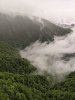
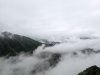
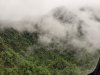
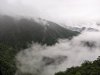
It was really foggy at the top, even more so than yesterday had been in the forest. The geological formations for which the mountain is famous were technically visible, but some were more visible than others! I'll put some photos of them in the following posts.
A male Rufous-gorgeted Flycatcher was seen by the temple there.
Walking back down the staircase was not fun! The steps aren't of consistent sizes or construction. Some are narrow (some less than foot width!), others are wide. Some are concrete, some are single slabs of stone, and some are mixtures. Some are straight-edged, and some are jagged. You can't tell if a step will be slippery or not either, until your foot goes down on it. It took me a lot longer to get down the mountain than it had to go up yesterday because I really didn't want to slip on them!
The staircase was quiet in terms of people compared to yesterday, perhaps because it was Monday although there had been masses of visitors up the top. A lot of the time I was alone for significant stretches of time which was great.
No mammals at all were seen today, not even macaques, but there were birds scattered pretty randomly along the way, including Grey-headed Parrotbills (the cartoon-like birds I saw last time I was at Fanjingshan), Grey-headed Canary-Flycatcher, Verditer Flycatcher, the first Grey-winged Blackbird of the trip, and a whole group of Buffy Laughing Thrushes.

Buffy Laughing Thrush
Back down the bottom in the tourist village area, I saw minivets flying back and forth in some trees by the river. It took a while to see them well enough but eventually I could identify them as Brown-rumped Minivets which were another new one for the trip. I actually thought they might be a lifer because I wasn't familiar with the name but it turned out that they were the same bird as Swinhoe's Minivet which I have seen elsewhere.
A Tiger Shrike seen on the walk back to the hotel was also new for the trip but not a lifer.
Another drizzly day. With an entire day at my disposal rather than just a half-day, today was a better day bird-wise and I saw 32 species in total, almost twice yesterday's 17 species.
Before even leaving my room I had an interesting bird on the powerline running across the river, a Cuculus cuckoo. There are several similar-looking cuckoos in China. I had a good look at it because it sat there for some time but I wondered if I would be able to identify it from appearance. Just after it left I could hear it calling from the trees on the other side of the river - "wuck-koo, wuck-koo". That would be the Common Cuckoo then. But when I looked at the eBird list there was only the Indian Cuckoo recorded here. I listened to the call - that wasn't it at all. I had a look at the whole list for Guizhou (the province Fanjingshan is in) and Common Cuckoo isn't on there at all. The next morning I saw the bird again calling from on top of a temple, and it was definitely a Common Cuckoo. I had a Google and the species is found all over China, so it seems Guizhou must just be under-birded. I don't know if there was just the one bird, but I could hear the call every day.
It took me quite a while to walk to the tourist area of the mountain this morning because there were loads of birds along the river on the way, including a pair of Mandarin Ducks in a tree. Russet Sparrows and Japanese Thrushes were nesting abundantly in the area, and of course there were all the White-browed Laughing Thrushes and Brown-breasted Bulbuls and Black-throated Tits and everything else, so I had to keep stopping to check every bird flying through the trees just in case it was something less ordinary.
There was no entry fee for me today (it seems that if you are returning on consecutive days you don't need to pay that initial 100 Yuan again), so it was just 58 Yuan for the shuttle, and then - reversing yesterday's strategy - I took the cable-car up to the top for 70 Yuan and walked back down the staircase. It also transpired that the cable-car would be out of service for safety checks for the following four days, meaning I had got back to Fanjingshan just in time to avoid another "arriving at the wrong time"!
The road between the entrance and the cable-car seems really long. The sign says 9.5km but it seems much longer. In 2013 I had walked down that road from the cable-car least a couple of times (I saw Elliot's Pheasants while doing so) but I couldn't imagine how I managed that after walking down all those mountain steps. Coming down today my legs were like jelly. The road can only be driven by the park vans and you're not allowed to walk it now - from memory the only reason they let me walk it back then was because there weren't any other visitors.
The cable-car is very high. The cabins are enclosed which makes them feel a lot safer than the open chairs on the cable-car in Dali, but I still don't like heights! During the ascent you can see how rugged the mountain is, and how much forest there is which there is no way to reach - or to even see - when on the staircase. Finding snub-nosed monkeys here would be an infinitesimally small chance. Finding Tibetan Macaques here is no problem, but they are much more common and also are not afraid to come to where the people are. I know I'm probably making this sound like I'm building up to a reveal that I found snub-nosed monkeys - but I did not. I didn't really expect to (at all) but it was worth coming here nonetheless. The thing is, it would be possible to see them here, but it would be blind luck rather than by any sort of plan.
From the upper cable-car station I went up the steep set of boardwalk stairs, basically in a continuous line of people because this is the route which leads to the mushroom rock and other scenic attractions at the top. You can even be carried up the staircase in a bamboo sedan chair.
There is another laughing thrush up here, the Elliot's Laughing Thrush, which is a common montane species in China but here I was seeing for the first time on this trip because I hadn't been to any suitable areas until now. There were so many people moving up the stairs that I couldn't get photos, even though these laughing thrushes are typically pretty relaxed, because every time I went to take a photo someone would either shove past me, walk in front of the camera, or simply scare the bird away.
I also saw a mixed flock of White-collared Yuhinas, Pekin Robins, and some grey-capped yellow warblers with yellow eye-rings. There are a whole set of these warblers in China which all look almost the same and mostly overlap in distribution, although being partly separated by breeding altitude (but not by non-breeding altitude when they all mix together). One of the ways to identify them is that some have the eye-ring broken at the back or the top, instead of being fully enclosed. How you are supposed to see that when the bird is zipping through the branches I don't know. The only one of the group listed on eBird for Fanjingshan is the White-spectacled Warbler, but the mountain is so little catalogued on there that I wouldn't put faith in there not being other species there as well.
A couple of bulbuls seen at Fanjingshan - Black Bulbul in the upper photo and Chestnut Bulbul in the lower photo.
It was really foggy at the top, even more so than yesterday had been in the forest. The geological formations for which the mountain is famous were technically visible, but some were more visible than others! I'll put some photos of them in the following posts.
A male Rufous-gorgeted Flycatcher was seen by the temple there.
Walking back down the staircase was not fun! The steps aren't of consistent sizes or construction. Some are narrow (some less than foot width!), others are wide. Some are concrete, some are single slabs of stone, and some are mixtures. Some are straight-edged, and some are jagged. You can't tell if a step will be slippery or not either, until your foot goes down on it. It took me a lot longer to get down the mountain than it had to go up yesterday because I really didn't want to slip on them!
The staircase was quiet in terms of people compared to yesterday, perhaps because it was Monday although there had been masses of visitors up the top. A lot of the time I was alone for significant stretches of time which was great.
No mammals at all were seen today, not even macaques, but there were birds scattered pretty randomly along the way, including Grey-headed Parrotbills (the cartoon-like birds I saw last time I was at Fanjingshan), Grey-headed Canary-Flycatcher, Verditer Flycatcher, the first Grey-winged Blackbird of the trip, and a whole group of Buffy Laughing Thrushes.
Buffy Laughing Thrush
Back down the bottom in the tourist village area, I saw minivets flying back and forth in some trees by the river. It took a while to see them well enough but eventually I could identify them as Brown-rumped Minivets which were another new one for the trip. I actually thought they might be a lifer because I wasn't familiar with the name but it turned out that they were the same bird as Swinhoe's Minivet which I have seen elsewhere.
A Tiger Shrike seen on the walk back to the hotel was also new for the trip but not a lifer.
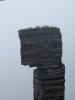
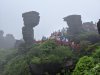
Mushroom Rock:

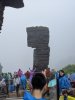
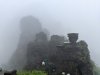
What the scene actually looks like in person...

From the other side:

Another formation nearby:

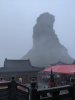
This is the Red Clouds Golden Summit with the Fanjingshan Temple on top. It's difficult to see because of the fog but the temple can just be seen. Also note the faint white zigzag near the bottom - that is a line of people all going up the stairs.

What the scene actually looks like in person...
From the other side:
Another formation nearby:
This is the Red Clouds Golden Summit with the Fanjingshan Temple on top. It's difficult to see because of the fog but the temple can just be seen. Also note the faint white zigzag near the bottom - that is a line of people all going up the stairs.
Attachments
It's spray. I don't like roll-on. I started with Lynx, that was the one which was initially confiscated. It's almost impossible to find deodorant of any kind in China, so I had to go without until I got to Japan where they seem to only sell Axe (but everywhere sells it, so no issues there). I ran out in Taiwan and again couldn't find any shops which stocked it ("we don't sell that here" I was told) so had to wait until Hong Kong where I found some Nivea Men.I have to know - do you use spray or roll-on deodorant? I can see how one might be perceived as a weapon but the other?
The train issue with the spray is really one of size - I don't know what the allowed ml is but the first one was apparently over their limit and the next one wasn't, even though they were both standard size cans. (And the first one had been on multiple trains until being confiscated at one station).
I kept the deodorant and knife at the very top of my pack so I could get them out easily because they always caused issues with the security at train stations. The security was pretty inconsistent though - the deodorant was always checked, the knife sometimes, contact lens solution once, my power-bank (for my phone) once or twice. The bags are going through X-ray machines too, so everything can be seen every time.
Fanjingshan - day three
With the cable-car out of commission for the next few days I had to walk both ways up and down the mountain today. As per usual, the walk to the mountain was quite slow due to interruption by birds, the first of which was a Chinese Sparrowhawk just by the hotel. This and the Buffy Laughing Thrushes were the only two lifers I saw while at Fanjingshan (out of 47 bird species seen in total).
It was a nice day today, there was some cloud at the start but up on the mountain it was clear. Would have been nice if that had been the case on the days when the cable-car was running! The place was deserted. With no cable-car there was almost nobody visiting. Most of the shops in the tourist area were closed, and the streets were empty.
Today I again had to pay for just the bus (58 Yuan) and not the 100 Yuan entry fee.
I wasn't looking forward to climbing both ways to be honest. My legs were still recovering from the other days! All the steps were dry though, which made coming back down feel so much safer!

Indochinese Yuhinas
There were loads of birds around today. Eleven species were seen on the mountain, and thirty overall for the day. I even saw a nest of Buffy Laughing Thrushes with chicks being fed. Streak-breasted Scimitar-Babblers also seemed to have a nest judging by the pair of birds I saw carrying insects around and calling continuously.

Buffy Laughing Thrush nest - the adult is behind the leaves on the left side.

Streak-breasted Scimitar-Babbler
I got a good close look at one of the grey-headed yellow warblers which occur here, and the eye-ring was broken at the top - a White-spectacled Warbler. It is true the eye ring was yellow, but on eBird there are photos of birds with both white and yellow eye-rings so I guess it's variable. White-spectacled Warbler is also the only one of the group listed on eBird for Fanjingshan.
Generally, all the birds were ones I'd already seen in the previous days. I was looking out for Temminck's Tragopans which I'd seen here in 2013 (photo here Temmincks tragopan (Tragopan temminckii) - ZooChat), but I haven't had much luck with pheasants in general on this trip and no tragopans were seen.
In non-bird sightings I finally saw a Maritime Squirrel. I had seen them here back in 2013 but none for the last two days. Today I saw four of them. Tibetan Macaques were seen on the van ride back down the road at the end.

The fine weather seemed to have brought out the forest invertebrates as well. I put some photos in an earlier post (the last post on the previous page). The more annoying of the insects were countless hoverflies who wanted sweat. The sweat-eating insects on the staircase must be getting rich off all the sweaty people climbing the mountain!

There was also this great big toad, maybe Bufo gargarizans. This photo also illustrates the irregularity of the steps on the mountain!
With the cable-car out of commission for the next few days I had to walk both ways up and down the mountain today. As per usual, the walk to the mountain was quite slow due to interruption by birds, the first of which was a Chinese Sparrowhawk just by the hotel. This and the Buffy Laughing Thrushes were the only two lifers I saw while at Fanjingshan (out of 47 bird species seen in total).
It was a nice day today, there was some cloud at the start but up on the mountain it was clear. Would have been nice if that had been the case on the days when the cable-car was running! The place was deserted. With no cable-car there was almost nobody visiting. Most of the shops in the tourist area were closed, and the streets were empty.
Today I again had to pay for just the bus (58 Yuan) and not the 100 Yuan entry fee.
I wasn't looking forward to climbing both ways to be honest. My legs were still recovering from the other days! All the steps were dry though, which made coming back down feel so much safer!
Indochinese Yuhinas
There were loads of birds around today. Eleven species were seen on the mountain, and thirty overall for the day. I even saw a nest of Buffy Laughing Thrushes with chicks being fed. Streak-breasted Scimitar-Babblers also seemed to have a nest judging by the pair of birds I saw carrying insects around and calling continuously.
Buffy Laughing Thrush nest - the adult is behind the leaves on the left side.
Streak-breasted Scimitar-Babbler
I got a good close look at one of the grey-headed yellow warblers which occur here, and the eye-ring was broken at the top - a White-spectacled Warbler. It is true the eye ring was yellow, but on eBird there are photos of birds with both white and yellow eye-rings so I guess it's variable. White-spectacled Warbler is also the only one of the group listed on eBird for Fanjingshan.
Generally, all the birds were ones I'd already seen in the previous days. I was looking out for Temminck's Tragopans which I'd seen here in 2013 (photo here Temmincks tragopan (Tragopan temminckii) - ZooChat), but I haven't had much luck with pheasants in general on this trip and no tragopans were seen.
In non-bird sightings I finally saw a Maritime Squirrel. I had seen them here back in 2013 but none for the last two days. Today I saw four of them. Tibetan Macaques were seen on the van ride back down the road at the end.
The fine weather seemed to have brought out the forest invertebrates as well. I put some photos in an earlier post (the last post on the previous page). The more annoying of the insects were countless hoverflies who wanted sweat. The sweat-eating insects on the staircase must be getting rich off all the sweaty people climbing the mountain!
There was also this great big toad, maybe Bufo gargarizans. This photo also illustrates the irregularity of the steps on the mountain!

Fanjingshan - day four
No mountain today - when I woke up my calves were aching after walking up and down 30,000 stairs over the last three days. I definitely wouldn't have been able to climb any steps today. Even the ones at the hotel were a bit much.
After breakfast I went for a walk along the road in the opposite direction to the mountain (towards Tongren), because it's flat. It wasn't very birdy at all, especially compared to when I was here in winter, but there were a lot of Collared Finchbills about. Then I crossed the bridge by the hotel because the tree-lined path along the other side of the river is always birdy.
I didn't have my camera because I was just going for a stroll with my binoculars, so of course when I got to the other side of the bridge, where it is a platform at about half-tree height, those trees were filled with birds - Red-billed Blue Magpies searching for nests, Tiger Shrikes probably doing the same, and Japanese Thrushes and Brown-rumped Minivets trying to drive them away, all within a couple of metres of me and perfect for photos.
There are actually heaps of Japanese Thrushes here at this time of year, they are all along the river trail and really easy to see.
None of the birds I saw today were even year birds, let alone trip or life birds, but Oriental Magpie and Black-naped Oriole were at least new for this specific visit to Fanjingshan (as I mentioned earlier, I saw 47 bird species while here; in January I saw 37 species).

Red-billed Blue Magpie, in a photo taken on another day.
Today was my last day here. Tomorrow I would leave on my way to Jiuzhaigou National Park which is a place I had never been before.
No mountain today - when I woke up my calves were aching after walking up and down 30,000 stairs over the last three days. I definitely wouldn't have been able to climb any steps today. Even the ones at the hotel were a bit much.
After breakfast I went for a walk along the road in the opposite direction to the mountain (towards Tongren), because it's flat. It wasn't very birdy at all, especially compared to when I was here in winter, but there were a lot of Collared Finchbills about. Then I crossed the bridge by the hotel because the tree-lined path along the other side of the river is always birdy.
I didn't have my camera because I was just going for a stroll with my binoculars, so of course when I got to the other side of the bridge, where it is a platform at about half-tree height, those trees were filled with birds - Red-billed Blue Magpies searching for nests, Tiger Shrikes probably doing the same, and Japanese Thrushes and Brown-rumped Minivets trying to drive them away, all within a couple of metres of me and perfect for photos.
There are actually heaps of Japanese Thrushes here at this time of year, they are all along the river trail and really easy to see.
None of the birds I saw today were even year birds, let alone trip or life birds, but Oriental Magpie and Black-naped Oriole were at least new for this specific visit to Fanjingshan (as I mentioned earlier, I saw 47 bird species while here; in January I saw 37 species).
Red-billed Blue Magpie, in a photo taken on another day.
Today was my last day here. Tomorrow I would leave on my way to Jiuzhaigou National Park which is a place I had never been before.

General question about mammal watching in China: Is there any place in China where one has even a remote chance of seeing a wild giant panda, or is all of the wild giant panda habitat strictly inaccessible to the public? If they are accessible, is looking for wild giant panda something that you ever considered doing?
You can see Giant Pandas in the wild, but it's not exactly easy. Generally speaking it would be luck if you managed it. Last time I was in China (in 2013) they had closed "all" the panda reserves to foreigners (not to visitors in general, just foreign visitors) because of a media storm - "all" is in quotation marks because it wasn't complete, for example I visited Wanglang and Tangjiahe and Labahe then which are all panda reserves. I think it was probably just the famous ones. You can visit all the reserves now I think, but obviously visiting is not the same as being able to see a panda. And some reserves are now too restricted to have any chance (e.g. at Wanglang now, as I found out earlier in the current trip). There are some reports on Mammalwatching of tours where you sit and wait for hours for a distant panda to climb a tree and be seen (not my idea of a good way to spend however much money they are charging!).General question about mammal watching in China: Is there any place in China where one has even a remote chance of seeing a wild giant panda, or is all of the wild giant panda habitat strictly inaccessible to the public? If they are accessible, is looking for wild giant panda something that you ever considered doing?
Giant Pandas are active by day, so always I keep an eye out when in panda country (e.g. at Labahe which I visited again on this trip) but they are not highly mobile like other bears (because they don't need to be, with their food all around them) and they are at very low densities so the chances are slim.

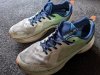
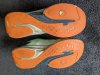
They actually turned out to be great shoes, surprisingly! I've been back in New Zealand for a couple of weeks now, and I'm still wearing them after over six months of continuous use.Completely unrelated to current discussions, but.... How are you getting on with the shoes you eventually managed to purchase after hunting for some high and low?
You can see in the photos below that they look dirtier obviously, but the only thing going wrong with them is there are a couple of holes in the lining at the back. The soles are well worn down though - there were the grippy things all over the soles when they were new and now they're mostly worn smooth. (The shoes are actually the same size as each other as well - there's a foreshortening effect in the photos so one shoe looks way smaller than the other!)


This is what the shoes looked like when I'd just bought them, on the 6th of January:
View attachment 762136
Attachments
Last edited:

Personal opinion - they look better dirty. That green is just too much.They actually turned out to be great shoes, surprisingly! I've been back in New Zealand for a couple of weeks now, and I'm still wearing them after over six months of continuous use.
You can see in the photos below that they look dirtier obviously, but the only thing going wrong with them is there are a couple of holes in the lining at the back. The soles are well worn down though - there were the grippy things all over the soles when they were new and now they're mostly worn smooth. (The shoes are actually the same size as each other as well - there's a foreshortening effect in the photos so one shoe looks way smaller than the other!)
View attachment 806546 View attachment 806547
This is what the shoes looked like when I'd just bought them, on the 6th of January:
View attachment 762136

Oh absolutely! They were ghastly. The top would be hidden by the ends of my trouser legs, but they were still kind of embarrassing to wear when they were new.Personal opinion - they look better dirty. That green is just too much.
Jiuzhaigou National Park - getting there
The first time I was in Sichuan (in 2013) I visited the reserves of Wanglang, Tangjiahe, and Labahe. I didn't visit Jiuzhaigou because even then it was renowned as being extremely touristy and busy. I was happy with my choices because I loved those other three reserves and they all gave me great animals.
On this current trip, when going through China at the start, I visited Wanglang again to look for Blue Eared Pheasants and found it had been "ruined" by changes to how people are allowed to visit (i.e. only in buses from the entrance, and no walking anywhere except in one section). That post is here: Chlidonias Goes To Asia, part seven: 2024-2025
I had looked up Jiuzhaigou at the time because it is right next to Wanglang, and is also a site for Blue Eared Pheasants, and discovered that it had been closed to visitors for some years (since a major earthquake in 2019) and only reopened this year - but what I was finding online was that tickets could only be booked online through the park's own website, but not by foreigners who had to go through a travel agent, and there was no ticket gate at the entrance for purchasing them in person. This all turned out to not be true (as probably might be expected in China).
When coming back into China for this run through, I was going to go to a mountain pass in Sichuan called Balang Shan which had been the place to go for pheasants. I had been there in 2013 and seen White Eared Pheasants, but I wanted to try again for Chinese Monal. I was googling information for that and came across a site detailing the current (2025) state of Sichuan birding sites. I can't find that page any more which is a pain, but it said that Balang Shan was no longer accessible at the "pheasant site". So that was off the table. However it mentioned Jiuzhaigou as still being a prime location even though it is busy and only able to be entered in the tour buses. (However the bonus of the park compared to somewhere like Wanglang is that you can walk along boardwalk trails inside Jiuzhaigou, it is just that the distances are really long so you get between different areas on the buses).
I decided to give Jiuzhaigou a try - I figured even if I wasn't able to book tickets I could still just turn up at the gate and see what happens, as is my usual modus operandi in China.
An extra piece of information on that page about Sichuan bird sites, was that at Labahe they have completed a cable-car to the top of the mountain where there is a long boardwalk from which Chinese Monals can be seen. I hadn't been going to return to Labahe but that made me want to, and it has the extra incentive of being a good site for Lady Amherst's Pheasant, a species I'd missed on my 2013 trip and which I'd also missed at Dali earlier on this current trip. Looks like Labahe's back on the menu boys!
From Fanjingshan I took a car to Tongren train station for 35 Yuan. On my first run through China I had just bought all my train tickets at the stations, usually on the day of travel, sometimes beforehand. This time I've mostly been booking them through Trip which is actually easier, but the main reason is that it is busier now and a lot of the trains are getting sold out. There are quite a lot of trains between Tongren and Chengdu but most were sold out. I got one leaving at noon, going via Guiyang, which would get into Chengdu at about 6.30pm. For the following day from Chengdu to Huanglongjiuzhai (to get to Jiuzhaigou) the only train I could get was a standing ticket (i.e. no seat) on a 6.45am train. Luckily that one is only an hour and a half ride.
Often with a standing ticket you can actually still get a seat when you're on the train because there are always people only travelling for shorter distances. So there might not be one individual empty seat all the way from (say) Guiyang to Chengdu, but there will be lots of people only travelling between cities along the route, so with a standing ticket you can just swap around between empty seats during the ride. But the Chengdu to Huanglongjiuzhai train doesn't have any stops, so a standing ticket actually is just standing the whole way. Interestingly, a standing ticket is the same price as a regular economy seat ticket so you can't actively save money by buying one of those instead of a seat.
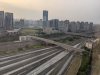
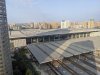
I booked a hotel in Chengdu right beside the East Railway Station (Chengdudong) which is where I arrived at and from where I would leave the next morning. It was called the Rayfont Hotel and Apartments, and is in a cluster of hotels all owned by the same company but with different names (based around "Rayfont" and "Longemont"), and each with different pricing. The one I was at was the cheapest of course, with the room being 94 Yuan (about NZ$21). The room number was 2406, which I thought was floor 2, room 406, but was actually floor 24, room 6. It overlooked the rail tracks which I quite liked. It was different from most views.
There were a lot of "standing" passengers on the train to Huanlongjiuzhai. I don't know how many passengers in total were on the train, but at least 1000 because it was fully booked. Each car holds 90 seated passengers, there are at least ten cars, and then loads of standing passengers. And all (or almost all) of them are going to Jiuzhaigou because the train only has one stop which is Huanlongjiuzhai. And there are multiple trains a day, all of which were fully booked. That's a lot of people!
From Huanlongjiuzhai railway station you then need to take a bus for another two hours to actually reach the Jiuzhaigou Scenic Area. There are lots of buses all waiting at the station, which cost 51 Yuan and you can just pay on board with WePay.
It was great being back in the Chinese mountains, with yaks in the fields and Tibetan prayer flags on the hillsides. There was even snow still on top of a mountain near the railway station. I appreciated the effort to make me feel comfortable.
Outside the entrance to the park is the Jiuzhaigou Tourist Centre, which is part of a village called Pengleng and which is composed primarily of hotels and restaurants. I had booked one called Four Seasons Fairy Tale Hotel which was 108 Yuan per night (about NZ$25). I had shown the bus driver the address to make sure I was going to the right place (at the railway station everyone was just calling out "Jiuzhaigou! Jiuzhaigou!" trying to attract the swarms of train passengers to their particular bus, and I wanted to check I wasn't going to end up at the actual town of Jiuzhaigou which is quite some distance away from the Jiuzhaigou Scenic Area). When we got to the Jiuzhaigou Tourist Centre he was letting some other people off for their hotels and said this was my stop as well. It turned out to be about twenty minutes walk further on - and, in fact, the bus would have had to drive straight past it which was a tad annoying.
Anyway, the hotel was nice and I could check in immediately even though it was several hours before the official time. China is great like that.
Even though I had been told by the internet that foreigners can't buy tickets to the park online, and that there are no counter sales, I'd come here anyway because I figured even if I couldn't get into the park I could still go birding along the roads outside (probably not in reality, because they turned out to be extremely busy with buses and with no walking areas at the sides). After booking the train and hotel I'd looked on Trip and, what do you know, they sell tickets to the park on there for foreigners. Stupid internet!
A combined entry ticket, which includes the "sightseeing bus" you need to get around inside the park, costs 280 Yuan which is about NZ$70 so it's not cheap.
After checking into the hotel I walked up the road to the park entrance, just a few hundred metres away, so I would know where it was for tomorrow. When I got there I found that in fact there was a ticket counter, and when I asked if I could just buy a ticket there (as in, after I'd used the one I had bought on Trip for tomorrow) the girl said "yes, of course". It was the same price too, at 280 Yuan. So there is literally no issue with foreigners visiting Jiuzhaigou currently.
I did book my tickets each day through Trip rather than buying at the counter though, because the counter doesn't open until 8am. The gates to the park also don't open until 8am but there are so many people queued at both the gates and the ticket office that if you wait until then to buy the tickets you probably wouldn't be getting in until closer to 9am.
I wasn't going to pay $70 today to go in for half the day (although in hindsight it would have still been worthwhile to have done so), so I just picked up a map for tomorrow and then went for a walk along the path which follows the river through the town.
I had already seen Eurasian Crag Martins (a type of very plain swallow) around the town area when I arrived, and wandering along the river area I saw another thirteen species, including the very nice Godlewski's Bunting, the large red-and-black Chestnut Thrush, an all-blue Blue Rock Thrush, Grey-backed Shrike, Long-tailed Minivets, Russet Sparrows and Dark-sided Flycatchers.
The first time I was in Sichuan (in 2013) I visited the reserves of Wanglang, Tangjiahe, and Labahe. I didn't visit Jiuzhaigou because even then it was renowned as being extremely touristy and busy. I was happy with my choices because I loved those other three reserves and they all gave me great animals.
On this current trip, when going through China at the start, I visited Wanglang again to look for Blue Eared Pheasants and found it had been "ruined" by changes to how people are allowed to visit (i.e. only in buses from the entrance, and no walking anywhere except in one section). That post is here: Chlidonias Goes To Asia, part seven: 2024-2025
I had looked up Jiuzhaigou at the time because it is right next to Wanglang, and is also a site for Blue Eared Pheasants, and discovered that it had been closed to visitors for some years (since a major earthquake in 2019) and only reopened this year - but what I was finding online was that tickets could only be booked online through the park's own website, but not by foreigners who had to go through a travel agent, and there was no ticket gate at the entrance for purchasing them in person. This all turned out to not be true (as probably might be expected in China).
When coming back into China for this run through, I was going to go to a mountain pass in Sichuan called Balang Shan which had been the place to go for pheasants. I had been there in 2013 and seen White Eared Pheasants, but I wanted to try again for Chinese Monal. I was googling information for that and came across a site detailing the current (2025) state of Sichuan birding sites. I can't find that page any more which is a pain, but it said that Balang Shan was no longer accessible at the "pheasant site". So that was off the table. However it mentioned Jiuzhaigou as still being a prime location even though it is busy and only able to be entered in the tour buses. (However the bonus of the park compared to somewhere like Wanglang is that you can walk along boardwalk trails inside Jiuzhaigou, it is just that the distances are really long so you get between different areas on the buses).
I decided to give Jiuzhaigou a try - I figured even if I wasn't able to book tickets I could still just turn up at the gate and see what happens, as is my usual modus operandi in China.
An extra piece of information on that page about Sichuan bird sites, was that at Labahe they have completed a cable-car to the top of the mountain where there is a long boardwalk from which Chinese Monals can be seen. I hadn't been going to return to Labahe but that made me want to, and it has the extra incentive of being a good site for Lady Amherst's Pheasant, a species I'd missed on my 2013 trip and which I'd also missed at Dali earlier on this current trip. Looks like Labahe's back on the menu boys!
From Fanjingshan I took a car to Tongren train station for 35 Yuan. On my first run through China I had just bought all my train tickets at the stations, usually on the day of travel, sometimes beforehand. This time I've mostly been booking them through Trip which is actually easier, but the main reason is that it is busier now and a lot of the trains are getting sold out. There are quite a lot of trains between Tongren and Chengdu but most were sold out. I got one leaving at noon, going via Guiyang, which would get into Chengdu at about 6.30pm. For the following day from Chengdu to Huanglongjiuzhai (to get to Jiuzhaigou) the only train I could get was a standing ticket (i.e. no seat) on a 6.45am train. Luckily that one is only an hour and a half ride.
Often with a standing ticket you can actually still get a seat when you're on the train because there are always people only travelling for shorter distances. So there might not be one individual empty seat all the way from (say) Guiyang to Chengdu, but there will be lots of people only travelling between cities along the route, so with a standing ticket you can just swap around between empty seats during the ride. But the Chengdu to Huanglongjiuzhai train doesn't have any stops, so a standing ticket actually is just standing the whole way. Interestingly, a standing ticket is the same price as a regular economy seat ticket so you can't actively save money by buying one of those instead of a seat.
I booked a hotel in Chengdu right beside the East Railway Station (Chengdudong) which is where I arrived at and from where I would leave the next morning. It was called the Rayfont Hotel and Apartments, and is in a cluster of hotels all owned by the same company but with different names (based around "Rayfont" and "Longemont"), and each with different pricing. The one I was at was the cheapest of course, with the room being 94 Yuan (about NZ$21). The room number was 2406, which I thought was floor 2, room 406, but was actually floor 24, room 6. It overlooked the rail tracks which I quite liked. It was different from most views.
There were a lot of "standing" passengers on the train to Huanlongjiuzhai. I don't know how many passengers in total were on the train, but at least 1000 because it was fully booked. Each car holds 90 seated passengers, there are at least ten cars, and then loads of standing passengers. And all (or almost all) of them are going to Jiuzhaigou because the train only has one stop which is Huanlongjiuzhai. And there are multiple trains a day, all of which were fully booked. That's a lot of people!
From Huanlongjiuzhai railway station you then need to take a bus for another two hours to actually reach the Jiuzhaigou Scenic Area. There are lots of buses all waiting at the station, which cost 51 Yuan and you can just pay on board with WePay.
It was great being back in the Chinese mountains, with yaks in the fields and Tibetan prayer flags on the hillsides. There was even snow still on top of a mountain near the railway station. I appreciated the effort to make me feel comfortable.
Outside the entrance to the park is the Jiuzhaigou Tourist Centre, which is part of a village called Pengleng and which is composed primarily of hotels and restaurants. I had booked one called Four Seasons Fairy Tale Hotel which was 108 Yuan per night (about NZ$25). I had shown the bus driver the address to make sure I was going to the right place (at the railway station everyone was just calling out "Jiuzhaigou! Jiuzhaigou!" trying to attract the swarms of train passengers to their particular bus, and I wanted to check I wasn't going to end up at the actual town of Jiuzhaigou which is quite some distance away from the Jiuzhaigou Scenic Area). When we got to the Jiuzhaigou Tourist Centre he was letting some other people off for their hotels and said this was my stop as well. It turned out to be about twenty minutes walk further on - and, in fact, the bus would have had to drive straight past it which was a tad annoying.
Anyway, the hotel was nice and I could check in immediately even though it was several hours before the official time. China is great like that.
Even though I had been told by the internet that foreigners can't buy tickets to the park online, and that there are no counter sales, I'd come here anyway because I figured even if I couldn't get into the park I could still go birding along the roads outside (probably not in reality, because they turned out to be extremely busy with buses and with no walking areas at the sides). After booking the train and hotel I'd looked on Trip and, what do you know, they sell tickets to the park on there for foreigners. Stupid internet!
A combined entry ticket, which includes the "sightseeing bus" you need to get around inside the park, costs 280 Yuan which is about NZ$70 so it's not cheap.
After checking into the hotel I walked up the road to the park entrance, just a few hundred metres away, so I would know where it was for tomorrow. When I got there I found that in fact there was a ticket counter, and when I asked if I could just buy a ticket there (as in, after I'd used the one I had bought on Trip for tomorrow) the girl said "yes, of course". It was the same price too, at 280 Yuan. So there is literally no issue with foreigners visiting Jiuzhaigou currently.
I did book my tickets each day through Trip rather than buying at the counter though, because the counter doesn't open until 8am. The gates to the park also don't open until 8am but there are so many people queued at both the gates and the ticket office that if you wait until then to buy the tickets you probably wouldn't be getting in until closer to 9am.
I wasn't going to pay $70 today to go in for half the day (although in hindsight it would have still been worthwhile to have done so), so I just picked up a map for tomorrow and then went for a walk along the path which follows the river through the town.
I had already seen Eurasian Crag Martins (a type of very plain swallow) around the town area when I arrived, and wandering along the river area I saw another thirteen species, including the very nice Godlewski's Bunting, the large red-and-black Chestnut Thrush, an all-blue Blue Rock Thrush, Grey-backed Shrike, Long-tailed Minivets, Russet Sparrows and Dark-sided Flycatchers.
The Rayfont Hotel and Apartments in Chengdu - the reception is much more grand than one would expect from the price of the rooms!

The view of the train tracks out the window of the first room I stayed in.

When I came back through Chengdu when leaving China I stayed here again, and my room then had a different view of the train station

The view of the train tracks out the window of the first room I stayed in.
When I came back through Chengdu when leaving China I stayed here again, and my room then had a different view of the train station
Attachments

At Jiuzhaigou on arrival day:
View of mountains, on the road through town on the way towards the entry building for the National Park.

A neat two-coloured river, just like being in the Amazon!

Dinner that night, which was Yak.

View of mountains, on the road through town on the way towards the entry building for the National Park.
A neat two-coloured river, just like being in the Amazon!
Dinner that night, which was Yak.
Attachments
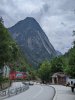
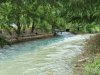
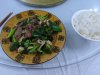
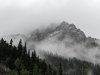
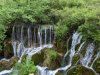
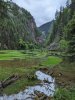
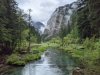
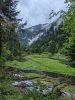
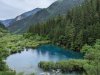
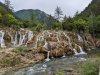
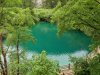
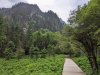
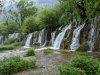
Jiuzhaigou National Park has some beautiful scenery. You wouldn't know from the photos I took on my phone but this park is packed with people!


Attachments