You are using an out of date browser. It may not display this or other websites correctly.
You should upgrade or use an alternative browser.
You should upgrade or use an alternative browser.
Chlidonias Goes To Asia, part three: 2013-2014
- Thread starter Chlidonias
- Start date
 I can understand problems with uploading photos if you are still travelling.
no, I'll only be at Mt. Kinabalu and Sepilok. Just ten days in Borneo this time.Any chance you will get near the (Bornean) Sumatran Rhino centre?

Any chance you will get near the (Bornean) Sumatran Rhino centre?
Not that it matters since he's already seen and photographed a Bornean Rhino. Lucky Bastard Badge from Thylo!
~Thylo

Leaving Peninsular Malaysia for Sabah I was allowed to leave my batteries in my check-in luggage, contrary to other Air Asia flights, but I had to take off my belt to go through the checkpoint. There are two airports for Kuala Lumpur, one is the KLIA (Kuala Lumpur International Airport) and the other is Air Asia's LCCT (Low Cost Carrier Terminal). I'm quite familiar with the LCCT, having flown in and out of there many times, but Air Asia is moving! There is now a brand new airport, the KLIA2, and Air Asia is moving all their facilities there on the ninth of May. I flew out of the LCCT but when I return from Borneo on the thirteenth I will be flying into a brand new airport. How exciting.
I arrived in Kota Kinabalu (the capital city of Sabah) at around 7.30pm, got the airport bus into town for five Ringgitts, and went to Lucy's Homestay where the dorms are 28 Ringgitts. In Kota Kinabalu it is difficult finding anywhere cheaper than that because of all the tourists coming through. Lucy remembered me from my last stay, in 2009 (or to be more precise, she remembered my hair!). The next morning I caught a mini-van to Mt. Kinabalu for 20 Ringgitts. Mt. Kinabalu is only about two hours from KK and it is a standard fixture in the tourist route of Sabah. (Last time I was in Sabah I wrote that it took three hours between KK and Mt. Kinabalu; I'm not sure why that would have been because the vans and the road are exactly the same now as then. Suffice to say this time I left KK at 8.30am and got to the mountain at 10.30). Few people stay more than one or two nights though because they are just there to climb the mountain and then move on to the next place to stay one or two nights at. There is accommodation inside the park but it is ridiculously expensive. Last time I was here I stayed at the Bayu Homestay (aka Bayu Lodge) which had 20 Ringgitt dorm beds and was about five minutes walk before the park gate (when coming from KK). That place is now closed, as I discovered after getting out of the van. I walked up to the park where I found that a new budget place called Tabuhan Lodge has opened up, literally directly across the road from the gate. They were full however, so I continued walking and found the Mountain Resthouse, just 200 metres further along. The dorms here were 35 Ringgitts but there are only three beds in each dorm and if you are alone you just get the whole room for yourself which is alright (if you are two or three people the dorms are 25 per person). The place is seriously run-down, most of the buildings are on a decided lean as they threaten to slide down the hill, and I slept with the lights on each night to stop the cockroaches eating my face, but the woman running it is friendly, there is free WIFI, and if you don't mind basic accommodation then it is handy for the park (you know, if the new Tabuhan Lodge opposite the gate is full when you arrive!). Like the Bayu Homestay was, the Mountain Resthouse is a dream for entomologists: there are uncountable numbers of moths of all sizes and shapes and colours attracted by the lights at night; I even found a big mantis in one of the bathrooms.
After arriving, checking in and getting something to eat, I headed into the park. The entry fee is 15 Ringgitts and although it states on the ticket it is a one-day ticket I was told it is valid for two days (unless staying inside the park in which case it is three days); in 2009 I was told one, two, three and five days -- in Malaysia things are just made up as they go along! In the event I only paid once over the four days I was there because each time I went in past the checkpoint I just held up my ticket to the guard as I walked past and he would wave me through. There are lots of trails through the forest on the mountain but you don't often meet anyone else on them unless they are also birders. Most people who come to Mt. Kinabalu are just there to climb it. They get driven up the 4.5km paved road which runs from the HQ to Timpohon Gate, hike up the seemingly never-ending steps to the summit and back over one or two days, and then get driven down to the HQ again. Some people do stay an extra day to walk some of the trails but it isn't very common.
The best trail for birds is the Liwagu Trail which runs along the Liwagu River valley from the HQ all the way up to Timpohon Gate. It is about 5.6km long and takes me around four to five hours (one does not walk quickly when birding). I did the Liwagu Trail every day, usually going upwards because coming down it is not as easy on the steeper sections. Most of the trails connect with the main paved road, so after reaching the top of the Liwagu Trail you can either just walk down the whole road to HQ or go into any of the other trails along the way. The Bukit Ular Trail is another of the better trails and that starts maybe twenty or thirty metres up the road from the Liwagu Trail's end.
Mt. Kinabalu is one of those places where bird waves are quite common, but in between the bird-waves there is almost nothing! You can be walking for ages seeing no more than one or two individual birds, and then suddenly there will be a great screeching flock of all sorts of different species hurtling past -- you try to quickly ID as many as possible, and then they're gone. On my first day I went up the Liwagu Trail and then down the paved road to the HQ. I had no bird-waves and saw exactly four species (chestnut-crowned erpornis, white-bellied erpornis, snowy-browed flycatcher and grey-throated babbler). Shameful. I met a New Zealander on the trail, which is a noteworthy event in itself because it is almost as rare to find a New Zealander in southeast Asia as it is to find a pangolin! He was wondering why it was so bird-less and when I explained about bird-waves he was very excited. I saw him later that day (he was staying at the same place as me) and he said he had found a bird-wave after meeting me and it made an immense difference to the experience by not only knowing why the birds were all together like that but also in explaining why he wasn't seeing much at the other times.
The mammals were just as absent as the birds that day. The only one I saw was a Bornean black-banded squirrel who lives up on the deck at Timpohon Gate, probably surviving mainly on a diet of biscuits. I thought this was probably the same squirrel as I saw here in 2009, but a couple of days later I saw five black-banded squirrels on the deck all at once. Interestingly enough, Timpohon Gate is quite a bit above the altitude range of black-banded squirrels as given in the field guide to Borneo's mammals.
Not all was lost for mammals though, because in the evening I returned to the park for some spot-lighting. I had been going to walk up the Liwagu Trail in the dark and then down the road, which would have been about six or seven hours in total, but I spent too long talking to a couple of guys at the hostel who wanted information on where to see animals in Borneo, and so started much later than I intended. And I never did do the Liwagu Trail at night because a tree came down across it that first night. During the day I didn't mind crawling through the canopy of the downed tree to get past, but I didn't fancy doing that at night by torch-light with the number of venomous snakes on the mountain! Anyway, right up the top of the road near Timpohon Gate is a big rubbish bin and at night this attracts scavenging animals including, apparently, ferret-badgers (seen there by animal-watcher Vladimir Dinets). It only takes an hour to walk straight up from the HQ to the top of the road (because at night you're not stopping for birds all along the way) and it isn't as steep as I had anticipated. I saw zero animals along the way, except for some moths and a few unidentifiable bats, but at the rubbish bin I found a hungry opportunist. The bin is pretty big (more of a dumpster really), with sides about five foot high. I shone my torch down inside and sitting on the rubbish bags was a rat. A giant rat. If there's one thing I like, it is a giant rat. This one was of a species called the long-tailed giant rat, and neither of those descriptives is inaccurate. It is very big and the tail is very long, easily twice the body length. It is also a most attractive rat, being a bright reddish colour streaked through with black, with a white belly, white gloves and grey leggings. It sat there for a while, whiffling its nose at the light but not really sure what to do, then casually disappeared in amongst the bags.
There a couple of small bins further up nearer the gate so I started to head that way, but got stopped in my tracks by a low-slung animal with a shortish thick tail scooting across the road just round the bend from the big bin. My brain automatically went "ferret-badger!". I could see that the animal hadn't gone under the road barrier and down the bank, so it must still be on the roadside. I sidled around the bend and sure enough there was a pair of eyes glowing back at me in the torch-light. I could tell immediately from the way it was sitting that it wasn't a ferret-badger, but rather some sort of small cat. The thing with eye-shine is that it is often so bright that it obscures the animal behind it until you get closer. I could see some markings on the face and throat so had a fair idea of which species of small cat it was, but I needed to confirm it. I edged across to the other side of the road to try and get a side-view of the animal, hoping it wouldn't dash off. It just sat there watching me. Once in a better position I could give a 100% accurate assessment of the species. Domestic tabby cat! I guess it lives in the power station up there. There was nothing higher up the road, and back at the dumpster the cat was inside and the rat was not. I suspect that rat would have been more than a match for that cat though if it had tried anything! However, there was more to come lower down the road on the way back down. A bat flew past and instead of vanishing into the night, it landed on a tree trunk and hung there swivelling its head about. No idea which species it was, other than a black-coloured horseshoe bat. A bit further on I picked up some eye-shine in the top of a tree, and then another pair of eyes, and another, and another! There was a whole group of small-toothed palm civets running about in the canopy! I didn't even know they were found on the mountain! I guess it was a family group, and they were feeding on either fruit or flowers. I stayed there watching them for about half an hour. Even further down the road I saw another small-toothed palm civet running along the power line above the road. They must be really common up here!
My second day on the mountain went much better than the first. Some of you may recall that back at the start of the trip, in August, I had met up with a fellow birder called Mike at the Hong Kong airport. Well, Mike was coincidentally in Sabah at the same time as me. In fact he flew into KK on the same day and came up to Mt. Kinabalu on the same day. However it turned out he didn't have any internet connection at the place he was staying so our attempts to connect were hindered somewhat. We were going to meet this morning for some birding but it didn't really work out because we didn't know where each other was. Instead I went up the Silau-Silau Trail, starting at about 6am, then up the Bukit Ular Trail, and then down the Liwagu Trail (where I discovered that tree which had fallen down in the night -- I reported it at the Visitor Centre so it could be cleared but it remained across the trail for the rest of my stay). The Silau-Silau Trail wasn't too birdy to be honest, although I saw the first chestnut-hooded laughing thrushes and Bornean whistlers of this trip, as well as an unacceptable fly-by of a Bornean montane forktail. In 2009 these were seen commonly but this time I saw one flash past, heard another, and only saw one more which I could count (and they were probably all the same individual bird). There were other birds which should have been common too which I didn't see anywhere, like the eye-browed flycatchers, and I only saw grey-chinned minivets once and indigo flycatchers twice. Mt. Kinabalu is odd like that -- a bird as common as dirt on one visit can be entirely absent on another. You really need to spend as long as possible on the mountain to keep winkling out a few more birds each day. The Bukit Ular Trail was better. Apart for twice getting too-short glimpses of what must have been a crimson-headed partridge, I saw a great bird-wave which included my first Bornean (bald-headed) laughing thrushes ever, and the first tickable views this visit of Bornean treepies. Up at the Timpohon Gate viewing deck, while I was watching the black-banded squirrel, a mountain black-eye (a type of white-eye but with black eye-rings instead of white) came hopping up along the railing. To go all the way to the summit you need an expensive guide, but you can go to Layang-Layang, halfway up, by yourself. There are various animals best seen between the Timpohon Gate and Layang-Layang but I'd seen most of them already (the only real exceptions being the friendly bush-warbler and the Bornean swiftlet) so I wasn't going to go that high this visit. Among the animals usually seen higher is the mountain black-eye. Another one is Jentink's squirrel, a little wee thing the size of a rat, and I unexpectedly saw one of those on the Bukit Ular Trail. And down below the viewing deck I saw two more higher species, the mountain ground squirrel and the mountain tree-shrew. So pretty good going.
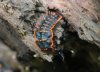
The walk down the Liwagu Trail also went well. As is well known God has an inordinate fondness for beetles, but he excelled himself with the trilobite larva, a creature so extraordinary that it was given a common name which is preposterously opposite to what it actually is and yet describes it so perfectly that you could probably imagine its general appearance just from the name. There are quite a number of species of this type of beetle around the southeast Asian highlands – I have also seen them in Sumatra and Peninsular Malaysia – but the Mt. Kinabalu one is probably best-known and also one of the most colourful. Interestingly they aren't shy at all, often being seen just wandering about on the ground in the middle of the day. I guess they must taste bad (and as I discovered in Sumatra they are bioluminescent, so they probably taste really bad). Trilobite larvae are sort of a random find when you're on the mountain, and I just came across one this visit (I saw at least five or six last time).
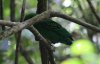
Short-tailed green magpies made their presence known initially by their raucous yet musical caroling. They are beautiful birds, bright green with red wings and a black mask, like a more-fashionable Zorro. A funny thing with green magpies is that in captivity the feathers tend to turn a powder-blue due to a lack of the right ingredients in their diet. Here I saw one which was blue! Not the blue of a captive bird, but a sort of greenish-blue, really distinct from the bright green of the other birds. Even better was to come, right near the end of the Liwagu Trail, almost back at the HQ. I had stopped to watch a bird-wave, mostly chestnut-hooded laughing thrushes but also some Sunda laughing thrushes, when another biggish bird came flying in and landed. Binoculars on it -- Whitehead's broadbill!! I was totally blown away to see this bird because I simply never expected to. It is one of the harder species to find on the mountain, and it was larger than I had thought it would be (I had been expecting it to be the size of the lesser green broadbill). I had been told that there had been a pair nesting recently right over one of the trails but they had been hounded so relentlessly by photographers that they abandoned their nest. Having seen the behaviour of photographers at Kaeng Krachan I can picture the scene exactly. I followed the wave along the trail for a while -- I even ignored a (probably smooth-tailed) tree-shrew in favour of the broadbill, if you can believe that! The broadbill was very active and perched regularly where I could see it well, but all the photos I tried to get were obscured by branches and leaves. I got one which I will try to upload (if my laptop lets me) where the head is half behind a branch but its the best I got.
I managed to meet up with Mike and his wife that evening and we tried some spot-lighting without much success. The bin at Timpohon Gate was full -- completely full so all that could be seen were the topmost rubbish bags -- and there were no rats visible. I stayed out later than they did but all I saw was a pair of small-toothed palm civets. One of them was calling, sounding like someone blowing on a tin whistle. Really weird noise and not at all what I would have thought a civet would sound like.
The third day was another good bird day. Mike and I met at the HQ at 6am; because he was going to Sepilok that day he only had until 9am. We started up the Liwagu Trail to see if we could run into the broadbill from yesterday. No luck there, but we did totally unexpectedly find a very obliging Everett's thrush! This is another endemic which not everyone manages to find on the mountain (and when they do it is usually high up, not at the lower end of the trails!). It hopped across the trail into the undergrowth but then just sat in plain view on a log preening for ages, before hopping back onto the trail, pausing, then dashing off to the other side. It was pretty quiet from then until when Mike had to leave, so I hope he saw something on the way back. Everett's thrush is probably a good consolation though if he didn't! Further on I found a small flock of grey-chinned minivets, black-capped white-eyes and some other usual stuff. Then a small round bird with a short cocked tail hopped across the trail and stopped on top of one of the water pipes. My first thought was "what the heck is that thing?", followed by "no, seriously, what the heck is that thing?!" It was entirely reddish in colour apart for the wings which were slate-grey. It looked like something which should be following an army ant trail in South America, not sitting on a trail on Mt. Kinabalu. I still have no idea what it was. What I wrote in my notebook was "some weird babblery thing - small round ball, cocked tail, slate back, reddish head and underparts - on ground". Down at the HQ later I had a look in the Borneo field guide in the giftshop and the only thing which comes even close is orange-headed thrush, but I have seen those before (even just recently at the Penang Bird Park) and the only way it would work is if it was a young one so smaller than an adult, had lost half its tail, decided to carry said shortened tail in a permanently popped-up fashion, and had further decided to not act or move like a thrush at all.
At the top of the trail I paid a visit to the viewing deck where there were five black-banded squirrels and also a Sunda bush-warbler (of the spot-breasted form), then went down the Bukit Ular Trail where there was a Bornean whistling thrush and nothing else! On the Silau-Silau Trail I found more green magpies, more Bornean laughing thrushes, and some greater racquet-tailed drongos lacking their racquets. There was no spot-lighting that night because the wind had got too strong. Rainforest trees are only shallow-rooted so being in a forest in high winds is not a good idea! Also it rained for the first and only time (last time I was at Mt. Kinabalu there was a lot of rain -- this visit there were hardly even any clouds a lot of the time).
My fourth and last day at Mt. Kinabalu was more like a repeat of the first day -- no birds!! I went up the Liwagu Trail as usual, and did see a pair of mountain wren-babblers and a golden-naped (Kinabalu) barbet really well, but otherwise there wasn't much. I spent a while "rock-pooling" in the river. There's lots of life in there, including two or three species of hillstream loaches, several (?) species of tadpoles, freshwater crabs, and larvae of caddis-flies, stoneflies, damselflies and others. Lots of fun. Going down the Bukit Ular Trail I found nothing, then down the Mempening Trail with much the same. At night I went up the road to the bin where there was nothing, down the Bukit Ular Trail, then down the road to the HQ. I had been going to do the Mempening or Silau-Silau Trail as well, but the Bukit Ular Trail was slow-going and those trails would have taken even longer. There's an extremely venomous snake up here called the Kinabalu pit-viper which lives on the ground and is active at night. It likes to sit in the leaves on the trails and wait for prey -- and apparently it can be quite aggressive if disturbed. So I was moving five or ten steps watching the ground with the torch, then stopping to scan the trees, move another five or ten steps, then scan. I didn't see any pit-vipers, but better safe than sorry! The trail is only a kilometre long but it took an hour.
The only animal I saw all night was one I couldn't identify. It was just downhill from where the big bin is, but it was at the top of a bank in amongst the trees and all I could see was the eyeshine. It had forward-facing eyes with greeny-bluey eye-shine, and it was making a really weird noise like a double gurgly hiccup. If I was to write the noise down it would be something like "glug glug". It wasn't a civet (red eye-shine), it wasn't the domestic cat (wrong noise), and it wasn't a giant flying squirrel (red eye-shine). The only other animal I can think of is a ferret-badger. I never saw it so it probably was a ferret-badger! I spent half an hour trying to see it but still only got the eyes apart for a vague outline when it turned its head from time to time. I couldn't get closer due to its position, and it never moved from the spot. After I came out from the Bukit Ular Trail I went back up the road (the trail comes out about 1.5km below Timpohon Gate) to see if the animal had moved but it was still in the same place; I couldn't even get eye-shine this time, but it started making its "glug glug" noise when the light moved over the area.
The next morning I took a bus to Sepilok where I am staying at the Sepilok B&B, five minutes down the road from the Rainforest Discovery Centre.
I arrived in Kota Kinabalu (the capital city of Sabah) at around 7.30pm, got the airport bus into town for five Ringgitts, and went to Lucy's Homestay where the dorms are 28 Ringgitts. In Kota Kinabalu it is difficult finding anywhere cheaper than that because of all the tourists coming through. Lucy remembered me from my last stay, in 2009 (or to be more precise, she remembered my hair!). The next morning I caught a mini-van to Mt. Kinabalu for 20 Ringgitts. Mt. Kinabalu is only about two hours from KK and it is a standard fixture in the tourist route of Sabah. (Last time I was in Sabah I wrote that it took three hours between KK and Mt. Kinabalu; I'm not sure why that would have been because the vans and the road are exactly the same now as then. Suffice to say this time I left KK at 8.30am and got to the mountain at 10.30). Few people stay more than one or two nights though because they are just there to climb the mountain and then move on to the next place to stay one or two nights at. There is accommodation inside the park but it is ridiculously expensive. Last time I was here I stayed at the Bayu Homestay (aka Bayu Lodge) which had 20 Ringgitt dorm beds and was about five minutes walk before the park gate (when coming from KK). That place is now closed, as I discovered after getting out of the van. I walked up to the park where I found that a new budget place called Tabuhan Lodge has opened up, literally directly across the road from the gate. They were full however, so I continued walking and found the Mountain Resthouse, just 200 metres further along. The dorms here were 35 Ringgitts but there are only three beds in each dorm and if you are alone you just get the whole room for yourself which is alright (if you are two or three people the dorms are 25 per person). The place is seriously run-down, most of the buildings are on a decided lean as they threaten to slide down the hill, and I slept with the lights on each night to stop the cockroaches eating my face, but the woman running it is friendly, there is free WIFI, and if you don't mind basic accommodation then it is handy for the park (you know, if the new Tabuhan Lodge opposite the gate is full when you arrive!). Like the Bayu Homestay was, the Mountain Resthouse is a dream for entomologists: there are uncountable numbers of moths of all sizes and shapes and colours attracted by the lights at night; I even found a big mantis in one of the bathrooms.
After arriving, checking in and getting something to eat, I headed into the park. The entry fee is 15 Ringgitts and although it states on the ticket it is a one-day ticket I was told it is valid for two days (unless staying inside the park in which case it is three days); in 2009 I was told one, two, three and five days -- in Malaysia things are just made up as they go along! In the event I only paid once over the four days I was there because each time I went in past the checkpoint I just held up my ticket to the guard as I walked past and he would wave me through. There are lots of trails through the forest on the mountain but you don't often meet anyone else on them unless they are also birders. Most people who come to Mt. Kinabalu are just there to climb it. They get driven up the 4.5km paved road which runs from the HQ to Timpohon Gate, hike up the seemingly never-ending steps to the summit and back over one or two days, and then get driven down to the HQ again. Some people do stay an extra day to walk some of the trails but it isn't very common.
The best trail for birds is the Liwagu Trail which runs along the Liwagu River valley from the HQ all the way up to Timpohon Gate. It is about 5.6km long and takes me around four to five hours (one does not walk quickly when birding). I did the Liwagu Trail every day, usually going upwards because coming down it is not as easy on the steeper sections. Most of the trails connect with the main paved road, so after reaching the top of the Liwagu Trail you can either just walk down the whole road to HQ or go into any of the other trails along the way. The Bukit Ular Trail is another of the better trails and that starts maybe twenty or thirty metres up the road from the Liwagu Trail's end.
Mt. Kinabalu is one of those places where bird waves are quite common, but in between the bird-waves there is almost nothing! You can be walking for ages seeing no more than one or two individual birds, and then suddenly there will be a great screeching flock of all sorts of different species hurtling past -- you try to quickly ID as many as possible, and then they're gone. On my first day I went up the Liwagu Trail and then down the paved road to the HQ. I had no bird-waves and saw exactly four species (chestnut-crowned erpornis, white-bellied erpornis, snowy-browed flycatcher and grey-throated babbler). Shameful. I met a New Zealander on the trail, which is a noteworthy event in itself because it is almost as rare to find a New Zealander in southeast Asia as it is to find a pangolin! He was wondering why it was so bird-less and when I explained about bird-waves he was very excited. I saw him later that day (he was staying at the same place as me) and he said he had found a bird-wave after meeting me and it made an immense difference to the experience by not only knowing why the birds were all together like that but also in explaining why he wasn't seeing much at the other times.
The mammals were just as absent as the birds that day. The only one I saw was a Bornean black-banded squirrel who lives up on the deck at Timpohon Gate, probably surviving mainly on a diet of biscuits. I thought this was probably the same squirrel as I saw here in 2009, but a couple of days later I saw five black-banded squirrels on the deck all at once. Interestingly enough, Timpohon Gate is quite a bit above the altitude range of black-banded squirrels as given in the field guide to Borneo's mammals.
Not all was lost for mammals though, because in the evening I returned to the park for some spot-lighting. I had been going to walk up the Liwagu Trail in the dark and then down the road, which would have been about six or seven hours in total, but I spent too long talking to a couple of guys at the hostel who wanted information on where to see animals in Borneo, and so started much later than I intended. And I never did do the Liwagu Trail at night because a tree came down across it that first night. During the day I didn't mind crawling through the canopy of the downed tree to get past, but I didn't fancy doing that at night by torch-light with the number of venomous snakes on the mountain! Anyway, right up the top of the road near Timpohon Gate is a big rubbish bin and at night this attracts scavenging animals including, apparently, ferret-badgers (seen there by animal-watcher Vladimir Dinets). It only takes an hour to walk straight up from the HQ to the top of the road (because at night you're not stopping for birds all along the way) and it isn't as steep as I had anticipated. I saw zero animals along the way, except for some moths and a few unidentifiable bats, but at the rubbish bin I found a hungry opportunist. The bin is pretty big (more of a dumpster really), with sides about five foot high. I shone my torch down inside and sitting on the rubbish bags was a rat. A giant rat. If there's one thing I like, it is a giant rat. This one was of a species called the long-tailed giant rat, and neither of those descriptives is inaccurate. It is very big and the tail is very long, easily twice the body length. It is also a most attractive rat, being a bright reddish colour streaked through with black, with a white belly, white gloves and grey leggings. It sat there for a while, whiffling its nose at the light but not really sure what to do, then casually disappeared in amongst the bags.
There a couple of small bins further up nearer the gate so I started to head that way, but got stopped in my tracks by a low-slung animal with a shortish thick tail scooting across the road just round the bend from the big bin. My brain automatically went "ferret-badger!". I could see that the animal hadn't gone under the road barrier and down the bank, so it must still be on the roadside. I sidled around the bend and sure enough there was a pair of eyes glowing back at me in the torch-light. I could tell immediately from the way it was sitting that it wasn't a ferret-badger, but rather some sort of small cat. The thing with eye-shine is that it is often so bright that it obscures the animal behind it until you get closer. I could see some markings on the face and throat so had a fair idea of which species of small cat it was, but I needed to confirm it. I edged across to the other side of the road to try and get a side-view of the animal, hoping it wouldn't dash off. It just sat there watching me. Once in a better position I could give a 100% accurate assessment of the species. Domestic tabby cat! I guess it lives in the power station up there. There was nothing higher up the road, and back at the dumpster the cat was inside and the rat was not. I suspect that rat would have been more than a match for that cat though if it had tried anything! However, there was more to come lower down the road on the way back down. A bat flew past and instead of vanishing into the night, it landed on a tree trunk and hung there swivelling its head about. No idea which species it was, other than a black-coloured horseshoe bat. A bit further on I picked up some eye-shine in the top of a tree, and then another pair of eyes, and another, and another! There was a whole group of small-toothed palm civets running about in the canopy! I didn't even know they were found on the mountain! I guess it was a family group, and they were feeding on either fruit or flowers. I stayed there watching them for about half an hour. Even further down the road I saw another small-toothed palm civet running along the power line above the road. They must be really common up here!
My second day on the mountain went much better than the first. Some of you may recall that back at the start of the trip, in August, I had met up with a fellow birder called Mike at the Hong Kong airport. Well, Mike was coincidentally in Sabah at the same time as me. In fact he flew into KK on the same day and came up to Mt. Kinabalu on the same day. However it turned out he didn't have any internet connection at the place he was staying so our attempts to connect were hindered somewhat. We were going to meet this morning for some birding but it didn't really work out because we didn't know where each other was. Instead I went up the Silau-Silau Trail, starting at about 6am, then up the Bukit Ular Trail, and then down the Liwagu Trail (where I discovered that tree which had fallen down in the night -- I reported it at the Visitor Centre so it could be cleared but it remained across the trail for the rest of my stay). The Silau-Silau Trail wasn't too birdy to be honest, although I saw the first chestnut-hooded laughing thrushes and Bornean whistlers of this trip, as well as an unacceptable fly-by of a Bornean montane forktail. In 2009 these were seen commonly but this time I saw one flash past, heard another, and only saw one more which I could count (and they were probably all the same individual bird). There were other birds which should have been common too which I didn't see anywhere, like the eye-browed flycatchers, and I only saw grey-chinned minivets once and indigo flycatchers twice. Mt. Kinabalu is odd like that -- a bird as common as dirt on one visit can be entirely absent on another. You really need to spend as long as possible on the mountain to keep winkling out a few more birds each day. The Bukit Ular Trail was better. Apart for twice getting too-short glimpses of what must have been a crimson-headed partridge, I saw a great bird-wave which included my first Bornean (bald-headed) laughing thrushes ever, and the first tickable views this visit of Bornean treepies. Up at the Timpohon Gate viewing deck, while I was watching the black-banded squirrel, a mountain black-eye (a type of white-eye but with black eye-rings instead of white) came hopping up along the railing. To go all the way to the summit you need an expensive guide, but you can go to Layang-Layang, halfway up, by yourself. There are various animals best seen between the Timpohon Gate and Layang-Layang but I'd seen most of them already (the only real exceptions being the friendly bush-warbler and the Bornean swiftlet) so I wasn't going to go that high this visit. Among the animals usually seen higher is the mountain black-eye. Another one is Jentink's squirrel, a little wee thing the size of a rat, and I unexpectedly saw one of those on the Bukit Ular Trail. And down below the viewing deck I saw two more higher species, the mountain ground squirrel and the mountain tree-shrew. So pretty good going.
The walk down the Liwagu Trail also went well. As is well known God has an inordinate fondness for beetles, but he excelled himself with the trilobite larva, a creature so extraordinary that it was given a common name which is preposterously opposite to what it actually is and yet describes it so perfectly that you could probably imagine its general appearance just from the name. There are quite a number of species of this type of beetle around the southeast Asian highlands – I have also seen them in Sumatra and Peninsular Malaysia – but the Mt. Kinabalu one is probably best-known and also one of the most colourful. Interestingly they aren't shy at all, often being seen just wandering about on the ground in the middle of the day. I guess they must taste bad (and as I discovered in Sumatra they are bioluminescent, so they probably taste really bad). Trilobite larvae are sort of a random find when you're on the mountain, and I just came across one this visit (I saw at least five or six last time).
Short-tailed green magpies made their presence known initially by their raucous yet musical caroling. They are beautiful birds, bright green with red wings and a black mask, like a more-fashionable Zorro. A funny thing with green magpies is that in captivity the feathers tend to turn a powder-blue due to a lack of the right ingredients in their diet. Here I saw one which was blue! Not the blue of a captive bird, but a sort of greenish-blue, really distinct from the bright green of the other birds. Even better was to come, right near the end of the Liwagu Trail, almost back at the HQ. I had stopped to watch a bird-wave, mostly chestnut-hooded laughing thrushes but also some Sunda laughing thrushes, when another biggish bird came flying in and landed. Binoculars on it -- Whitehead's broadbill!! I was totally blown away to see this bird because I simply never expected to. It is one of the harder species to find on the mountain, and it was larger than I had thought it would be (I had been expecting it to be the size of the lesser green broadbill). I had been told that there had been a pair nesting recently right over one of the trails but they had been hounded so relentlessly by photographers that they abandoned their nest. Having seen the behaviour of photographers at Kaeng Krachan I can picture the scene exactly. I followed the wave along the trail for a while -- I even ignored a (probably smooth-tailed) tree-shrew in favour of the broadbill, if you can believe that! The broadbill was very active and perched regularly where I could see it well, but all the photos I tried to get were obscured by branches and leaves. I got one which I will try to upload (if my laptop lets me) where the head is half behind a branch but its the best I got.
I managed to meet up with Mike and his wife that evening and we tried some spot-lighting without much success. The bin at Timpohon Gate was full -- completely full so all that could be seen were the topmost rubbish bags -- and there were no rats visible. I stayed out later than they did but all I saw was a pair of small-toothed palm civets. One of them was calling, sounding like someone blowing on a tin whistle. Really weird noise and not at all what I would have thought a civet would sound like.
The third day was another good bird day. Mike and I met at the HQ at 6am; because he was going to Sepilok that day he only had until 9am. We started up the Liwagu Trail to see if we could run into the broadbill from yesterday. No luck there, but we did totally unexpectedly find a very obliging Everett's thrush! This is another endemic which not everyone manages to find on the mountain (and when they do it is usually high up, not at the lower end of the trails!). It hopped across the trail into the undergrowth but then just sat in plain view on a log preening for ages, before hopping back onto the trail, pausing, then dashing off to the other side. It was pretty quiet from then until when Mike had to leave, so I hope he saw something on the way back. Everett's thrush is probably a good consolation though if he didn't! Further on I found a small flock of grey-chinned minivets, black-capped white-eyes and some other usual stuff. Then a small round bird with a short cocked tail hopped across the trail and stopped on top of one of the water pipes. My first thought was "what the heck is that thing?", followed by "no, seriously, what the heck is that thing?!" It was entirely reddish in colour apart for the wings which were slate-grey. It looked like something which should be following an army ant trail in South America, not sitting on a trail on Mt. Kinabalu. I still have no idea what it was. What I wrote in my notebook was "some weird babblery thing - small round ball, cocked tail, slate back, reddish head and underparts - on ground". Down at the HQ later I had a look in the Borneo field guide in the giftshop and the only thing which comes even close is orange-headed thrush, but I have seen those before (even just recently at the Penang Bird Park) and the only way it would work is if it was a young one so smaller than an adult, had lost half its tail, decided to carry said shortened tail in a permanently popped-up fashion, and had further decided to not act or move like a thrush at all.
At the top of the trail I paid a visit to the viewing deck where there were five black-banded squirrels and also a Sunda bush-warbler (of the spot-breasted form), then went down the Bukit Ular Trail where there was a Bornean whistling thrush and nothing else! On the Silau-Silau Trail I found more green magpies, more Bornean laughing thrushes, and some greater racquet-tailed drongos lacking their racquets. There was no spot-lighting that night because the wind had got too strong. Rainforest trees are only shallow-rooted so being in a forest in high winds is not a good idea! Also it rained for the first and only time (last time I was at Mt. Kinabalu there was a lot of rain -- this visit there were hardly even any clouds a lot of the time).
My fourth and last day at Mt. Kinabalu was more like a repeat of the first day -- no birds!! I went up the Liwagu Trail as usual, and did see a pair of mountain wren-babblers and a golden-naped (Kinabalu) barbet really well, but otherwise there wasn't much. I spent a while "rock-pooling" in the river. There's lots of life in there, including two or three species of hillstream loaches, several (?) species of tadpoles, freshwater crabs, and larvae of caddis-flies, stoneflies, damselflies and others. Lots of fun. Going down the Bukit Ular Trail I found nothing, then down the Mempening Trail with much the same. At night I went up the road to the bin where there was nothing, down the Bukit Ular Trail, then down the road to the HQ. I had been going to do the Mempening or Silau-Silau Trail as well, but the Bukit Ular Trail was slow-going and those trails would have taken even longer. There's an extremely venomous snake up here called the Kinabalu pit-viper which lives on the ground and is active at night. It likes to sit in the leaves on the trails and wait for prey -- and apparently it can be quite aggressive if disturbed. So I was moving five or ten steps watching the ground with the torch, then stopping to scan the trees, move another five or ten steps, then scan. I didn't see any pit-vipers, but better safe than sorry! The trail is only a kilometre long but it took an hour.
The only animal I saw all night was one I couldn't identify. It was just downhill from where the big bin is, but it was at the top of a bank in amongst the trees and all I could see was the eyeshine. It had forward-facing eyes with greeny-bluey eye-shine, and it was making a really weird noise like a double gurgly hiccup. If I was to write the noise down it would be something like "glug glug". It wasn't a civet (red eye-shine), it wasn't the domestic cat (wrong noise), and it wasn't a giant flying squirrel (red eye-shine). The only other animal I can think of is a ferret-badger. I never saw it so it probably was a ferret-badger! I spent half an hour trying to see it but still only got the eyes apart for a vague outline when it turned its head from time to time. I couldn't get closer due to its position, and it never moved from the spot. After I came out from the Bukit Ular Trail I went back up the road (the trail comes out about 1.5km below Timpohon Gate) to see if the animal had moved but it was still in the same place; I couldn't even get eye-shine this time, but it started making its "glug glug" noise when the light moved over the area.
The next morning I took a bus to Sepilok where I am staying at the Sepilok B&B, five minutes down the road from the Rainforest Discovery Centre.
photos:
Bad (and yet best) photo of a Whitehead's broadbill, because DDCorvus will probably like it, because vogelcommando has probably kept it, and because FBBird is probably sick of pheasants by now
Trilobite larva
A sign I found today at the Rainforest Discovery Centre by Sepilok....
Bad (and yet best) photo of a Whitehead's broadbill, because DDCorvus will probably like it, because vogelcommando has probably kept it, and because FBBird is probably sick of pheasants by now
Trilobite larva
A sign I found today at the Rainforest Discovery Centre by Sepilok....
Attachments

photos:
Bad (and yet best) photo of a Whitehead's broadbill, because DDCorvus will probably like it, because vogelcommando has probably kept it, and because FBBird is probably sick of pheasants by now
Trilobite larva
A sign I found today at the Rainforest Discovery Centre by Sepilok....
Well, I welcome that broadbill photograph too.
As for tarsier visibility ..., sadly one is not allowed to visit Sepilok after dark!
he said he had found a bird-wave after meeting me and it made an immense difference to the experience by not only knowing why the birds were all together like that but also in explaining why he wasn't seeing much at the other time.
/i] .
Not being a birder, could you explain why the birds are all together?
Nice to travel with you!
oh, sorry. A bird-wave is where a whole bunch of birds get together and move together as a feeding flock (a wave of birds, if you will). Basically because there are so many birds all together they scare up a whole lot more insects and so the feeding opportunities are better than if searching alone. Probably it helps also in that there are several species of birds in the flock which feed on different sizes or types of insects.Not being a birder, could you explain why the birds are all together?
Nice to travel with you!
Generally the bird-wave is composed of either larger birds or smaller birds, but sometimes you get mixed-size flocks. Often squirrels and tree-shrews join in as well. Some species are habitual bird-wavers -- any time I see a lesser racquet-tailed drongo anywhere there is usually a bird-wave coming through.
there are only two entry periods per day for the orangutan sanctuary at Sepilok (at the feeding times) but they also -- or at least used to -- do night walks as well.As for tarsier visibility ..., sadly one is not allowed to visit Sepilok after dark!
At the Rainforest Discovery Centre down the road from the orang sanctuary there are not really any restrictions on being in there during the night. That's why I don't bother with the orang sanctuary.
and this has now been identified for me as a female white-browed shortwing, as seen (for example) in photos here: Frogmouth: October 2010Chlidonias said:Then a small round bird with a short cocked tail hopped across the trail and stopped on top of one of the water pipes. My first thought was "what the heck is that thing?", followed by "no, seriously, what the heck is that thing?!" It was entirely reddish in colour apart for the wings which were slate-grey. It looked like something which should be following an army ant trail in South America, not sitting on a trail on Mt. Kinabalu. I still have no idea what it was. What I wrote in my notebook was "some weird babblery thing - small round ball, cocked tail, slate back, reddish head and underparts - on ground". Down at the HQ later I had a look in the Borneo field guide in the giftshop and the only thing which comes even close is orange-headed thrush, but I have seen those before (even just recently at the Penang Bird Park) and the only way it would work is if it was a young one so smaller than an adult, had lost half its tail, decided to carry said shortened tail in a permanently popped-up fashion, and had further decided to not act or move like a thrush at all.


Where are you headed to after Borneo, and how many body parts do you have left to finance it?
Where are you headed to after Borneo, and how many body parts do you have left to finance it?
Based on TLD's guess on how he's making money, he's really only selling one

~Thylo
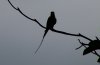
this photo probably isn't quite as amazing as you had in mind, but they would insist on perching against the sky! I just took it about two hours ago, and at least it shows the "longicauda" well!.....cool you ended up in Borneo. Any pictures of Psittacula longicauda or blue-rumpets would be amazing.
Attachments
All the major sites in Sabah are connected by an excellent bus network. In 2009 I went Kota Kinabalu to Mt. Kinabalu to Lahad Datu (for Danum Valley) to the Kinabatangan to Sepilok to Poring to Mt. Kinabalu again and back to Kota Kinabalu (and fitted the Crocker Range in there as well somehow, I think just as a round-trip to and from KK). This visit I am just doing Mt. Kinabalu and Sepilok due to only being here ten days and not liking to rush about like a headless megapode. But still I would only be at Sepilok for three nights. From Mt. Kinabalu I caught a passing bus from the side of the road outside the Mountain Resthouse, in the company of two English guys who were also going to Sepilok. The bus cost 40 Ringgitts (it varies according to which bus you catch) and took four hours to reach the turn-off to Sepilok (an hour before the town of Sandakan), from where we took the remaining couple of kilometres by taxi for five Ringgitts each.
Most tourists visiting the orangutan sanctuary at Sepilok just stay in Sandakan and make a day-trip, but there is lots of accommodation around the Sepilok area. No need to book ahead because I doubt anywhere is ever full. I was staying in a three-bed 33 Ringgitt dorm (of which I was the sole occupant) at the Sepilok B&B which is where I stayed in 2009. It is about twenty minutes walk away from the orangutan sanctuary but only 400 metres from the Rainforest Discovery Centre, so much better sited for me. The orangutan sanctuary (where people go to see “wild orangutans” on their holiday to Borneo) is open just twice a day, between 9am and noon and then between 2pm and 4pm, which is when the free-ranging ex-pet orangutans are fed. The cost of entry is 40 Ringgitts. In contrast the Rainforest Discovery Centre (henceforth abbreviated to RDC) costs 15 Ringgitts and while officially open between 8am and 5pm can in practice be visited at literally any time – there are no gates and you simply pay on the way out if you entered before opening time. There are lots of trails at the RDC, ranging from paved roads through gravel paths to rough leaf-covered tracks, and in addition there is a fabulous Canopy Walkway ten metres off the ground with viewing towers over 26 metres tall.
It is extremely hot in lowland Borneo. I had forgotten quite how hot it is. At Mt. Kinabalu the temperature is perfect, you can walk all day without breaking a sweat and one small bottle of water will last the day. Getting off the bus at the Sepilok junction was like stepping into a furnace. The sun felt like it would be hot enough to not only fry an egg on a bald man's head but also give the bald man skin cancer in the frying time. Thus birding is mainly restricted to early morning and late afternoon. You can keep birding all day if you want but it is a lot of lost sweat for just a couple of birds. What I found was that by even 9am the birds have mostly disappeared out of the heat. Unfortunately the food times at the Sepilok B&B do not match well with birding like this. They have a free breakfast which is an actual buffet breakfast, not the white bread and coffee of most places, but it is only available from seven until nine. The first morning I went out at six and came back at seven (that's why the closeness of the RDC is so handy!), then back out for the rest of the morning. The next morning I went out until 8.30 and came back for a later breakfast because that worked better. Lunch is fine because I wasn't doing anything anyway. Dinner was annoying. The kitchen at the B&B didn't open until 6pm and closed at 9pm – and I was in the RDC at those times spotlighting! There is a very good cafe at the RDC but it closes randomly between 3pm and 5pm depending on their whims. For the first night I got some boiled eggs at the cafe before it closed at 4pm, the second night I headed back to the B&B at 8.30pm, and the third night I took the “go out late” option and had dinner at 6pm then went to the RDC afterwards. You have to have some flexibility if you want to both eat and bird/mammal-watch at the RDC.
On my first afternoon I didn't really see very much. There is a lot of bird activity in the morning but not much in the late afternoon (more than in the middle of the day, but still not a lot). Best animal of the afternoon was in fact an ant-mimic spider scurrying about on the railing of the Canopy Walkway. I can't recall ever seeing one in real life before, and they are neat little things. The body is the exact shape of an ant's body, and to complete the illusion they run on six legs and hold the front pair of legs straight out in front to look like antennae. I couldn't get any photos unfortunately because, as mentioned in earlier posts, my little camera refuses to take photos now and my proper camera has a lens which can't focus on tiny invertebrates. There are lots of swiftlets over the forest, most of which I think are black-nest and edible-nest swiftlets (I haven't got either on the list though due to ID difficulties!); also glossy swiftlets, silver-rumped spinetails and I saw one whiskered tree-swift. There was a pair of Wallace's hawk-eagles nesting in the really big tree next to Trogon Tower on the Canopy Walkway. This was the tree the red giant flying squirrels used to live in...er, I think not any longer but more on them later. I also came across more filthy photographers. I am really starting to dislike these guys. I don't mean birders who take photos of birds, or even pure photographers who show some craft and respect for their subjects. No, I mean the scum photographers who have no idea of what the word respect means, the sort I met at Kaeng Krachan in Thailand or the ones I heard about at Mt. Kinabalu who forced the broadbills to desert their nest. The sort of people who don't give a damn about the birds' welfare and would rather a bird abandons its chicks to die, just so long as they get a photo. And they always have their cameras on rapid-fire so it sounds like machine-gun fire. Takes me back to my days on foot-patrol in 'Nam, where Sarge got half his face blown off in a fire-fight with Charlie; poor Sarge, he only had one day left to retirement. There were two guys at the RDC after photos of Diard's trogon and they had a tape of the call. I don't use tapes, I prefer to find birds on their terms and if I can't find them then too bad for me. But these guys didn't even know how to use a tape to attract a bird. They had the call on a continuous loop and played it, well, continuously and at such a volume that even I could plainly hear it hundreds of metres away through the forest! Any time I was at the RDC I could hear it playing, non-stop, all the freaking time!! They would just stand on a trail with their cameras set up and play the tape for an hour. Then move to another trail and do the same thing. I wanted to just go and stamp on it. Did I see a Diard's trogon without a tape? Of course I did. Did I get a photo of a Diard's trogon without a tape? Yes I did. Are those two guys going to a special hell when they die where someone is going to be screaming COME HERE COME HERE COME HERE COME HERE COME HERE COME HERE COME HERE COME HERE at their face for all of eternity. Yes they are.
There are lots of squirrels at the RDC. In 2009 I saw six or seven species I think. Some of the best were the giant flying squirrels, of which (in 2009) I saw both the red and the black species. Flying squirrels are nocturnal and the reds used to live in the really big tree I mentioned. If you stood on the walkway by Trogon Tower you could see them gliding out over the forest around dusk. On my first evening this visit I was standing there with a couple of other people, waiting, not sure where the squirrels would come from now, and the two English guys who had come from Mt. Kinabalu on my bus suddenly turned up from the far end of the walkway and said “fancy running into you here.... we just saw a flying squirrel!” Poo. I spent part of the night walking round the trails looking for slow loris and tarsiers but with no success. I had actually fully resigned myself to never seeing a slow loris. I would keep looking any time I was in the right habitats but I knew it would never happen. Although I really do think I am owed a slow loris given the amount of time I've spent out at night looking for them!! I didn't see any other animals that night either. I did hear things crashing about in the undergrowth which sounded reasonably big but I couldn't see anything.
The next morning was much better for birds than the previous afternoon. Also it was good for squirrels, first with a pair of endemic ear-spot squirrels which look very similar to plantain squirrels but are smaller and have a pale spot behind each ear; then a couple of actual plantain squirrels; later at breakfast there was a Prevost's squirrel in the garden of the B&B. Prevost's have a lot of subspecies with different colourations; the ones here are glossy black with a red belly. Along the road between the B&B and the RDC there were flocks of pink-necked green pigeons and glossy starlings, as well as the ubiquitous yellow-vented bulbuls and a brown barbet in a tree-top. The name brown barbet doesn't make it sound very interesting but they are actually very attractive with a beautiful salmony-peach throat. Hawking over the lake just inside the entrance were numerous swifts, swiftlets and Pacific swallows. Up on the Canopy Walkway there wasn't much new but a singing white-crowned shama, endemic to Borneo, was very nice. I returned to the B&B for breakfast, seeing Oriental magpie-robin, dollarbird, chestnut munia, dark-necked tailorbird, slender-billed crow and collared kingfisher along the roadside. After breakfast as I walked back to the RDC I spotted a small flock of Malayan black hornbills. I walked round some of the trails for the rest of the morning trying unsuccessfully to find pittas. There are six species of pittas recorded here and I've only seen two of them before (both at Danum Valley). Further along from the Canopy Walkway is a building called Drongo House, next to a second short canopy walk leading to Broadbill Tower. Inside Drongo House is a big board with a full bird list for the RDC. I had read on the board the previous afternoon that dusky munias could sometimes be seen feeding in the grass outside Drongo House, so this morning I was careful in my approach – and sure enough there was a little flock of five or six dusky munias feeding in the grass outside Drongo House! Above Drongo House was a fruiting tree, out of which flew a flock of small parrots which must have been blue-rumped parrots but they were gone before I could see them properly. A brown barbet remained though so I got to watch that for a while. Quite a few bulbuls about as well, including black-headed, red-eyed, streaked and puff-backed.
In the afternoon I saw nothing. Literally nothing. At dusk I was up on the Canopy Walkway in the spot where the English guys had seen the red giant flying squirrel. Nothing. Sigh. The squirrels come out just on or before dusk so when it got too late for them to be appearing at that spot, I headed along to the regular spot from last time, by Trogon Tower – and there were the flying squirrels, goddammit. They were up at the top of one of the emergent trees, so very high up, but the eye-shine showed up nicely and they were silhouetted against the sky so I could watch them moving around. Then one flew off, followed by the other, so I got to see them gliding as well. For the rest of the night when spot-lighting – Nothing!! Seriously, looking for animals at night at the RDC is even less rewarding than looking for animals during the day!! But, if you don't try then you can't succeed right?
The second morning was yet another slooooow birding event. Lowland rainforest is like that – it can be busy or it can be dead, but you won't know which until you are out looking. I gave the Canopy Walkway a miss to start off with, in preference for trying to find pittas on the trails. I found none, of course, but I did find a few babblers which being ground-dwellers can't usually be seen from the canopy. Chestnut-winged babblers were first, followed by white-chested babblers, and then a fluffy-backed tit-babbler which probably has the best common name of any babbler species. Up on the Canopy Walkway before returning to the B&B I saw a plain pigmy squirrel. I had forgotten how tiny these were! It was only the size of a mouse, but that mouse is Speedy Gonzalez – the pigmy squirrels fairly fly between branches, like they have little rocket-packs in the soles of their feet.
I had to go into Sandakan on this day too, to get a bit more money and also to buy some more socks. I was on my very last pair and the holes were getting a bit too big. There is a shuttle bus which runs between Sepilok and Sandakan four times a day and costs five Ringgitts. One thing I really like about Malaysia is that the music of choice here is always 80s rock. The bus to and from Sandakan was playing the entire collection of The Scorpions, and elsewhere I hear Bon Jovi, Whitesnake, Guns 'n' Roses, Def Leppard. I think that the era you grow up in is the era of music you prefer, hence “today's music sucks, it was much better in my day!” which is quite true. Today's music does suck, and 80s hair bands are the pinnacle of musical achievement.
On my third and final night I went to the RDC after dinner at about 8.30pm, instead of going over in the late afternoon and waiting for nightfall. I headed first for the Kingfisher Trail. There are lots of really excellent bird information signs scattered around the trails, with quality photos for identification (handy for me, with no field guide!), but along the Kingfisher Trail there is also some mammal signage (for tarsier, slow loris, colugo and bearded pig). I thought it would be nice to see a tarsier right next to a tarsier sign. Of course I did not see a tarsier by the tarsier sign; jolly misleading advertising if you ask me! Some way past the tarsier sign, almost up to the slow loris sign in fact, I caught a tiny glimpse of red in a tree. Was that eye-shine? I had a second look, nothing, another sweep of the torch – and a pair of glowing red eyes were staring back at me. I knew exactly what it was as soon as I saw them. Slow loris!! Finally! It's only taken me eight years of searching to find one! And not just any old slow loris but a Bornean slow loris, which ramps up its Awesome Factor significantly. The loris looked at me, climbed down the branch it was on, up another, and disappeared into the leaves. I moved around on the trail trying to relocate it but couldn't. The thing with eye-shine is that the animal obviously needs to be looking at you for you to get the reflection – if it turns away then you see nothing. And between me and the loris was a creek, just too deep to step into and just too wide to jump across, and in any case on the other side was just a thick tangle of jungle. I tried for some time to see it again but it had either departed unseen or had tucked its head into its stomach and gone to sleep. It wasn't exactly my dream sighting – the loris sitting a metre away on a branch blinking in bemusement, so close I could reach out and tickle its fat little belly while it giggled hysterically – but I'll take it! Time for the slow loris victory dance. You can imagine it as Fred Astair or as Joey from Friends, up to you. I broke my porcupine curse on this trip (at Khao Yai in Thailand) and then suddenly ended up seeing lots of porcupines of two different species, so I'm hoping that now the loris curse is broken I will see loads more! Now, where those tarsiers at?
I finished off the Kingfisher Trail, went along the length of the Ridge Trail which meets back at the start of the Kingfisher Trail again so I did that a second time but the loris was still unseeable, then over to the Broadbill Tower walkway, then towards the Canopy Walkway. There was nothing seen up to that point, although I could hear noises in the night all around. Halfway to the Canopy Walkway, a Horsfield's tarsier suddenly came hurtling in from the side, landed with a thump on the ground in the middle of the trail literally a metre in front of my feet, then bounced onto a sapling, richocheted off onto another and disappeared into the undergrowth. As with the slow loris it was impossible to then relocate it due to the thickness of the vegetation, and because tarsiers don't have eye-shine (dirty cheating scoundrels!) I couldn't even get a reflection to tell me where it was. I could hear it though, crashing about between the leaves. They are NOISY! The Sulawesi tarsiers were like silent ninja kangaroos as they bounced through the trees. The Bornean tarsiers are more like Mr. Magoo ninjas. It's as if they just throw themselves into the void yelling “I DON'T KNOW WHERE I'M GOING!” and crash into whatever lies in front, and then repeat, “WHY AM I DOING THIS?!” and crash into another tree. The difference may have been that the Sulawesi tarsiers were jumping around in the branches, whereas the Bornean ones seem to prefer the undergrowth. I had been hearing them all night – and on the other nights –without knowing if it was tarsiers or not, and not being able to see anything, but they must be really really common at the RDC. I saw another briefly when almost back at the entrance but although I spent forty minutes trying to see it and could hear it (or them – I think there were several in there) perfectly well, I never saw it a second time.
The next morning I slept in until 6am and then had to pack my bag because I was leaving back to KK straight after breakfast, so I didn't get a third morning birding. It is six hours by bus to KK (from the junction on the main highway) and the bus ends its trip at KK's northern bus terminal, nine kilometres from the city centre. The taxi drivers (and the bus driver himself) emphatically stated there were no local buses from the terminal to town which made no sense at all. Fortunately there is an information desk at the terminal and they told me where to catch the local bus from (it costs one Ringgitt, and is just out on the main road, past a couple of blocks of shops). I am now back at Lucy's Homestay. Next post will be about parrots.....
Most tourists visiting the orangutan sanctuary at Sepilok just stay in Sandakan and make a day-trip, but there is lots of accommodation around the Sepilok area. No need to book ahead because I doubt anywhere is ever full. I was staying in a three-bed 33 Ringgitt dorm (of which I was the sole occupant) at the Sepilok B&B which is where I stayed in 2009. It is about twenty minutes walk away from the orangutan sanctuary but only 400 metres from the Rainforest Discovery Centre, so much better sited for me. The orangutan sanctuary (where people go to see “wild orangutans” on their holiday to Borneo) is open just twice a day, between 9am and noon and then between 2pm and 4pm, which is when the free-ranging ex-pet orangutans are fed. The cost of entry is 40 Ringgitts. In contrast the Rainforest Discovery Centre (henceforth abbreviated to RDC) costs 15 Ringgitts and while officially open between 8am and 5pm can in practice be visited at literally any time – there are no gates and you simply pay on the way out if you entered before opening time. There are lots of trails at the RDC, ranging from paved roads through gravel paths to rough leaf-covered tracks, and in addition there is a fabulous Canopy Walkway ten metres off the ground with viewing towers over 26 metres tall.
It is extremely hot in lowland Borneo. I had forgotten quite how hot it is. At Mt. Kinabalu the temperature is perfect, you can walk all day without breaking a sweat and one small bottle of water will last the day. Getting off the bus at the Sepilok junction was like stepping into a furnace. The sun felt like it would be hot enough to not only fry an egg on a bald man's head but also give the bald man skin cancer in the frying time. Thus birding is mainly restricted to early morning and late afternoon. You can keep birding all day if you want but it is a lot of lost sweat for just a couple of birds. What I found was that by even 9am the birds have mostly disappeared out of the heat. Unfortunately the food times at the Sepilok B&B do not match well with birding like this. They have a free breakfast which is an actual buffet breakfast, not the white bread and coffee of most places, but it is only available from seven until nine. The first morning I went out at six and came back at seven (that's why the closeness of the RDC is so handy!), then back out for the rest of the morning. The next morning I went out until 8.30 and came back for a later breakfast because that worked better. Lunch is fine because I wasn't doing anything anyway. Dinner was annoying. The kitchen at the B&B didn't open until 6pm and closed at 9pm – and I was in the RDC at those times spotlighting! There is a very good cafe at the RDC but it closes randomly between 3pm and 5pm depending on their whims. For the first night I got some boiled eggs at the cafe before it closed at 4pm, the second night I headed back to the B&B at 8.30pm, and the third night I took the “go out late” option and had dinner at 6pm then went to the RDC afterwards. You have to have some flexibility if you want to both eat and bird/mammal-watch at the RDC.
On my first afternoon I didn't really see very much. There is a lot of bird activity in the morning but not much in the late afternoon (more than in the middle of the day, but still not a lot). Best animal of the afternoon was in fact an ant-mimic spider scurrying about on the railing of the Canopy Walkway. I can't recall ever seeing one in real life before, and they are neat little things. The body is the exact shape of an ant's body, and to complete the illusion they run on six legs and hold the front pair of legs straight out in front to look like antennae. I couldn't get any photos unfortunately because, as mentioned in earlier posts, my little camera refuses to take photos now and my proper camera has a lens which can't focus on tiny invertebrates. There are lots of swiftlets over the forest, most of which I think are black-nest and edible-nest swiftlets (I haven't got either on the list though due to ID difficulties!); also glossy swiftlets, silver-rumped spinetails and I saw one whiskered tree-swift. There was a pair of Wallace's hawk-eagles nesting in the really big tree next to Trogon Tower on the Canopy Walkway. This was the tree the red giant flying squirrels used to live in...er, I think not any longer but more on them later. I also came across more filthy photographers. I am really starting to dislike these guys. I don't mean birders who take photos of birds, or even pure photographers who show some craft and respect for their subjects. No, I mean the scum photographers who have no idea of what the word respect means, the sort I met at Kaeng Krachan in Thailand or the ones I heard about at Mt. Kinabalu who forced the broadbills to desert their nest. The sort of people who don't give a damn about the birds' welfare and would rather a bird abandons its chicks to die, just so long as they get a photo. And they always have their cameras on rapid-fire so it sounds like machine-gun fire. Takes me back to my days on foot-patrol in 'Nam, where Sarge got half his face blown off in a fire-fight with Charlie; poor Sarge, he only had one day left to retirement. There were two guys at the RDC after photos of Diard's trogon and they had a tape of the call. I don't use tapes, I prefer to find birds on their terms and if I can't find them then too bad for me. But these guys didn't even know how to use a tape to attract a bird. They had the call on a continuous loop and played it, well, continuously and at such a volume that even I could plainly hear it hundreds of metres away through the forest! Any time I was at the RDC I could hear it playing, non-stop, all the freaking time!! They would just stand on a trail with their cameras set up and play the tape for an hour. Then move to another trail and do the same thing. I wanted to just go and stamp on it. Did I see a Diard's trogon without a tape? Of course I did. Did I get a photo of a Diard's trogon without a tape? Yes I did. Are those two guys going to a special hell when they die where someone is going to be screaming COME HERE COME HERE COME HERE COME HERE COME HERE COME HERE COME HERE COME HERE at their face for all of eternity. Yes they are.
There are lots of squirrels at the RDC. In 2009 I saw six or seven species I think. Some of the best were the giant flying squirrels, of which (in 2009) I saw both the red and the black species. Flying squirrels are nocturnal and the reds used to live in the really big tree I mentioned. If you stood on the walkway by Trogon Tower you could see them gliding out over the forest around dusk. On my first evening this visit I was standing there with a couple of other people, waiting, not sure where the squirrels would come from now, and the two English guys who had come from Mt. Kinabalu on my bus suddenly turned up from the far end of the walkway and said “fancy running into you here.... we just saw a flying squirrel!” Poo. I spent part of the night walking round the trails looking for slow loris and tarsiers but with no success. I had actually fully resigned myself to never seeing a slow loris. I would keep looking any time I was in the right habitats but I knew it would never happen. Although I really do think I am owed a slow loris given the amount of time I've spent out at night looking for them!! I didn't see any other animals that night either. I did hear things crashing about in the undergrowth which sounded reasonably big but I couldn't see anything.
The next morning was much better for birds than the previous afternoon. Also it was good for squirrels, first with a pair of endemic ear-spot squirrels which look very similar to plantain squirrels but are smaller and have a pale spot behind each ear; then a couple of actual plantain squirrels; later at breakfast there was a Prevost's squirrel in the garden of the B&B. Prevost's have a lot of subspecies with different colourations; the ones here are glossy black with a red belly. Along the road between the B&B and the RDC there were flocks of pink-necked green pigeons and glossy starlings, as well as the ubiquitous yellow-vented bulbuls and a brown barbet in a tree-top. The name brown barbet doesn't make it sound very interesting but they are actually very attractive with a beautiful salmony-peach throat. Hawking over the lake just inside the entrance were numerous swifts, swiftlets and Pacific swallows. Up on the Canopy Walkway there wasn't much new but a singing white-crowned shama, endemic to Borneo, was very nice. I returned to the B&B for breakfast, seeing Oriental magpie-robin, dollarbird, chestnut munia, dark-necked tailorbird, slender-billed crow and collared kingfisher along the roadside. After breakfast as I walked back to the RDC I spotted a small flock of Malayan black hornbills. I walked round some of the trails for the rest of the morning trying unsuccessfully to find pittas. There are six species of pittas recorded here and I've only seen two of them before (both at Danum Valley). Further along from the Canopy Walkway is a building called Drongo House, next to a second short canopy walk leading to Broadbill Tower. Inside Drongo House is a big board with a full bird list for the RDC. I had read on the board the previous afternoon that dusky munias could sometimes be seen feeding in the grass outside Drongo House, so this morning I was careful in my approach – and sure enough there was a little flock of five or six dusky munias feeding in the grass outside Drongo House! Above Drongo House was a fruiting tree, out of which flew a flock of small parrots which must have been blue-rumped parrots but they were gone before I could see them properly. A brown barbet remained though so I got to watch that for a while. Quite a few bulbuls about as well, including black-headed, red-eyed, streaked and puff-backed.
In the afternoon I saw nothing. Literally nothing. At dusk I was up on the Canopy Walkway in the spot where the English guys had seen the red giant flying squirrel. Nothing. Sigh. The squirrels come out just on or before dusk so when it got too late for them to be appearing at that spot, I headed along to the regular spot from last time, by Trogon Tower – and there were the flying squirrels, goddammit. They were up at the top of one of the emergent trees, so very high up, but the eye-shine showed up nicely and they were silhouetted against the sky so I could watch them moving around. Then one flew off, followed by the other, so I got to see them gliding as well. For the rest of the night when spot-lighting – Nothing!! Seriously, looking for animals at night at the RDC is even less rewarding than looking for animals during the day!! But, if you don't try then you can't succeed right?
The second morning was yet another slooooow birding event. Lowland rainforest is like that – it can be busy or it can be dead, but you won't know which until you are out looking. I gave the Canopy Walkway a miss to start off with, in preference for trying to find pittas on the trails. I found none, of course, but I did find a few babblers which being ground-dwellers can't usually be seen from the canopy. Chestnut-winged babblers were first, followed by white-chested babblers, and then a fluffy-backed tit-babbler which probably has the best common name of any babbler species. Up on the Canopy Walkway before returning to the B&B I saw a plain pigmy squirrel. I had forgotten how tiny these were! It was only the size of a mouse, but that mouse is Speedy Gonzalez – the pigmy squirrels fairly fly between branches, like they have little rocket-packs in the soles of their feet.
I had to go into Sandakan on this day too, to get a bit more money and also to buy some more socks. I was on my very last pair and the holes were getting a bit too big. There is a shuttle bus which runs between Sepilok and Sandakan four times a day and costs five Ringgitts. One thing I really like about Malaysia is that the music of choice here is always 80s rock. The bus to and from Sandakan was playing the entire collection of The Scorpions, and elsewhere I hear Bon Jovi, Whitesnake, Guns 'n' Roses, Def Leppard. I think that the era you grow up in is the era of music you prefer, hence “today's music sucks, it was much better in my day!” which is quite true. Today's music does suck, and 80s hair bands are the pinnacle of musical achievement.
On my third and final night I went to the RDC after dinner at about 8.30pm, instead of going over in the late afternoon and waiting for nightfall. I headed first for the Kingfisher Trail. There are lots of really excellent bird information signs scattered around the trails, with quality photos for identification (handy for me, with no field guide!), but along the Kingfisher Trail there is also some mammal signage (for tarsier, slow loris, colugo and bearded pig). I thought it would be nice to see a tarsier right next to a tarsier sign. Of course I did not see a tarsier by the tarsier sign; jolly misleading advertising if you ask me! Some way past the tarsier sign, almost up to the slow loris sign in fact, I caught a tiny glimpse of red in a tree. Was that eye-shine? I had a second look, nothing, another sweep of the torch – and a pair of glowing red eyes were staring back at me. I knew exactly what it was as soon as I saw them. Slow loris!! Finally! It's only taken me eight years of searching to find one! And not just any old slow loris but a Bornean slow loris, which ramps up its Awesome Factor significantly. The loris looked at me, climbed down the branch it was on, up another, and disappeared into the leaves. I moved around on the trail trying to relocate it but couldn't. The thing with eye-shine is that the animal obviously needs to be looking at you for you to get the reflection – if it turns away then you see nothing. And between me and the loris was a creek, just too deep to step into and just too wide to jump across, and in any case on the other side was just a thick tangle of jungle. I tried for some time to see it again but it had either departed unseen or had tucked its head into its stomach and gone to sleep. It wasn't exactly my dream sighting – the loris sitting a metre away on a branch blinking in bemusement, so close I could reach out and tickle its fat little belly while it giggled hysterically – but I'll take it! Time for the slow loris victory dance. You can imagine it as Fred Astair or as Joey from Friends, up to you. I broke my porcupine curse on this trip (at Khao Yai in Thailand) and then suddenly ended up seeing lots of porcupines of two different species, so I'm hoping that now the loris curse is broken I will see loads more! Now, where those tarsiers at?
I finished off the Kingfisher Trail, went along the length of the Ridge Trail which meets back at the start of the Kingfisher Trail again so I did that a second time but the loris was still unseeable, then over to the Broadbill Tower walkway, then towards the Canopy Walkway. There was nothing seen up to that point, although I could hear noises in the night all around. Halfway to the Canopy Walkway, a Horsfield's tarsier suddenly came hurtling in from the side, landed with a thump on the ground in the middle of the trail literally a metre in front of my feet, then bounced onto a sapling, richocheted off onto another and disappeared into the undergrowth. As with the slow loris it was impossible to then relocate it due to the thickness of the vegetation, and because tarsiers don't have eye-shine (dirty cheating scoundrels!) I couldn't even get a reflection to tell me where it was. I could hear it though, crashing about between the leaves. They are NOISY! The Sulawesi tarsiers were like silent ninja kangaroos as they bounced through the trees. The Bornean tarsiers are more like Mr. Magoo ninjas. It's as if they just throw themselves into the void yelling “I DON'T KNOW WHERE I'M GOING!” and crash into whatever lies in front, and then repeat, “WHY AM I DOING THIS?!” and crash into another tree. The difference may have been that the Sulawesi tarsiers were jumping around in the branches, whereas the Bornean ones seem to prefer the undergrowth. I had been hearing them all night – and on the other nights –without knowing if it was tarsiers or not, and not being able to see anything, but they must be really really common at the RDC. I saw another briefly when almost back at the entrance but although I spent forty minutes trying to see it and could hear it (or them – I think there were several in there) perfectly well, I never saw it a second time.
The next morning I slept in until 6am and then had to pack my bag because I was leaving back to KK straight after breakfast, so I didn't get a third morning birding. It is six hours by bus to KK (from the junction on the main highway) and the bus ends its trip at KK's northern bus terminal, nine kilometres from the city centre. The taxi drivers (and the bus driver himself) emphatically stated there were no local buses from the terminal to town which made no sense at all. Fortunately there is an information desk at the terminal and they told me where to catch the local bus from (it costs one Ringgitt, and is just out on the main road, past a couple of blocks of shops). I am now back at Lucy's Homestay. Next post will be about parrots.....
yeah slow loris have been my major nemesis mammal. Everyone else sees them no trouble at all. I never see them. It has been a frustrating several years!!I think I commented before, I'm sure when we were at KoiYai NP. in Thailand, for one or two nights only, we saw Slow Loris on the night drive. I've never looked for them, either before or since, and wasn't then either!
