Chlidonias presents: Bustralia

Adelaide to Alice Springs


Adelaide is my favourite city in Australia, I have discovered. Everyone there is friendly. If I were to move to Australia, Adelaide would be top of my list for where to live.


While in Adelaide I had been staying at a hostel called Tequila Sunrise, in a 22-bed dorm. The beds were pods, with curtains across the front of each one for privacy, so it was better than a regular dorm room. One of the better things about this hostel was that it provides free breakfast and dinner! Most actual hotels don’t do that – I mean, breakfast if you’re lucky. And it was proper breakfast and dinner too. In the morning it was pancakes, cereals, bread, juice, fruit; and dinners were meals of pasta or chicken or whatever. With the bed being about NZ$48 and with two free meals a day I saved a lot of money there.

Nevertheless, after seven nights there I was ready to move! The hostel was really noisy most of the time. One of the things with hostels now is that the people staying in them are rarely backpackers or travellers – they are just foreign workers. They get up early in groups, making heaps of noise, put on their hi-viz vests and all head out (in waves, so group after group through the early morning) and then in the evening they are carousing to all hours. It gets a bit tiresome.


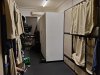
IMG20250912193406.jpg
The dorm room at Tequila Sunrise - my bed is the one at bottom-right.


My next stop after Adelaide was Alice Springs, which was twenty hours away on a Greyhound bus. My bus from Melbourne to Adelaide had been eleven hours which was quite comfortable. That was with Firefly, using a V/Line bus. I wondered how similar or different the Greyhound bus would be.

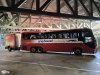
IMG20250917172515.jpg


The bus was leaving at 6pm. The hostel was just one street over from the bus station which was handy. There were only about ten people on board. A few got off en route and a few got on, but it was a pretty empty bus overall.

The passengers were divided between foreign tourists and Aborigine locals, and the first thing I noticed was that the locals were getting on the bus carrying big blankets. I thought it was a little odd, but quickly realised once we got under way that the interior of the bus was freezing. I’m used to this in southeast Asia where they set the air-con to Arctic, and people bring their gloves and scarves to ride the bus, but I hadn’t even thought this would be a thing in Australia. I had a sweatshirt with me but everything else was in my pack in the luggage hold. Even with the sweatshirt I was struggling not to die from hypothermia.

I was also surprised by the night temperatures outside the bus. We had the first break at a truck stop at Port Wakefield at 7.30pm, where Silver Gulls were wandering around in the dark hoping for food, and it was even colder than it had been inside the bus. More shocking than that was the price of Mars Bars in the shop there – AU$5.10!!

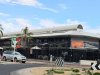
IMG20250917193003.jpg


The temperature at Coober Pedy, at 5.30am, was like being in deep space. When I was but a boy, books often made mention of how in tropical places like rainforests and deserts it drops below freezing at night. I’m not sure how this started because obviously tropical rainforests don’t freeze overnight, but people back then didn’t have the internet so we just believed whatever books told us. Because I know rainforests are the same temperature day and night I didn’t think much about nights in the desert, but it really was unbelievably cold.

There had been very little wildlife seen along this bus ride. Most of the ride had initially been in the dark of course (although a Red Kangaroo had been seen on the road), and I was mostly asleep then, but even in the daylight hours there was almost nothing to be seen. A pair of Wedge-tailed Eagles were seen on a road-killed kangaroo just north of Coober Pedy, but not much else. No camels or kangaroos or bustards or emus.

The first daylight break was half an hour at Cadney Park, at 7.30am. I saw my first Yellow-throated Miners here, as well as a Pied Butcherbird (not my first).

Just before 11am the bus crossed into the Northern Territory, and at 11.45am there was another half-hour break at Erlunda where there were more Yellow-throated Miners and an Australian Raven. There were a surprising number of tourists at this one-building road-stop, although it turned out they were on tour buses rather than having all arrived coincidentally.

What also was very numerous here were the flies. The Outback and flies are synonymous but they don’t want your food, they want your sweat. You could be eating a smelly cheese sandwich or a rotting fish carcasse, and the flies will ignore that and zoom straight at your face. They are like the sweat bees in Asia, if anyone has had to deal with those – they are harmless but particularly like to go for your eyes for the moisture, and they drive you bonkers.

At 2.30pm the bus arrived in Alice Springs, where it was an unexpected 26 degrees. I’m staying at the Diplomat Hotel which is quite a lot more expensive than the Tequila Sunrise, but I was fairly done with dorms for the moment! The whole hotel is surrounded by metal spiked bars to keep out the undesirables. However, despite the town’s online reputation as being dangerous, so far (after two days) the atmosphere is nothing other than “regular country town”.


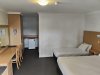
The Diplomat Hotel in Alice Springs:

IMG20250918153304.jpg

IMG20250918143828.jpg
 

Attachments

  • IMG20250912193406.jpg
    IMG20250912193406.jpg
    114.8 KB · Views: 66
  • IMG20250917172515.jpg
    IMG20250917172515.jpg
    163.9 KB · Views: 80
  • IMG20250917193003.jpg
    IMG20250917193003.jpg
    112.2 KB · Views: 72
  • IMG20250918153304.jpg
    IMG20250918153304.jpg
    135.2 KB · Views: 76
  • IMG20250918143828.jpg
    IMG20250918143828.jpg
    65.7 KB · Views: 68
Last edited:
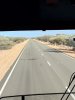
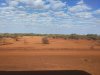
Some scenery from the bus - South Australia:

IMG20250918083446.jpg IMG20250918084107.jpg


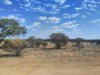
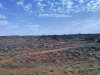
And the Northern Territory:

IMG20250918103932.jpg IMG20250918104926.jpg IMG20250918112457.jpg
 

Attachments

  • IMG20250918083446.jpg
    IMG20250918083446.jpg
    67.2 KB · Views: 64
  • IMG20250918084107.jpg
    IMG20250918084107.jpg
    106.4 KB · Views: 71
  • IMG20250918103932.jpg
    IMG20250918103932.jpg
    148.9 KB · Views: 61
  • IMG20250918104926.jpg
    IMG20250918104926.jpg
    137.8 KB · Views: 68
  • IMG20250918112457.jpg
    IMG20250918112457.jpg
    139.4 KB · Views: 67
Alice Springs and the Reptile Centre


As mentioned in the previous post, I arrived in Alice Springs at 2.30pm after a twenty hour bus ride from Adelaide. After checking into the hotel (and leaving a $200 bond at reception!) I went over to the Information Centre to see what could be done about visiting the local sewage ponds. This isn’t something a regular person does when on holiday, but birders just think differently.

I knew that casual access to the ponds wasn’t allowed, with visitors needing to first complete an online induction and then after being granted a certificate they need to arrange a visit via the Information Centre with an authorised guide. The problem I had encountered was that all the links I could find for the induction were dead, and I couldn’t locate anything on the Power and Water Corporation website. I figured that when I got to Alice I could find out about this because I had several days to play with for the requisite induction formalities.

Find out about it I did – it turns out that visitor access to the ponds has been forbidden all year! The lady I talked to didn’t know the exact reasons, something to do with two government departments at odds with one another, but it meant that I couldn’t get in there after all. This was a real pain because the ponds are the only substantial area of standing water in the area and is home to dozens of species, several of which would have been lifers for me.

The lady did confirm the ponds were visible from the road so at least I might be able to see some birds through the fence, even if the views might not be very good.


Yesterday and today haven’t been the best bird days of the trip. The tally yesterday was just 26 species because I was at Gorge Wildlife Park so most of the birds were wild ones seen around there. And then this day ended up at only eleven birds because I was on the bus most of the day.

I saw Feral Pigeons in the dark at the Coober Pedy roadhouse (at 5.30am before the sun came up), followed by a pair of Wedge-tailed Eagles on a road-killed kangaroo a bit north of there. At the first break-stop of the morning, at Cadney Park at 7.30am, I saw a party of Yellow-throated Miners (lifer), a Pied Butcherbird, an Australian Magpie, and Crested Pigeons. Little Corellas and Galahs were seen from the bus just after Cadney Park. At 11.45am there was another half-hour break at Erlunda (in the Northern Territory) where there was an Australian Raven. The only additional birds seen in Alice Springs itself, after arrival, were Australian Ringnecks and Little Crows (another lifer).

The default corvid in Alice is the Little Crow, but there are also Torresian Crows and Australian Ravens here. The Little Crow is an inland arid-country bird, which is why I haven’t seen it before. They are smaller than the other two species here, although effectively you can only tell this if they are right in front of you: otherwise you really need to hear their calls to tell them apart conclusively. Once I had seen all three (I saw Torresian Crow the next day) I stopped paying attention to them unless they were calling.


full

Little Crow


Other than dropping into the Information Centre my only activity for the day was a visit to the Alice Springs Reptile Centre which is situated in the middle of town (maybe five minutes walk from my hotel) and which costs AU$24 for adults. This is a small facility but packed with species, displayed in three rooms and an outdoors area. There were 41 species on display when I visited (47 species were signed, but six of them were not currently present).

The tanks in the main two rooms are what you might call "normal-sized" - i.e. not very big, as is usually the case with reptile displays, but generally okay - while the tanks in the Gecko Cave are all quite large and, relative to the size of the inhabitants, much better than the other tanks (although, being geckos, they were not all as easy to see). I was particularly taken with the tiny Black-necked Delma, a legless lizard which was too small for me to photograph.

The outside enclosures were all of a reasonable size, as can be seen in some of the photos below.


I have put a species list here: Alice Springs Reptile Centre species list, September 2025 [Alice Springs Reptile Centre]

The photo gallery is here: Alice Springs Reptile Centre - ZooChat


full


full


full


full


full


full


full
 
It looks like your motel in Alice is surrounded by a big protective 'cage' on the lower floors. Any photos of the spiked railings? ;) I don't remember anything like this though our motel on each occassion was slightly more out of town the other side of the creek bed, though still within easy reach for anybody up to no good. We arrived there on the one day a year they hold camel races, it was great to see.
The Beach Stone curlew(Gorge wildlifepark) always looks to me like its big beak is top-heavy and it will topple forwards. Saw them in the wild once but a long distance away.
 
New It looks like your motel in Alice is surrounded by a big protective 'cage' on the lower floors.

Not quite as intimidating as the motels in South Africa with 13 strands of electric fence around the property, 24 hour manned gated entry and CCTV cameras everywhere!
 
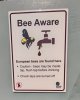
IMG_20250923_093638.jpg

In most countries water comes out of the taps. In Australia it's bees.

"Crikey it's hot today, sure could go for a nice cold glass of bees," is what Australians say, probably.
 

Attachments

  • IMG_20250923_093638.jpg
    IMG_20250923_093638.jpg
    68.2 KB · Views: 54
I've fallen behind on my posts again. I was hoping to post more or less each day as it happened but that didn't work out for Alice Springs. I've just arrived at Pine Creek, where I'll be for the next couple of days, and discovered they don't have Wifi here (at the Lazy Lizard) - I wouldn't have thought I'd ever be in any town in Australia that didn't have Wifi but here we are.

So I'll try to write up the Alice posts (on my laptop) and then they'll be ready to post when I get to my next stop...
 
I've fallen behind on my posts again. I was hoping to post more or less each day as it happened but that didn't work out for Alice Springs. I've just arrived at Pine Creek, where I'll be for the next couple of days, and discovered they don't have Wifi here (at the Lazy Lizard) - I wouldn't have thought I'd ever be in any town in Australia that didn't have Wifi but here we are.

So I'll try to write up the Alice posts (on my laptop) and then they'll be ready to post when I get to my next stop...

You also have not yet provided any original music or songs, as promised in the intro. What format should we look for those in, BTW?
 
Food report!

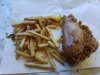
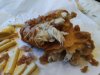
Here's a meal I bought at Alice Fish & Chips. AU$19.90. The fish is barramundi which I don't think I've had before.

The chips were somehow not hot even though they were cooked on the spot and I ate them outside the shop.

The fish itself was good but the batter was like this weird hard shell which sort of shattered. Most of it got left on the paper to be thrown away. In the second photo you can see it's not even attached to the fish. It's like a brandy snap except with fish in it instead of cream. Is this how fish is normally battered in Australia?

Pretty disappointing meal.


IMG20250921140245.jpg IMG20250921140347.jpg
 

Attachments

  • IMG20250921140245.jpg
    IMG20250921140245.jpg
    134 KB · Views: 45
  • IMG20250921140347.jpg
    IMG20250921140347.jpg
    119.5 KB · Views: 47
Food report!

Here's a meal I bought at Alice Fish & Chips. AU$19.90. The fish is barramundi which I don't think I've had before.

The chips were somehow not hot even though they were cooked on the spot and I ate them outside the shop.

The fish itself was good but the batter was like this weird hard shell which sort of shattered. Most of it got left on the paper to be thrown away. In the second photo you can see it's not even attached to the fish. It's like a brandy snap except with fish in it instead of cream. Is this how fish is normally battered in Australia?

Pretty disappointing meal.


View attachment 829264 View attachment 829265

That's the smallest piece of Barra I've ever seen in a meal. And the batter is not normal either.

I regularly eat Barra and chips [every couple of weeks] and I would return that. Even the seagulls would knock that back!

I hope the chips were worth the near 20 bucks you paid for them.
 
Food report!

Here's a meal I bought at Alice Fish & Chips. AU$19.90. The fish is barramundi which I don't think I've had before.

The chips were somehow not hot even though they were cooked on the spot and I ate them outside the shop.

The fish itself was good but the batter was like this weird hard shell which sort of shattered. Most of it got left on the paper to be thrown away. In the second photo you can see it's not even attached to the fish. It's like a brandy snap except with fish in it instead of cream. Is this how fish is normally battered in Australia?

Pretty disappointing meal.


View attachment 829264 View attachment 829265
Are things just a lot pricier in the remote parts of inland Australia given the logistics, even with the road trains? Speaking of which, how many road trains have you seen on this trip so far?
 
Are things just a lot pricier in the remote parts of inland Australia given the logistics, even with the road trains? Speaking of which, how many road trains have you seen on this trip so far?

Yes. It’s a real social inequality issue because there’s remote communities that typically only have one shop, and the price of fresh food in particular is many times what it is in coastal cities.
 
Alice Springs: Olive Pink Botanic Gardens and Telegraph Station


There were a few things I wanted to do in Alice Springs – or rather, there were a few things I was restricted to doing because I would be on foot. There is a local bus system about town but it doesn’t get you very far and I didn’t want to be shelling out for expensive tours.

There are two animal collections (the Reptile Centre which I visited the previous day when I arrived in town, and the Desert Park which I’d be visiting in a few days hence). Then for the wild birds I’d be going to the Olive Pink Botanic Gardens, the various trails around Telegraph Station, the sewage ponds, and then further out I’d be trying to reach Simpson’s Gap west of town.


Today was cooler than yesterday, overcast, and the weather forecast said 50% chance of rain. First on the agenda was the Olive Pink Botanic Gardens, on the other side of the Todd River which cuts through the town. There is a bus which runs past the gardens, but it is only ten minutes walk from the town centre where my hotel was. Being the desert, the Todd River doesn’t have a lot of water in it at the moment. And by “not a lot” I mean “none”. It’s just a ribbon of sand lined with big eucalyptus trees. There are 2m flood markers though, because when it does flow it really flows. I think there’s only one proper high bridge (the one just by the botanic gardens) with the other crossings being either low bridges or just basic crossings, so when the river is running the locals have to make big detours to get from one side to the other.

After crossing the bridge the pedestrian/cycle path loops underneath it and then continues along the east bank past the gardens. Between the bridge and the gardens is a big rocky hill. I stopped to have a scan of this because the main mammal I wanted to see at Alice Springs was the Black-flanked Rock Wallaby (also called the Black-footed Rock Wallaby), and I knew they could be found “easily” at the gardens. In no time at all, I spotted a wallaby, then another, and another. The gardens were on the other side of this hill, and when I got there I found there was a track leading to the top of this hill where it was extremely easy to see the rock wallabies, as well as Euros.

full

Black-flanked Rock Wallabies

full

Euro


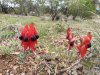
The Olive Pink Botanic Gardens are not as colourful as their name might suggest. I was pleased to see a Sturt Desert Pea in flower, which are indeed colourful, but the gardens are dedicated to the indigenous desert flora and don’t have any of the usual flower beds and greenhouses which you might expect from a botanic gardens. This makes it a natural habitat for the local birds, but I struggled to find much. The grounds are a lot smaller than I thought they would be and I have a feeling some of the species on the eBird list may have been seen elsewhere (there are a suspicious number of waterbirds listed, for example).

Nevertheless, amongst the birds I did see were Rainbow Bee-eaters which are always a joy, Rufous Whistlers, and two lifers – Grey-crowned Babblers and a Western Bowerbird.

full

Rainbow Bee-eater

full

Grey-crowned Babbler

The gardens are actually “famous” as a reliable location for the bowerbird. I was waiting out a rain shower under the overhang of the cafe and a bowerbird flew up and perched on the back of one of the chairs. Having said that, I went through the gardens twice more during my stay, and the only other time I saw a bowerbird there was one flying rapidly away out of the grounds.

full

Western Bowerbird


To the north of town is Telegraph Station which has a number of trails around it, and which is also the location of the “original” Alice Spring. It’s not really a spring at all, just a depression at the side of the river which has a granite base under the sand, so when the river flows or there is heavy rainfall, water collects there because it can’t drain away. Basically the town was built here because the discoverer thought there was a ready supply of spring water when in fact it had recently rained.

It’s about 5km walk to Telegraph Station. There is a wide paved pathway called the Riverside Trail the whole way from town. Telegraph Station itself is not interesting (to me). There is a picnic area, a little cafe and an old homestead, but I saw a Sacred Kingfisher there.

Walking back I took the Bradshaw Walk which is a rough-ish track going through rocky hills and is much more enjoyable than the relatively lifeless Riverside Trail. The birds came in ups and downs as they often do, with stretches of seeing nothing punctuated by suddenly seeing birds in every bush. The most birdy bit was unfortunately right when a sideways downpour began, so I was trying to watch the birds while keeping my binoculars dry and not being able to take any photos.

My attention was first drawn to a male Splendid Fairy-Wren, quite possibly the bluest thing on the planet. The inland subspecies here is sometimes split as the Turquoise Fairy-Wren because of the throat colour.

full

Splendid Fairy-Wren (photo taken on a different day)

There were also White-browed Babblers, an Inland Thornbill and a Western Gerygone buzzing about, and they were all accompanied by a little flock of Zebra Finches, a mainstay of home aviculture. I’ve seen Zebra Finches in the wild in West Timor but never before in Australia, and since then they have been split as two species which I’m kind of ambivalent on but I’ll take it.

The Zebra Finches were thus the third lifer of the day (after the Grey-crowned Babblers and Western Bowerbird at the gardens), and a bit later I came across a fourth with a female Redthroat. This is a bird which seems to attract attention as one to seek out. It is a type of scrubwren but found in dry-country scrub, mainly inland, and it is really kind of boring, especially if you see a female because it doesn’t have the red throat and is therefore just a little dull bird.


Today’s bird total was 28 species, with two mammals (the Black-flanked Rock Wallaby and the Euro).

At the Olive Pink Botanic Gardens: Crested Pigeon, Spotted Dove, Galah, Australian Ringneck, Rainbow Bee-eater, Black-faced Cuckoo-Shrike, Rufous Whistler, Grey-crowned Babbler, Willy Wagtail, Magpie-Lark, White-plumed Honeyeater, Yellow-throated Miner, Western Bowerbird.

The Telegraph Station part of the day (plus some of the ones above which I won’t repeat): Nankeen Kestrel, Black-shouldered Kite, Sacred Kingfisher, White-browed Babbler, Splendid Fairy-Wren, Redthroat, Inland Thornbill, Western Gerygone, Zebra Finch, Mistletoebird, Brown Honeyeater, Pied Butcherbird, Australian Magpie, Little Crow, Torresian Crow.


When I was at the Information Centre yesterday I had seen on their map that there was a museum here called Megafauna Central (just a few doors along actually), and entry was free which was even better. So after coming back from Telegraph Station I stopped in here. It’s a very small museum dedicated to the local Alcoota fossil beds which date to around 8 million years ago. There are lots of bones of extinct marsupials on display, the extinct crocodile Baru, a few scattered bones from less-robust species like the flamingos which used to live here in the Miocene, and there is a full skeleton and life-size reconstruction of Dromornis stirtoni. I knew these were big but to see one as it may have appeared in life (albeit rather garishly coloured) is staggering. Well worth a visit if in Alice Springs.


full

Dromornis stirtoni recreation


full

Cast of skeleton and skull of the Alcoota crocodile Baru sp.


More photos from the museum in the gallery (starting at this one): Megafauna Central museum, Alice Springs - ZooChat
 
The Riverside Trail and some scenery from around the Telegraph Station area:

IMG20250919104121.jpg IMG20250919102445.jpg IMG20250919115755.jpg IMG20250919135600.jpg IMG20250919140141.jpg
 

Attachments

  • IMG20250919104121.jpg
    IMG20250919104121.jpg
    196.6 KB · Views: 43
  • IMG20250919102445.jpg
    IMG20250919102445.jpg
    130.4 KB · Views: 38
  • IMG20250919115755.jpg
    IMG20250919115755.jpg
    213.3 KB · Views: 38
  • IMG20250919135600.jpg
    IMG20250919135600.jpg
    266.6 KB · Views: 37
  • IMG20250919140141.jpg
    IMG20250919140141.jpg
    235.9 KB · Views: 45
I saw my only wild king quail in Alice Springs, at the top of the Anzac hill lookout. Are they commonly seen around the town?
 
I saw my only wild king quail in Alice Springs, at the top of the Anzac hill lookout. Are they commonly seen around the town?

King Quail aren’t actually found in Alice Springs or anywhere in central Australia for that matter, they’re very much birds of deep forest or tall, wet grassland. If it is indeed the species you saw it would have been an escapee.
 
Back
Top