Confrontations with other visitors

  • Thread starter Thread starter JT
  • Start date Start date
Yes, but where does that practice and belief stem from and why is it a human universal ?

Thats where anthropology may offer some explanation which of course doesn't matter to the unfortunate zoo crocs which end up swallowing coins but still interesting.

I think most visitors see an exhibit’s pool as an enhanced wishing well. Throwing coins has long been an issue within zoos. Animals such as ostriches have died at Auckland Zoo due to copper poisoning.

Decades ago, zoo visitors were also encouraged to give coins to the elephant as it was walked around the zoo by the keeper. The idea was the elephant would trade in the coin for a treat, but sometimes it ingested it nonetheless.

An even worse craze was visitors throwing rubber balls to the gaping mouths of the hippopotami. Three died at Auckland Zoo due to this; as well as hippos at the Adelaide and Melbourne Zoo.
 
I think most visitors see an exhibit’s pool as an enhanced wishing well. Throwing coins has long been an issue within zoos. Animals such as ostriches have died at Auckland Zoo due to copper poisoning.

Decades ago, zoo visitors were also encouraged to give coins to the elephant as it was walked around the zoo by the keeper. The idea was the elephant would trade in the coin for a treat, but sometimes it ingested it nonetheless.

An even worse craze was visitors throwing rubber balls to the gaping mouths of the hippopotami. Three died at Auckland Zoo due to this; as well as hippos at the Adelaide and Melbourne Zoo.

Totally agree it is a destructive habit and one that has killed many zoo animals and harmed many more.

But it seems to be a human universal across the planet when it comes to zoos and I'm not sure how you solve it as it is clearly an irrational behaviour arising from some deep seated psycho-social / cultural mechanism.

Improved signage ? Doesn't seem to work or curb peoples irrational desire to engage in that behaviour.

Allocating a pool or fountain area where people can do this? Could work , would spare zoo animal suffering and money could be collected and put to some use.
 
Last edited:
Totally agree it is a destructive habit and one that has killed many zoo animals and harmed many more.

But it seems to be a human universal across the planet when it comes to zoos and I'm not sure how you solve it as it is clearly an irrational behaviour arising from some deep seated psycho-social / cultural mechanism.

Improved signage ? Doesn't seem to work or curb peoples irrational desire to engage in that behaviour.

Allocating a pool or fountain area where people can do this? Could work , would spare zoo animal suffering and money could be collected and put to some use.

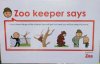
Signage I think works to a point, as does clearing the pond of coins so as not to give people the idea. This is one of my favourite signs on the subject of not throwing (Wellington Zoo):

upload_2021-3-9_20-5-59.jpeg

In this case, the greater danger is the chimps lobbing something back at the crowd. Gombe, one of the young males, was infamous for this prior to his export.
 

Attachments

  • upload_2021-3-9_20-5-59.jpeg
    upload_2021-3-9_20-5-59.jpeg
    81.6 KB · Views: 44
Totally agree it is a destructive habit and one that has killed many zoo animals and harmed many more.

But it seems to be a human universal across the planet when it comes to zoos and I'm not sure how you solve it as it is clearly an irrational behaviour arising from some deep seated psycho-social / cultural mechanism.

Improved signage ? Doesn't seem to work or curb peoples irrational desire to engage in that behaviour.

Allocating a pool or fountain area where people can do this? Could work , would spare zoo animal suffering and money could be collected and put to some use.

Signage works most of the time, at least in my experience. It has prevented visitors from doing specific things or going to specific places.

During my last visit to Auckland Zoo, the main Water Fountain was filled with coins. There was even some tiny animal figures in there, that were probably bought from the gift shop, one which I recognised as a $40 Elephant figure! :eek:

Some kids were reaching in and grabbing them, and I ended up telling them to cut it out. They ran off to their parents, who were sitting on the other side of the large lawn:rolleyes:, and that put a stop to their coin collecting.
 
I know of a couple of zoos which take advantage of this urge to toss pennies and take people’s “donations”!

That just ruins the whole intention. Apparently removing the coins gives bad luck, so that’s why there is always a lot of money in there, because some people are afraid to take it.
 
Out of my friends who know little about zoos, the three dangerous animals they’re most surprised to learn are dangerous are chimpanzees, cassowary and tapir.

So much emphasis has been given to gorillas being portrayed as gentle giants over the past few decades (to offset the negative opinion generated by King Kong); as well as orangutans, chimps are often tarred with the same brush.

Tapir only appear to present a danger when it’s a mother protecting their young; but they can still deliver a nasty bite. I met a pair of them up close once and kept a safe distance, with my rucksack shielding my junk. I didn’t entirely trust them. :eek:
When I was in high school, I attended classes at the North Carolina Zoo's Zoo School program. In the reception area, there was an instruction bulletin on what to do in case of an animal escape. There were three threat levels depending on what species it was. My memory on it is a bit fuzzy but I remember Level 1 was animals like nonvenomous reptiles, birds, small mammals, etc. Level 2 was mostly large hoofed mammals and ostriches. Level 3 were the most dangerous, consisting of elephants, bears, big cats, and the chimpanzees.
 
When I was in high school, I attended classes at the North Carolina Zoo's Zoo School program. In the reception area, there was an instruction bulletin on what to do in case of an animal escape. There were three threat levels depending on what species it was. My memory on it is a bit fuzzy but I remember Level 1 was animals like nonvenomous reptiles, birds, small mammals, etc. Level 2 was mostly large hoofed mammals and ostriches. Level 3 were the most dangerous, consisting of elephants, bears, big cats, and the chimpanzees.

Yep, that sounds about right. If they have them, zoos would also include African wild dogs at Level 3.

Generally speaking, most animals outside of their natural environment (exhibit) are going to be scared - and while their instinct may be to avoid humans; if they feel threatened or trapped, they could lash out with devastating consequences.
 
I have never really had any real confrontations with other zoo goers, with the most I’ve seen was during my last trip to faunia, when some lady alongside with her kids were feeding rheas chips and such over the barrier to their exhibit (which should be noted isn’t particularly high and just tall enough for the ratites not to be able to peer over). After a little advice she stopped feeding them and left them be.
 
  • Like
Reactions: JT
When I worked at the North Carolina Zoo over the summer, I had to get on to people a few times. Mostly kids running off the paths into the woods or people trying to touch the squirrels. One time I had a kid throwing little pieces of mulch at the Red Wolves. When I called out to them to stop, their mom then got on to them and they stopped. I also heard from co-workers about two separate occasions where someone took a long stick and tried to poke the Alligators.
 
I went to Roger Williams in June and I was at the snow leopard exhibit when there was a guy taking photographs. I saw the guy before at other parts of the zoo so I decided to ask if he was from here. He replied with no, but was from a zoo photography Facebook group. He actually never even heard of zoochat lol.
 
I went to Roger Williams in June and I was at the snow leopard exhibit when there was a guy taking photographs. I saw the guy before at other parts of the zoo so I decided to ask if he was from here. He replied with no, but was from a zoo photography Facebook group. He actually never even heard of ZooChat lol.
Well, did you offer them an invite? :p
 
Last edited:
While visiting Burger's Zoo - Arnhem - the Netherlands a few years ago I was taking some photos ( a thing I do quite regualry ;) ) when a small group of mid-30ers walked toward me and one of them wanted to be funny for the rest of his group and said " I hate pararazzi ". I just smiled and turn my back to him, showing the back-side of my T-shirt :
20140107_100851 paparazzi.jpg

He said "of course not all" and the rest of the group also found it quite funny.
 

Attachments

  • 20140107_100851 paparazzi.jpg
    20140107_100851 paparazzi.jpg
    86.2 KB · Views: 31
While visiting Burger's Zoo - Arnhem - the Netherlands a few years ago I was taking some photos ( a thing I do quite regualry ;) ) when a small group of mid-30ers walked toward me and one of them wanted to be funny for the rest of his group and said " I hate pararazzi ". I just smiled and turn my back to him, showing the back-side of my T-shirt :
View attachment 525685

He said "of course not all" and the rest of the group also found it quite funny.
Shouldn't that be "Paparazzo" (singular)?
 
If I would be alone yes but in most cases my wife also visit zoos with me and she has a similar T-shirt ;).
 
Back
Top