Although you were all expecting this to be a post for *Destination Madagascar*; I have decided that due to both the recent announcement of the “Speculative Zoo Design and Planning Forum”, as well as some time restraints with school, and other little things in life. I decided instead that today we will focus on two, smaller, “sub-attractions” that are simply known as both the *Swan Pond* and the *Wetlands Walk*. But now, let us begin:
SWAN POND: - (1 exhibit)
If you were to exit out of the *Lorikeet Jungle* exhibit, but did not turn left for the *AACC*. Then the next exhibit that we would’ve come across would be this relatively, old relic of a not so distant past. You see, along with the already mentioned *Monkey Island*, the *Swan Pond* itself, is considered to be one of the few remaining historic relics that have managed to survive, and to be restored for modern generations in the present day. Although the pond itself is the sole exhibit found within this complex; it is worth noting that the exhibit is actually home to not just swans, but also four to five other species as well, that have called this historic exhibit their home. Similar to what is seen on the monkey island, directly across the path from the exhibit’s multiple viewing areas are several, strategically placed signs used to educate guests about what kinds of animals that you can find in the exhibit today, along with a few other signs that directly educate guests about the exhibit’s storied past. Today, you should expect to find not only an experienced breeding pair of 1.1.0 Whooper Swans, but also four other species of waterfowl in the form of 3.3.0 Emperor Geese, 3.1.0 Northern Shovelers, 5.4.0 Barrow’s Goldeneyes, and 4.4.0 Buffleheads; along with the occasional wild bird such as Mallards, Great Blue Herons, and several others that are worth a decent mention.
(5 bird taxa)
In addition to the historic *Swan Pond*, and once you leave the pond’s viewing areas. You would make a slight turn to your left, and walk straight ahead towards the next stop on our tour, for in which it is listed as seen below:
WETLANDS WALK: - (12 exhibits)
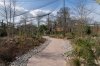
Directly on the same path from where you exited the historic *Swan Pond*, you will later approach the rather simple entry arch for the “Walk”, as some guests and zoo enthusiasts like to call it; and after walking underneath it, not too far away is a simple, closed-top aviary that temporarily houses a pair of 1.1.0 Southern Screamers, as well as a relatively small breeding group of 3.3.0 Chilean Flamingoes. Previously, before the screamers and flamingoes arrived and were temporarily put on display, the aviary was the long-term home to a single 0.1.0 Oriental White Stork who had lived in this aviary for many years, before she passed away back in 2019 due to health complications related to her long-lived lifespan. However, just like what I had mentioned before, the screamers and flamingoes are not expected to live within this aviary forever; for it is here that the flamingoes will eventually move into a permanent exhibit that is currently under construction as of late, while the screamers will be relocated to a new, and more suitable home here at the “walk” sometime next week; but for now, both species have seemed to get along just fine in their temporary housing, with little to no issues to be reported whatsoever. Further down the path from this aviary, you will soon find a covered viewing area with one side looking out into a spacious, open-topped exhibit, while the other side displays multiple educational signage that explains guests about the plight, threats and conservation of the adjacent exhibit’s 1.1.2 European Mink. For a small mammal species such as a mink, the following exhibit is a naturalistic paradise, with multiple viewing areas designed for certain visitor age groups, a large, perch-filled pond for them to swim and hunt; along with various different places to hide whenever they do not feel like being in the spotlight from the eyes of guests. In short, this relatively large, 1,700 sq ft, well-planted exhibit should have all of the necessary benefits for these nearly-threatened mustelids to thrive within a safe place that they would otherwise not have out in the wild. Not too far away from the mink viewing area, the next exhibit that guests will encounter is a smaller, open-topped enclosure similar to the native turtle exhibit at the Bronx Zoo, (the one outside of the WoR building), that contains not only sizable breeding groups of 10.8.0 European Pond Turtles, and 11.9.0 Eastern Painted Turtles; but also an innumerable group of Common Carp, as well as several native species of fish, amphibians, invertebrates, and more. Further down the path, and after making a slight turn to your right. The next two exhibits that you will begin to see are both home to a single species of crane; with the former, and larger of the two exhibits being home to a breeding pair of 1.1.0 Brolgas, while the smaller enclosure next door is home to a single 1.0.0 Red-Crowned Crane, who for the time being, will be on his own until we can find him a suitable partner to keep him company, (as he is an older bird when it comes to his age). Also, located in the same shaded viewing structure as the Brolga exhibit is a small freshwater aquarium that contains a trio of 2.1.0 Australian Lungfish, along with schools of 0.0.20 Oxeye Herring, and 0.0.17 Saratoga as well. Past the aquarium and crane exhibits, but before we approach the next exhibit, it is worth noting that in this small section there lies a shaded, interactive, water play area for children that educates both them and their families about soil erosion, the water cycle, the flow of water, as well as the fact about how wetlands are vital to not only the plants and animals that call them home. But also the people that live, play, and work, in and around these vital portions of habitat. Beyond the play area, and approaching towards your left; you will notice that there are two small, well-planted habitats that are currently empty. Before long, however, the smaller exhibit that you see in front of you will eventually become the permanent home for the Southern Screamers that I have previously mentioned. In addition, the larger exhibit directly next door, is usually the home to an all-female trio of 0.3.0 Capybaras; But due the construction progress with the neighboring screamer exhibit, all of the zoo’s capybaras have been temporarily relocated to an off-display holding area, until the surrounding construction has reached its conclusion. Not too far away from the currently empty capybara exhibit, we have now arrived at the entrance to a large, simple, and diverse, free-flight aviary that contains a wide variety of bird species from various parts of the world; which in term, are all individually listed below, as seen here:
• - 1.1.2 Boat-Billed Heron
• - 3.5.0 Baer’s Pochard
• - 1.1.0 Belted Kingfisher
• - 4.5.0 North American Ruddy Duck
• - 5.5.0 Glossy Ibis
• - 3.3.0 Snowy Egret
• - 4.3.0 Canvasback
• - 6.6.0 Chilean Pintail
• - 4.0.0 Orinoco Goose
• - 2.2.0 White-Faced Heron
• - 6.7.0 Lesser Whistling Duck
After exiting out of the aviary, and making a right-hand turn, you will notice another shaded education area with multiple signage boards that educate guests about bird migrations, how vital wetlands are to a large variety of birds and other organisms, how some birds were able to be brought back from extinction via extensive conservation efforts, and so much more. Adjacent to this education area, you will find a large, closed-top exhibit with above, and underwater viewing making it easier for guests to find the zoo’s sole 1.0.0 Alligator Snapping Turtle, as well as an innumerable population of unspecified Perches that populate, and occupy the same underwater viewing area. Nearby, there is also a smaller, cylindrical-shaped paludarium that houses a breeding pair of 1.1.0 Lake Erie Water-Snakes, who also happen to share the same exhibit with a surplus population of 0.0.26 Pumpkinseed Sunfish, and a far larger breeding group of unspecified Minnows as well; with the latter being purposely placed in the exhibit to give the snakes an easy meal. Leaving the snake, and turtle exhibits behind and approaching on the path straight ahead, is home to perhaps the unofficial star species of the “walk”. Which also happens to be ironically, the last major species that guests will encounter here on this “walk”; for it is here that I am referring towards a spacious, 7,800 sq ft, open-topped enclosure for not only a vibrant flamboyance of 8.9.4 Greater Flamingoes, but also two other species of Eurasian waterfowl, (5.5.0 Garganeys and 3.4.0 White-Winged Ducks), that tend to share and to seemingly coexist alongside them. Given the occasional chilly weather that seems to occur within the surrounding area. In the recent past, we decided to build them a relatively large, and spacious indoor enclosure that was designed to not only serve as the birds holding area/night house; but to also serve as a way for guests to see them year-round whenever the temperatures seem to otherwise tell them to not be out on exhibit. Now if you were to follow the main path past the flamingoes, and towards the attraction’s exit, then you would’ve ended up back at both the main entrance, as well as the *Conservation Commons* entry plaza. But since we have plenty of exhibits that we haven’t seen, or touched upon just yet, (Destination Madagascar especially). We will now make a detour that will make us backtrack, and walk down the exact same path that we have only just entered from. Thus ending not only this specific part of the tour, but also the majority of the thread’s progress until things have settled down with the aforementioned new forum, along with the eventual tour post of *Destination Madagascar*, that I expect to be finished, and posted sometime in early to mid December at its earliest.
(2 mammal taxa)
(18 bird taxa) - (currently)
(4 reptile taxa)
(7 fish taxa)