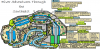
Moebelle, where is this Southeast Asian River Boat Ride Thingy located on the forum? I'm interested in reading it...
No need to read
 Note, the green colored things are caves with exhibits above and side-to-side of the boat.
Moebelle, where is this Southeast Asian River Boat Ride Thingy located on the forum? I'm interested in reading it...
Note, the green colored things are caves with exhibits above and side-to-side of the boat. Care to go into detail about the exhibits? If I was any good at drawing, I might try to make a map.
Nice.

Japan would be good for Raccoon Dogs, Japanese Serows, and Snow Macaques.
Maybe another good location is the Middle East. Persian or Arabian Leopards, Arabian Oryx, and maybe Honey Badgers or Caracals.

Okay, I've decided to go with Japan. This is my species list so far. Any other additions? I'm bound to add more, but this is just a quick list I came up with.
Don't worry, once I get an official list, a detailed exhibit will follow!
How about Crested Ibis? A good candidate to represent disappearing species.
So, how's it going as of now, BZF?
 ... I've just been so busy this whole week and I've barely got the chance to start... I'm still working on it, but no more official release dates, as I don't know when it will be done.

Hmm, didn't think of that one. I'm also thinking of Amimi Shrews, Iriomote Cats, Japanese Badgers, some kind of pinnepid, Copper and Green Pheasants, and Mountain Hawk-Eagles.
 )
)5. Gran Chaco
The Gran Chaco is a dry scrub land located mainly in Paraguay and neighboring countries. This is a region that was little known to the outside world until recently due to its inhospitable terrain. It is home to one of the most exciting zoological discoveries of the past 100 years, the Chacoan Peccary, an animal known before only from fossils, but found alive in 1972. The Chaco is also the evolutionary home of the armadillo. No zoo exhibit has ever tried to reproduce this area of South America.
The exhibit for VtSA consists of two animal exhibits with a possible third. The main two areas for the Chacoan Peccary and for a species of Armadillo.
1. Chacoan Peccary – Being the most important species known from the Chaco, it is important to showcase this endemic species here. There is a major push from the Pig, Peccary, and Hippo TAG to find more holders for this species.
2. Armadillo – As armadillos are abundant and diverse in this region it is a great opportunity to show them off here. More species of Armadillos are known from the Gran Chaco than anywhere else.
3. Geoffroy's Cat – This is a small cat found throughout the southern plains of South America, and it quite prevalent in the Gran Chaco. While not held in many collections, it is widely available and makes a wonderful addition to this area.
4. Seriema – This is an optional exhibit that would be located on top of the Chaco/Pampas prey barn. If cost and construction prohibits it can easily be deleted and the Seriema can be moved to another aviary throughout the exhibit (Pantanal aviary or monkey exhibit preferably).
Exhibit size.
Armadillo exhibit – 140 sq. ft.
Geoffroy's Cat exhibit – 510 sq. ft.
Armadillo/Geoffroy's Cat holding – 160 sq. ft.
Chacoan Peccary exhibit – 3,250 sq. ft.
Seriema exhibit (opt.) - 1,600 sq. ft.
Chaco/Pampas holding – 1,700 sq. ft.
Map key – 1) Peccary exhibit 2) Geoffroy's Cat exhibit 3) Armadillo exhibit 4,5) Seriema exhibit, Peccary & bird holding underneath 6) Cat and Armadillo holding
6. The Cerrado
The Cerrado is the vast savanna of eastern Brazil. At one time, it was the largest expanse of grasslands in South America. This region is known for such animals as Marsh and Pampas Deer, Rheas, Giant and Lesser Anteaters, and Maned Wolves. Two of these, the Maned Wolf and the Giant Anteater can be exhibited together and an exciting mixed species exhibit that involves a predator. Most zoos confuse the Cerrado with the Pampas and mislabel it as such. This would be a wonderful opportunity to correct this error.
The VtSA exhibit consists of a single enclosure primarily designed for Maned Wolves and Giant Anteaters, however, it has also been designed so that the animals that inhabit the nearby large Pantanal exhibit can be rotated to give all of the species more space and a varied environment.
The real Cerrado is littered with termite mounds of varying sizes and this should be recreated in the exhibit not only to give a sense of realism but to also give the animals some needed enrichment. Some of these termite mounds, if not all of them, can be built with small, green LED lights in them to simulate the bio-luminous beetle larvae that live in them. This can make for unique lighting for night events. A simple shallow water feature will give not only a barrier to the public, but will also tie into the water features in the Chaco and the Pantanal.
Holding is done in a large barn that will serve both the Cerrado and the large Pantanal exhibit as well as the Brocket Deer/Howler Monkey exhibit. Barn will also have several outdoor holding yards. This barn has two levels. The upper level is for monkey and bird holding as well as small office and keeper space.
Exhibit size.
Cerrado exhibit – 9,000 sq. ft.
Cerrado/Pantanal barn (lower level only) – 5,000 sq. ft.
Cerrado/Pantanal holding yards – 1,400 sq. ft.
Map Key – 1) Cerrado exhibit 2) Cerrado/Pantanal barn
3) holding yards
7. Pantanal
The Pantanal is the world's largest wetlands and is located in southern Brazil. It is adjacent to the Cerrado and together with it forms a vast grassland. The Pantanal is one of the most diverse areas of South America and home to many exciting animals. Many tall grasses and palm trees make up the landscape of the Pantanal, which should be easily recreated here. The VtSA Pantanal exhibit consists of five exhibits plus viewing into a sixth. All major vertebrae categories are represented except amphibians.
1. Large Pantanal exhibit – This exhibit is the largest exhibit in the Pantanal. It is a mixed species exhibit primarily for Lowland Tapirs and Capybara. All of the species in the Pantanal can be rotated with the species in the Cerrado. A water feature will be a key element of this exhibit as it needs to recreate a swampy environment. Multiple water fowl can also be included in the exhibit. Holding for this exhibit if in the large Cerrado/Pantanal barn and is accessible to the exhibit via a tunnel under the visitor pathway. Behind the exhibit, but technically not in the Pantanal area is a view into the Jaguar exhibit. This will give the effect of it being a predator/prey style exhibit. Also, as the Jaguar exhibit is located in the Amazon section, and should be densely planted, it will give the illusion that this part of the Pantanal is at the edge of the forest. Species include: Lowland Tapir, Capybara, White-Faced Whistling Duck, Fulvous Whistling Duck, Ringed Teal, Rosybill, Crested Screamer, and Maguari Stork.
2. Black Howler Monkeys and Red Brocket Deer – This is a smaller, netted in exhibit across from the main Pantanal exhibit. Brocket Deer are rarely displayed despite being a PMP species from the Cervid TAG. This could make a highly entertaining mixed species exhibit as primates and hoofstock are rarely displayed together, but can co-mingle well. This will also utilize multiple levels of the exhibit with the deer on the ground while the monkeys are in the trees. Holding for the exhibit is from the large Cerrado/Pantanal barn. Monkeys would be held in a second level of the barn which would also hold office/storage space. Also several birds can be housed in this exhibit. Species – Black Howler Monkey, Red Brocket Deer, Toco Tucan, Sunbittern, Wattled Jacana.
3. Filtration – Behind the Howler Monkey/Brocket Deer exhibit is the pumps and filtration for the Pantanal, Cerrado, Chaco, and Amazon Jaguar exhibits. This can either consist of underground vaults or above ground facilities. This would be determined by the water features department as to what works the best, is safest, and most user friendly.
4. Jaguars – While their exhibit is not technically part of the Pantanal exhibit, the Jaguars will be visible from multiple points in the Pantanal. The will first be seen behind the large Pantanal exhibit in a predator/prey relationship. The main viewing will be through a window/training area just past the large Pantanal exhibit. Also, since the Jaguars and Pumas can be rotated, it is possible that the Pumas will be seen from here as well.
5. Aviary – The bird life in the Pantanal is of extreme importance. Of significant note is the Hyacinth Macaw found primarily in the Pantanal. The aviary will sit on top of two large aquariua/terraria. This will utilize the maximum about of vertical space available. Aviary species – Hyacinth Macaw, Roseate Spoonbill, Boat-billed Heron.
6. Green Anaconda – The Pantanal is home to a large population of Anacondas, the world's heaviest and second longest snake. The exhibit would be situated below the Pantanal Aviary and would be visible in a semi-tunnel that is somewhat darkened. The exhibit should be large enough to house several Anacondas. Should also house several fish species as well. Suggested species – Green Anaconda, Neon Tetra, Discus Fish, Freshwater Stingray.
7. Red Bellied Piranha – This feared fish is abundant in the Pantanal. Like the Anacondas, the Piranhas will be seen in an aquarium placed underneath the Pantanal Aviary. Also like the Anacondas, it will be viewed in a semi-tunnel. Again, other fish can be displayed along with the Piranhas (tetras, etc.).
8. Caiman exhibit – The major aquatic predator of the Pantanal is the caiman. Several species exist, but the primary species is the Yacare Caiman. It is theoretically possible to keep this species in a mixed species exhibit assuming that a suitable species can be found, most likely a turtle species. Also possible for inclusion is the Broad-Snouted Caiman which shares much of its range with the Yacare Caiman and can be housed in the same exhibit. A pair of each species could easily be housed in the exhibit. There is a small holding/filtration building for the caimans if weather/temperature dictates.
9. Small exhibits – There are several smaller areas not designated for animal use but could be utilized to hold immature caimans or turtles.
10. PLAYa Pantanal – This is a water play area for kids. The name is a play on the word play, and the Spanish word playa, which translates as beach. This area can include water fountains, small splash ponds, and streams. Across one of the streams is a rope bridge for those adventurous enough to cross it. Lots of sandy areas are available for kids to make their own sand castles.
Exhibit size.
Large Pantanal exhibit – 9,400 sq. ft.
Monkey/Deer – 1,350 sq. ft.
Cerrado/Pantanal holding (incl. 2nd level) – 7,100 sq. ft.
Filtration area – 880 sq. ft. (above ground only)
Aviary – 1,300 sq. ft.
Anaconda – n/a
Piranha – n/a
Caiman – 820 sq. ft.
Caiman holding/filtration – 270 sq. ft.
PLAYa Pantanal – 3,000 sq. ft.
Small exhibit 1 (immature caiman) – 160 sq. ft.
Small exhibit 2 (turtle) – 70 sq. ft.
Map Key – 1) Large Pantanal exhibit 2) Pantanal/Cerrado Barn 3) Howler Monkey/Brocket Deer exhibit 4) Filtration 5) Jaguar training window 6) PLAYa Pantanal 7) PLAYa Pantanal rope bridge 8) Caiman exhibit 9) Aviary 10) Anaconda (underneath aviary) 11) Piranha (underneath aviary) 12) Juvenile Caiman (opt.)
8. Amazon
The Amazon Rainforest is the world's largest expanse of rainforest. The Amazon River is the world's longest river (recent discoveries of a new source higher up in the Andes has pushed it past the Nile). It has the world's largest watershed. With all of these superlatives, the Amazon must also be one of the greatest homes of wildlife in existence. The Amazon area of VtSA rightfully reflects this diversity. Mammals, Reptiles, Birds, Amphibians, Fish, Insects, and Arachnids are all to be present in the Amazon.
Due to several issues the Amazon section is to be built indoors. This serves several very important purposes. The construction of this building need not be a complex, multi-level rainforest like many others, but can be a simple path through various large mixed species enclosures. Enclosures for this exhibit have been designed to give the animals copious space and not feel cramped like many other indoor rainforest exhibits. The concept of the entire Amazon area is to feel like a trip both upstream and up into the canopy. The building will consist of seven main areas, plus a few smaller ones.
1. The River – fish
2. Aquatic reptiles – Caimans and Caiman lizards
3. Small predators – small cats, Tayra, and Bush Dogs.
4. The Cave – bats, insects, and reptiles/amphibians
5. Tamarins/Marmosets/Sloth
6. Larger monkeys
7. Birds
In addition to these, smaller reptile and amphibian exhibits will be scattered along the trail. Birds of all sorts can be mixed in with some of the monkey species.
1. Theater - After exiting the Pantanal, the guest will enter into a 50-100 seat movie theater. The theater will show a short (5-7 minute) film on the Amazon (or South America in general, conservation or any number of topics). This space can also be used as an after hours event center for parties, sleep-overs, meetings, etc. Seating should be removable for this purpose. Throughout the duration of the film, the guest will be unaware of the theater's exit. The exit will be revealed as the film is ending and curtains are pulled back to reveal a large fish tank with a walk-through tunnel.
2. Amazon Fish - Tank is large enough to hold many species. Primary species should include Arapaima, Pacu, Red-Tailed Catfish, Freshwater Stingrays, Arrowanas. Various turtle species can also be included. Due to the large size it is possible that either Amazonian Manatees or River Dolphins could be housed in the exhibit in the unlikely event that either species becomes available.
3. Aquatic Reptiles - After leaving the river tunnel, the guest enters an area for large aquatic reptiles. The primary exhibit here is for a large crocodilian. Two options exist, the Orinoco Crocodile and the Black Caiman. The Black Caiman is preferred for this exhibit for several reasons. Unlike the Orinoco Crocodile, it is actually found in the Amazon basin. Also, very few zoos worldwide display this species. Being the largest caiman it would, a mature specimen would be a sight to see. A third option that is geographically incorrect, but only slightly, is the American Crocodile. Two smaller exhibits are along side the large crocodilian exhibit. One would be primarily for Caiman Lizard. This exhibit could easily house other species as well (fish, birds, and other reptiles). The second exhibit is for Dwarf Caiman. Either species of Dwarf Caiman (Cuvier's or Smooth Fronted) would fit into this exhibit.
4. Small Predators - After the aquatic reptiles are five exhibit for small predators. All of these exhibits are flexible for their occupants. Up to five species can be housed in them, but if needed multiple animals of the same species can be given two or more exhibits. The two largest exhibit can be divided down the middle via netting (Invisinet) so as to house two conspecific animals (male/female/non-breeding) seemingly in the same exhibit while still meeting their needs for privacy/solitude. Preferred species – Ocelot, Margay, Jaguarundi, Bush Dog, and Tayra. Other possible species include Giant Otter, Oncilla, Grison, etc.
5. Jaguar Research Station – Amid the small predator enclosures is the Jaguar Research Station. This is an interpretive area that overlooks the large Amazon Jaguar exhibit. The exhibit itself is entirely outdoors, and is the larger of the two primary Jaguar exhibits. As it is part of a three-exhibit rotational exhibit, Pumas might also be viewed from this area. This exhibit's primary view will be from the JRS, but can also be viewed from the Pantanal both as a predator/prey style exhibit behind the large Pantanal exhibit and through a training window. The exhibit should resemble a lush valley filled with trees (real and artificial) and a pool for the animals to swim. This area would need to be staffed with an interpreter (either zoo staff or volunteer). Biofacts from Jaguars and other Amazonian animals need to be present. Also, this area would be perfect to have demonstrations from small animals like Kinkajou, Tamandua, and Prehensile-Tailed Porcupine. Looping videos and interactive games like in Base Camp are to be used. For after hours events the JRS can be used as an event center for parties, sleep-overs, meetings, etc.
6. The Cave – The cave is a small area primarily for bats. Preferably, Vampire Bats should be featured in this exhibit, but any South American bat species can be housed here according to need. Also here are several small exhibits for insects, amphibians, and reptiles. The collection demands for these exhibits and their ultimate design should be done by the Reptile Curator and Department.
7. Tamarins/Marmosets – Five small exhibits are clustered together after the cave and are intended for small monkey species. Each exhibit can hold one species of Tamarin or Marmoset or several depending on species compatibility (i.e. Golden Lion Tamarins mixed with Pygmy Marmosets). If desired, a separating wall between two of the exhibits can be removed creating a larger exhibit space. In addition to small monkeys other species can be housed in these exhibits. Small ground dwelling mammals (Paca, Agouti, etc.) and various birds (Aracaris, Guans, Currasows, etc.) can easily be housed with the small monkeys. Adjacent to this area is an exhibit designated for sloths, however, this are can be merged into the monkey exhibits if the sloth can be mixed with the small monkeys. Any thoughts on the exact collection should be reviewed by both the Bird and Mammal Departments.
8. Larger Monkeys – Three exhibits are designed to house larger species of monkeys. The first exhibit is designated for a mixed exhibit of White-Faced Saki and Gray Titi Monkeys. Appropriate birds and small mammals can also be mixed in this exhibit. The largest exhibit in this area, and one of the largest exhibits in the amazon building is designated for Spider Monkeys. As the monkeys are largely arboreal this leaves the floor of the exhibit open for a terrestrial animal. The space is large enough to keep a small group of Collared Peccaries (or White-Lipped Peccaries if some could be sourced) and would make an exciting mixed species exhibit. The final larger monkey exhibit is intended for Squirrel Monkeys. Other compatible species (birds) can be kept with the Squirrel Monkeys at the discretion of the curators.
9. Birds – In addition to the various birds that can be housed in some of the smaller exhibits (Caiman Lizard, Tamarins, etc) there are three exhibits devoted entirely to birds. One is a large exhibit solely for the Ornate Hawk Eagle. Another is a small exhibit for any number of species to be determined by collection need. The final exhibit of the Amazon is a large walk-through aviary. The exhibit is large enough to hold many species. Exact collection should be determined by the Bird Department. It is possible to have this exhibit be an interactive one with feeding like Bird's Landing in the Children's Zoo.
10. Other Exhibits – Throughout the whole Amazon building there are small to medium sized exhibits designed to house reptiles and amphibians. Collection is to be determined by the staff.
11. Holding and Service – The building is designed so that animal holding and service areas are easily accessible to zoo staff. Each exhibit has access to a different holding facility or the large off exhibit corridors. Various service doors exist throughout the facility to link visitor paths to the off exhibit facilities. Off exhibit corridors have enough space for small offices for the keepers. When not accessible to the off exhibit corridors, animal holding has been provided (primarily for the small predators).
Exhibit size
Large fish tank – 2,600 sq. ft.
Large Caiman/Crocodile exhibit – 1,250 sq. ft.
Dwarf Caiman exhibit – 430 sq. ft.
Caiman Lizard exhibit – 240 sq. ft.
Small Predator exhibit 1 – 1,050 sq. ft.
Small Predator exhibit 2 – 1,500 sq. ft.
Small Predator exhibit 3 – 1,500 sq. ft.
Small Predator exhibit 4 – 830 sq. ft.
Small Predator exhibit 5 – 670 sq. ft.
Bat exhibit – 360 sq. ft.
Tamarin exhibit 1 – 52 sq. ft.
Tamarin exhibit 2 – 70 sq. ft.
Tamarin exhibit 3 – 145 sq. ft.
Tamarin exhibit 4 – 150 sq. ft.
Tamarin exhibit 5 – 220 sq. ft.
Sloth exhibit – 130 sq. ft.
Saki/Titi Monkey exhibit – 860 sq. ft.
Spider Monkey/Peccary exhibit – 1,500 sq. ft.
Squirrel Monkey exhibit – 400 sq. ft.
Ornate Hawk Eagle exhibit – 580 sq. ft.
Small bird exhibit – 60 sq. ft.
Walk-through aviary – 2,400 sq. ft.
Amazon Jaguar exhibit – 10,700 sq. ft.
Theater – 2,500 sq. ft.
Jaguar Research Station – 1,900 sq. ft.
Total off exhibit area – 12,700 sq. ft.
Total animal space – 25,300
Total building space ~36,000
Map Key 1) Theater 2) Walk-through Amazon tank 3) Black Caiman 4) Caiman Lizard 5) Dwarf Caiman 6) Small predator exhibits 7) Jaguar Research Station 8) Amazon Jaguar exhibit 9) Small herp exhibits 10) The Cave 11) Tamarin/marmoset exhibits 12) Sloth exhibit 13) Saki/Titi Monkey exhibit 14) Spider Monkey/Peccary exhibit 15) Squirrel Monkey exhibit 16) Ornate Hawk Eagle exhibit 17) Small aviary 18) Walk-through aviary
9. Llanos
The Llanos is the grasslands and savannas of Venezuela and Columbia. This is a land that is drained by the Orinoco River and is sometimes known as Orinoquia. In some ways, the Llanos is like the Pantanal, for at times it too can become a flooded plain, but its proximity to North America makes it quite different.
The Llanos exhibit in VtSA consists of 3 separate exhibits for Jaguar, Harpy Eagle, and a large mixed species exhibit featuring King Vulture and White-Tailed Deer.
1. Fallen Log – As the guests exit from the Amazon, they enter into a vast, hollow, fallen tree that serves as a tunnel and viewing for two exhibits. On the right hand side is the Harpy Eagle exhibit, while on the left is viewing into the Llanos Jaguar exhibit.
2. Harpy Eagle – This exhibit is viewed both from the Fallen Log and from the main visitor path. Ideally it should a mated pair of birds. Housing for the Eagles will be simple boxes like currently exist in the Wings of Wonder exhibit.
3. Llanos Jaguar – This is the second Jaguar exhibit and a bit smaller in size than the Amazon exhibit. Viewing is done from inside the Fallen Log, through a training window on the main path, and behind the mixed species exhibit in a predator/prey style exhibit. Outside of the Fallen Log the guest will view the Jaguars pool up close and will be able to see these cats swimming. The training window, like its counterpart in the Pantanal, can be used for daily scheduled training sessions with the cats. As the exhibit is part of a three-exhibit rotational exhibit Pumas might also be see in this area.
4. Mixed Species Exhibit – This exhibit highlights a species not commonly thought of as coming from South America, the White-Tailed Deer. As this species is common in Texas, and many rescued animals are needing homes, it would be a great opportunity to showcase this species. Many species from the region can be mixed with the deer. This netted in enclosure is also home to the King Vulture, Scarlet Ibis, Scarlet Macaw, and Capuchin Monkeys. If desired, Collared Peccaries can also be added to this exhibit if they are not housed in the Amazon building. Holding for this exhibit will be underneath the rockwork for the Spectacled Bear exhibit.
Exhibit Size
Harpy Eagle – 960 sq. ft.
Llanos Jaguar – 7,000 sq. ft.
Llanos mixed species – 5,500 sq. ft.
Map Key – 1) Harpy Eagle 2) Fallen Log 3) Jaguar 4) Mixed species exhibit
10. Tepui
Tepuis are fantastical formations in the highlands of Venezuela and Columbia, and are often found towering above the Llanos. These highlands are the inspiration for such works as Sir Arthur Conan Doyle's The Lost World and the Pixar movie Up. The world's highest water fall, Angel Falls, is found on a large Tepui. These remote uplands are sometimes referred to as the Galápagos of the mainland due to their unique fauna and flora found nowhere else. Many of these unique species are not available to zoos, so to honor the Tepui, VtSA has created a cafe and event center themed around the region.
Outside of Cafe Tepui, there is space for two small aviaries of species to be determined. The cafe itself will be a two level space. The lower level will house the kitchen and dining/event space. One major feature of the lower level indoor seating is a view into the Amazon walk-through aviary through a glass wall. The upper level will house the bulk of the seating and will be all open air. Access will be via a large staircase inside on the lower level. Rockwork surrounding the building recreate geologic features encompassing the upper level should be designed to recreate some of the more fantastical formations seen in a real Tepui. Also a small recreation of Angel Falls should be incorporated and flow into the Harpy Eagle exhibit. The view from the upper level of the cafe will look out into the Llanos exhibits, just as you would on a real Tepui.
Adjacent to the cafe are public restrooms. These are the only large public restrooms in VtSA.
Interpretation – Graphics and videos of the real Tepui should be shown inside of the cafe.
Exhibit size
Small aviary 1 – 190 sq. ft.
Small aviary 2 – 240 sq. ft.
Cafe lower level – 5,570 sq. ft.
Cafe upper level – 3,970 sq. ft.
Restrooms – 800 sq. ft.
What species are you thinking since the obvious choice, Japanese Sea Lion, is Extinct?

may I just ask what programme you used for the layout maps,as their very detailed.