Dwarf angelfishes ( Centropyge ) in captivity

8) Centropyge boylei - Peppermint angelfish. No information found on being kept in public collections and also not represented in the Gallery.

We already found out that the Peppermint angelfish has been kept at the Waikiki Aquarium but now @splendens uploaded a photo he/she made at the California Academy of Science of the sign of this species. He/she also made the comment that the fishes themselfs werenot allowed to be photographed :(. Would be intresting to know howmany Peppermint angelfishes are kept at the moment at the California Academy.
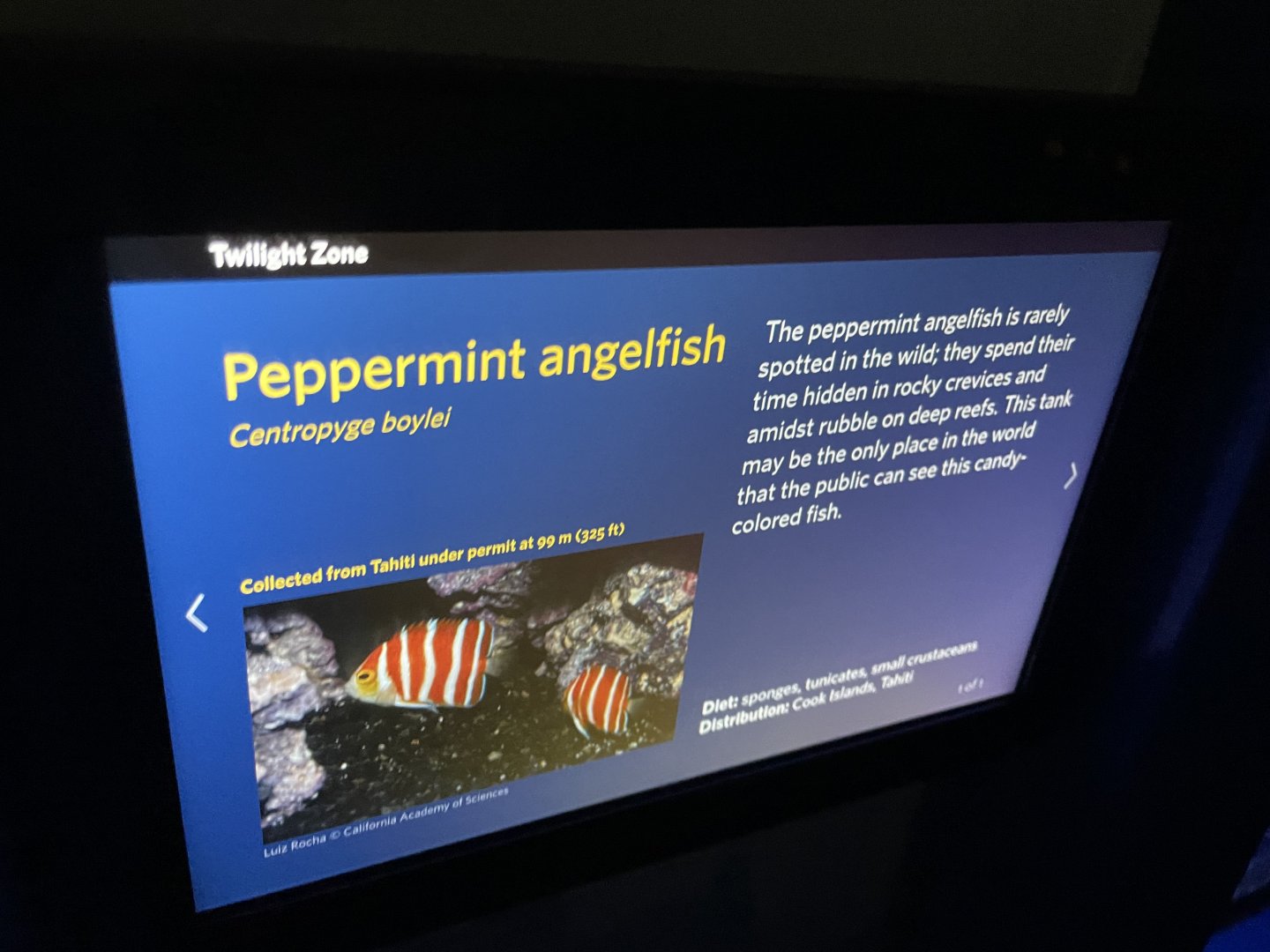
 
Wow, my ever time favourite species of angelfish! I didn't knew that they're so rare in captivity. Any idea of why? I'm very stranged that no more aquariums in the world display this species. It's really difficult to keep and feed maybe?
 
Wow, my ever time favourite species of angelfish! I didn't knew that they're so rare in captivity. Any idea of why? I'm very stranged that no more aquariums in the world display this species. It's really difficult to keep and feed maybe?

Hi Kakapo, the sign already explains it. They are rarely seen in the wild and they live in quite deep water were few commercial fish-collectors are collecting fish for the trade.
 
They were only discovered by some ichthyologists who were using specialist diving gear to get down to 100 metres. Most scuba divers don't dive that deep because there's very little light at that depth. Deepest I've been is only 42 metres. The problem with getting them into captivity is not getting to them, but bringing them to the surface is also very difficult because of the change in pressure. They can die before they get to the surface if you don't bring them up slowly enough.

:p

Hix
 
Last edited:
They were only discovered by some ichthyologists who were using specialist diving gear to get down to 100 metres. Most scuba divers don't dive that deep because there's very little light at that depth. Deepest I've been is only 42 metres. The problem with getting them into captivity is not getting to them, but bringing them to the surface is also very difficult because of the change in pressure. They can die before they get to the surface if you don't bring them up slowly enough.

:p

Hix

The same is also true for a few other angels, notably C. narcosis and C. nigrocellata. It's possible to bring them up successfully, but it's a more risky operation for both collector and fish. (C. narcosis was named such for good reason) Hence the high prices of $5,000-10,000 USD apiece.
 
They were only discovered by some ichthyologists who were using specialist diving gear to get down to 100 metres. Most scuba divers don't dive that deep because there's very little light at that depth
As well as diving to that depth being quite dangerous. Nitrogen narcosis is a very real danger at that depth, and you could only spend a few minutes at the bottom before you have to come back up to avoid the bends.
 
I had no idea of C. boylei being a deepwater species, curious to see for a such bright colored fish to live in badly illuminated waters. I know Centropyge multicolor is also a deepwater species, tough it was kept successfully at least by Berlin zoo-aquarium when I saw it.
 
I had no idea of C. boylei being a deepwater species, curious to see for a such bright colored fish to live in badly illuminated waters

Quite common for deepwater reef species to be brightly colored actually, including various species from Centropyge, Odontanthias, Liopropoma, and others. In the case of the Peppermint Angelfish, the bright red coloration benefits it since due to red wavelengths being the first to dissappear at depth, rendering the Peppermint largely invisible in its native haunts.

I know Centropyge multicolor is also a deepwater species, tough it was kept successfully at least by Berlin zoo-aquarium when I saw it.

Typically not so deep as several of its cousins, and as such it is seen much more often in the aquarium trade. A very nice species though, I saw a nice specimen in an aquarium store once.
 
I've since read that the original collectors of the Peppermint Angelfish did NOT use specialist diving gear, just normal scuba down to 100 metres (definitely not recommended for anyone other than the extremely experienced). Apparently the collectors suffered severely from nitrogen narcosis on that dive so much so that when they surfaced they couldn't remember collecting the fish.

:p

Hix
 
Have to add 2 more species to the original list because 2 species have been recognized as being true species - both were already known - even in the aquarium-trade but sofar didn't get full species-rang :
34 ) Centropyge cocosensis - Cocos Island lemonpeel angel. No public collection that I know of but in the aquarium-trade it should have been avaible from time to time. In our Gallery there are no photos of this species.
35 ) Centropyge woodheadi - Black-edged harald angelfish. Also from this species no known public holders but here also kept in the private aquarium hobby. Also from this one no photos sofar in our Gallery.
An article about the 2 new species can be found here :
Centropyge cocosensis & C. woodheadi, two ‘new’ species of pygmy angelfish | Reef Builders | The Reef and Saltwater Aquarium Blog
 
This is a juvenile C.cocosensis, and an adult, in the Christmas Island - Wildlife gallery
full

full


:p

Hix
 
Back
Top