Enclosure Size Versus Animal Behaviour

Hi Lafone,

I am asking for data collection and presentation. Just not the type that I highlighted in the study I referred to.

Am I projecting my feelings onto animals and their behaviour?

I had a dog for a long time - he has passed now sadly. We knew how each other felt a lot of the time - he wagged his tail and I smiled and petted him. Simple! Sometimes his behaviour confused me and sometimes my behaviour confused him, but most of the time we knew how each other felt.

And my dog loved being outdoors and in open spaces. That was very clear to me.

Most people can see obvious signals in animals. And I would assume zoo and park specialists can see even more.

I could tell when my dog was bored. Can zoo specialists tell when their animals are bored?

Can we take the human projection of animal feelings out of the equation? Not entirely, but most of the time I think we can.
 
Before I respond to the previous posts, I'd like to say its nice to see such an active forum and so many people who are concerned about zoo and park animal welfare.

And also to say I am very surprised at the lack of support for more space in zoos and parks! Is this because many people associated with zoos have always had to live within financial constraints and have spent a lot of time developing and enriching small spaces? Have they become very good at it and want to defend and support it? Is it simply a way of life?

And is there anyone reading this thread who, like me, actually thinks larger spaces for animals could be a good idea and worth trying out?

It is a fun forum indeed - really enjoy the enthusiasts here.

No one who posted here so far is unsupportive of the right size spaces for zoo animals or larger enclosures indeed - really it’s about ensuring size is right and there are more things to think about than simply bigger enclosures.

I think you’re too focused on one thing and just wanting that whatever, but that’s not necessarily going to be right for the animals and they are the important thing.

Sorry to hear you lost your dog - pets are such a lovely part of our lives and a truly valuable one.

I wouldn’t ignore keepers opinions at all indeed other posts showed that sort of evidence can be used in studies. But all that evidence will be and should be subjected to analysis - as mentioned above there’s not always enough research and any properly validated analysis is welcome imho.
 
Hi Shirokuma,

"I think “free” is a complex concept both for humans and other animals."

Very true! And many books have been written about it.

"Similarly, an animal might have freedom in the wild but in a zoo it is free from threat, free from predation, free from starvation, free from poaching, free from habitat destruction."

From the Fables of Aesop - the Dog and the Wolf.

"A Dog offered to help a Wolf get regular feed from his Master. The Wolf listened but saw a bald spot on Dog’s neck where the collar sat. Goodbye said Wolf." And the moral - "Better starve free than be a fat slave."

Is that right or wrong?

Sometimes in life there are no right or wrong answers, there are just answers.

I'm a big fan of, and visitor to, Scandinavia (and as the book says "its almost nearly perfect people"). Are they perfect? No far from it, but they do a lot of the obvious things right. A lot more than we do here in Scotland and elsewhere. I sometimes think they look in horror at the rest of the world and think "What an awful mess!"

That's what I think zoos and parks need to do - get the obvious things right. And I thought more space was a no brainer. But seemingly that's open to question!
 
Unfortunately I must say the academic zoo literature is filled with studies that either do not or cannot control for these factors. This is partly because zoos do not cooperate enough to make bigger research projects possible, partly because many zoos are hesitant to do anything that can even lightly be considered an 'experiment' (much of the literature is about observations when a change would have taken place anyway), and partly because zoos often invest just enough to have some research carried out but not enough to actually support a long-term or in-depth project. The result is a literature filled with studies that are rife with unaddressed variables, extremely low sample sizes, and too many caveats to count. These studies can still be valid if the authors are honest about the shortcomings and frame the findings right (e.g., as a proof of concept or a case study, if the sample size is low), but they lack the power of more large-scale research.

A lot of zoo research is actually carried out as we speak, probably more than most people here would guess, but too much of it never sees the light of day. Too often research is not communicated to the public, is locked within the zoo where it was carried out, or at best is lost in an endless swamp of grey literature, unavailable for meta-analyses or review articles. It is time for zoos to step up their game and take their research seriously. Luckily there are a few zoos that do better, and there are promising developments that may clear the way for the larger zoo community to follow.

The conclusion I get from what you are saying is there needs to be a co-ordinating body, either nationally or, in Europe, a European body, to look at the bigger picture. Is there no body or authority looking at the bigger picture?

I've just googled and there is the European Association of Zoos and Aquaria. Is it a paper tiger?
 
The conclusion I get from what you are saying is there needs to be a co-ordinating body, either nationally or, in Europe, a European body, to look at the bigger picture. Is there no body or authority looking at the bigger picture?

I've just googled and there is the European Association of Zoos and Aquaria. Is it a paper tiger?

I've just checked out the European Association of Zoos and Aquaria. and its governing documents, standards and guidelines. There are volumes and volumes of it. "Thick enough to stun an ox" (as a famous singer once said).

The most important document is tragically missing from the list. That document is "What success looks like and is it is being achieved". It should be the document at the top of the list.

There is the "annual report" but it makes pretty grim reading. On the positive side it is a potential cure for insomnia.

I'm not surprised that a "What success is" document is missing. That document is missing in many public and private organizations throughout the world.

Maybe someone should let them know! But I suspect any communication received like that would quickly be made extinct.
 
I've just checked out the European Association of Zoos and Aquaria. and its governing documents, standards and guidelines. There are volumes and volumes of it. "Thick enough to stun an ox" (as a famous singer once said).

The most important document is tragically missing from the list. That document is "What success looks like and is it is being achieved". It should be the document at the top of the list.

There is the "annual report" but it makes pretty grim reading. On the positive side it is a potential cure for insomnia.

I'm not surprised that a "What success is" document is missing. That document is missing in many public and private organizations throughout the world.

Maybe someone should let them know! But I suspect any communication received like that would quickly be made extinct.


I sent them an email asking the question anyway :-)
 
It is a fun forum indeed - really enjoy the enthusiasts here.

No one who posted here so far is unsupportive of the right size spaces for zoo animals or larger enclosures indeed - really it’s about ensuring size is right and there are more things to think about than simply bigger enclosures.

I think you’re too focused on one thing and just wanting that whatever, but that’s not necessarily going to be right for the animals and they are the important thing.

Sorry to hear you lost your dog - pets are such a lovely part of our lives and a truly valuable one.

I wouldn’t ignore keepers opinions at all indeed other posts showed that sort of evidence can be used in studies. But all that evidence will be and should be subjected to analysis - as mentioned above there’s not always enough research and any properly validated analysis is welcome imho.

I agree there are more things to think about than bigger enclosures.

And thanks - you are spot on about pets. They are one of life's gifts.

I've been looking into this further via the European Zoo Association (EAZA) and British and Irish Zoo Association (BIAZA). Seemingly the 5 domain model is used when it comes to animal welfare. The first 4 domains are: 1) food and drink; 2) environment; 3) health; 4) behaviour and interaction. They all feed into the resulting 5) Mental experiences.

The model says we can never know the mental experience of an animal (or human) but we can infer it. It seems to cover most of what has been said in the previous posts here, but it is recognized that the model still has limitations and is still being developed.

I've also been reading in BIAZA that there seems to be quite a difference between theory and practice and BIAZA have some quite strong published concerns about that.

When it comes to zoos, apart from money, the other word I keep thinking about is "enrichment". Its obvious people here go to a lot of zoos. Some have gone to over 100 zoos! Have they seen a lot of "enrichment". Today I see wider spaces, better environments, but "enrichment" in terms of 4) behaviour and interaction? Not so much.

Take the tigers in the Highland Wildlife Park. In the wild they hunt at night. One of the park keepers told me that, in the Park, the staff go home at night and are not there. So what do the tigers do? Sleep? They have nothing to hunt. Do they get bored?

But I wonder do zoo lovers here think animals are better off in the wild than in zoos? Like space I thought people preferring animals to be in the wild was a given. Now I'm not so sure.
 
I agree there are more things to think about than bigger enclosures.

And thanks - you are spot on about pets. They are one of life's gifts.

I've been looking into this further via the European Zoo Association (EAZA) and British and Irish Zoo Association (BIAZA). Seemingly the 5 domain model is used when it comes to animal welfare. The first 4 domains are: 1) food and drink; 2) environment; 3) health; 4) behaviour and interaction. They all feed into the resulting 5) Mental experiences.

The model says we can never know the mental experience of an animal (or human) but we can infer it. It seems to cover most of what has been said in the previous posts here, but it is recognized that the model still has limitations and is still being developed.

I've also been reading in BIAZA that there seems to be quite a difference between theory and practice and BIAZA have some quite strong published concerns about that.

When it comes to zoos, apart from money, the other word I keep thinking about is "enrichment". Its obvious people here go to a lot of zoos. Some have gone to over 100 zoos! Have they seen a lot of "enrichment". Today I see wider spaces, better environments, but "enrichment" in terms of 4) behaviour and interaction? Not so much.

Take the tigers in the Highland Wildlife Park. In the wild they hunt at night. One of the park keepers told me that, in the Park, the staff go home at night and are not there. So what do the tigers do? Sleep? They have nothing to hunt. Do they get bored?

But I wonder do zoo lovers here think animals are better off in the wild than in zoos? Like space I thought people preferring animals to be in the wild was a given. Now I'm not so sure.

There are animals in the wild and animals in zoos.

'Zoos are bad' views lead to things like the misguided and rather mean attempts at 'rewilding' animals who've not been bred for release but have lived in captivity for decades. Will animals who have never lived in the wild be 'better off' thrown into it? I rather doubt it.

If you are arguing zoos shouldn't exist then you have to be content with some species going extinct and with education and conservation becoming a much more abstract concept. Lots of zoos contribute to projects in the wild. Is the same money really going to be raised via the Discovery channel?

I think animals in zoos should have the very best standards of welfare and care. And animals in the wild should have their habitats protected and ways found for them to live productively in a world we, the most dangerous of animals, make it very hard for anyone but us and what we consume to live in.

The best zoos have an educational and conservation purpose. I think they are an important resource. Bad zoos or roadside shows which don't educate or conserve but exploit animals would of course be no loss.

Wouldn't it be nice if people didn't hunt animals to extinction, drive them out of their habitats, exploit and perscute them and there was no need to conserve them. Yes. Wouldn't it be cool if everyone cared about animal welfare. Yes. Are those things reality? No.

Good zoos / parks have a part to play in an imperfect world. Idealism about there being no need for zoos or ranges or 'closed' habitats or supported programmes or funding, lasts about as long as it takes to find a picture of a rhino caught by ivory poachers.
 
Zoo tigers don't hunt at night because they don't *need* to hunt. Animals in the wild hunt because they *must*, or they die. Hunting is stressful and takes a lot of energy. They can get injured by their prey, they can end up in fights with other animals, both of their own species and others. They can use up a lot of energy and not catch anything, weakening them for future hunts. Given the choice, animals would rather not hunt, except for the occasional bit of fun. Think of sharks in big tanks with lots of other fish. The sharks almost never eat the animals they share their environment with. Why? Because they don't need to. Their needs are met by the food they're given by their keepers. Hunting would be a waste of energy, which their body tells them to conserve.
 
But I wonder do zoo lovers here think animals are better off in the wild than in zoos?
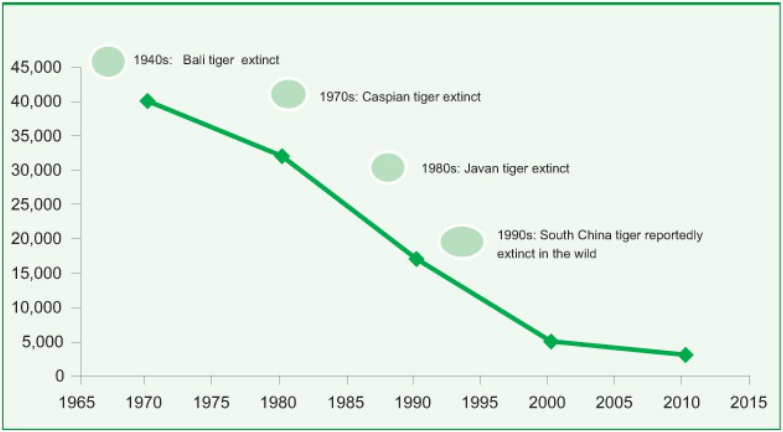
Here is what happens to tigers in the wild
1412938552.png

That is why zoos must keep and protect tigers. It would be great (as was already said) if tigers could be safe in the wild but that simply is not the case, has never been the case, and as human populations grow and spread tigers - and their prey - will be even further endangered. No prey, no tigers.
Give up on this "zoo vs wild" thing. It is not a real choice.
 
Last edited:
When it comes to zoos, apart from money, the other word I keep thinking about is "enrichment". Its obvious people here go to a lot of zoos. Some have gone to over 100 zoos! Have they seen a lot of "enrichment". Today I see wider spaces, better environments, but "enrichment" in terms of 4) behaviour and interaction? Not so much.

Take the tigers in the Highland Wildlife Park. In the wild they hunt at night. One of the park keepers told me that, in the Park, the staff go home at night and are not there. So what do the tigers do? Sleep? They have nothing to hunt. Do they get bored?
What do you think the keepers do all day? Twiddle their thumbs? Enrichment happens pretty much all day and often at night as well. Also animals are extremely adaptable and normally nocturnal animals often have no issue adjusting their activity levels to when keepers are there and enrichment is provided. So often yes they do just sleep at night.
 
Hi All,

I pretty much agree with everything you have said after my last post. How do I know what zoo keepers in the Highland Wildlife Park do? Well, the BBC have produced two 10-part series about life inside Edinburgh Zoo and Highland Wildlife Park explaining what zoo keepers do. I watched most of the episodes. Both the series are called “Inside the Zoo”.

Let me provide some more information about Scotland and the Highlands. Scotland (and these rest of the countries on these islands) killed off their large carnivores – the bear, the wolf and the lynx – long ago. Unlike people who live the main land of other continents, we never live in fear of being attacked by a dangerous wild animal.

However, there are many here who are interested in wildlife and are pro habitat conservation for large carnivores. Just as long as it is not in Scotland! Because Scotland is too small and we could not change. I think that is hypocritical. I think we should be able to live with them here. Two of the many challenges are finding space and managing security.

In reality though Scots have become used to their safe countryside and the re-introduction of large carnivores is seen as madness by many. The re-introduction of large carnivores would meet a lot of resistance whereas, I think, the idea of a much larger secure wildlife park is something people could accept if the reasons for it were explained.

In the Highlands the main land uses are farming, hunting estates, forestry, hill and mountain climbing. We do have space and I think there are ways a portion of it could be made available. As someone who is retired, I have spent a long time watching how important things do, and don’t, get done here.

You are right there are problems with larger enclosures and maybe more space should be dedicated to conserving more species as opposed to making enclosures bigger. And dangerous animals in Scotland would be safer in a wildlife park.

I had hoped the people on this forum would help give me reasons for having a much bigger park. Whereas many of you seem (to me) to think it is not the way to go. That has surprised me.
 
Hi All,

I pretty much agree with everything you have said after my last post. How do I know what zoo keepers in the Highland Wildlife Park do? Well, the BBC have produced two 10-part series about life inside Edinburgh Zoo and Highland Wildlife Park explaining what zoo keepers do. I watched most of the episodes. Both the series are called “Inside the Zoo”.

Let me provide some more information about Scotland and the Highlands. Scotland (and these rest of the countries on these islands) killed off their large carnivores – the bear, the wolf and the lynx – long ago. Unlike people who live the main land of other continents, we never live in fear of being attacked by a dangerous wild animal.

However, there are many here who are interested in wildlife and are pro habitat conservation for large carnivores. Just as long as it is not in Scotland! Because Scotland is too small and we could not change. I think that is hypocritical. I think we should be able to live with them here. Two of the many challenges are finding space and managing security.

In reality though Scots have become used to their safe countryside and the re-introduction of large carnivores is seen as madness by many. The re-introduction of large carnivores would meet a lot of resistance whereas, I think, the idea of a much larger secure wildlife park is something people could accept if the reasons for it were explained.

In the Highlands the main land uses are farming, hunting estates, forestry, hill and mountain climbing. We do have space and I think there are ways a portion of it could be made available. As someone who is retired, I have spent a long time watching how important things do, and don’t, get done here.

You are right there are problems with larger enclosures and maybe more space should be dedicated to conserving more species as opposed to making enclosures bigger. And dangerous animals in Scotland would be safer in a wildlife park.

I had hoped the people on this forum would help give me reasons for having a much bigger park. Whereas many of you seem (to me) to think it is not the way to go. That has surprised me.

I think it would be great to see those animals back in the wild in the U.K. and there would in reality be very little danger from them to anyone but I think the public reaction would be really challenging particularly among farmers etc.

In the meantime having them in safe spaces and protecting them where they can still be in the wild is the balance we can get with good zoos and supporting programmes outside them.
 
I hope the discussion encouraged you to assume less, inquire more, and think deeper.

I started this thread with an enquiry of

"Have there been any studies done on zoo or wildlife park enclosure size versus animal behaviour?"

And having spoken to friends, they assumed the same as me regarding enclosure size. So it seems a natural thing to have done. In fact I've now read that studies have shown that zoo visitors prefer larger enclosure sizes, but they still want to see the animals too. And that can be difficult if they are in the distance at the far side of an enclosure that is not accessible.

Although I agree with you when it comes to "zoo versus wild" re tigers, my understanding is that the black bear population in North America is pretty stable and they are not endangered. The figures I've seen range from 600,000 to 900,000 bears. In fact I've read in California the population has gone up substantially. So dangerous animals can exist in the wild and they do not always have to go extinct. It depends on the animal, the country and the attitude of the people I assume.

Are you happy to see black bears living in the wild in North America? Or do you think they are safer in zoos?
 
I think it would be great to see those animals back in the wild in the U.K. and there would in reality be very little danger from them to anyone but I think the public reaction would be really challenging particularly among farmers etc.

In the meantime having them in safe spaces and protecting them where they can still be in the wild is the balance we can get with good zoos and supporting programmes outside them.

The Royal Zoological Society of Scotland says its work is all about "conservation". But its silence on seeing these animals back in the wild in Scotland is deafening.

I suspect it is because the idea would be so unpopular they are scared they would lose support and funding.

That really is disappointing. How it can expect people in other countries to live with wild animals when it is too scared to mention it in Scotland just seems wrong in my opinion.

It seems like double standards to me - do as we say, but not as we do. And I suspect people in other countries would see it that way too.
 
The Royal Zoological Society of Scotland says its work is all about "conservation". But its silence on seeing these animals back in the wild in Scotland is deafening.

I suspect it is because the idea would be so unpopular they are scared they would lose support and funding.

That really is disappointing. How it can expect people in other countries to live with wild animals when it is too scared to mention it in Scotland just seems wrong in my opinion.

It seems like double standards to me - do as we say, but not as we do. And I suspect people in other countries would see it that way too.
Perhaps you might support the rewilding efforts already underway in Scotland
Call for Scotland to be a Rewilding Nation | Rewilding Britain
 
Perhaps you might support the rewilding efforts already underway in Scotland
Call for Scotland to be a Rewilding Nation | Rewilding Britain
I'm well aware of this.

There are a number of rewilding projects going on in Scotland and it is part of a bigger debate re land use and land reform here.

There have been some successes and some problems, but much more work needs to be done. The idea of re-introducing wolf and lynx will, I suspect, be very strongly resisted if it got anywhere near fruition.
 
Although I agree with you when it comes to "zoo versus wild" re tigers, my understanding is that the black bear population in North America is pretty stable and they are not endangered. The figures I've seen range from 600,000 to 900,000 bears. In fact I've read in California the population has gone up substantially. So dangerous animals can exist in the wild and they do not always have to go extinct. It depends on the animal, the country and the attitude of the people I assume.

Are you happy to see black bears living in the wild in North America? Or do you think they are safer in zoos?
There are indeed black bear, coyote and the occasional wolf in the suburbs in which I live. Many people would have them eliminated but there is a strong conservation ethos that encourages us to live with them. A zoo not far from here built a black bear exhibit specifically to help area visitors appreciate the animals and learn how to live with them..But have you pulled a switch on us? You began the thread, as you say, with "wouldn't zoo animals benefit from larger enclosures" and now you want to discuss "do predators need to be in zoos at all"
I have to question whether your interest was ever in improving animal welfare in zoos at all but that there was something else going on.
 
Back
Top