Enrichment, we provide all the food, control reproduction and security

zooman

Well-Known Member
15+ year member
The more great animal enclosures l see the more apparent it is becoming that enrichment needs to evolve.

As the three primary activities of animals are food, reproduction and staying live. in captivity we provide all the food, control reproduction and provide security. So no wonder allot of animals exhibit sterotyped behaviour, plucking and ( appear bored )lack stimulation.

Are we doing a disservice to provide these things in abundance?

I know zoos provide fasting days to cats but it also appears to be the same days all year.

I wonder if it would benefit a orangutan to have no land area and to not provide such easy access to a regular abundance of food?

Do Gorillas eat there feaces because of the high quality diet they have? Is it really so bad to lock gorillas out of there indoor areas weather permitting and to provided other primates in there enclosure to compete for browse??

I know we can't provide live food (in most cases)to cats, bears and dogs, will this be permitted in the future.

I propose all this as l have now repeatedly seen great exhibits with lethargic ( bored looking) animals and enrichment has to evolve to meet this challenge!

I have no doubt that the best enrichment in most cases is reproduction and raising young. I wonder if we could ever use euthanasia on a regular basis? Not saying l would agree ethically with this, just putting it out there, as the commercial farming of farm animals seems to progress without anywhere near the objectification a zoo animal gets.

Your thoughts appreciated??
 
The more great animal enclosures l see the more apparent it is becoming that enrichment needs to evolve.

As the three primary activities of animals are food, reproduction and staying live. in captivity we provide all the food, control reproduction and provide security. So no wonder allot of animals exhibit sterotyped behaviour, plucking and ( appear bored )lack stimulation.

Are we doing a disservice to provide these things in abundance?

I know zoos provide fasting days to cats but it also appears to be the same days all year.

I wonder if it would benefit a orangutan to have no land area and to not provide such easy access to a regular abundance of food?

Do Gorillas eat there feaces because of the high quality diet they have? Is it really so bad to lock gorillas out of there indoor areas weather permitting and to provided other primates in there enclosure to compete for browse??

I know we can't provide live food (in most cases)to cats, bears and dogs, will this be permitted in the future.

I propose all this as l have now repeatedly seen great exhibits with lethargic ( bored looking) animals and enrichment has to evolve to meet this challenge!

I have no doubt that the best enrichment in most cases is reproduction and raising young. I wonder if we could ever use euthanasia on a regular basis? Not saying l would agree ethically with this, just putting it out there, as the commercial farming of farm animals seems to progress without anywhere near the objectification a zoo animal gets.

Your thoughts appreciated??[/
QUOTE]

Can you explain this last point? I do agree that there should always be ways to increase enrichment. There was a thread here before about trails in zoos that allow animals to travel wider areas. Those could be a start. I'm not sure what else would be good.
 
Of course animals are like people they don't sing and dance all day long the farm sheep and goates I have contact with spend time feeding and resting then feeding then resting, and on it goes all day.

Hunters are different of course as are male animals who have a territory to defend. I have often wonderd if different zoos could send each other bedding/urine/ poo from say their big cats on an iregular bases which they could place around their own exhibits ,to stimulate the cats offactory senses. and giving the residents a sense of some other animal having passed through their territory. I imagine elephants and rhinos could benefit the same, it may even improve the reproduction cycle in some cases to have "competition" for the bull or bring on the cycling of the cows.

Of course some anti zoo groups could then decry it as causing extra stress to a captive animal

( my spell check isn't working at present so appoligies in advance)
 
The more great animal enclosures l see the more apparent it is becoming that enrichment needs to evolve.

As the three primary activities of animals are food, reproduction and staying live. in captivity we provide all the food, control reproduction and provide security. So no wonder allot of animals exhibit sterotyped behaviour, plucking and ( appear bored )lack stimulation.

Are we doing a disservice to provide these things in abundance?

I know zoos provide fasting days to cats but it also appears to be the same days all year.

I wonder if it would benefit a orangutan to have no land area and to not provide such easy access to a regular abundance of food?

Do Gorillas eat there feaces because of the high quality diet they have? Is it really so bad to lock gorillas out of there indoor areas weather permitting and to provided other primates in there enclosure to compete for browse??

I know we can't provide live food (in most cases)to cats, bears and dogs, will this be permitted in the future.

I propose all this as l have now repeatedly seen great exhibits with lethargic ( bored looking) animals and enrichment has to evolve to meet this challenge!

I have no doubt that the best enrichment in most cases is reproduction and raising young. I wonder if we could ever use euthanasia on a regular basis? Not saying l would agree ethically with this, just putting it out there, as the commercial farming of farm animals seems to progress without anywhere near the objectification a zoo animal gets.

Your thoughts appreciated??[/
QUOTE]

Can you explain this last point? I do agree that there should always be ways to increase enrichment. There was a thread here before about trails in zoos that allow animals to travel wider areas. Those could be a start. I'm not sure what else would be good.

Hi E,

I am looking for new ways to enrich a animals environment, these ways are directly related to animal survival and reproduction. I am seriously seeing way to many great exhibits with all the enrichment devices you can imagine and it is just not working.

I think we need to push the boundaries of animal containment, as l am coming to the opinion that in the last 30 years we may have just made the enclosures look allot better to us however the benefits to the animal are no where near the same increase if you could measure both equally....
 
I've always thought that setting up infra-sound telephones for elephants would be a good idea, letting different herds communicate without having to transport any of the animals.
 
Many zoos and keepers share this concern and are doing some very creative work to address it.
For example:
The Shape of Enrichment


Thank you Zooplantman, l appreciate the link, there site looks huge, l will have a good look at it in the next couple of days, just arrived Berlin and three big zoo days ahead of me!
 
What do you mean by "no land area" for orang-utans? Flooding their enclosure?

Yes maybe flooding there enclosure, last month when l saw them in the wild they were 60-100ft off the ground and our guide told us he had never seen a orangutan on the ground unless it was a very old and large male.
 
Bad idea; Orangs drown easily

I think orangs are one of the most challenging animals to keep enriched in captivity, maybe 6" of water would be enough to keep them off the ground.
 
I think another way to describe the approach you are pondering is that it is controlled stressing of the animals.
So that requires that keepers be able to guage just how much stress is enough but not too much, and how it affects the various individuals sharing the exhibit.
Is that a reasonable goal?
 
Other zoos should follow the example of Singapore and let orangutans on trees during the day. Apes should also receive much more enrichment. Unfortunately zoos don't like cleaning and the look of lots man-made items torn by orangutans.

I wonder if any zoo tried to train apes not to destroy vegetation in their exhibit?

Another idea is to allow innovative interaction with visitors across the glass. Maybe some simple tasks, where both visitors and orangutans pull ropes, press buttons etc. The result would be some food reward to the orangutans?

A point about other animals. For social species the most important enrichment is their social group. Zoos often provide too small groups, even if large social groups are usually very attractive for visitors. This is an example of projecting human perspectives on the mind of animals: humans don't like to live in large crowds, so don't see too small groups of animals like baboons or flamingos as a disadvantage.
 
I think orangs are one of the most challenging animals to keep enriched in captivity, maybe 6" of water would be enough to keep them off the ground.

The problem is rather: how to give them something interesting on the trees ;)

Another thing is that climbing structures in zoos are often too simplistic or too thick to be enjoyed by orangutans.
 
Omaha puts trash in exhibits as enrichment for their animals. It doesn't look the greatest but it keeps the animals active. This summer I was at a wildlife sanctuary in Costa Rica and they had a huge rope that the visitors could pull on so they could "play" with the jaguar. I also think the idea of bringing in things like bedding from other animals could simulate the olfactory senses. I think things like shed antlers in tiger or wolf enclosures would also help in this regard.
 
I think another way to describe the approach you are pondering is that it is controlled stressing of the animals.
So that requires that keepers be able to guage just how much stress is enough but not too much, and how it affects the various individuals sharing the exhibit.
Is that a reasonable goal?


Yes, controlled stressing of an animal is exactly what l mean! With your experience am l off track? I know how sensitive gorillas are would it be to there detriment? I think for bears and dogs it could definitely be a benefit.
 
I think orangs are one of the most challenging animals to keep enriched in captivity, maybe 6" of water would be enough to keep them off the ground.

I doubt it, they'd just wade about in it. You've seen for yourself the huge discrepancy between how Orangutans live in the wild, and how they are kept in Zoos. I agree with you about how difficult they are to cater for properly in captivity too- one of the very hardest species, being both mainly solitary and almost completely arboreal in the wild.

Unfortunately the space available in Zoos means they are always going to use the ground area as they become so familiar with every inch of their environment. I think the best suggestion is to supply as much 'fluid' climbing facilities- ropes, artificial vines etc, as a way of encouraging them to 'travel' off the ground as much as possible. 'Feeding stations' up high would help in that too.
 
I doubt it, they'd just wade about in it. You've seen for yourself the huge discrepancy between how Orangutans live in the wild, and how they are kept in Zoos. I agree with you about how difficult they are to cater for properly in captivity too- one of the very hardest species, being both mainly solitary and almost completely arboreal in the wild.

Unfortunately the space available in Zoos means they are always going to use the ground area as they become so familiar with every inch of their environment. I think the best suggestion is to supply as much 'fluid' climbing facilities- ropes, artificial vines etc, as a way of encouraging them to 'travel' off the ground as much as possible. 'Feeding stations' up high would help in that too.

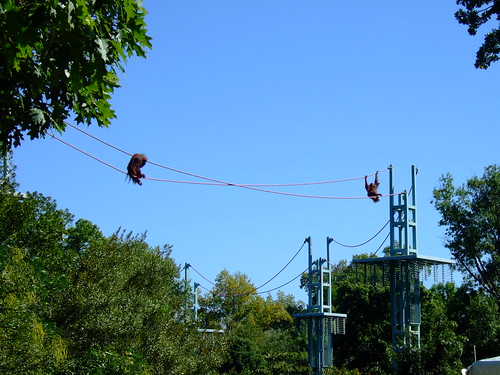
There was a thread on trails earlier where I think there was mention of having a strong rope in between two exhibits to allow orangutans to travel over the visitors.
 
National Zoo has an orangutan trail connecting several exhibits.
The O Line - National Zoo| FONZ
1471619155_514261fe36.jpg
 
Of course animals are like people they don't sing and dance all day long the farm sheep and goates I have contact with spend time feeding and resting then feeding then resting, and on it goes all day.

Hunters are different of course as are male animals who have a territory to defend. I have often wonderd if different zoos could send each other bedding/urine/ poo from say their big cats on an iregular bases which they could place around their own exhibits ,to stimulate the cats offactory senses. and giving the residents a sense of some other animal having passed through their territory. I imagine elephants and rhinos could benefit the same, it may even improve the reproduction cycle in some cases to have "competition" for the bull or bring on the cycling of the cows.

Of course some anti zoo groups could then decry it as causing extra stress to a captive animal

( my spell check isn't working at present so appoligies in advance)
Farm animals are quite 'dumb' comparing to their wild ancestors/relatives, that's the result of selection.

Most of the vets will disapprove the poop/urine exchange, and the testing of these substances for diseases can be quite long...
In some enrichment manual, I read that elephant dung can be used to stimulate territorial behavior in rhinos.
In the same zoo, inter-species olfactory communication can be possible.
But likely no intra-species one between several zoos.
 
Back
Top