DRAGONS IN DANGER
The biggest highlights of this house are most certainly the Komodo Dragon exhibits, with both indoor and outdoor enclosures for the species; the dragons have bred at Chester a few times, mostly via parthenogenesis - although a traditional breeding also took place a few years ago. At the present time, Chester is the ESB/EEP studbook coordinator for Komodo Dragon.
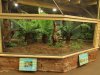
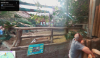
Opposite the main indoor exhibit for Komodo Dragon, there is a smaller exhibit which has variously held Malagasy iguanas and skinks, juvenile Ploughshare Tortoise and - most recently and currently - a group of juvenile Komodo Dragon. The first photograph is the best image in the gallery showing the foot of the exhibit and the overall size, although it was taken during a timespan when Ploughshare were in residence rather than the current occupants, whilst the second image shows the upper levels of the exhibit at the present time.
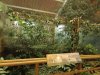
After the Ploughshare Tortoises originally held in the above exhibit grew larger, they were moved into their current exhibit - this photograph shows about half of the overall space, but is the best quality image I was able to find:
Immediately next to this exhibit, there is a large exhibit for Mountain Chicken - another species for which Chester manages the studbook.
This house also contains several large and densely-vegetated aviaries containing a wide range of species from south-east Asia, all of which are category relevant. The inhabitants include (but are not limited to) the following:
- Black-naped Fruit-dove
- Mindanao Lorikeet
- Mindanao Bleeding-heart
- Yellow-faced Myna
- Malayan Peacock Pheasant
- Cinnamon Ground Dove
- Grey-capped Emerald Dove
- Great Argus
- Luzon Bleeding-heart
- Victoria Crowned Pigeon
- Malay Crestless Fireback
- Chestnut-backed Ground Thrush
- Pink-headed Fruit Dove
- Philippine Mouse Deer

 REALM OF THE RED APE
The Bornean Orangutan exhibits which form the central focal point of the Realm of the Red Ape complex are - without a shadow of a doubt - the best in Europe for the species as regards quality, design and visual appeal, much as the exhibits for Sumatran Orangutan over in the Monsoon Forest house are the best for *that* species. I will return to this point anon, but for now I will note that the fact Chester has the best exhibits in Europe for *two* species of great ape, both of which are category relevant, is a massive point in its favour.
The complex as a whole covers a total of around 4,775 m² - I have not included the "old Orang House" immediately adjacent within this total, as although it has historically been used as additional offshow housing for the inhabitants I am not certain this is still the case.

The indoor exhibits (which are shared with Lar Gibbon) comprise a series of several excellent enclosures linked to one another - along with the offshow dens and the outdoor exhibits - by a series of tunnels, and viewed from the upper levels. Some of the indoor exhibits are roofed-over with mesh, both permitting scatter feeding from above and permitting some level of natural airflow and rainfall to reach the exhibits in question.
These exhibits are supplemented by a pair of massive (covering a total of 2,500 m²) and well-vegetated outdoor enclosures providing a large amount of climbing material and options - both ape species have access to these enclosures, which they share with Asian Short-clawed Otter.
The visitor walkway through the house is lined by several smaller aviaries and terrariums for a wide range of south-east Asian species, the vast majority of which are category-relevant. Examples include the following aviaries for Blue-crowned Hanging Parrot, and for Red avadavat, White-headed munia and Tricolored parrotfinch:
...and the following exhibits for Blue Tree Monitor and Reticulated Python:
As one leaves the Realm of the Red Ape house, a large and pleasant mixed exhibit for Asian Short-clawed Otter and Babirusa can be seen from the ramp:
----
Images and discussion pertaining to the Madagascar exhibit complex and to the Islands exhibit complex to follow

but in case I get side-tracked and do not get the opportunity, I will again repeat my above assertions that the Sumatran Orangutan exhibit within Monsoon Forest is the best for the species in Europe, and that the breeding record at Chester with Sulawesi Babirusa (and the fact that the collection is responsible for "saving" the species in European collections) is of equal or greater significance to the Pangolin breedings at Prague, and make the following points which I intend to return to in more detail:
- The smaller walkthrough aviaries within Islands are excellent.
- Monsoon Forest - both in terms of the free-flying species within the main body of the building and the various exhibits found throughout - is one of the best tropical houses in Europe.
- Islands is filled with world-class exhibits and enclosures; along with the above-mentioned Sumatran Orangutan exhibit (which is mixed with Moloch Gibbon), this area of Chester also contains the best Sun Bear exhibit in Europe, one of the best Sumatran Tiger exhibits in Europe, the best Sulawesi Black Macaque exhibit in Europe, excellent exhibits for species such as Javan Banteng, Visayan Warty Pig, Sulawesi Babirusa and Lowland Anoa - amongst others.
- The Fossa exhibit within the Madagascar exhibit complex is the best in Europe without a shadow of a doubt.
- The exhibit for Coquerel's Sifaka is exceptionally good, one of the top-tier lemur exhibits in Europe as a whole, and Chester should be praised for spearheading attempts to establish a European captive population of the species via the import of several pairs from the USA.
Needless to say, if anyone feels like picking up the baton and covering the above points themselves, and providing supplementary photographs, go for it

ditto for anything I have forgotten to mention.


 primarily relating to relative quality of exhibitry, the value/notability of certain species and the breeding thereof, and a few points relating to both collections which have yet to be highlighted.
 But it is very average, which is why I called it ‘mediocre.’ The EEP have advised Prague to make some changes from what I’ve heard. On the flip side, I actually don’t mind the macaque enclosure which I felt offered a lot of height and privacy, though it could have done with a bit more to enable foraging (can’t quite remember, or judge from images, what the natural substrate was like).