Afrykarium Walkthrough
Walkthrough of Wroclaw Zoo Afrykarium: Visit on the 9th of April 2015
Afrykarium is a fantastic exhibit in Wroclaw zoo that is definitely the best part of the zoo. I personally think that it is the best single exhibit that I have ever been to and is simply fantastic.
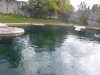
When you first enter through the gates of Wroclaw Zoo, the think that dominates what you see is the huge and impressive sight of the Afrykarium. It is an enormous building that is black in colour and really stands out as a stunning piece of architecture. The part of Afrykarium that you see is the side-on view that has the entrance under an overhang, at the entrance is a huge wall of traditional African-style artwork that is mainly a mixture of oranges in colour so complements the very dark, black of the building. In front of this whole wall is also a long and thin rectangular water feature which is a very shallow pond with perfectly still water and pebbles on the bottom that has the effect of bordering the Afrykarium (see attached picture). The Afrykarium is not right up at the entrance to the zoo but in front is a rectangular paddock for an African Savannah mixed enclosure. This has a fairly large group of
reticulated giraffes as well as
Ostrich, Red Hartebeest (only one in Europe at the moment) and
Chapmann’s Zebra. The African Savannah hoofstock enclosure has the effect of creating a nice area in front of the Afrykarium that gives it somewhat of an ‘introduction’ to the African themed Afrykarium. Of course the hooftsock exhibit was there before the Afrykarium but I think that it still adds to the effect.
You walk past the hoofstock exhibit and come up to the entrance of Afrykarium. At the front is a covered area which is under the second floor of the Afrykarium with the orange artwork. This is where you queue to enter the Afrykariun. When I was there, there was no queue and I could just walk in and I can’t imagine ever having the queue long but I suppose in peak summer season you might wait five minutes or so. There is no extra fee for entering Afrykarium as the entrance is covered by the extremely reasonable entrance cost to the zoo which is only 8 US dollars or 5 pounds 50 (for the whole zoo and Afrykarium!). Of course this entrance cost can only be kept because of subsidies and I think the zoo could easily charge just that for the Afrykarium but they don’t – not at the moment at least – so it is very good value.
You enter Afrykarium and come in to a large two-story hall. In front are some amenities such as a snacks shop and – if I remember correctly – a toilet. There is also an
‘African Swamp’ area in this hall which is comprised of some waterways for
turtles and
fish such as
lungfish and
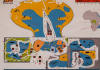
arowanas along with some plants. If you see the attached map, the hall is the white area at the bottom centre with the African swamp being labelled with it marked as that blue area above the white with some green patches. There is a specific route around the Afrykarium with the exit being to the left of the entrance in the direction that you are now facing so you then turn right and begin the tour around the Afrykarium, this path is marked on the map as the orange line going around and I will be writing this walkthrough following the route that you would take around. The first thing you come up to is a sandy area that leads to a seemingly shallow tank. There is viewing into it where there are some saltwater fish and from here you descend down into the underground area while going along the tank. The tank continues down several meters and when you reach the entirety of it, you realise it is very big. There are at least a dozen fish species which are all from the red sea because it is a red sea tank and when I was there were some people in scuba gear cleaning the mould which gives you an idea of the size.
You walk along the red sea tank and enter the underground area, this is themed like a cave with walls and ceiling being brown mock-rock and darker lighting. The first thing you come to in this area is the underwater viewing for the
hippos, this is the controversial topic of keeping hippos in an all indoor area but I will discuss this with the main part of the enclosure. The pool isn’t as clear as the other tanks of course with hippos being in it but when I was there, the hippos weren’t near to the underwater view area and instead were some of the fish species that share the hippo’s pool. There is signage that is a screen that changes to show the different species every few seconds. Continuing past the viewing window for hippos, pass a disabled lift to the upper areas (stairs further on) and come up to the underwater burrow for
aardvark(s?). This is a small looking little burrow with a tunnel leading up to the ‘outdoor’ area which is still indoors but in the upper area (talk about later). Next to the aardvarks is a typical tunnel complex-style exhibit for
naked mole-rats and you turn a corner, coming up to two large, tall tanks for
African Cichlids – one for
Lake Malawi Cichlids and one for
Lake Tanganyikans. There is a large number of fish – several hundred – with some large and very colourful ones. You then come up to the staircase which leads to the upper area.
You take the stairs up and come out in a huge, open hall. The roof has lots of skylights (mainly just glass) which lets in the natural light and it feels very close to being outside. Even though there are three large hippos and lots of other animals, there is no bad smell or anything like that which is a problem commonly associated with indoor hippo areas. There are lots of free flying birds and these are White-faced Whistling Duck, marbled teal, village weaver, yellow-necked francolins (I call them spurfowl myself, don’t know what’s correct but most signs call them francolins),
hadada ibis, red-billed teal, bare-faced go-away birds, white-fronted bee-eaters and
hamerkop. There is lots of nice planting in a savannah-like way including some fair sized trees. Coming up from the staircase, the first thing on you see which is on the left is a nice little enclosure for dik-diks. It is nicely planted and landscaped which goes together with the overall rockwork etc. which makes the enclosure seem part of everything – not enclosed at all. Next along from that is an enclosure for
dwarf mongooses and the ‘outdoor’ area for
aardvarks, it is done up in the same theme and looks very nice. It is very large and also provides the area where visitors can’t walk for the non-water bids.
Still in the same upper area, you go along a path around the hippo enclosure. It really is very big and looks fantastic. There are three hippos and when I went around, two were on the out-of-water area and one was in the water. The water bird species were also around on the out-of-water area and on the water. I would say that this enclosure for hippos is perfectly adequate, and actually quite good. Although the land area is a bit small, it is not too small and the water area is really big. I don’t think the indoor only aspect is a problem because it is in such an open building with so much natural light and as long as the smell doesn’t get bad – which as previously mentioned, it wasn’t when I was there – I don’t think there is a problem. Anyway, you go along a path around the hippo area which is raised above the pool and gives a view completely down on it. There are some trees whith the tops at the level of the pathway and in them there were lots of bird sitting, including a huge hamerkop nest. There is also a waterfall that goes over the path and thunders down into the hippo pool (I mean the path goes between the waterfall and the wall). Once you have gone along the path around the hippo area, you leave this big, open area coming into the
‘Mozambique Channel’.
The ‘Mozambique Channel’ is a long acrylic tunnel that goes through a huge shark tank with dozens of sharks, maybe up to a hundred. There are zebra sharks, blacktip sharks and guitar rays, cow nose rays along with green turtles and lots of very large wrasses and other fish. You go through the impressive shark tank tunnel and exit coming into the boat part of the Afrykarium past part of the other side of the African Swamp. If you look at the attached map you can see the boat coming out of the main building at the top centre. In the indoor part you go through the boat and the bits on the sides are outdoor areas. Because the outdoor areas don’t really fit into the walk through, I will talk about them now.
From the outside you can look at the two huge pools which are one for a group of, I think four cape fur seals and a huge group of 50+
African penguins and
cape shelducks. The two ponds are nicely themed with rocks and sunning areas for penguins and seals. You can look at the outside of the pools and there are viewing points. This also allows you to look at the very impressive Afrykarium with the ship.
Back to the inside area now, you enter the area of the boat inside. There is the option to go to an upstairs area of the boat where there is a café, but I didn’t go up so I can’t say what it’s like. You go into the boat and the first side are huge underwater viewing windows for the African Penguins. The pool is by far the deepest and biggest I’ve seen for penguins and you can really see the penguins ‘fly’ underwater in the huge groups. It is really very impressive and gives a fantastic look at the penguins. On the opposite side of the path is a tank with three different species of moray eel and some empty tanks as well with species to come in the future. You walk along the boat with the penguin viewing windows and turn around to more viewing windows into another huge pool which has the cape fur seals. This boat represents the Skeleton coast and of course both of these species are found in that region as are the fish in the tanks on the other side with species such as lionfish and monos. The huge pool for the fur seals is huge and impressive with opportunities to see them swimming underwater and playing with some buoys. Only two of the fur seals were swimming around when I was there because the rest were out sunning and they swam off into the distance out of view (that’s how big it is) before swimming closer and back into view again.
You then leave the ship and come back out to the other side to another part of the African Swamp area before going into the last section which is Congo. There are more views of some of the species from the African Swamp but I found that some of it was a bit empty. Probably due to the Afrykarium still being quite new and some of the species still needing to breed more to fill up the tanks. You go past the African Swamp area and enter the Congo. The whole area has a few species of birds free flying as well as lots of nice tropical plants very nicely done up. Some of the plants still needed to grow more to fill up some of the space but it still looked fantastic. The bird species in the Congo section are
Blue-bellied rollers, Violet Turacos, Red-crested Turacos Fulvous Whistling Ducks, and Speckled Mousebirds.
When you first come into the Congo area, you see an area of plants and some of the free-flying birds on your right, and on the left is a nice enclosure for
Nile Crocodiles and various species of fish. The sides are glass allowing a view above and below water as well as onto the land area. The enclosure is very nice and integrates well into the surrounding landscaping, almost seamlessly. You go past the Nile Crocodiles area and go down slightly into a sort of cave-y area before coming up to the under-water viewing for a pair (It was a pair during my visit, but sadly one died a few days afterwards) of
Antillean Manatees. These of course represent the African Manatees that would suit the Congo area but I believe the zoo was unable to obtain any of the African species. The tank is very bare but suitably large with two sections that I believe could be divided and large underwater viewing windows all the way along. This provides a very nice view of the animals. There are a few fish sharing the tank with the manatees but something that I thought was excellent was that the free-flying whistling ducks had the manatee tank as their water area so they could be seen swimming on top of the water from below but perhaps even more interesting is that they can be seen diving underwater in the manatee tank through the viewing windows. Of course because the tank’s primary inhabitants are the manatees, it is deep and large in size so this allows the ducks to be seen diving quite deep and behaving underwater in ways I haven’t seen before. I saw one swim all the way to the bottom and then swim back up to the surface upside down. I thought this was a really cool idea.
After the manatee tanks, you take stairs up to a viewing deck that is set above ground level and looks over the Congo Area. Many of the free flying birds can be seen here and there are views over the Nile Crocodile enclosure as well as over the Manatee tank where the manatees can be seen from above eating floating vegetables that they have been fed and the Fulvous Whistling ducks that could be seen from underwater can be seen from above water here. There was a path leading from this area to an area at the back that had some plants and an area where the birds were fed that is marked on the map being for glossy starlings but this path was not open to the public when I was there. This is now the end of the Congo area and you walk along a raised pathway from the deck past the Croc area that you can look directly down on before getting to an escalator which takes you to ground level outside the Congo Area. You are now back in the main entrance area that you came in by and you turn right to go to the exit. In front of the exit is a stand for refreshments as well as a small gift shop and you leave through the same place that you came in from. That is the end of Afrykarium.
I have attached an image of a map that I photographed at the entrance to Afrykarium (it may be nice to follow this around to get a better idea of the route that I am describing though it's probably too late by my this writing it at the end if you've read the whole thing already

) and also views of the front entrance and one of the sides of the back. (by one of the sides of the back I mean I have attached a picture of the fur seal section and on the other side of the boat-thing is the penguin section).
I will be uploading pictures of the Afrykarium and other parts of the zoo to the Wroclaw Zoo gallery (
Zoo Wroclaw Gallery) sometime in a couple of weeks.