Here comes the expected Burgers' Zoo post.
It is just as easy to just copy stuff from the must see exhibits thread here:
14. Burgers’ Bush
Burgers’ Zoo, Arnhem, the Netherlands
Opened: 1988
Size: 14.000 square metres
Inhabitants: roughly 50 species, including aardvark, small-clawed otter, Rodriquez fruit bats, >35 bird species and a range of reptiles, amphibians and fish (and 1000+ plant species, as it is also a botanical garden)
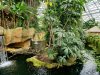
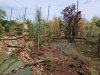
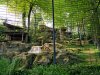
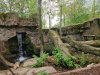
Even after close to 35 years, the Bush is still a landmark in the European zoo landscape. What started as the first large-scale experiment at recreating an ecosystem in a zoo, is still one of Europe’s leading exhibits. Several large rainforest halls have been built since, but none have quite matched the wild rainforest feeling, as they are often somewhat cleaner interpretations. It is also still the only one that expects its visitors to explore the place, as there is a large trail network instead of following one fixed route. Despite this dense network, smart landscaping and planting means the cross-viewing is very limited, giving the hall an even larger feel. The only main drawback is that the roof doesn’t exceed 20 metres above the ground, and is often lower, due to building regulations. There is no specific theme, though the vegetation is neatly divided in an Asian, African and S-American section, but the free-ranging animals naturally don’t keep to those areas. Not only are there over 40 free-ranging animals to find, including many rarities, but many have seen breeding success here too. This is really a hall where one has to look for the animals, as there are only a few enclosures dotted around. With some patience and spotting skills you could spend hours here, and one should as this exhibit only shows it’s secrets after a lot of patience. With Dracaena bushii, this is probably also the only zoo exhibit which has a species named after it. One can only imagine how the Bush could have looked if the original plans, which were twice the size, could have been realised.

@lintworm
@lintworm
@KevinB
@ralph
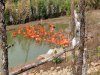
Dracaena bushii
@lintworm
With regards to S-American inhabitants, roughly 1/3 of the hall has S-American planting, including a significant collection of
Aristolochia and there are 3 exhibits within the hall that are American. These are a red-footed tortoise exhibit, the former caiman exhibit (temporarily without the caiman), but still houses 6 S-American fish species and the capybara & yellow-spotted river turtle exhibit (with pacu & red-tailed catfish in the water). The free-ranging species that count for this category are:
Seba's short-tailed bat
Scarlet ibis
Sun bittern
Crested quail dove
American black vulture
Red-rumped cacique
Montserrat oriole
Screaming piha
Spangled cotinga
Purple honeycreeper
Brazilian tanager
Paradise tanager
Turquoise tanager
Violaceous euphonia
Chestnut-bellied seedfinch
Blue-backed grassquit
Rose-bellied bunting
Green iguana
Guadeloupe anole
Plumed basilisk
Montserrat whistling frog
The anoles and frogs number in the thousands. The bird collection is quite choice and with all species bar the paradise & turquoise tanager and the American black vultures (of which they only house 2 males) they have had breeding success. Of the scarlet ibis they currently keep a bachelor group, but breeding used to happen in the past.
Then on to the Desert:
32. Burgers’ Desert
Burgers’ Zoo, Arnhem, the Netherlands
Opened: 1994
Size: 6000 square metres
Inhabitants: large variety of Sonoran/American desert mammals, birds and some ectotherms
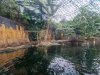
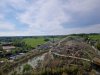
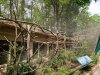
After creating a rainforest replica, Burgers’ Zoo raised the bar and set out to recreate a desert. Designing an immersive environment that faithfully represents such an open landscape is challenging, but they largely succeeded in avoiding any cross-viewing (designers of Beauval should take note). Unsurprisingly the Desert has hardly been copied, given the difficulty of creating a large varied environment. Contrary to the Bush the Desert focuses on one specific location, the Sonora and Mojave desert of Northern Mexico and Southern USA. Apart from the high attention to detail in the landscaping, there is also a quite faithful representation in terms of animal species kept. Apart from a few exceptions, most animals are native to the represented ecosystem. Given the paucity of N-American animals in European collections, this naturally means that the Desert houses more zoo rarities than the majority of zoos on the continent (4 of the bird species kept are unique for European zoos). To maintain such a unique collection, several bird and mammal species are kept in larger numbers behind the scenes to maintain a breeding population, and there is close collaboration with dedicated private keepers. Now approaching it’s 30th birthday, the building has held up remarkably well and is still a unique sight in the European zoo landscape.

@Bosjesman
@lintworm
@Mr Gharial
@Goura
@Morgan
This is the current line-up in terms of free-ranging species:
Turkey vulture
Gambell's quail
Montezuma quail
Blue-winged teal
West-Peruvian dove (signed as white-winged dove)
Socorro dove
Common ground dove
Painted bunting
Rose-bellied bunting
Yellow grosbeak
Ultramarine grosbeak
American goldfinch
Grey cardinal
Black-breasted grosbeak
The vast majority of these species are big rarities in Europe, but are bred annually here. Side enclosures hold:
Ringtail (Burgers' Zoo was the only zoo to breed these in Europe in the past 20 years or so)
North American porcupine
Black-tailed prairie dog
Collared peccary
Merriam's kangaroo rat
Cactus mouse
Hispid cotton rat
Greater roadrunner
Burrowing owl
Mexican housefinch
Orange-breasted bunting
Gila monster
Red diamond rattlesnake
Milk snake
Colorado river toad
Red-knee tarantula
Another choice line-up and the zoo is heavily invested in being able to continuously show the rarer species. So apart from the on show animals, kangaroo rats and cactus mouse have off-show breeding rooms and Burgers' Zoo is the number 1 breeder of greater roadrunner in Europe (though for the first time in ages they only keep 1 pair + the chick from last year and no additional pairs).
The tunnel connecting the Bush and the Desert also has a rather nice set up for blind cavefish:
@KevinB
Then there is the Mangrove:
88. Burgers’ Mangrove
Burgers’ Zoo, Arnhem, the Netherlands
Opened: 2017
Size: 3000 square metres
Inhabitants: Caribbean manatee, fiddler crabs, horseshoe crabs and a large variety of butterflies, birds, fish and some reptiles.
As earlier projects have shown, a Burgers’ Zoo project tends to get better with age and nowhere is it as easy to see this process as in the Mangrove. Even though this is clearly one of the better zoo developments of the past 5 years, it is only now that it is really showing what it is set to become. With the vegetation slowly maturing, new species are slowly added to complete the system and some obvious cross viewing issues are slowly disappearing. It will still be years though before the building is in its prime. The Mangrove follows a journey through the ecosystems of the Shipstern Reserve in Belize, which Burgers’ Zoo bought together with Papiliorama, Kerzers, Switzerland 30 years ago. There are basically three areas in the building, each with their own star species: the Mangrove and its mudflat with fiddler crabs, a freshwater creek with manatees and the dry tropical forest with butterflies. While manatees and butterflies always fascinate regular zoo visitors, it is the fiddler crabs that are the real stars here. By keeping a large group on an even larger mudflat, there is always something going on and it is an exhibit most people spend a lot of time observing. It takes some guts to go all-in on such an obscure species, but with Europe’s first zoo breeding they are on the right track. Zoo nerds aren’t forgotten either, as a focus on Central American birds and fish has already brought in some rarities, most of which are breeding already. From a landscaping perspective, this might be Burgers’ weakest hall, but given the size and round shape that might be unavoidable. The walls are never far away from the visitor path, so there is always a reminder you are in the zoo. Ignoring the walls there is however so much to explore and to look forward to, that the only conclusion is that they did it again…

@vogelcommando
@lintworm
@lintworm
@lintworm
@lintworm
The current line-up of free-ranging species is the following:
Crested bobwhite
West Peruvian dove
Blue ground dove
Red-legged honeycreeper
Blue-backed grassquit
Indigo bunting
Ruddy-breasted seedeater
Violaceous euphonia
Bay-headed tanager
Striped basilisk
Allison's anole
White-throated gecko
Again a choice collection with significant breeding success of the majority of species.
It is worth highlighting the sheer quality of the mudflat enclosure. It is an extremely engaging display, mostly because of the many fiddler crabs (the vast majority is however a W-African/European species, the American ones have almost all died out). But with a side pool with upside-down jellyfish and the main area also inhabited by four-eyed fish, surgeonfish, molly and horseshoe crabs (if you are lucky enough to see them), this is one of my favourite exhibits in the zoo. For the crabs the exhibit is self-sustaining, the sun provides ample algae growth, so they have never had to be fed by the keepers.
@felis silvestris
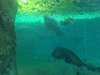
The manatee pool is not shabby either at 1 million litres with a variety of depths and multiple cichlid species + tropical gar as natural predators.
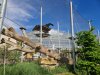
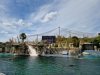
The final S-American exhibit is inhabited by a male group of Peruvian squirrel monkeys and a few old ring-tailed coati. It is a well-planted exhibit of 950 square metres which included multiple mature oak trees which both species take full advantage of:
@KevinB (most of the trees you can see are part of the exhibit and accessible for the monkeys & coati).
Overall there is a lot of very high quality here and especially in terms of landscaping, Beauval just cannot compare. The animal collection might not be very large, but especially when it comes to birds it is a choice collection. It is also worth noting that the majority of those rarities are kept in sizable numbers and breeding success is very high with Burgers' being the only reason multiple species are around in other zoos too. A prime example is painted bunting, of which the zoo currently keeps 26 individuals and it breeds some 10-20 of them annually, which are often sent to other zoos where no long term success is managed (like Beauval...). Burgers' Zoo deliberately chooses to keep fewer species than it possibly could (which sometimes frustrates me), but by going all-in on the species it selects, it can in many cases keep even short-lived small passerine species in the collection for decades with good breeding results.


 .
.