Right then, I'll submit my idea.
The Namib
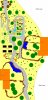
Visitors enter The Namib habitat through a tunnel made to resemble the caves found in the outcrops that dot the landscape, complete with representations of local bushman artwork. Upon leaving the tunnel, visitors get a view of the huge state-of-the-art indoor area, as well as several large surrounding habitats that are made to look like part of a large system of dry riverbeds known as wadis. As visitors head on towards the indoor house, where their journey begins, they pass the first enclosure, housing a small family group of bat-eared foxes, which have an underground den that can be viewed by the passing visitors in a small tunnel. Having passed this, the visitors then wander down a trail past native Namib flora and come across a second enclosure, made to resemble the Namibian karst, complete with low-growing shrubs and loose rocks to provide an excellent habitat for a growing family of black mongooses which are the only members of their species on display in captivity. These mongooses have a hollow acacia tree to retreat into, and a glass viewing window inside means that visitors can get amazingly close to these unique animals. Following on from this is the large indoor house. Off-display stalls and on-display paddocks for each large mammal and bird species can be found here, as well as smaller displays for other animals. The indoor stalls for the largest habitat comes first, a mixed-species hoofstock paddock that houses small but noticeable herds of gemsbok, Hartmanns mountain zebra, greater kudu, springbok and Southern African giraffes. These animals can all be viewed from a viewing balcony that overlooks their waterhole, and can be observed laying in the shade of camel thorn acacia trees.
Following on from this are the three larger predator habitats, each one housing the animals in large suitable environments that are all visually linked to the hoofstock enclosure, so that the predators can observe their prey and make for a more interesting display. One enclosure is also a series of four rotation habitats. The first enclosure is a habitat for a pack of endangered African wild dogs, and displays nearby show visitors how the dogs used to range far and wide across Africa, and the conservation efforts protecting them in Namibia. Following on from this is a large rotation exhibit of four enclosures, all of which are on-show. At random intervals in the day, the honey badgers , caracals, black-backed jackalsand brown hyenas rotate between the four enclosures, so each predator gets to investigate new scents in each habitat, and make for an extremely active display. Viewing windows in rock faces enable the four predators to be observed as they explore and hunt in their enclosures, and displays show visitors how each of the four predators survives, and the relationships between each species in the wild. The final large enclosure is a red sandstone habitat with large acacia trees. This provides the perfect environment for a pair of African leopards, both of which are able to go on display together. A viewing area hidden inside a tree enables close-up viewing into the lives of these magnificent big cats. Opposite the predator viewing area, through the large indoor area, is a viewing area for a large aviary housing a pair of giant and majestic Verreaux's black eagles, while a large indoor open-top habitat houses rock monitor lizards.
After this, visitors enter the final part of the indoor house, which is home to several aviaries, a few other open-top habitats, vivariums and an indoor area for the most important captive-breeding programme in the complex. Five vivariums house, in order Peringuey's adder, Cape coral snakes, a mixed habitat for shovel-snouted lizards and Namibian web-footed geckos, white lady spiders and fog-basking beetles, and a nearby aviary is home to a pair of some extremely rare and valuable Monteiro's hornbills that are native to the region. A large viewing area into an aviary housing lappet-faced vultures and Cape vultures, both classified as vulnerable, can be seen hunched on boulders and cliffs, descending at feeding time when a large carcass is placed into the enclosure. There are both indoor and outdoor areas for a pair of rare blue cranes, that have a view out into the recreated Namib landscape and almost appear to be roaming freely in the vegetation.
Finally, visitors head down a corridor towards the last section of the house. Along this corridor is a giant walk-through aviary, home to four species of birds, namely the Namaqua sandgrouse, sociable weaver bird, red-faced mousebird and peach-faced lovebird, which all, apart from the former, live in the giant haystack-like nests built by the weaver birds. In this corridor is a large solar-powered interactive display, where visitors can find out about the nest as a habitat, and watch films of species that inhabit these nests, such as slender mongooses, striped weasels, lovebirds, spotted-owlets, boomslangs, pygmy-falcons and Cape cobras. In the final area of the house, there are two large open-plan exhibits. The first is home to Namibian desert dune ants, and the second houses the rarely seen and nocturnal hairy-footed gerbils that emerge periodically to feed. Nearby are signs demonstrating what these two very different species do to survive in the desert. And then, opposite these two habitats is an indoor on-display area and a huge outdoor paddock for the world's only captive breeding group of South-Western black rhinoceroses. Two pairs live in the complex, and one pair rotates through an on-display and off-display pair of outdoor paddocks, while the other pair only lives off-show. The habitat has a waterhole, a mud-wallow, a dryriverbed, live vegetation and is seperated from the rest of the park by a small but deep ditch that makes it appear as if the rhinoceros are roaming freely. Before visitors leave the complex, there is a cafe that serves local Namib delicacies for the more daring visitors, and a gift shop selling merchandise and souveniers related to the complex, the animals on display there and their conservation. Also, the exit lobby to the indoor area contains animal ambassadors that are always happy to talk about their charges, who otherwise live off-display, such as small-spotted genets, Southern white-faced scops owls, Meyer's parrots, African rock pythons, Namaqua chameleons, an aardvark, slender-tailed meerkats and even a ground pangolin.
Hope this fits the criteria, and I hope you enjoy reading about it as much as I did creating it.