SOMETIME THIS SPRING, LIKELY IN LATE MARCH,
A FLOCK OF BLACK-CROWNED NIGHT HERONS WILL
RETURN FROM THEIR WINTER ROOSTS IN FLORIDA to nest
near the Zoo’s Bird House. A few scouts will show up in advance. Several weeks
later, about a hundred breeding pairs will follow and begin building nests. A
month after that, heron chicks will begin hatching and squawking for food.
Black-crowned night herons have nested at the Zoo for more than a century.
They have no other rookery in the city. Visitors frequently report them as
escapees from the Bird House, and Zoo staff even feed them, to make sure they
don’t compete with birds in the collection.
The herons are part of a long tradition of ornithology at the Zoo. Soon, that
heritage will get a significant upgrade as work begins on a multiyear renovation
MEHGAN MURPHY/NZP
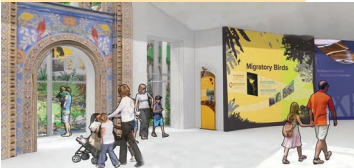
of the Zoo’s Bird House. The new exhibit, “Experience Migration on Bird Plateau,”
will better connect visitors to the amazing bird science that the Smithsonian
supports.
The herons’ share of that science stems from the work of the Smithsonian
Migratory Bird Center, founded in 1991 to study the phenomenon of avian
migration. Roughly 75 percent of the bird species in North America migrate, many of them accomplishing physical feats
that boggle the mind. (For example, the American redstart, which weighs as much as a quarter, travels about 300 miles
a day during its migration from Canada to South America.)
Unfortunately, the majority of migrating birds are in significant decline, due to deforestation and other threats to
habitat, climate change, and additional factors. In its 25-year history, the Migratory Bird Center has made major strides
in understanding the factors behind such population plunges. There’s no other research center like it in the world.
Among its chief accomplishments has been changing the way people think about bird conservation—specifically,
getting them to look more holistically at migrating birds, throughout their entire annual cycle. Taking steps to protect a
species at its summer breeding grounds in the U.S. won’t help if similar measures don’t also conserve the birds’ winter
grounds farther south. As with so many aspects of ecology, everything is connected. Conservation efforts need to be
integrated and coordinated if they are truly to make a difference.
Similarly, the new “Experience Migration” exhibit will more fully integrate conservation science into the visitor
experience. Long a fantastic place to see birds—including flamingos, cassowaries, and kiwi—the Bird House will now
also serve as a “storefront for science,” as Pete Marra, head of the Smithsonian Migratory Bird Center, puts it. Visitors
will be able to walk through the various habitats of migrating birds. They’ll also be able to help researchers who
catch wild birds flying through the Zoo, measure and tag them, and track them afterward to better understand their
migration patterns. During construction, the birds currently in the collection will be moved to temporary space, but we’ll be adding new species to capitalize on the new facility. And don’t worry about the black-crowned night herons. The construction
process will be designed to avoid impacting their nesting season each spring. After all, the herons—along with countless
other migratory bird species—are the true benefactors of the conservation work we do.