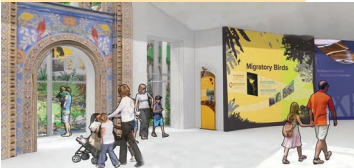
Smithsonian National Zoo Experience Migration

dcpandafan

Well-Known Member
Because this is the zoos next major exhibit renovation I decided I would start a thread about it for people that don't know much about it or if anyone had questions or just wanted to talk about it.

Here's what the zoo has on it's website about the future exhibit.

The Smithsonian's National Zoo is transforming its historic 1928 Bird House and surrounding plateau into an educational celebration of birds and bird migration. 'Experience Migration' will be a first-of-its-kind zoo attraction that immerses visitors in birds' miraculous annual journeys and explains how and why they make them. We will engage people directly in our world-renowned pioneering research led by scientists at the Smithsonian Migratory Bird Center, while inspiring them to participate in protecting migratory birds and their shrinking habitats.

Experience Migration Project - National Zoo
 
I just realized that the zoo actually changed the page. So if you haven't looked at it in a while or ever. I would recommend checking it out. It doesn't go into as much detail as the first one though.
 
I just realized that the zoo actually changed the page. So if you haven't looked at it in a while or ever. I would recommend checking it out. It doesn't go into as much detail as the first one though.

Have you head anything about when the migration exhibit will be opening? Have they started working on it yet?
 
Have you head anything about when the migration exhibit will be opening? Have they started working on it yet?

They haven't physically started working on it. Construction is supposed to start late this year or early next year. The zoo has been slowly lowering the bird house populations the past few months so they can start construction on time. I honestly don't know when its supposed to open. When I visited the zoo I believe one of the signs said "see you in 2020" but I've also read on the zoos website spring 2021 and on Samsungs website I read 2019.

I've been trying to find possible documents the zoo has made about it, but so far no luck.
 
Last edited:
Oh yeah I forgot this.
"The next planned public-facing exhibit renovation is of the historic 1928
Bird House and surrounding plateau, which will turn the facility into an educational celebration of birds and bird migration. FY 2016 will mark the completion of the design phase for this first-of-its-kind zoo attraction that immerses visitors in birds’ miraculous annual journeys. It will engage visitors directly in NZP’s world renowned and pioneering research led by scientists at the Smithsonian Migratory Bird Center, while also inspiring the public to participate in protecting migratory birds and their shrinking habitats. It was an NZP scientist, along with more than 20 other conservation organizations, who developed The State of the Birds 2014 —
the most comprehensive review of long-term trend data for U.S. birds ever conducted. The report finds bird populations declining across several key habitats and includes a “watch list” of bird species in need of immediate conservation
help. This exhibit is essential to tell that important story"

"Planning a Zoo renovation is a major undertaking that must ensure the
safety of the existing live collection while expanding the number and variety of the
species on exhibit. In FY 2016, the collection will be transferred to a suitable
location so that construction can safely begin."

http://www.si.edu/content/pdf/about/FY2017-BudgetRequest.pdf
 
SOMETIME THIS SPRING, LIKELY IN LATE MARCH,
A FLOCK OF BLACK-CROWNED NIGHT HERONS WILL
RETURN FROM THEIR WINTER ROOSTS IN FLORIDA
to nest
near the Zoo’s Bird House. A few scouts will show up in advance. Several weeks
later, about a hundred breeding pairs will follow and begin building nests. A
month after that, heron chicks will begin hatching and squawking for food.
Black-crowned night herons have nested at the Zoo for more than a century.
They have no other rookery in the city. Visitors frequently report them as
escapees from the Bird House, and Zoo staff even feed them, to make sure they
don’t compete with birds in the collection.
The herons are part of a long tradition of ornithology at the Zoo. Soon, that
heritage will get a significant upgrade as work begins on a multiyear renovation
MEHGAN MURPHY/NZP
of the Zoo’s Bird House. The new exhibit, “Experience Migration on Bird Plateau,”
will better connect visitors to the amazing bird science that the Smithsonian
supports.
The herons’ share of that science stems from the work of the Smithsonian
Migratory Bird Center, founded in 1991 to study the phenomenon of avian
migration. Roughly 75 percent of the bird species in North America migrate, many of them accomplishing physical feats
that boggle the mind. (For example, the American redstart, which weighs as much as a quarter, travels about 300 miles
a day during its migration from Canada to South America.)
Unfortunately, the majority of migrating birds are in significant decline, due to deforestation and other threats to
habitat, climate change, and additional factors. In its 25-year history, the Migratory Bird Center has made major strides
in understanding the factors behind such population plunges. There’s no other research center like it in the world.
Among its chief accomplishments has been changing the way people think about bird conservation—specifically,
getting them to look more holistically at migrating birds, throughout their entire annual cycle. Taking steps to protect a
species at its summer breeding grounds in the U.S. won’t help if similar measures don’t also conserve the birds’ winter
grounds farther south. As with so many aspects of ecology, everything is connected. Conservation efforts need to be
integrated and coordinated if they are truly to make a difference.
Similarly, the new “Experience Migration” exhibit will more fully integrate conservation science into the visitor
experience. Long a fantastic place to see birds—including flamingos, cassowaries, and kiwi—the Bird House will now
also serve as a “storefront for science,” as Pete Marra, head of the Smithsonian Migratory Bird Center, puts it. Visitors
will be able to walk through the various habitats of migrating birds. They’ll also be able to help researchers who
catch wild birds flying through the Zoo, measure and tag them, and track them afterward to better understand their
migration patterns. During construction, the birds currently in the collection will be moved to temporary space, but we’ll be adding new species to capitalize on the new facility. And don’t worry about the black-crowned night herons. The construction
process will be designed to avoid impacting their nesting season each spring. After all, the herons—along with countless
other migratory bird species—are the true benefactors of the conservation work we do.

Deniss Kelly, the zoo director.

h9Sf1YJ.png


Also the exhibit seems to be renamed to "Experience Migration on Bird Plateau" instead of just "Experience Migration".

https://nationalzoo.si.edu/JoinFonz/Join/Zoogoer/Zoogoer_Spring_2016.pdf
 
Last edited:
Back
Top