1940-1983:
This part also took longer to make than I thought it would, but here it is, the 3rd part of the history of the Egyptian temple.
First a correction on my previous post:
On July 21, 1931, the skin and skeleton of a black rhino from Antwerp Zoo arrived at the Museum of Natural Sciences in Brussels. So a black rhinoceros lived in Antwerp Zoo until July 1931.
I found out that this Eastern black rhino did not live in the Egyptian temple but in the Hippo Building.
And now to the 1940-1983 section:
This part starts in 1 of the most bad parts of all human history: the 2nd World War. On May 10, 1940, it was Belgium's turn. At the beginning of the war, like 26 years before, 31 predators were preemptively shot, including lions, tigers and jaguars. In the winter of 1940, many more precious animals died from the cold. At the end of 1944 the Antwerp Zoo served as a British army base. For this, the Antwerp Zoo was rewarded in 1945 with 2 female Asian elephants named Monty and Ike. 40% of the animals survived the war, which is very high compared to the 1st World War. However, the buildings did not fare as well: the Aquarium, Reptile Building and Bird Building were hit by a flying bomb at the end of the war. The Bird Building had to be completely demolished, only the façade is still standing. In 1944, 16 bombs hit the Hippo Building, Natural History Museum and Winter Garden and, of the Hippo Building, thanks to the war, only the indoor pools remain from the original building. The Antelope building from 1861 and the Predator building were also completely destroyed and had to be completely demolished. All these buildings are only a fraction of what was destroyed during the war. And the Egyptian Temple was not left untouched either, as the roof with the beautiful glass dome collapsed. But the animals of the Egyptian temple also suffer from the war. For example, the 3rd okapi of the Antwerp Zoo, Tele, dies.
Building:
As already mentioned, the roof of the Egyptian temple collapsed. Therefore, in 1949, a restoration was done to the building, but again it was mainly painting works. This time the painting works were under the direction of P. De Troyer. The decoration of the side walls was completely changed, only the facade still has the original paintings. The elephants' pool was also damaged during the war. In 1964, fundamental problems were finally looked at, instead of repainting or minor restoration works, these major restoration works continued until 1965. The main problems were seeping rainwater and the urine of the animals, because of this, ventilation holes were installed. Under the direction of R. Landois, the appearance of 1861 was restored.
Animals:
Asian elephants: As already mentioned, in July 1945 the Antwerp Zoo received 2 Indian elephants (0.2) donated by the British Army because the zoo served as a British Army base. The elephants were named Monty and Ike and came from Allwetterzoo Münster. How many elephants were present at that time is very difficult to say due to the unknown dates of death. Monty was euthanized on May 10, 1957 due to her aggressive behavior. Ike, however, would live another 36 years, until November 9, 1981, she turned 45 years old.
In the meantime, 5 more Asian elephants arrived at the Antwerp Zoo:
The female elephant Kasia arrived from the wild in 1951. On 1/8/1951 she left for the Warsaw Zoo, where she died on 20 July 1956.
On an unknown date, the male elephant Romeo II arrived from the wild. He leaves on an unknown date for Tierpark Hagenbeck, where he died on January 19, 1965.
On April 6, 1967, the 10-month-old female elephant Urajah arrived, he left on April 25, 1969 for Soest Zoo, a holding and trading facility in the Netherlands.
On May 12, 1976, the young female elephant Dumbo arrives for the first time in the Antwerp Zoo, she moves once to Vincennes Zoo and twice to the Rotterdam Zoo. Finally she moves as matriarch of the herd to Planckendael in 2012, where she dies on May 19, 2020.
On June 11, 1976, young female elephants Dora and Duvel arrived from the wilds of Assam (India). Dora left for Zoo Barben on 30 June 1998 and is still living there. Duvel died in the Antwerp Zoo on 7 June 1996, 20 years after her arrival.
African Forest elephants: Also in this period, African Forest elephants arrived from the Belgian Congo.
In 1947, 2 elephants of an unknown gender arrived from the Belgian Congo, already in the same year they left the collection.
On July 30, 1952, female Forest elephant José, together with African plains elephant Willibadi, arrived at the port of Antwerp from the Gangala-na-Bodio Elephant Domestication Centre in Belgian Congo, keepers from Congo came with the elephants. José died on April 23, 1959. José was the last African Forest elephant of the Antwerp Zoo.
African elephants: In this period both African plains elephants and African savanna elephants were kept in the Antwerp Zoo.
As mentioned earlier, female African plains elephant Willibadi arrived on July 30, 1952 from the Gangala-na-Bodio Elephant Domestication Centre, a training station for elephants in the Belgian Congo. Although she was portrayed as a Forest elephant, she was in fact an African plains elephant, the only one Zoo Antwerpen ever had. She died on July 30, 1953.
From 1921 until about 1960 several African savanna elephants lived in the Antwerp Zoo, it is not known which ones.
From 27 June 1947 until 1949 African elephant Api lived in the Antwerp Zoo, but this one lived in the Hippo Building.
Giraffes: As already mentioned before, Zoo Antwerpen used to be known for its breeding successes with giraffes, and this period is no exeption. At the time, the back of the Egyptian Temple, where giraffes still live today, was divided into 2 enclosures, of which the right one served for the okapis. Here is the information I could find:
In 1946 giraffe Babinne was born.
In the spring of 1949, 3 giraffes arrived in the port of Antwerp, destined for Antwerp Zoo. The 3 giraffes came from the Belgian Congo. Besides the giraffes, many other animals arrived for Antwerp Zoo, including a monitor lizard, a dibatag antelope and a pair of maned wolves from Rio de Janeiro (Brazil).
On 28 April 1953 giraffe Gloria was born.
On March 7, 1955, reticulated giraffe Babin gave birth to a son named Ira.
On July 27, 1959, giraffe Clea gave birth to a son named Mil. The father is giraffe Climax.
In 1965, Gloria herself, born in 1953, gave birth to a daughter named Soraphe. Soraphe was born on August 3, 1965. But also Clea, who still gave birth to a male in 1959 again has a son named Seventeen. Seventeen was born on August 4, 1965. Although Gloria was depicted as a reticulated giraffe at birth, she is now called a masai giraffe like Clea, however, they look neither like a reticulated giraffe nor a masai giraffe.
Okapi: Until 1965 all okapis of the Antwerp Zoo lived in the Egyptian temple, 2 okapis however lived on the African savannah. After this they moved to the Moorish temple which is now the bongo area. Thanks to veterinarian Agatha Gijzen, the Antwerp Zoo became the okapi's studbook keeper in 1959 and succeeded in breeding okapis.
Here information about the okapis that lived in the Egyptian temple:
On October 25, 1943, female okapi Tele dies of malnutrition because of the war, after living in Antwerp Zoo for 15 years.
On May 28, 1948, male okapi Besobe and female okapi Ekate arrive from the Okapi Wildlife Reserve near the Epulu River in the Belgian Congo, like all okapis of this period. Ekate dies as early as May 29, 1948. Besobe dies on July 22, 1958.
On May 1, 1949, the male okapi Butembo arrives. Butembo dies on May 27, 1949.
On September 29, 1950, the female okapi Dasegela arrives. She dies on July 27, 1971, at the age of 23.
On September 18, 1954, Dasegala gives birth to a son named Hoka. The okapi's father is Besobe.
On June 30, 1955, female okapi Isangani arrives. She dies on October 23, 1962.
On August 10, 1955, another okapi arrives, this time a male named Imayala. Imayala dies on January 29, 1972, at the age of 17.
Dasegala and Besobe have another calf on July 3, 1956, however, the female calf dies the same day, and thus was possibly a stillbirth.
On January 22, 1958, however, a successful birth does take place. This time Dasegala gives birth to a female, named Lipumbe. Once again, Besobe is the father. Lipumbe, however, turns out to be not so healthy and attempts are made to raise Lipumbe by hand. Veterinarian Agatha Gijzen also takes care of the okapi, but the okapi already dies on February 4, 1958.
On April 24, 1959, however, it is a greater success. Again Dasegala gives birth to a female, named Mafuta, the father is again Besobe. Mafuta dies on February 2, 1961, at the age of 1. Until then, Mafuta was housed on the African savannah, along with sitatungas, marabous, shoebill storks and more.
On September 12, 1961, the female okapi Nyeusi arrives. She dies 5 years later, on January 28, 1967.
On January 22, 1958, Dasegala again gives birth to a daughter, this time named Lipumbe. The calf's father is again Besobe. However, the calf dies as early as February 4, 1958.
On April 24, 1959, Dasegala gives birth to another daughter. This is the last child of Besobe, who died 9 months earlier. The calf is named Mafuta. An attempt is made to raise Mafuta by hand but Mafuta dies on February 2, 1961, at the age of 1.
On June 1, 1960, Cheik (1.0) and Kebu (0.1) arrive. The okapis are the last okapis to be shipped from the Belgian Congo, as the country became independent on June 30, 1960. The 2 okapis left for Tierpark Hagenbeck on October 1, 1960, where both animals died already on October 10, 1960.
On November 13, 1960, the female okapi Nduku was born, as a child of Dasegela (0.1) and Imayala (1.0). Nduku is the last calf of Dasegela and the first of Imayala. Again, the calf does not survive long, dying on December 31, 1960.
On May 6, 1961, the okapis Congo Ja Sika (1.0) and Bakeda (0.1) arrive. They leave for Bristol Zoo on 29 August 1961, becoming Bristol Zoo's first okapis. Congo Ja Sika dies the same day, Bakeda dies only 10 years later, on 13 August 1971.
On September 12, 1961, the 2 male okapis Okeusi and Mazanga arrive. Okeusi stays in Antwerp, but Mazanga leaves for Bristol Zoo on 15 December 1961, to join Bakeda (who also came from Antwerp). He had 12 children with different females before dying in Bristol on 27 May 1977.
On April 3, 1962, okapi Isangani gave birth to a cub for the first and only time. The father of the cub is Imayala, who will be a father for the last time. However, the cub dies on the same day, or was a stillbirth.
In or around 1965, the okapis Imayala (1.0), Dasegala (0.1), Nyeusi (0.1), and Okeusi (1.0) move from the Egyptian Temple to the Moorish Temple. However, Imayala had been living with okapi Isangani (died in 1962) on the Congolese savannah for some time. A 1966 photograph shows okapis Imayala, Dasegala, and Okeusi together on an outdoor enclosure of the Moorish temple.
Zebras: Just about every map from this period mentions zebras living in the Egyptian temple. All zebra species lived in the Egyptian temple. Here the zebra species of the time+extra information:
In 1978, there were 1.4 Burchell's zebras present in Zoo Antwerp.
The Chapman's zebras lived in the Egyptian temple until they moved to the current kangaroo enclosure somewhere between 1971 and June 1972. On April 12, 1954, a Chapman's zebra was born in the Egyptian temple. In 1959, the/a stallion in the group was a Chapman's zebra named Jimmy.
Hartmann's mountain zebras lived in the Egyptian temple (they still do) from 1934 until an unknown year when they moved to the current kangaroo enclosure, where the Chapman's zebras previously lived and they continued to live until 2012.
Rhinos: Since 1950, rhinos came to live in the Rhino Building, right across the left side of the Egyptian Temple. However, these were only (Northern) white rhinos (the first outside Africa) and in 1978 Indian rhinoceros. The black rhinos, however, continued to live in the Egyptian temple. Below is information about the Eastern black rhinos that lived in the Egyptian temple:
On September 22, 1949, 1-year-old rhino Cona (also called Bona) arrived at the Antwerp Zoo from the Belgian Congo. She died on March 7, 1956.
On June 26, 1953, the almost-1 year old male black rhino Grando arrived from the British colony of Kenya. Grando died on February 21, 1964 as the last male black rhino of Antwerp Zoo.
On August 3, 1956, female black rhino Jessica arrived from the British colony of Kenya. She died on November 5, 1969 and was the last black rhino of the Antwerp Zoo.
The black rhinos lived in the 2 rightmost enclosures on the left side of the Egyptian temple (right across the Rhino Building and now right across the Buffalo aviary). The rightmost enclosure did not have an access gate to the indoor enclosure (it was next to the building façade and is now part of the zebras' separation area) and so a wooden fence was used to lead Jessica (who lived in the enclosure) to her indoor enclosure.
Jessica and Grando were regularly put together in the elephant pen, but without breeding success.
According to the image database, there was another rhino present named Yassam. On 1 picture Yassam and Grando can be seen together (with bars in between), but I can't find anything about this rhino.
Tapirs: Park maps from 1966 to 1978 show that tapirs lived in the Egyptian temple, and no longer in the Hippo building. A 1980 map shows that tapirs were again living in the Hippo building and no longer in the Egyptian temple.
The only species present in Antwerp Zoo at that time was the South American tapir. These were regularly let into the elephant enclosure but it seems they also had their own enclosure on the left side of the temple. In 1973 there were 1.1 South American tapirs in the collection. In 1978 there were still 1.1.
Others: A 1950 park map shows "swamp hogs" in the Egyptian temple. However, I have no idea what species this might be. If anyone knows, please let me know.
So far this section.



 .
. .
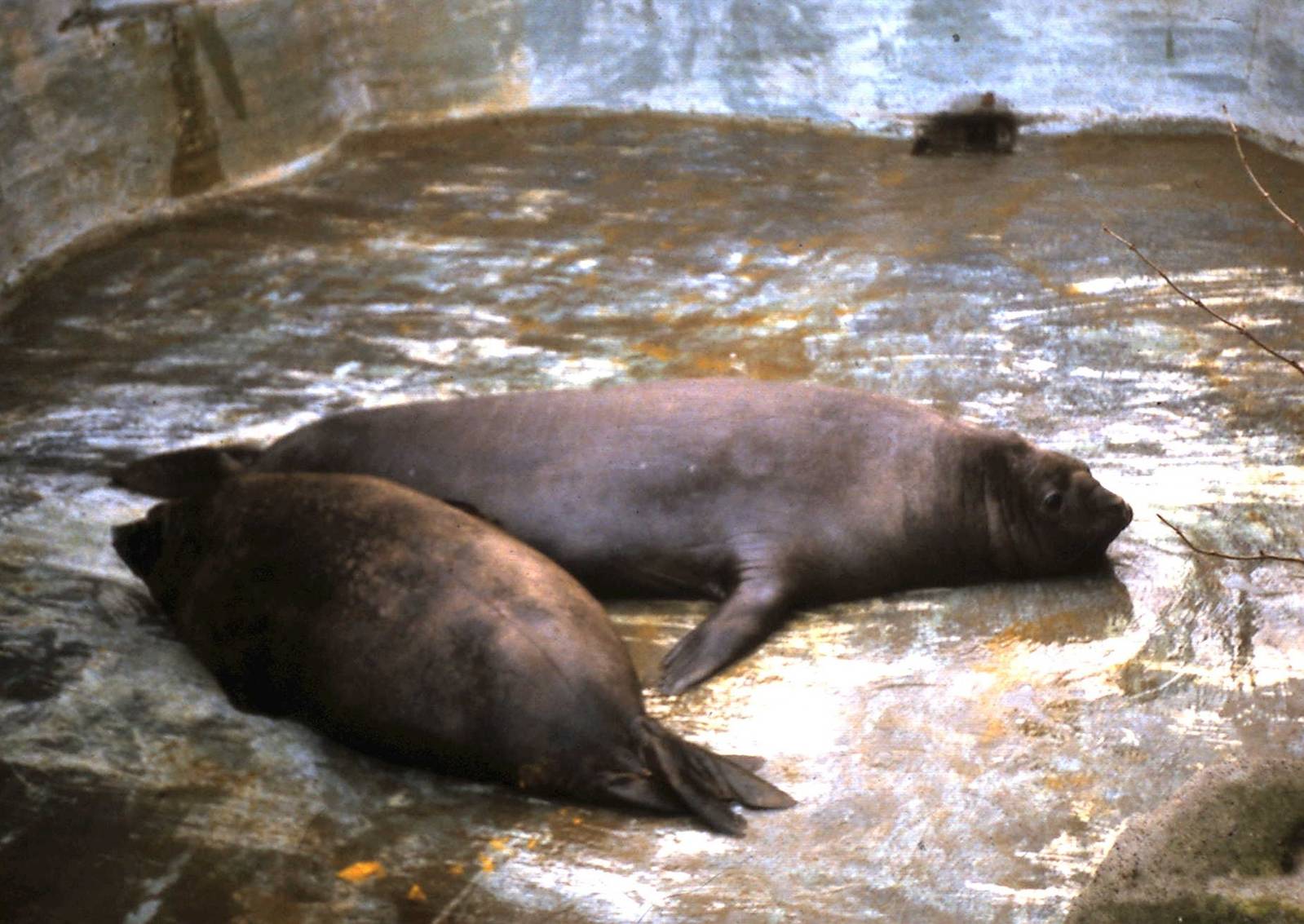
. , I meant the penguins were removed from the enclosure, not the elephant seals.
 . I will use different posts for different time periods or different subject, thereby I always wanted to make an overview of the histroy of the Egyptian Temple. Thanks for the idea