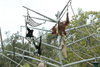
Melbourne Zoo Future of Melbourne Zoo 2023 (Speculation / Fantasy)

Status
Not open for further replies.
Had an idea regarding the sheering shed that is at WORZ assuming it’s heritage listed in some capacity the externals probably can’t be changed but the internals could be completely redone as a Victorian Nocturnal House with Eastern Barred Bandicoots making a return, Murray Darling Carpet Pythons, Fat-tailed Dunnarts, Plains-wanderer, a Bettong sp., Marbled Geckos and other animals often associated with farm structures. This could then expand the native section of the zoo and give it a point of difference displaying species unique to the West of Victoria in such a way that also comments on human wildlife conflict as well.
Would be
a big increase in quality from the current(?) nocturnal house
LOVE this idea!
 
I do think that breeding programs should reassess how they function. I do feel many of these species could be bred in larger numbers, and encouraged to display more instinctual, wild behaviours, with the excess being sent to their endemic countries, with the aim of them being released in the wild or reserves.

Larger groups are beneficial for so many reasons. Most primates learn through observation and it’s preferable for juvenile and adolescent females to observe maternal care of young prior to raising their own offspring. There’s an opportunity to hold these larger groups in open range zoos like Werribee versus city zoos who hold small populations of the same species.

It’s obvious that larger groups mirror the natural social behaviour of a species. Elephants living in matriarchal herds and chimpanzees living in communities being two examples. Not only are these animals more stimulated, they’re better socially prepared for whatever future situations they find themselves in (in the case of chimpanzees, this can mean integrating into another troop).
 
Zoos Victoria Criteria

As we’re all aware, Zoos Victoria have the following species criteria:

Recovery - threatened species recovery programme, preferably reintroduced to the wild.

Ark - species under threat of extinction in the wild and part of regional and international breeding programmes.

Ambassador - the face of a conservation campaign.

Enabling - species that engage with people and form emotional bonds.

Research - species that support the research of Zoos Victoria for the improvement of animal welfare.

We’re led to believe this is applied broadly to Zoos Victoria as a whole (four zoos), but I feel like they’d benefit by assessing each zoo individually (with criteria that fits their collection).

Werribee is African mammals centric. The Recovery and Research categories are largely redundant as they’re geared towards native species.

Healesville is native species centric. Is there anything at Healesville we’d consider Enabling? Again, a redundant category.

The criteria is very much biased towards native species. Any native species ticks the Recovery box. Most will tick the Research or Ark box (or both). Since a species must meet two of the five criteria, that means all native species fit.
 
Zoos Victoria Criteria

As we’re all aware, Zoos Victoria have the following species criteria:

Recovery - threatened species recovery programme, preferably reintroduced to the wild.

Ark - species under threat of extinction in the wild and part of regional and international breeding programmes.

Ambassador - the face of a conservation campaign.

Enabling - species that engage with people and form emotional bonds.

Research - species that support the research of Zoos Victoria for the improvement of animal welfare.

We’re led to believe this is applied broadly to Zoos Victoria as a whole (four zoos), but I feel like they’d benefit by assessing each zoo individually (with criteria that fits their collection).

Werribee is African mammals centric. The Recovery and Research categories are largely redundant as they’re geared towards native species.

Healesville is native species centric. Is there anything at Healesville we’d consider Enabling? Again, a redundant category.

The criteria is very much biased towards native species. Any native species ticks the Recovery box. Most will tick the Research or Ark box (or both). Since a species must meet two of the five criteria, that means all native species fit.

Exotic Species Criteria

Further to the above, I thought it’d be interesting to examine how exotic species fit into the Zoos Victoria criteria.

Categories they don’t fit:


We can start off by eliminating Research. Data is collected on every individual of every species as a part of routine husbandry. Occasionally, a research paper may be written as focus topic; but to date, Zoos Victoria’s ongoing/long term research has only focussed on native species - understandable when Australian facilities are expected to lead the way in this field.

We can eliminate Recovery. Generally speaking, exotic species are not released back into the wild. There will be exceptions e.g. Perth Zoo has released three Sumatran orangutans; however these serve as isolated incidences and it’s not something Zoos Victoria has participated in in recent years.

Categories they fit:

This leaves: Ark, Ambassador and Enabling…

The problem here is Ark (concerning endangered or critically endangered species) is very much linked to Ambassador. You can find exceptions if you look hard enough (beads for baboons); but generally speaking, conservation campaigns like palm oil exist because they concern threats to endangered species.

Enabling is a highly subjective criteria and measured using tools such as social media engagement analysis. Pop culture has a significant impact, popularising some species over others e.g. Quokka, Tasmanian devils, anything from the Lion King.

Conclusion:

In conclusion, an exotic species is for the most part for the chopping block under this criteria unless it’s endangered and enabling (it must meet a minimum of two criteria).

However, it appears the Enabling category is super-sized when it suits (i.e. it counts for two) as Asian-small clawed otter and Slender-tailed meerkat only meet no other category but Enabling, yet still remain at the zoo. Many zoos rate otters as one of their most enabling species in terms of visitor engagement.
 
Great short MZ visit this morning. Spent a good amount of time watching the Siamang from the Japanese Garden. Was SUPER active. Swung and balanced on all the ropes, took turns clambering up each of the big trees, and even scaled the palm tree, and used two dangling palm fronds as a fireman's pole to get down again.

Made me think that an aerial bridge to another enclosure as has been suggested here, would be awesome. Even if this was just to another Siamang enclosure on the other side of the Macaw Cafe, or in Growing Wild. (Or both).
 
Great short MZ visit this morning. Spent a good amount of time watching the Siamang from the Japanese Garden. Was SUPER active. Swung and balanced on all the ropes, took turns clambering up each of the big trees, and even scaled the palm tree, and used two dangling palm fronds as a fireman's pole to get down again.

Made me think that an aerial bridge to another enclosure as has been suggested here, would be awesome. Even if this was just to another Siamang enclosure on the other side of the Macaw Cafe, or in Growing Wild. (Or both).

It was certainly eye-opening to visit Singapore’s Tree Tops Trail and see Siamang brachiating through a forest, a stark contrast to Australasia’s comparatively small Siamang exhibits.

Since then, Auckland Zoo have opened their aerial pathway, which is equally as enriching for their Siamang pair. I see no reason why this wouldn’t work just as well at Melbourne Zoo.

Until Auckland Zoo’s Bornean orangutan and Siamang were recently integrated, they rotated use of the aerial pathway. The only note I would make on this is the Bornean orangutan greatly overshadowed the Siamang and indeed there was disappointment from all involved if it wasn’t the orangutans turn.

With this in mind, I’d recommend Melbourne Zoo either install an aerial pathway for both orangutans and gibbons (with the view of integrating them); or one purely for the gibbons. That way everyone’s expectations are met and people enjoy it for what it is.
 
Great short MZ visit this morning. Spent a good amount of time watching the Siamang from the Japanese Garden. Was SUPER active. Swung and balanced on all the ropes, took turns clambering up each of the big trees, and even scaled the palm tree, and used two dangling palm fronds as a fireman's pole to get down again.

Made me think that an aerial bridge to another enclosure as has been suggested here, would be awesome. Even if this was just to another Siamang enclosure on the other side of the Macaw Cafe, or in Growing Wild. (Or both).
How often are the siamang on the Japanese island? I’ve actually never seen them there before. This aerial bridge should be greatly enriching for animals and guests, and I wonder if the siamang and orangutan can be mixed as they often are
 
Zoos Victoria Criteria

As we’re all aware, Zoos Victoria have the following species criteria:

Recovery - threatened species recovery programme, preferably reintroduced to the wild.

Ark - species under threat of extinction in the wild and part of regional and international breeding programmes.

Ambassador - the face of a conservation campaign.

Enabling - species that engage with people and form emotional bonds.

Research - species that support the research of Zoos Victoria for the improvement of animal welfare.

We’re led to believe this is applied broadly to Zoos Victoria as a whole (four zoos), but I feel like they’d benefit by assessing each zoo individually (with criteria that fits their collection).

Werribee is African mammals centric. The Recovery and Research categories are largely redundant as they’re geared towards native species.

Healesville is native species centric. Is there anything at Healesville we’d consider Enabling? Again, a redundant category.

The criteria is very much biased towards native species. Any native species ticks the Recovery box. Most will tick the Research or Ark box (or both). Since a species must meet two of the five criteria, that means all native species fit.

Exotic Species Criteria

Further to the above, I thought it’d be interesting to examine how exotic species fit into the Zoos Victoria criteria.

Categories they don’t fit:


We can start off by eliminating Research. Data is collected on every individual of every species as a part of routine husbandry. Occasionally, a research paper may be written as focus topic; but to date, Zoos Victoria’s ongoing/long term research has only focussed on native species - understandable when Australian facilities are expected to lead the way in this field.

We can eliminate Recovery. Generally speaking, exotic species are not released back into the wild. There will be exceptions e.g. Perth Zoo has released three Sumatran orangutans; however these serve as isolated incidences and it’s not something Zoos Victoria has participated in in recent years.

Categories they fit:

This leaves: Ark, Ambassador and Enabling…

The problem here is Ark (concerning endangered or critically endangered species) is very much linked to Ambassador. You can find exceptions if you look hard enough (beads for baboons); but generally speaking, conservation campaigns like palm oil exist because they concern threats to endangered species.

Enabling is a highly subjective criteria and measured using tools such as social media engagement analysis. Pop culture has a significant impact, popularising some species over others e.g. Quokka, Tasmanian devils, anything from the Lion King.

Conclusion:

In conclusion, an exotic species is for the most part for the chopping block under this criteria unless it’s endangered and enabling (it must meet a minimum of two criteria).

However, it appears the Enabling category is super-sized when it suits (i.e. it counts for two) as Asian-small clawed otter and Slender-tailed meerkat only meet no other category but Enabling, yet still remain at the zoo. Many zoos rate otters as one of their most enabling species in terms of visitor engagement.

Whilst I'm only speculating, I would possibly argue that a bias in the criteria towards native species is the point - Australian species have the greatest potential for breeding programs in Australia to have a direct conservation impact.

That's not to say that I don't believe non-Australian species should be housed and bred in captivity in Australia - I see the value in people being able to view and connect with animals from across the world in easy access from where they live - but that, with the resources Zoos Victoria have available to them, I suspect they would rather dedicate these resources to species which can have the maximum impact in terms of conservation, education, etc.

I do think it's a valid question about common, small species like meerkats, otters etc, and where they fit. Meerkats, arguably, have a place due to Melbourne Zoo's connection with the children's hospital. The idea that enabling is a super-category makes sense, although kind of undermines the concept of having categories in the first place :p

How often are the siamang on the Japanese island? I’ve actually never seen them there before. This aerial bridge should be greatly enriching for animals and guests, and I wonder if the siamang and orangutan can be mixed as they often are

Are the siamang on the Japanese island the older offspring of the breeding pair, with the others in the orangutan complex, or did I imagine that?
 
How often are the siamang on the Japanese island? I’ve actually never seen them there before. This aerial bridge should be greatly enriching for animals and guests, and I wonder if the siamang and orangutan can be mixed as they often are

Oregon, San Diego, Fresno Chaffee, Cincinnati, Miami, Metro Richmond and Omaha have all mixed orangutans with gibbons. Orangutans have also been mixed with tapir and otters at other zoos.

Adelaide tried it, but the male Siamang had his arm broken by the male orangutan.

Space is essential - both in introductions and to ensure long term cohesion; but depending on the personalities of those involved, can be enriching for all concerned.

upload_2023-3-19_17-14-48.jpeg
San Diego by @zankara
 

Attachments

  • upload_2023-3-19_17-14-48.jpeg
    upload_2023-3-19_17-14-48.jpeg
    202.3 KB · Views: 10
Whilst I'm only speculating, I would possibly argue that a bias in the criteria towards native species is the point - Australian species have the greatest potential for breeding programs in Australia to have a direct conservation impact.

That's not to say that I don't believe non-Australian species should be housed and bred in captivity in Australia - I see the value in people being able to view and connect with animals from across the world in easy access from where they live - but that, with the resources Zoos Victoria have available to them, I suspect they would rather dedicate these resources to species which can have the maximum impact in terms of conservation, education, etc.

I do think it's a valid question about common, small species like meerkats, otters etc, and where they fit. Meerkats, arguably, have a place due to Melbourne Zoo's connection with the children's hospital. The idea that enabling is a super-category makes sense, although kind of undermines the concept of having categories in the first place :p


Are the siamang on the Japanese island the older offspring of the breeding pair, with the others in the orangutan complex, or did I imagine that?

I don’t know the specifics (i.e. dollar amounts) but I’d imagine Zoos Victoria gets government funding to undertake conservation projects for native species. Similarly, rescue hospitals in zoos would be government funded as otherwise it’d just be a drain on a zoo’s resources to treat animals that putting it bluntly are going to either die or be released back into the wild - bringing no benefit to the zoo beyond the satisfaction of helping wildlife.

International visitors would come to Melbourne Zoo (one of Australia’s most prestigious zoos) with an expectation of seeing the iconic Australian species. While I accept that, I think we’d all rather see their collections streamlined so that the bare minimum of natives are held at Melbourne Zoo. It’s not like we’re gonna see Sumatran tigers and Nepalese red pandas at Healesville, so at least give us Melbourne Zoo.

Melbourne Zoo have just 1.2 Siamang - a breeding pair named Isidor and Sumpit; and their four year old daughter, Kemala. Perhaps you were thinking of Melbourne also having White-cheeked gibbons (now just a single female); or thinking of Adelaide Zoo, who until a few years ago had two breeding pairs (each with a son).
 
I don’t know the specifics (i.e. dollar amounts) but I’d imagine Zoos Victoria gets government funding to undertake conservation projects for native species. Similarly, rescue hospitals in zoos would be government funded as otherwise it’d just be a drain on a zoo’s resources to treat animals that putting it bluntly are going to either die or be released back into the wild - bringing no benefit to the zoo beyond the satisfaction of helping wildlife.

International visitors would come to Melbourne Zoo (one of Australia’s most prestigious zoos) with an expectation of seeing the iconic Australian species. While I accept that, I think we’d all rather see their collections streamlined so that the bare minimum of natives are held at Melbourne Zoo. It’s not like we’re gonna see Sumatran tigers and Nepalese red pandas at Healesville, so at least give us Melbourne Zoo.

Melbourne Zoo have just 1.2 Siamang - a breeding pair named Isidor and Sumpit; and their four year old daughter, Kemala. Perhaps you were thinking of Melbourne also having White-cheeked gibbons (now just a single female); or thinking of Adelaide Zoo, who until a few years ago had two breeding pairs (each with a son).
I think MZ must have recently acquired a second White-cheeked Gibbon, as on the Arboreal trail today there was a predominantly black, and a predominantly white gibbon in their enclosure.
 
I think MZ must have recently acquired a second White-cheeked Gibbon, as on the Arboreal trail today there was a predominantly black, and a predominantly white gibbon in their enclosure.

Looking back on notes, I see a male named Canh (born 2015) was recently transferred in from Perth Zoo as a mate for Melbourne’s female. She was previously paired with a male, who was transferred to Tasmania Zoo after they failed to produce offspring at Perth. She’s very shy, which may have contributed to her lack of success in breeding to date.

Glad to hear they’ve been integrated and are on exhibit together!
 
I don’t know the specifics (i.e. dollar amounts) but I’d imagine Zoos Victoria gets government funding to undertake conservation projects for native species. Similarly, rescue hospitals in zoos would be government funded as otherwise it’d just be a drain on a zoo’s resources to treat animals that putting it bluntly are going to either die or be released back into the wild - bringing no benefit to the zoo beyond the satisfaction of helping wildlife.

International visitors would come to Melbourne Zoo (one of Australia’s most prestigious zoos) with an expectation of seeing the iconic Australian species. While I accept that, I think we’d all rather see their collections streamlined so that the bare minimum of natives are held at Melbourne Zoo. It’s not like we’re gonna see Sumatran tigers and Nepalese red pandas at Healesville, so at least give us Melbourne Zoo.

Melbourne Zoo have just 1.2 Siamang - a breeding pair named Isidor and Sumpit; and their four year old daughter, Kemala. Perhaps you were thinking of Melbourne also having White-cheeked gibbons (now just a single female); or thinking of Adelaide Zoo, who until a few years ago had two breeding pairs (each with a son).
so how often are siamang viewable from the garden? Or is there always at least one there?
 
Siamangs were moved to the orangutan sanctuary about 2 years ago and are no longer available to see at the Japanese garden
The Siamang is at the Japanese Garden. I spent 15-20 minutes this morning watching one of the Siamang climbing up and down each of the trees, and swing and running along the ropes.

I do believe that the enclosure has been refurbished - it looked quite fresh.
 
Last edited:
Great short MZ visit this morning. Spent a good amount of time watching the Siamang from the Japanese Garden. Was SUPER active. Swung and balanced on all the ropes, took turns clambering up each of the big trees, and even scaled the palm tree, and used two dangling palm fronds as a fireman's pole to get down again.

Made me think that an aerial bridge to another enclosure as has been suggested here, would be awesome. Even if this was just to another Siamang enclosure on the other side of the Macaw Cafe, or in Growing Wild. (Or both).

I think MZ must have recently acquired a second White-cheeked Gibbon, as on the Arboreal trail today there was a predominantly black, and a predominantly white gibbon in their enclosure.

so how often are siamang viewable from the garden? Or is there always at least one there?

Didn’t they move there in January?

The Siamang are a bonded family group consisting of a pair and their adolescent daughter, so you’ll always find them together.

The Siamang is at the Japanese Garden. I spent 15-20 minutes this morning watching one of the Siamang climbing up and down each of the trees, and swing and running along the ropes.

Re. Saimang, Melbourne have only ever had a pair. Isidor and Sampit who’ve been there for over two decades now. They’ve had many offspring, but all were sent overseas at a young age.

They initially were at Orangutan Sanctuary (in the late 2000’s) before moving back to the Lemur Islands for a few years before being moved to the Japanese Island (circa 2015). They were then moved back to the Orang-utan Sanctuary in 2019 and the pair (Isidor and Sampit) have since moved back to the Japanese Island this year.

Their recent born daughter (Kemala) was born in 2018, and she remains in the Orangutan Sanctuary as the plan is for her to be paired with a new male and form a new breeding pair there. Her parents will be retired on the Japanese Island.

The new male White Cheeked Gibbon is Cahn from Perth. He arrived late December to replace their former male Jin Huan who was sent to Tasmania. Li Lians very very shy, so it remains to be seen whether this a breeding or non breeding pair.
 
How often are the siamang on the Japanese island? I’ve actually never seen them there before. This aerial bridge should be greatly enriching for animals and guests, and I wonder if the siamang and orangutan can be mixed as they often are

Oregon, San Diego, Fresno Chaffee, Cincinnati, Miami, Metro Richmond and Omaha have all mixed orangutans with gibbons. Orangutans have also been mixed with tapir and otters at other zoos.

Adelaide tried it, but the male Siamang had his arm broken by the male orangutan.

Space is essential - both in introductions and to ensure long term cohesion; but depending on the personalities of those involved, can be enriching for all concerned.

View attachment 611957
San Diego by @zankara

In regards to potentially mixing them, I'd actually imagine these recent moves with the Saimang will support this going forward (potentially indicating an Orangutan expansion too!).

The current pair at Melbourne (Isidor and Sampit) were trialled with the Orangutans at Melbourne back in the late 2000's but it never worked; mainly due to the personalities of this pair who always liked to stir up the orangutans (and we know that didn't always end well:rolleyes:).

Anyhow, it's possible this new pair of their daughter (Kemala) plus a male will perhaps be in hopes of mixing them with the Orangutans again down the line.
 
Since I’m visiting the zoo in the next week or two and have no self respect, does anyone have any questions they want me to ask?

- Gorilla breeding: Is Kimya pregnant? If not, why not? And are there any plans for imports?
- White Cheeked Gibbons: Are they a breeding pair?
- Orangutans: Is an expansion being considered? And also are there plans to import a female?
- Saimangs: When will Kemala's mate arrive and where from (if he hasn't already)?
- Baboons: Will the males be moved elsewhere? If so, where to?
- Snow Leopards: Is there any plans to re-pair them again (should be)?

And of course the question we'll keep on asking until we get the answer! What will be replacing the elephants!:D
 
Status
Not open for further replies.
Back
Top