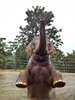
Taronga Zoo Future of Taronga Zoo (Speculation / Fantasy)

Re. Size of Taronga Zoo’s elephant facility:

The main (cow) exhibit is 4500 m²; while the former bull facility consists of a 2000 m² paddock and a 500 m² exercise yard.

Though the size of their cow exhibit seems to be a bit off; I don’t think it’s that big, at least from the eye.

Those figures came from Taronga Zoo’s Project Manager of Exhibit Planning, so I’m inclined to believe they’re accurate.
 
No problem. Though expanding the facilities was seen as a way to accommodate a breeding herd, the breeding programme was more successful than anyone could have anticipated - with three of the four cows producing calves and quickly out growing the exhibit. On hindsight, the move to Dubbo was inevitable from the beginning.

That's very true. Gung's move to Dubbo, which effectively brought to an end natural breeding at Taronga - also allowed the giraffe herd to be relocated within the zoo during the African Savannah developments. This would have been much more convenient for the animals and keepers alike than trying to move fully-grown giraffe out of Taronga, or have them off-display during the duration of construction.

I agree with others that the camels aren't the most effective use of the space anymore. I gather that they could quite easily be housed back at Dubbo or at another facility, although for the meantime prevent that exhibit from being empty now that the giraffe have moved into their upgraded exhibit.

I think going back a bit, prior to needing to use the old elephant exhibit for elephants again with Gung having his own accommodation, the plan was to make that area for New Guinea animals and/or constructing a building on that site for very small animals like invertebrates and the like. Obviously, that's going back over 15 years ago now, so it doesn't represent the current plans (at least as far as I'm aware).

The other exhibit in that area which is currently empty is the saltwater crocodile exhibit below the tamarins. It's a very heavily forested area of the zoo, so it would be great for it to be utilised for something, especially as the croc exhibit is the only exhibit on that path between the concert lawns and GSO. The croc was moved out (and moved out of the collection) as the exhibit was no longer considered up to standard for such a large animal. For a time the path was closed, but it was reopened again, with signs outside the exhibit indicating that it's empty, as it's more accessible than having to walk back through GSO or get up a whole bunch of stairs near the Palm Aviary.

I like @Swanson02's suggestion of having a mini South American area. If it were big enough, then the old crocodile exhibit could be used to house alligator (they are a smaller crocodilian species, after all). Moving the capybara for a mixed exhibit also frees up their exhibit for another species linked to the Congo precinct.

Likewise I like @Jambo's idea to use the area to house pygmy hippo and colobus.
 
That's very true. Gung's move to Dubbo, which effectively brought to an end natural breeding at Taronga - also allowed the giraffe herd to be relocated within the zoo during the African Savannah developments. This would have been much more convenient for the animals and keepers alike than trying to move fully-grown giraffe out of Taronga, or have them off-display during the duration of construction.

I agree with others that the camels aren't the most effective use of the space anymore. I gather that they could quite easily be housed back at Dubbo or at another facility, although for the meantime prevent that exhibit from being empty now that the giraffe have moved into their upgraded exhibit.

I think going back a bit, prior to needing to use the old elephant exhibit for elephants again with Gung having his own accommodation, the plan was to make that area for New Guinea animals and/or constructing a building on that site for very small animals like invertebrates and the like. Obviously, that's going back over 15 years ago now, so it doesn't represent the current plans (at least as far as I'm aware).

The other exhibit in that area which is currently empty is the saltwater crocodile exhibit below the tamarins. It's a very heavily forested area of the zoo, so it would be great for it to be utilised for something, especially as the croc exhibit is the only exhibit on that path between the concert lawns and GSO. The croc was moved out (and moved out of the collection) as the exhibit was no longer considered up to standard for such a large animal. For a time the path was closed, but it was reopened again, with signs outside the exhibit indicating that it's empty, as it's more accessible than having to walk back through GSO or get up a whole bunch of stairs near the Palm Aviary.

I like @Swanson02's suggestion of having a mini South American area. If it were big enough, then the old crocodile exhibit could be used to house alligator (they are a smaller crocodilian species, after all). Moving the capybara for a mixed exhibit also frees up their exhibit for another species linked to the Congo precinct.

Likewise I like @Jambo's idea to use the area to house pygmy hippo and colobus.

Using Gung’s exhibit to accomodate the giraffes for that year was no doubt a contributing factor in the decision to move him to Dubbo - as well as wanting to get the maximum number of elephants off site at Taronga. It’s interesting to note that since his relocation, he’s yet to breed given Thong Dee was pregnant upon transfer and Porntip conceived via AI to Putra Mas.

I’d prefer to see a medium sized herd of camel held at Dubbo than a small herd at Taronga. They don’t really seem a good fit for a city zoo these days and it feels like a geographical clash with this heritage listed elephant temple. It’s too small for Indian rhinoceros, but if weren’t for the sudiae ban, I could imagine few species more fitting than the Babirusa.
 
I like @Swanson02's suggestion of having a mini South American area. If it were big enough, then the old crocodile exhibit could be used to house alligator (they are a smaller crocodilian species, after all). Moving the capybara for a mixed exhibit also frees up their exhibit for another species linked to the Congo precinct.

South American Precinct:

It'd be great to see Taronga (or any zoo in the region) develop a South American precinct that goes beyond housing a handful of monkey species.

There's a huge array of reptiles that can be imported and exhibiting Maned wolf would add an additional biome (grasslands) to the precinct - let's teach the visitors South America doesn't end with the rainforest.

With Brazilian tapir set to become a species of focus in the region, there's an oppotunity for Taronga to acquire them and Blacl'Hansd spider monkeys to create a mixed species exhibit; with Capybara and Bolivian squirell monkeys presenting another option.
 
That's very true. Gung's move to Dubbo, which effectively brought to an end natural breeding at Taronga - also allowed the giraffe herd to be relocated within the zoo during the African Savannah developments. This would have been much more convenient for the animals and keepers alike than trying to move fully-grown giraffe out of Taronga, or have them off-display during the duration of construction.

I agree with others that the camels aren't the most effective use of the space anymore. I gather that they could quite easily be housed back at Dubbo or at another facility, although for the meantime prevent that exhibit from being empty now that the giraffe have moved into their upgraded exhibit.

I think going back a bit, prior to needing to use the old elephant exhibit for elephants again with Gung having his own accommodation, the plan was to make that area for New Guinea animals and/or constructing a building on that site for very small animals like invertebrates and the like. Obviously, that's going back over 15 years ago now, so it doesn't represent the current plans (at least as far as I'm aware).

The other exhibit in that area which is currently empty is the saltwater crocodile exhibit below the tamarins. It's a very heavily forested area of the zoo, so it would be great for it to be utilised for something, especially as the croc exhibit is the only exhibit on that path between the concert lawns and GSO. The croc was moved out (and moved out of the collection) as the exhibit was no longer considered up to standard for such a large animal. For a time the path was closed, but it was reopened again, with signs outside the exhibit indicating that it's empty, as it's more accessible than having to walk back through GSO or get up a whole bunch of stairs near the Palm Aviary.

I like @Swanson02's suggestion of having a mini South American area. If it were big enough, then the old crocodile exhibit could be used to house alligator (they are a smaller crocodilian species, after all). Moving the capybara for a mixed exhibit also frees up their exhibit for another species linked to the Congo precinct.

Likewise I like @Jambo's idea to use the area to house pygmy hippo and colobus.

I do remember Taronga's plans for a Northern Australian area. Melbourne similarly had plans for the same precinct which were eventually canned for the new Orangutan complex which was completed in 06. It appears Melbourne and Taronga were working close together at the time; both built Seal precincts in 08/09 and also worked together for the Thai elephant import a few years prior.

The Saltwater croc exhibit could potentially be used for some smaller African forest animals - turtles and alike (if included as apart of the African section).

If it's apart of a South American, I like the idea of Alligators.

I also like the idea of using the current Capybara exhibit for Pygmy Hippos. All they really need is a renovated pool where the current water area is, and more natural flora shade of course, and it could be one, nice Pygmy Hippo exhibit.

With the new Reptile House being constructed, that sort of forms a barrier between the Congo precinct and the lower (potentially South American precinct). With Tamarins and (potentially Alligators); the former bull elephant exhibit could be converted into a walkthrough dome featuring smaller monkeys, birds ect. It's a flat piece of land, so should be ideal for this.
 
If it were big enough, then the old crocodile exhibit could be used to house alligator (they are a smaller crocodilian species, after all).
If it's apart of a South American, I like the idea of Alligators.

Just a note that the only species of alligator held and bred in the region in large enough numbers to easily source is the American alligator - and this isn’t a South American species.

Some zoos lump it in with their South American exhibits under a label like “the tropics” or “the Americas” - the latter of which also encompasses species like the Black-handed spider monkeys, which is predominantly found in Central America.

Hypothetically, Taronga could import one of the many alligator species native to South America (there’s one facility in Australia that actually holds Spectacled caiman); but personally I believe theming a precinct on the Americas would offer the most opportunities, as well as being the most cost effective course of action.
 
Just a note that the only species of alligator held and bred in the region in large enough numbers to easily source is the American alligator - and this isn’t a South American species.

Some zoos lump it in with their South American exhibits under a label like “the tropics” or “the Americas” - the latter of which also encompasses species like the Black-handed spider monkeys, which is predominantly found in Central America.

Hypothetically, Taronga could import one of the many alligator species native to South America (there’s one facility in Australia that actually holds Spectacled caiman); but personally I believe theming a precinct on the Americas would offer the most opportunities, as well as being the most cost effective course of action.

Very fair point - I admit that I'd not really realised that, most likely as a result of zoo theming (where's the facepalm emoji when you need it? :p). I agree with you that, even if it requires more generic 'Americas' theming, if a crocodilian species is included within such a precinct, it most likely would be the American Alligator.

There's also a slither of space down the hill from the former croc exhibit, which is currently uninhabited jungle. While I'm occasionally hesitant to recommend building exhibits in areas of established canopies for fear of damaging the trees, this area of Taronga rivals Melbourne's rainforest areas in terms of established jungle, and is currently quite under-utilised.

Personally, I'd love for Taronga to reacquire tapir. Tapirs are some of my favourite animals and, considering that Malayans are on the way out, being involved with a rejuvenated program for Brazilians would be wonderful in my eyes. I agree that the new RAAC, especially if it takes up the space of the current gorilla exhibit as well, will separate the zoo (being a building) in a way that the current use of the land doesn't, so turning the area between that, the concert lawns/B2B, GSO and the bottom of the zoo into something exciting would be great.

One thought which I did have in regard to the Congo Forest precinct is that the initial construction boundaries seemed to extend right down to the path and right down to the corner opposite the food market, just above the existing gorilla exhibit. This area now contains a toilet block (on the map called the SC Johnson Family Room) which I believe was built during the African Savannah construction. While I'm not saying that the zoo is hampered in progress by where a toilet block is located, I do feel like the zoo is potentially unlikely to demolish such a recent construction, so this could indicate that the toilet block will remain on the outskirts of the Congo Forest (or, I could be completely wrong, and they could just knock it over as soon as they catch sight of an okapi :D)
 
Very fair point - I admit that I'd not really realised that, most likely as a result of zoo theming (where's the facepalm emoji when you need it? :p). I agree with you that, even if it requires more generic 'Americas' theming, if a crocodilian species is included within such a precinct, it most likely would be the American Alligator.

There's also a slither of space down the hill from the former croc exhibit, which is currently uninhabited jungle. While I'm occasionally hesitant to recommend building exhibits in areas of established canopies for fear of damaging the trees, this area of Taronga rivals Melbourne's rainforest areas in terms of established jungle, and is currently quite under-utilised.

Personally, I'd love for Taronga to reacquire tapir. Tapirs are some of my favourite animals and, considering that Malayans are on the way out, being involved with a rejuvenated program for Brazilians would be wonderful in my eyes. I agree that the new RAAC, especially if it takes up the space of the current gorilla exhibit as well, will separate the zoo (being a building) in a way that the current use of the land doesn't, so turning the area between that, the concert lawns/B2B, GSO and the bottom of the zoo into something exciting would be great.

One thought which I did have in regard to the Congo Forest precinct is that the initial construction boundaries seemed to extend right down to the path and right down to the corner opposite the food market, just above the existing gorilla exhibit. This area now contains a toilet block (on the map called the SC Johnson Family Room) which I believe was built during the African Savannah construction. While I'm not saying that the zoo is hampered in progress by where a toilet block is located, I do feel like the zoo is potentially unlikely to demolish such a recent construction, so this could indicate that the toilet block will remain on the outskirts of the Congo Forest (or, I could be completely wrong, and they could just knock it over as soon as they catch sight of an okapi :D)

I feel like Taronga would be wise to consider redeveloping the forest area you describe to make productive use of the land. While the second biggest challenge of any city zoo is making the zoo look ‘green’; the first challenge is finding space to accomodate constantly changing perceptions on what constitutes an acceptable sized exhibit.

Many zoos have forest areas. Many zoos have undeveloped forest areas, which add value to the zoo by allowing the construction of off display exhibits for species which require privacy to breed e.g. Temminck’s golden cat at Auckland Zoo, but if Taronga’s is serving no direct purpose, then I see little reason to maintain it in the current state.
 
Very fair point - I admit that I'd not really realised that, most likely as a result of zoo theming (where's the facepalm emoji when you need it? :p). I agree with you that, even if it requires more generic 'Americas' theming, if a crocodilian species is included within such a precinct, it most likely would be the American Alligator.

There's also a slither of space down the hill from the former croc exhibit, which is currently uninhabited jungle. While I'm occasionally hesitant to recommend building exhibits in areas of established canopies for fear of damaging the trees, this area of Taronga rivals Melbourne's rainforest areas in terms of established jungle, and is currently quite under-utilised.

Personally, I'd love for Taronga to reacquire tapir. Tapirs are some of my favourite animals and, considering that Malayans are on the way out, being involved with a rejuvenated program for Brazilians would be wonderful in my eyes. I agree that the new RAAC, especially if it takes up the space of the current gorilla exhibit as well, will separate the zoo (being a building) in a way that the current use of the land doesn't, so turning the area between that, the concert lawns/B2B, GSO and the bottom of the zoo into something exciting would be great.

One thought which I did have in regard to the Congo Forest precinct is that the initial construction boundaries seemed to extend right down to the path and right down to the corner opposite the food market, just above the existing gorilla exhibit. This area now contains a toilet block (on the map called the SC Johnson Family Room) which I believe was built during the African Savannah construction. While I'm not saying that the zoo is hampered in progress by where a toilet block is located, I do feel like the zoo is potentially unlikely to demolish such a recent construction, so this could indicate that the toilet block will remain on the outskirts of the Congo Forest (or, I could be completely wrong, and they could just knock it over as soon as they catch sight of an okapi :D)

That area of space you mention has been considered for development in the past, but they've determined the terrain to just be too steep, and too heavily forested in some areas. It could make a nice trail though leading down to the bay, featuring smaller forest species. Larger species and larger architectural designs such as aviaries would of course be unsuited to that particular area.

Tapirs could be a nice fit for the former bull exhibit. Add in some Capybara to form a mixed species exhibit, and it'll be a nice replacement for the Camels. Of course, the enclosure will need to be done up a bit, with some more trees, shade and grass; but it's achievable.

From a map of the Congo precinct, it appears it's planned from the Koalas all the way down to the Gorillas; and just misses the current Capybara enclosure. It's not an awful lot of space; and i'm doubtful unless they plan to extend the precinct; Gorillas, Okapi/Bongo and a monkey species such as Colobus may be all they have space for.
 
@Abbey @Patrick Keegan @Swanson02 @Zoofan15 @Zorro *alphabetical

Hey do you guys think with the unfortunate sudiae ban that ZooFan pointed out as the hitch with Babirusas being a fitting species to take residence in the Temple exhibit (another brilliant idea my friend @Zoofan15, just frustrating with the ban and Australia seems to really remain staunch with bans), would you guys think perhaps Nilgais could be an alternative? or would they also be a banned species I'm not up to speed on what genuses are currently not allowed but I thought as an antelope they may be allowed (but probably not a specifically approved species just yet?)

ps did you guys see the ZooLex plans for the Trail of the Elephants when it was being built, how on the original blueprints they named Babirusas as hopefully co-habitating with the Chital Deers in what's now the Bongo exhibit (needless to mention last part you all know what exhibit am referring to lol).

pss @Zoofan15 Your South American zone is such an awesome idea and wish Taronga would consider it as it would be a step-up back to some spotlight on the amazing South American animals we have/have had/hopefully will have in our region, and with the sad loss of so many interesting species from Taronga, just one example being the Dholes, it would be so worthwhile to see Maned Wolves have a place at Taronga (they did for a blink of an eye in the 1980s apparently), but that's one example you mentioned. Its interesting that in that 1991 Primate TAG report on another thread (thanks again to the legend who found it) that back then there was actually a mention Taronga's representatives made of some thought at the time being given by Taronga's management to have some focus towards South American animals...which ended up just being the Squirrel Monkey/CT Tamarin Island and reduction of American Alligators pond/lake usage (and the round shaped Tamarin exhibit on the walk towards the Orangutan exhibits, bulldozed about 16 years ago). Love Asian and African animals equally of course....but every city-zoo in the region pretty much devotes all their exotic focus there in unison it seems.

psss those were some long ps's sorry lol
 
Last edited:
Hey do you guys think with the unfortunate sudiae ban that ZooFan pointed out as the hitch with Babirusas being a fitting species to take residence in the Temple exhibit (another brilliant idea my friend @Zoofan15, just frustrating with the ban and Australia seems to really remain staunch with bans), would you guys think perhaps Nilgais could be an alternative? or would they also be a banned species I'm not up to speed on what genuses are currently not allowed but I thought as an antelope they may be allowed (but probably not a specifically approved species just yet?)

ps did you guys see the ZooLex plans for the Trail of the Elephants when it was being built, how on the original blueprints they named Babirusas as hopefully co-habitating with the Chital Deers in what's now the Bongo exhibit (needless to mention last part you all know what exhibit am referring to lol).

Babirusas would be great, and Melbourne too had plans for them in the mid 2000's alongside Taronga. It appears they may have planned for a group import, and then cooperated on the level of a regional breeding program. I believe the import restrictions were still there at the time; but they seemingly had hope they could find a way around that.

The Bongo habitat would've been a nice idea for both Chital and Babirusa; it would make a really interesting mixed species exhibit. On the topic, does anyone know what happened to Taronga's Chital in the end?

I think @Zoofan15 may be able to confirm but I believe Nilgai are among those banned.
 
@Abbey @Patrick Keegan @Swanson02 @Zoofan15 @Zorro *alphabetical

Hey do you guys think with the unfortunate sudiae ban that ZooFan pointed out as the hitch with Babirusas being a fitting species to take residence in the Temple exhibit (another brilliant idea my friend @Zoofan15, just frustrating with the ban and Australia seems to really remain staunch with bans), would you guys think perhaps Nilgais could be an alternative? or would they also be a banned species I'm not up to speed on what genuses are currently not allowed but I thought as an antelope they may be allowed (but probably not a specifically approved species just yet?)

Nilgai in the Elephant Temple

Nilgai can indeed be imported as they’re included on the live import list. For reference, the list currently comprises the following bovids:

Nilgai, Boselaphus tragocamelus
Waterbuck, Kobus ellipsiprymnus
Red Lechwe, Kobus leche
Dama Gazelle, Nanger dama ruficollis
Grant's Gazelle, Nanger granti
Scmitar-horned Oryx, Oryx dammah
Gemsbok, Oryx gazella
Addax, Addax nasomaculatus
Sable Antelope, Hippotragus niger
Eland, Taurotragus oryx
Nyala, Tragelaphus angasii
Bongo, Tragelaphus eurycerus
Sitatunga, Tragelaphus spekii
Greater Kudu, Tragelaphus strepsiceros

For bovids not on this list, more paperwork will need to be filled out in order to import them - which makes me think for now it’s unlikely any zoo will bother, when they have the above options (some of which are no longer in the region and are just as exciting) to work with.

Nilgai are Asia’s largest antelope, so size wise they’re perfect bearing in mind anything larger like Indian rhinoceros would be looking cramped in the elephant temple exhibit; while anything smaller wouldn’t do it justice. I think you’ve identified the happy medium!

Nilgai are Least Concern, which may discourage Taronga from importing - but not necessarily, especially if other zoos in the region are on board (I imagine Altina etc would be). Lowland nyala we’re imported in large numbers recently and are also Least Concern. There’s rumoured to be a few in private hands, but if so, I don’t know if these numbers would be sustainable enough to supply a surplus.
 
Nilgai in the Elephant Temple

Nilgai can indeed be imported as they’re included on the live import list. For reference, the list currently comprises the following bovids:

Nilgai, Boselaphus tragocamelus
Waterbuck, Kobus ellipsiprymnus
Red Lechwe, Kobus leche
Dama Gazelle, Nanger dama ruficollis
Grant's Gazelle, Nanger granti
Scmitar-horned Oryx, Oryx dammah
Gemsbok, Oryx gazella
Addax, Addax nasomaculatus
Sable Antelope, Hippotragus niger
Eland, Taurotragus oryx
Nyala, Tragelaphus angasii
Bongo, Tragelaphus eurycerus
Sitatunga, Tragelaphus spekii
Greater Kudu, Tragelaphus strepsiceros

For bovids not on this list, more paperwork will need to be filled out in order to import them - which makes me think for now it’s unlikely any zoo will bother, when they have the above options (some of which are no longer in the region and are just as exciting) to work with.

Nilgai are Asia’s largest antelope, so size wise they’re perfect bearing in mind anything larger like Indian rhinoceros would be looking cramped in the elephant temple exhibit; while anything smaller wouldn’t do it justice. I think you’ve identified the happy medium!

Nilgai are Least Concern, which may discourage Taronga from importing - but not necessarily, especially if other zoos in the region are on board (I imagine Altina etc would be). Lowland nyala we’re imported in large numbers recently and are also Least Concern. There’s rumoured to be a few in private hands, but if so, I don’t know if these numbers would be sustainable enough to supply a surplus.

They could easily hold a smaller herd at Taronga whilst holding a larger herd at Dubbo. The bull enclosure is decent sized for an Indian Rhino; although they wouldn't have the space for a breeding pair.
 
Just on nilgai - males can be quite aggressive and are high jumpers. Not sure what the perimeter of the space is like but it might need modifying. Anyway I would suspect they do better in an open-range facility compared to other potential choices.
I think the idea of Brazilian tapir is a no-brainer. Perfect species for city zoos and mixes well with a range of other species. Being a perissodactyl surely it can't be that hard to import again. Melbourne and Adelaide used to churn them out in the past.
 
Just on nilgai - males can be quite aggressive and are high jumpers. Not sure what the perimeter of the space is like but it might need modifying. Anyway I would suspect they do better in an open-range facility compared to other potential choices.
I think the idea of Brazilian tapir is a no-brainer. Perfect species for city zoos and mixes well with a range of other species. Being a perissodactyl surely it can't be that hard to import again. Melbourne and Adelaide used to churn them out in the past.

Nilgai can jump as high as 2.5 metres, which is I believe the the fence height apart of the complex. So it would have to be extended if they wish to house them. I'd suspect Dubbo may be better suited to this species as (as you mentioned) - males can be aggressive to one another, and this species can run up to 50 km/h when chasing other males.

Brazilian Tapirs are the better suiters to the current enclosure, and Taronga as a whole. Not much modifications would need to be made besides the addition of additional shade structures. Melbourne I don't think have ever bred them? Dubbo and Adelaide are the only ones to have bred them within the last 25 or so years.
 
Just on nilgai - males can be quite aggressive and are high jumpers. Not sure what the perimeter of the space is like but it might need modifying. Anyway I would suspect they do better in an open-range facility compared to other potential choices.
I think the idea of Brazilian tapir is a no-brainer. Perfect species for city zoos and mixes well with a range of other species. Being a perissodactyl surely it can't be that hard to import again. Melbourne and Adelaide used to churn them out in the past.

This is a photo of the exhibit fencing. I see Nilgai can jump up to 2.5 metres high, so this would be sufficient as the minimum height for containment of Asian elephant bulls is 2.5 metres; with a required 1 metre foundation to prevent digging (apparently Nilgai are as likely to tunnel under as they are to jump).

Though Brazilian tapir are a clash with the temple theming, it’d be great to see Taronga participate in this breeding programme. Like you say, if even a handful of holders held breeding pairs then a large population could soon be generated.

upload_2022-10-1_8-0-58.jpeg
Bobby Jo-Clow (Taronga Zoo)
 

Attachments

  • upload_2022-10-1_8-0-58.jpeg
    upload_2022-10-1_8-0-58.jpeg
    33.5 KB · Views: 31
@Zoofan15 Man that is a cool photo/picture, really cool.

@Jambo @tetrapod @Zoofan15 *alphabetical

Yeah of course Nilgai are better off for open range zoos like most large sizes species are. The Nilgai idea was just an alternative idea for the pseudo-Indian theme of the 'Temple' exhibit. The other species which came to mind was Gaurs but went with Nilgai as a preference. Of course it would be great to see Brazilian Tapirs back at Taronga (really love Titico, pretty sure her name was something else and sad to admit can't remember her name now but always keen to know how she is travelling at DDZ, and Toby or Tobias remember him from '94/'95) as themes clearly are not necessary to adhere to ot course with that exhibit housing the zoos Giraffes well for a short period and now Dromedaries adequately. Of course the yard is not very big by today's standards and like ZooFan15 pointed out is not big enough for GOH Rhinos (Babirusa idea is really fitting, just sucks about import ban). That's really interesting about male Nilgai being able to jump as high as 2.5m wow that's a huge jumping capacity).
 
@Zoofan15 Man that is a cool photo/picture, really cool.

@Jambo @tetrapod @Zoofan15 *alphabetical

Yeah of course Nilgai are better off for open range zoos like most large sizes species are. The Nilgai idea was just an alternative idea for the pseudo-Indian theme of the 'Temple' exhibit. The other species which came to mind was Gaurs but went with Nilgai as a preference. Of course it would be great to see Brazilian Tapirs back at Taronga (really love Titico, pretty sure her name was something else and sad to admit can't remember her name now but always keen to know how she is travelling at DDZ, and Toby or Tobias remember him from '94/'95) as themes clearly are not necessary to adhere to ot course with that exhibit housing the zoos Giraffes well for a short period and now Dromedaries adequately. Of course the yard is not very big by today's standards and like ZooFan15 pointed out is not big enough for GOH Rhinos (Babirusa idea is really fitting, just sucks about import ban). That's really interesting about male Nilgai being able to jump as high as 2.5m wow that's a huge jumping capacity).

Indian Rhinos are a nice alternative, and I think they could hold the species; although they'd be non breeding.

Guars would also be a nice fit; as Water Buffalos have been considered as replacements for elephants (by us of course). Although i'm not sure whether we have any in the region atm.

Re. Brazilian Tapirs; Tiquie was her name. She's still kicking up at DDZ. Toby was from Adelaide I believe. I'm not sure what happened to him, but I assume he died in the early 2000's, or was transferred out to Dubbo.
 
@Zoofan15 Man that is a cool photo/picture, really cool.

@Jambo @tetrapod @Zoofan15 *alphabetical

Yeah of course Nilgai are better off for open range zoos like most large sizes species are. The Nilgai idea was just an alternative idea for the pseudo-Indian theme of the 'Temple' exhibit. The other species which came to mind was Gaurs but went with Nilgai as a preference. Of course it would be great to see Brazilian Tapirs back at Taronga (really love Titico, pretty sure her name was something else and sad to admit can't remember her name now but always keen to know how she is travelling at DDZ, and Toby or Tobias remember him from '94/'95) as themes clearly are not necessary to adhere to ot course with that exhibit housing the zoos Giraffes well for a short period and now Dromedaries adequately. Of course the yard is not very big by today's standards and like ZooFan15 pointed out is not big enough for GOH Rhinos (Babirusa idea is really fitting, just sucks about import ban). That's really interesting about male Nilgai being able to jump as high as 2.5m wow that's a huge jumping capacity).

Bonnet Macaque Temple

It’s my belief Nilgai are the ideal species size wise for the exhibit and in keeping with the temple theme; but an alternative could be a large troop of Bonnet macaque - given the relationship between these monkeys and buildings in their native India. They’re not endangered and being a primate, could easily be sourced in large numbers.

The exhibit fencing would need replacing for macaques, but bar some landscaping, the exhibit is otherwise suitable in size and topography. Some additional “ruins” theming would make for an attractive and stimulating exhibit.
 
@Zoofan15 Man that is such a good idea; Bonnet Macs' in a troop and a big area for them considering the dimensions of the exhibit would be an amazing choice of resident species for that 'Temple' exhibit. Especially too as you've picked up on the temple connection with India and how monkeys like Macaques and Langurs there have that sacred place in religious observance and ancient cultural stories like Hanuman the Hindu god namesake for Hanuman Langurs (personally I really like the choice of Bonnet Macaques for the exhibit, especially as they are VUL or END if memory serves right). Think you're really onto something really interesting big time there and would be so awesome if it actually happened (like how you thought 'outside the box' there too with a charismatic monkey species from the Indian subcontinent not just ungulate alternatives for the exhibit).

@Abbey Hey sorry would of put post above with you @ too but I stupidly forgot that you were still posting on the thread here too, :oops: sorry Abbey I feel bad cos it was only on thursday so don't know why I didnt remember. Was on a bus going somewhere when did the last post so wrote it on my phone and just took a quick glance at who was writing on here and cos there'd been a fair few posts last 24 hours only saw a handful and typed up the post too quickly.
 
Back
Top