giraffe subspecies

Arizona Docent

Well-Known Member
15+ year member
There has been discussion on other threads about giraffe taxonomy. Namely, whether giraffes are one species comprised of various (8?) subspecies, or whether there are actually distinct species.

When I did the Journey Into Africa tram tour at the SD Safari Park a couple weeks ago, I was pleased to hear the driver address this very topic. She said after much debate, recent studies have confirmed there are two species of giraffe. In her words, basically masai giraffes and everything else.
 
Somehow, I think the world expert on the topic might have something to say on this matter...
 
In the new Ungulate Taxonomy, Groves and Grubb list 8 species. They elevate all 9 subspecies to the level of species with the exception of the Rothschild which is lumped in with the Nubian (separate subspecies). At the very least there are two species northern and southern with the dividing line being the Tana River in Kenya. Each of the two groups have 4 (or 5) subdivisions. All this is from a 2007 paper by David Brown et al. Wonder if we might get him to comment ;)
 
Hi. This is a very topical issue. I am helping give a workshop on the very subject at the International Association of Giraffe Care Professionals in San Francisco in February.

We are actively discussing this question within the IUCN giraffe specialist group. There is genetics work on the Thorncroft's giraffe, Central African and South Sudan giraffe populations, and Southern Africa that is either in progress or needs to be done before we know what the complete genetics picture for giraffes across Africa is, and it is likely to be a few more years before we have all of this information because getting genetic samples from some of these places is extremely difficult (e.g., Chad, Central African Republic, Democratic Republic Congo, Ethiopia, South Sudan). From the genetics work that I and others have done it looks like reticulated, Rothschilds, Masai, Angolan, Southern African, and West African giraffes are all reproductively isolated from each other. They are also all different morphologically in spot patterns and skull shape. By some species concepts these would be considered different species, and I personally think that they are. Before we can overhaul giraffe taxonomy though we need to have a thorough picture of their genetic differentiation and probably further morphological analysis.

Thanks much for reporting what you heard at the San Diego Safari Park. We researchers and conservationists are working increasingly with the zoo community to let them know that there are minimally six reproductively isolated groups that were thought of as subspecies because people assumed that they all interbred in the wild. They DON'T. They have not interbred with each other on the time scale of millions or hundreds of thousands of years. The assumption that they are "only" interbreeding subspecies and thus it doesn't matter if for example West African giraffes (now down to about 200 individuals) go extinct because there are plenty in Southern and Eastern Africa is very wrong. The West African giraffes probably are functionally a completely different species from other giraffe groups. If anyone wants to know more here is a link to an interview I did about the research (BBC NEWS | Science/Nature | Not one but 'six giraffe species').

How does this relate to zoos? Many of the potential giraffe species are endangered (West Africa, Central African, Rothschilds, reticulated, possibly Masai [contrary to current assumptions]). Zoos have been telling visitors for many decades through zoo talks and tours, website information, exhibit graphics, and publications that there is only one species of giraffe and that it is in no conservation danger when the truth is the exact opposite:eek:. The reason I pester folks here for pictures of zoo giraffe exhibit graphics from around the world is that I am trying to put together a database of what information is going out to the world through zoo giraffe exhibits so that we can hopefully work with the zoos to get out the urgent message that giraffes need conservation help.
 
That is very interesting information david and good luck with your ongoing research.
Hopefully i am not straying too far from the main topic, but what would concern me with built up captive populations of giraffe etc. being re introduced back to their original homeland (re the stated desire of many zoos) is that the immune system, while in the safer captive environment would relax/mutate? and endemic african diseases/infections such as anthrax would soon decimate the re introductions.
 
Hi. This is a very topical issue. I am helping give a workshop on the very subject at the International Association of Giraffe Care Professionals in San Francisco in February.

We are actively discussing this question within the IUCN giraffe specialist group. There is genetics work on the Thorncroft's giraffe, Central African and South Sudan giraffe populations, and Southern Africa that is either in progress or needs to be done before we know what the complete genetics picture for giraffes across Africa is, and it is likely to be a few more years before we have all of this information because getting genetic samples from some of these places is extremely difficult (e.g., Chad, Central African Republic, Democratic Republic Congo, Ethiopia, South Sudan). From the genetics work that I and others have done it looks like reticulated, Rothschilds, Masai, Angolan, Southern African, and West African giraffes are all reproductively isolated from each other. They are also all different morphologically in spot patterns and skull shape. By some species concepts these would be considered different species, and I personally think that they are. Before we can overhaul giraffe taxonomy though we need to have a thorough picture of their genetic differentiation and probably further morphological analysis.

Thanks much for reporting what you heard at the San Diego Safari Park. We researchers and conservationists are working increasingly with the zoo community to let them know that there are minimally six reproductively isolated groups that were thought of as subspecies because people assumed that they all interbred in the wild. They DON'T. They have not interbred with each other on the time scale of millions or hundreds of thousands of years. The assumption that they are "only" interbreeding subspecies and thus it doesn't matter if for example West African giraffes (now down to about 200 individuals) go extinct because there are plenty in Southern and Eastern Africa is very wrong. The West African giraffes probably are functionally a completely different species from other giraffe groups. If anyone wants to know more here is a link to an interview I did about the research (BBC NEWS | Science/Nature | Not one but 'six giraffe species').

How does this relate to zoos? Many of the potential giraffe species are endangered (West Africa, Central African, Rothschilds, reticulated, possibly Masai [contrary to current assumptions]). Zoos have been telling visitors for many decades through zoo talks and tours, website information, exhibit graphics, and publications that there is only one species of giraffe and that it is in no conservation danger when the truth is the exact opposite:eek:. The reason I pester folks here for pictures of zoo giraffe exhibit graphics from around the world is that I am trying to put together a database of what information is going out to the world through zoo giraffe exhibits so that we can hopefully work with the zoos to get out the urgent message that giraffes need conservation help.


It's great that a man who's doing so much important work is prepared to come onto this site and be so approachable to rank amateurs like me! The figures from your links show that a very high proportion of G.(c,) rothschildi lives in zoos; how far do you think that the global zoo community is aware of this?
 
That is very interesting information david and good luck with your ongoing research.
Hopefully i am not straying too far from the main topic, but what would concern me with built up captive populations of giraffe etc. being re introduced back to their original homeland (re the stated desire of many zoos) is that the immune system, while in the safer captive environment would relax/mutate? and endemic african diseases/infections such as anthrax would soon decimate the re introductions.

Hi dublion, disease transmission is certainly something that people who reintroduce wildlife are concerned about (both introducing bad stuff into captive populations, and vice versa). An example is the desert tortoise. Many people used to collect these tortoises for pets before they were listed as endangered species and it became illegal. People who have put captive animals back into the wild have actually introduced respiratory diseases to the wild tortoise population. Doh!

In terms of giraffes, my take on it is that the giraffes now in zoos and in the future are primarily there as ambassadors for the wild cousins rather than as a stock for reintroduction. Most people will never see a giraffe in the wild, so we need to figure out ways for the zoo giraffes to hopefully inspire zoo visitors to be interested in giraffe conservation. Others may have different opinions on the purpose of zoo giraffes.
 
It's great that a man who's doing so much important work is prepared to come onto this site and be so approachable to rank amateurs like me! The figures from your links show that a very high proportion of G.(c,) rothschildi lives in zoos; how far do you think that the global zoo community is aware of this?

Thanks very much for the compliment Ian, but I think that anybody who is interested in giraffes can be a giraffe conservationist (or any other kind of animal or plant) if they have the interest. We ALL have to be conservationists of some kind if we want these creatures and their habitats to sustainably survive into the future.

There are a few hundred Rothschild's giraffes in the wild. There is one free ranging wild population left in Murchison Falls National Park in Uganda, and several groups in fenced reserves in Kenya (their habitat was converted to agriculture in the 1970s). The Rothschilds were officially listed as endangered on the IUCN Red List by some of my colleagues, including Zoe Muller who runs a research project on them (Welcome - The Rothschild's Giraffe Project). There was some press coverage of it, but they need all of the ongoing attention that they can get. Putting up accurate signs about their conservation status at zoos that exhibit them and having zoo volunteers, education staff etc. give talks about them would be great outreach for these giraffes.
 
I'm sure your involvement with the IUCN will certainly help get the information out, especially since most zoos get their conservation information from the IUCN. Not only have zoos been publicizing that giraffes need little conservation attention, but the IUCN has as well.

Not to stray far from the discussion, when did giraffe get their own IUCN specialist group? Its good to know that they are no longer clumped with antelope!
 
gerenuk;514991 Not to stray far from the discussion said:
We are still technically housed within the antelope specialist group (although that is under review), but we have been our own unit (the International Giraffe Working Group) since 2003ish when several of us first got together and decided that we needed a specialist group.
 
Hi David Brown,

Renaming subspecies as species changes little about conservation possibilities in the wild, but creates mess in taxonomy. For example Dibatag and Beira are long known to be distinctive genera, but this changes little in Somalia.

I think conservation of wild cats can be a model here, who are succesful in protecting populations in the wild, despite Sumatran Tigers, Amur Leopards are not proposed to be species but subspecies.

Overall, I see little benefit of taxonomical inflation: subspecies are renamed species, species are renamed genera etc. I feel it is putting conservation on top of its head. Species are different so they should get conservation priority, not that animals we want to have conservation priority are renamed as species.
 
Hi David Brown,

Overall, I see little benefit of taxonomical inflation: subspecies are renamed species, species are renamed genera etc. I feel it is putting conservation on top of its head. Species are different so they should get conservation priority, not that animals we want to have conservation priority are renamed as species.

@Jurek: For the giraffes this is not an issue of taxonomic inflation but a recognition that what were thought to be subspecies that interbreed with each other in the wild are as reproductively isolated from each other as lions and tigers are from each other or African and Asian elephants.

The giraffe groups are not interbreeding with each other in the wild. This was not known until the genetics work was done. The assumption has been that there is only one giraffe species with "shallow" differentiation that is prone to disappear due to interbreeding in the wild over evolutionary time. If that were the case then it wouldn't matter from a biodiversity conservation perspective if giraffes from West Africa or the Rothschilds giraffe went extinct because equivalent populations live in other parts of Africa. We now know this is not the case. West African giraffes and Rothschilds giraffes are on independent ecological and evolutionary trajectories and have been separated for a million years.

This finding has had real conservation impacts in that the government of Kenya now recognizes that they are likely the custodian of the greatest giraffe diversity in the world (3 potential species: Rothschilds, reticulated, Masai) and now are constructing a giraffe conservation strategy thanks to the pioneering work of the Kenyan Wildlife Service, and my colleagues Julian Fennessy, Zoe Muller, John Doherty, and others.

The conservation of the West African giraffe has become a major conservation priority also for the government of Niger and has gotten support from conservation organizations that were not previously paying attention to giraffes.
 
@Jurek: For the giraffes this is not an issue of taxonomic inflation but a recognition that what were thought to be subspecies that interbreed with each other in the wild are as reproductively isolated from each other as lions and tigers are from each other or African and Asian elephants.

Of course giraffes cannot interbreed. They are isolated in national parks and few remaining wilderness places surrounded by farmland. In-between populations are extinct. If not interbreeding is a key, quick look at the IUCN map shows not nine isolated species of giraffe but at least 20.

However I think comparing them to Asian and African elephants, different genera, is a bit of fantasy.

Zoos provided an interesting test for giraffe variability, because giraffes from various parts of Africa were brought together with hard-to-trace information about their precise origin. It turns that all forms interbreed, and safe identification can be done only by DNA analysis (vide recent renaming EAZA West African giraffes as Central African).

Lots of good work in conservation done, but this could be made - as among big cats - without bringing species concept into debate.
 
Of course giraffes cannot interbreed. They are isolated in national parks and few remaining wilderness places surrounded by farmland. In-between populations are extinct. If not interbreeding is a key, quick look at the IUCN map shows not nine isolated species of giraffe but at least 20.

However I think comparing them to Asian and African elephants, different genera, is a bit of fantasy.

Zoos provided an interesting test for giraffe variability, because giraffes from various parts of Africa were brought together with hard-to-trace information about their precise origin. It turns that all forms interbreed, and safe identification can be done only by DNA analysis (vide recent renaming EAZA West African giraffes as Central African).

Lots of good work in conservation done, but this could be made - as among big cats - without bringing species concept into debate.

Hi Jurek,

I think some concepts we're talking about have become unclear:

1. People thought that giraffe subspecies interbreed in nature because they will interbreed in zoos. The genetic study of wild giraffe populations shows that this is not true. If giraffe populations were interbreeding in the wild then in Kenya, where 3 different subspecies meet (reticulated, Masai, Rothschild) we would expect to see that their genetics were all mixed together, but this is not the case. They do not interbreed with each other in nature and if they ever did it has not been for hundreds of thousands of years. A Masai giraffe and a reticulated giraffe will interbreed if you put them together in a zoo, but they will not interbreed if they encounter each other in the wild (which was possible in many areas until the late 20th century and may still be possible in parts of Kenya). So while they will interbreed with each other in zoos as will lions and tigers, grizzly and polar bears, African and Asian elephants, etc., they will not in nature. They are reproductively isolated form each other.

2. My point about the African and Asian elephants was not to suggest that giraffe species should be put in different genera like the elephants are, but to suggest that the degree of genetic differences between giraffe groups that are geographically close (parapatric even like Masai and reticulated) is on the scale of the genetic differences between elephant species on different continents. The African bush and forest elephants do have a history of interbreeding in the wild, unlike the giraffe groups.
 
Last edited:
If giraffe populations were interbreeding in the wild then in Kenya, where 3 different subspecies meet (reticulated, Masai, Rothschild) we would expect to see that their genetics were all mixed together

No, why? Who suggested such uniform population model to you? It is oversimplistic and not real.

It is well known that giraffe are non-migratory species, so it is to be expected that they have large local genetic differences.

This is perfectly normal that when populations of a species expand from different refugia, populations with different genetics come close together and you have uniform populations in all the expansion area and big change in the contact zone. And if the species is long-lived and sedentary, this mixing of genotypes can take long time.

In true different species, when they meet they switch ecological niches and keep expanding over each others territory without interbreeding.
 
Hi Jurek,

There is actually data that giraffe can move long distances, hundreds of kilometers. Giraffes in West Africa and Namibia move around a lot, and likely do in other regions as well.

The 3 giraffe groups in Kenya had contiguous ranges historically and there were no physical barriers that we know of keeping them isolated so it is somewhat unusual that the genetics of the different groups is not mixed together and have remained stable over most of the giraffes evolutionary history. This is not an overly simple model as you state, but is the evolutionary reality for these groups.

The common expectation of giraffe genetic patterns is actually the opposite of what you suggest in that the interbreeding of giraffes in zoos lead to the hypothesis that giraffe admixture would be common in the wild. The data shows that this is not the case.

Here is the link to the genetics paper: http://www.biomedcentral.com/1741-7007/5/57

Species concepts are very debatable of course, but the genetics data does suggest that giraffes have a pattern of reproductive isolation that is considered speciation in other species (like African elephants). What you state about "true different species" is indeed what is happening between the different giraffe groups.
 
Last edited:
The biologic species concept where animals can interbreed needs to be abandoned. I was told be a German zoo director during a rather interesting dinner that he had an accidental pairing of an Addax and an Arabian Oryx (both clearly different genera not only species). The resulting hybrid was again fertile and crossed with another Arabian Oryx. Basically a big "in your face" to the BSC.

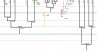
To illustrate David's data a little better, I made a chart of the various phylogenies of 4 comparative genera to illustrate how deep the giraffe splits really are. I was only able to show 6 of the 9 (or 8) giraffe populations due to the other populations not having their genetics sampled.

Also, an interesting quote I found on a birding forum
"9. Groves taxonomy decides."
 

Attachments

  • Panthera giraffa homo elphantidae cladogram.jpg
    Panthera giraffa homo elphantidae cladogram.jpg
    124.4 KB · Views: 14
jbnbsn99 said:
Also, an interesting quote I found on a birding forum
"9. Groves taxonomy decides."
out of context!! That quote was one person's opinion on how he arranges his personal mammal life list.
 
Hi DavidBrown,

You given a link to research paper. Figure 1 on the paper shows that within Reticulated giraffe diversity are nested West African, Rotschild's and some Angolan giraffes. Within Masai giraffe diversity are nested all South African giraffes.

West Africans and Rotschilds are closer related to each other than some Reticulated to other Reticulated and some Masai to other Masai.

Microsatellite locii show similar incomplete pattern. At higher resoultion, most microsattelite patterns groups to single localities (giraffes in each locality are different, same race or not).

Also, this paper states that mt DNA clades are "largely" that is not fully consistent with phenotypes (races defined by spot shapes etc).

I don't understand why you claim on this basis that giraffe subspecies are distinct and don't interbreed, when the data show precisely the opposite.

Hi jbnbsn99,

Species differ greatly in genetic diversity and comparing distantly related species for the same genetic variation is meaningless. For example genetic diversity of one fruitflies genus is about as high as all great apes + humans, but genetic diversity of lake Tanganyika fish with 300 species and numerous genera is lower than within humans.

About remark on bird forum. Surely species spotters must pick and accept some single source, but appeal to authority is not a good idea.
 
Back
Top